What makes Tony Soprano so likeable? Why would we rather leave the cannoli and take the gun? Do we truly want Scarface’s Tony Montana to succeed? Is Michael Corleone a misunderstood hero or a despicable villain?
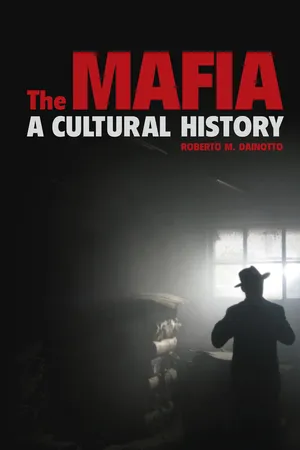
Roberto M. Dainotto traces the complex and fascinating development of the mafia: its rural beginnings in Western Sicily; its growth into what has been aptly described as a global multinational of crime; and its parallel evolution in music, print and on the big screen. The book probes the tension between the real mafia – its brutal and often violent reality – and how we imagine it to be: a mythical assembly of codes of honour, family values and chivalric masochism. Rather than dismissing such mafia stereotypes as untrue, Dainotto sets out to understand what needs and desires, material and psychic longings, are satisfied by our mafia fantasies.
Exploring the rich array of films, books, television, music and even video games portraying and inspired by the mafia, this book offers not only a social, economic and political history of the mafia but a new way of understanding our enduring fascination with what lurks behind the sinister omertà of the family business.
- English
- ePUB (mobile friendly)
- Available on iOS & Android
eBook - ePub
About this book
Information
References
Unless otherwise specified, translations are by the author.
Preface
1 Sam Roberts, ‘Mario Cuomo, Vocal Foe of Italian Stereotyping, Finally Sees The Godfather’, New York Times (21 October 2013), p. 12.
2 Tracy Wilkinson, ‘Luck Finally Runs Out for Italy’s Boss of Bosses’, Los Angeles Times (12 April 2006), pp. 7–8.
3 Hannah Arendt, Eichmann in Jerusalem: A Report on the Banality of Evil (New York, 2006), p. 250.
ONE Of Rustic Knights and Godfathers: The Origin of the Mafia
1 Cited in Fred Baker and Ross Firestone, Movie People (New York, 1972), p. 53.
2 Francis Ford Coppola, Francis Ford Coppola: Interviews, ed. Gene D. Phillips and Rodney Hill (Jackson, 2004), p. 169.
3 Jon Lewis, ‘If History Has Taught Us Anything . . . Francis Coppola, Paramount Studios, and The Godfather Parts I, II, and III’, in Francis Ford Coppola’s The Godfather Trilogy, ed. Nick Browne (Cambridge, 2000), p. 47.
4 Phoebe Poon, ‘The Corleone Chronicles: Revisiting The Godfather Films as Trilogy’, Journal of Popular Film and Television (2006), p. 193.
5 Bob Mondello, ‘Godfather III: A Staggering Saga’, All Things Considered (24 December 1990).
6 Naomi Greene, ‘Family Ceremonies: or, Opera in The Godfather Trilogy’, in Francis Ford Coppola’s The Godfather Trilogy, ed. Browne, p. 133; Marcia J. Citron, ‘Operatic Style and Structure in Coppola’s Godfather Trilogy’, Musical Quarterly, LXXXVII/3 (2004), p. 452; George De Stefano, An Offer We Can’t Refuse: The Mafia in the Mind of America (New York, 2006), p. 129.
7 André Bazin, What is Cinema?, trans. Hugh Gray (Berkeley, CA, 2004), I, p. 25.
8 Sergei Eisenstein, Film Form: Essays in Film Theory, trans. Jay Leyda (New York, 1949), p. 49.
9 Jonathan J. Cavallero, Hollywood’s Italian American Filmmakers: Capra, Scorsese, Savoca, Coppola, and Tarantino (Urbana, IL, 2011), p. 120.
10 Citron, ‘Operatic Style’, p. 452; Greene, ‘Family Ceremonies’, p. 135.
11 John Paul Russo, ‘Redemption in Francis Ford Coppola The Godfather: Part III’, in Mafia Movies: A Reader, ed. Dana Renga (Toronto, 2011), pp. 153–4.
12 Citron, ‘Operatic Style’, p. 438.
13 Greene, ‘Family Ceremonies’, p. 140.
14 Cited in Lars Franke, ‘The Godfather Part III: Film, Opera, and the Generation of Meaning’, in Changing Tunes: The Use of Pre-existing Music in Film, ed. Phil Powrie and Robynn Jeananne (Aldershot, 2006), p. 31.
15 Vera Dika, ‘The Representation of Ethnicity in The Godfather’, in Francis Ford Coppola’s The Godfather Trilogy, ed. Browne, pp. 82–92.
16 Michele Colombo, Il romanzo dell’Ottocento (Bologna, 2011), p. 102.
17 Benedetto Croce, La letteratura della nuova Italia (Bari, 1964), IV, p. 332.
18 Giovanni Verga, Luigi Capuana and Gino Raya, Lettere a Luigi Capuana (Florence, 1975), p. 31.
19 Ibid., p. 49.
20 Giovanni Verga, Tutte le novelle, ed. Carla Riccardi (Milan, 1979), p. 202.
21 Gino Tellini, Il romanzo italiano dell’Ottocento e Novecento (Milan, 1998), p. 180.
22 Cited in Giacomo Debenedetti, Verga e il naturalismo (Milan, 1993), p. 318.
23 Verga, Capuana and Raya, Lettere a Luigi Capuana, p. 114.
24 Ibid., p. 114.
25 Cited in Claudia Petraccone, Le due civiltá. Settentrionali e meridionali nella storia d’Italia dal 1860 al 1914 (Bari, 2000), p. 166.
26 Verga, Novelle, p. 130.
27 Piero Bevilacqua, Breve storia dell’Italia meridionale dall’Ottocento a oggi (Bari, 1993), p. 34.
28 Salvatore Scarpino, La guerra cafona. Il brigantaggio meridionale contro lo Stato unitario (Milan, 2005), p. 10.
29 Christopher Duggan, A Concise History of ltaly (Cambridge, 1984), p. 140.
30 Salvatore Lupo, History of the Mafia, trans. Anthony Shugaar (New York, 2009), pp. 31–2.
31 Petraccone, Le due civiltà, p. 57.
32 Daniel Pick, Faces of Degeneration: A European Disorder, c. 1848–c. 1918 (Cambridge, 1989), pp. 109–54.
33 Salvatore Cafiero, Questione meridionale e unità nazionale 1861–1995 (Rome, 1996), pp. 32–5.
34 Pasquale Villari, Le lettere meridionali ed altri scritti sulla questione sociale in Italia (Florence, 187...
Table of contents
- Front Cover
- Half Title
- Title Page
- Copyright
- Contents
- Preface
- ONE Of Rustic Knights and Godfathers: The Origin of the Mafia
- TWO From Corleone to Hollywood
- THREE The Far West is Here
- FOUR The Godfather
- FIVE Prime Time
- SIX Avatars
- References
- Bibliography
- Acknowledgements
- Photo Acknowledgements
- Index
Trusted by 375,005 students
Access to over 1.5 million titles for a fair monthly price.
Study more efficiently using our study tools.
Frequently asked questions
Yes, you can cancel anytime from the Subscription tab in your account settings on the Perlego website. Your subscription will stay active until the end of your current billing period. Learn how to cancel your subscription
No, books cannot be downloaded as external files, such as PDFs, for use outside of Perlego. However, you can download books within the Perlego app for offline reading on mobile or tablet. Learn how to download books offline
Perlego offers two plans: Essential and Complete
- Essential is ideal for learners and professionals who enjoy exploring a wide range of subjects. Access the Essential Library with 800,000+ trusted titles and best-sellers across business, personal growth, and the humanities. Includes unlimited reading time and Standard Read Aloud voice.
- Complete: Perfect for advanced learners and researchers needing full, unrestricted access. Unlock 1.5M+ books across hundreds of subjects, including academic and specialized titles. The Complete Plan also includes advanced features like Premium Read Aloud and Research Assistant.
We are an online textbook subscription service, where you can get access to an entire online library for less than the price of a single book per month. With over 1.5 million books across 990+ topics, we’ve got you covered! Learn about our mission
Look out for the read-aloud symbol on your next book to see if you can listen to it. The read-aloud tool reads text aloud for you, highlighting the text as it is being read. You can pause it, speed it up and slow it down. Learn more about Read Aloud
Yes! You can use the Perlego app on both iOS and Android devices to read anytime, anywhere — even offline. Perfect for commutes or when you’re on the go.
Please note we cannot support devices running on iOS 13 and Android 7 or earlier. Learn more about using the app
Please note we cannot support devices running on iOS 13 and Android 7 or earlier. Learn more about using the app
Yes, you can access The Mafia by Roberto M. Dainotto in PDF and/or ePUB format, as well as other popular books in History & Social History. We have over 1.5 million books available in our catalogue for you to explore.