- English
- ePUB (mobile friendly)
- Available on iOS & Android
eBook - ePub
About this book
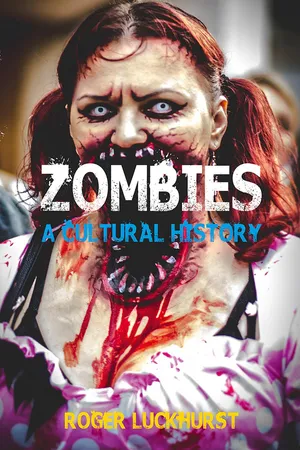
Zombies: A Cultural History, now available in paperback, sifts materials from anthropology, folklore, travel writing, colonial histories, long-forgotten pulp literature, B-movies, medical history and cultural theory to give a definitive short introduction to the zombie, exploring the manifold meanings of this compelling, slow-moving yet relentless monster.
Information
1
From Zombi to Zombie: Lafcadio Hearn and William Seabrook
How the obscure and fragmentary superstitions about the zombi began their journey out of the local regions of the Caribbean and became the global zombie can be put down to the influence of two extraordinary travel writers who published books 40 years apart.
In 1887, the bohemian writer and journalist Lafcadio Hearn (1850–1904) was hired by Harper’s magazine to write picturesque pieces on the French West Indies. Hearn, who was of mixed Irish-Greek parentage but had been educated in France and England, had travelled to America at nineteen in his first headlong flight from bourgeois European life. Hearn was a curious mix. He was a journalist in Cincinnati and New Orleans who reported on working-class and African American life in lurid terms, but he also spent his time translating the French decadent prose poetry of Théophile Gautier and Pierre Loti. His impressionistic reportage from New Orleans included records of the deaths of Marie Laveau, a Vodou queen, and Bayou John, ‘the last of the Voudous’, a Senegalese-born ‘obi man’, ‘the last really important figure of a long line of wizards or witches’. ‘Swarthy occultists will doubtless continue to elect their “queens” and high-priests through years to come’, but Hearn mournfully reflected that ‘the influence of public school is gradually dissipating all faith in witchcraft.’1 This was a classic antiquarian’s lament, trying to capture the fragility of the exotic as the modern world bulldozed every last enchantment. Hearn soon began producing books that focused on artfully retold folkloric tales, stories captured on the brink of dying out. He favoured ghost stories and superstitions transposed into crystalline, decadent prose. He wrote to a friend: ‘I have pledged me to the worship of the Odd, the Queer, the Strange, the Exotic, the Monstrous.’2 He is most celebrated for his collections Some Chinese Ghosts and In Ghostly Japan, and his obsession with Far Eastern folklore led to life, marriage and assimilation in Japan, where he lived from 1890 and adopted the name Koizumi Yakumo.
His two-year stay in Martinique from 1887 was an escape from a brief sojourn in New York, which he hated: ‘Civilisation is a hideous thing. Blessed is savagery!’, he declared.3 He wrote two books about Martinique, one a historical novel set during the slave rebellion of 1848, the other an episodic travel narrative titled Martinique Sketches. Martinique was known as le pays de revenants, meaning either the country so alluring it always compelled visitors to return or, more ominously, the country of ghosts. The place did seem to teem with stories of exactly the kind of ‘weird beauty’ Hearn loved to collect. Like a good folklorist, Hearn dutifully records the ephemeral superstitions of the country from his informants, racing to capture these wisps of oral culture in stylized written form before their vanishing.
‘Night in all countries brings with it vaguenesses and illusions which terrify certain imaginations’, Hearn reflects, ‘but in the tropics it produces effects peculiarly impressive and sinister.’4 Martinique was so superstitious, though, that the local Kreyòl has the common saying: ‘I ni pè zombie mêmn gran’-jou (he is afraid of ghosts even in broad daylight) . . . Among the people of colour there are many who believe that even at noon – when the boulevards behind the city are most deserted – the zombis will show themselves to solitary loiterers.’5 These lofty reflections, however, get stuck on the word that Hearn has confidently translated as ‘ghost’, as if aware he has not quite caught all the local resonances of the term. And thus he starts a conversation with his landlady’s daughter Adou, in which halting translation is at the core of the exchange.
‘Adou,’ I ask, ‘what is a zombi?’
The smile that showed Adou’s beautiful white teeth has instantly disappeared; and she answers, very seriously, that she has never seen a zombi, and does not want to see one.
‘Moin pa té janmain ouè zombi, – pa’ lè ouè ça, moin!’
‘But, Adou, child, I did not ask you whether you ever saw It; – I asked you only to tell me what It is like?’ . . .
Adou hesitates a little, and answers:
‘Zombi? Mais ça fai désòde lanuitt, zombi!’
‘Ah! It is Something which “makes disorder at night.” Still, that is not a satisfactory explanation. ‘Is it the spectre of a dead person, Adou? It is one who comes back?’
‘Non, Missié, – non; cé pa ça.’
‘Not that? . . . Then what was it you said the other night when you were afraid to pass the cemetery on an errand?’ . . .
‘I said, “I do not want to go by that cemetery because of the dead folk; – the dead folk will bar the way, and I cannot get back again.”’ ‘And you believe that, Adou?’
‘Yes, that is what they say . . .’
‘But are the dead folk zombis, Adou?
‘No; the moun-mò are not zombis. The zombis go everywhere: the dead folk remain in the graveyard . . . Except on the Night of All Souls: then they go to the houses of their people everywhere.’
‘Adou, if after the doors and windows were locked and barred you were to see entering your room in the middle of the night, a Woman fourteen feet high?’ . . .
‘Why, yes: that would be a zombi. It is the zombis who make all those noises at night one cannot understand . . . Or, again, if I were to see a dog that high [she holds her hand about five feet above the floor] coming into our house at night, I would scream: Mi Zombi!’6
Frustrated by this odd exchange in which zombi constantly slips away from definition, leaping from noun to noun, lost in translation, Hearn then returns to Adou’s mother for clearer answers. Things only get worse, however:
‘I ni pé zombi’ – I find from old Théréza’s explanations – is a phrase indefinite as our own vague expressions, ‘afraid of ghosts,’ ‘afraid of the dark.’ But the word ‘Zombi’ also has strange special meanings . . . ‘Ou passé nans grand chimin lanuitt, épi ou ka ouè gouôs difé, épi plis ou ka vini assou difé-à pli ou ka ouè difé-à ka màché: çé zombi ka fai ça . . . Encò, chouval ka passé, – chouval ka ni anni toua patt: ça zombi.’ (You pass along the high-road at night, and you see a great fire, and the more you walk to get to it the more it moves away: it is the zombi makes that . . . Or a horse with only three legs passes you: that is a zombi.)7
Hearn makes it plain how he senses that there are ‘strange special meanings’ of the word which he cannot access without incorporating the act of translation into his very discussion. He cannot parse the difference between the zombi and the moun-mò, or keep the referent stable at any point. He might not have known that the ‘three foot horse’ also featured as an instance of Jamaican duppy lore, but here it is confidently called a zombi.8 Hearn wants to incorporate this brand of supernaturalism into his appetite for global instances of the exotic and strange, but finds the zombi oddly resistant to his urge for definitional knowledge.
Much deeper into the Sketches, Hearn introduced another informant, Cyrillia, lovingly slotted into the libidinal economy of Martinician women built in the book. She also provides commentary on the supernatural, and again the meaning of zombi is a riot of confusion. Hearn declares:
Zombi! – the word is perhaps full of mystery even for those who made it. The explanations of those who utter it most often are never quite lucid: it seems to convey ideas darkly impossible to define, – fancies belonging to the mind of another race and another era, – unspeakably old.9
This assertion is indebted to Victorian anthropological notions that superstitious beliefs are ‘survivals’, fragments of beliefs or customs that have failed to die out in the process of cultural evolution. ‘Survival in Culture . . . sets up in our midst primaeval monuments of barbaric thought and life’, Edward Tylor declared in 1871.10 Whereas Tylor regarded his function as an ethnographer ‘to expose the remains of crude old culture which have passed into harmful superstition, and to mark these out for destruction’, Hearn’s quest for the weird and strange was exactly the reverse: to preserve its last traces.11 He is happy to let his informants multiply senses of the word rather than providing any stable accumulation of meanings. This passage continues:
One form of the zombi-belief – akin to certain ghostly superstitions held by various primitive races – would seem to have been suggested by nightmare, – that form of nightmare in which familiar persons become slowly and hideously transformed into malevolent beings. The zombi deludes under the appearance of a travelling companion, an old comrade . . . or even under the form of an animal. Consequently the creole negro fears everything living which he meets after dark upon a lonely road, – a stray horse, a cow, even a dog.
Hearn then records Cyrillia’s narrative of her regular encounters with zombis in her bedroom at their favoured hour in the dead of night, gently rocking in her rocking chair. This charming set of superstitions, transcribed by an indulgent Hearn, is given yet another kind of status in his last paragraph on the subject, however. There is a ‘source and justification’ for many peasant superstitions: the baneful influence of the ‘negro sorceror’, with his array of poisons and dark occult influences. Martinique has burned witches in the ignorant, pre-modern past, ‘but even now things are done which would astonish the most sceptical and practical physician.’12 This is typical of Hearn, who eroticizes the mixed races in exact proportion to the extent that he demonizes African blacks. It also oddly shifts the status of folkloric tales into a different order of reality, hinting at an objective truth behind the fragile splinters of local legends and lore. It is a final moment of hesitancy between the natural and the supernatural, scientific and folkloric explanations, that typifies writing on the zombi in the Caribbean.
Hearn was a pioneer in transporting words between languages: English owes him the word ‘tsunami’, for instance.13 If he was one of the first travellers to name the ‘zombi’ in his travel narrative, then this first lesson is that it seems to defy the essence demanded of the question ‘What is a zombi?’
Forty years later, a second traveller from America ventured not to Martinique but to Haiti. The self-mythologizing journalist, alcoholic, occultist, primitivist, sadomasochist and exotic traveller William Seabrook (1884–1945) bravely credited himself with porting the word from Kreyòl to English in his autobiography, No Place to Hide:
Zombie is one of the African words. I didn’t invent the word zombie, nor the concept of zombies. But I brought the word and concept to America from Haiti and gave it in print to the American public – for the first time. The word is now part of the American language. It flames in neon lights for names of bars, and drinks, is applied to starved surrendering soldiers, replaces robot, and runs the pulps ragged for new plots in which the principal zombie instead of being a black man is a white girl – preferably blond. The word had never appeared in English print before I wrote The Magic Island.14
There is no doubt that Seabrook’s breathless account of his travels and initiation into the Voodoo cult in the mountains of Haiti, published in 1929, was hugely influential, although he was surfing the crest of a much larger trend, as we shall see.
Seabrook was an American writer who grew up in the South, among plantations and black servants. He claimed that his grandmother, nursed by a ‘black Obeah slave-girl from Cuba’, had passed on a few occult tricks. After a dissolute early life as newspaperman, advertising executive, tramp and ambulance volunteer in the Great War, Seabrook committed to the life of a travel writer of exotic locales and became – despite his alcoholism – one of the highest-paid feature journalists of the era. He moved among the Modernist, occult and bohemian circles of New York, Paris and London in the 1920s and ’30s. He spent time with the black magic ‘Anti-Christ’ Aleister Crowley, publishing a short piece about their ‘experiments’ together in 1921, and also knew the circle in Paris of Maria de Naglowska, a practitioner of ritualistic sex magic who wrote several books on the subject. Seabrook later collected his occultist adventures together in a book called Witchcraft. Seabrook himself had a kink for tying up women, something he discusses openly in his Freudian autobiography. In France, he hung out on the fringes of Surrealism, and was published by Michel Leiris and Georges Bataille in their journal, Documents. Leiris was a great admirer of Seabrook’s The Magic Island, a copy of which he carried with him during his own journey to Dakar, as he recorded in Phantom Africa. Seabrook’s rubber fetish photos of his masked and bound wife appeared in Documents, while Man Ray photographed Seabrook doing various sadistic things to his lover, Lee Miller, herself a celebrated Surrealist and documentary photographer. Seabrook knew Jean Cocteau and Thomas Mann, and once travelled the length of France to meet the Modernist doyenne Gertrude Stein, convinced she could cure him of his alcoholism onc...
Table of contents
- Front Cover
- Half Title
- Title Page
- Copyright
- Contents
- Introduction
- 1 From Zombi to Zombie: Lafcadio Hearn and William Seabrook
- 2 Phantom Haiti
- 3 The Pulp Zombie Emerges
- 4 The First Movie Cycle: White Zombie to Zombies on Broadway
- 5 Felicia Felix-Mentor: The ‘Real’ Zombie
- 6 After 1945: Zombie Massification
- 7 The Zombie Apocalypse: Romero’s Reboot and Italian Horrors
- 8 Going Global
- References
- Select Bibliography
- Acknowledgements
- Photo Acknowledgements
- Index
Trusted by 375,005 students
Access to over 1.5 million titles for a fair monthly price.
Study more efficiently using our study tools.
Frequently asked questions
Yes, you can cancel anytime from the Subscription tab in your account settings on the Perlego website. Your subscription will stay active until the end of your current billing period. Learn how to cancel your subscription
No, books cannot be downloaded as external files, such as PDFs, for use outside of Perlego. However, you can download books within the Perlego app for offline reading on mobile or tablet. Learn how to download books offline
We are an online textbook subscription service, where you can get access to an entire online library for less than the price of a single book per month. With over 1.5 million books across 990+ topics, we’ve got you covered! Learn about our mission
Look out for the read-aloud symbol on your next book to see if you can listen to it. The read-aloud tool reads text aloud for you, highlighting the text as it is being read. You can pause it, speed it up and slow it down. Learn more about Read Aloud
Yes! You can use the Perlego app on both iOS and Android devices to read anytime, anywhere — even offline. Perfect for commutes or when you’re on the go.
Please note we cannot support devices running on iOS 13 and Android 7 or earlier. Learn more about using the app
Please note we cannot support devices running on iOS 13 and Android 7 or earlier. Learn more about using the app
Yes, you can access Zombies by Roger Luckhurst in PDF and/or ePUB format, as well as other popular books in History & Film & Video. We have over 1.5 million books available in our catalogue for you to explore.