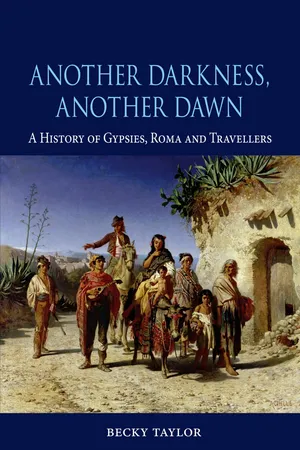
Gypsies, Roma and Travellers are some of the most marginalized and vilified people in society. They are rarely seen as having a place in a country, either geographically or socially, no matter where they live or what they do. Another Darkness, Another Dawn is a new history that charts their movement through time and place: from their roots in the Indian subcontinent, across the Byzantine and Ottoman empires to western Europe and the Americas, to their place in the contemporary world.
This history of Romani people demonstrates how their experiences provide a way to understand mainstream society's relationship with outsiders and immigrants, both in the past and present. Rather than seeing these peoples as separate from the societies in which they have lived, and as untouched by history, this book sets Gypsies' experiences in the context of broader historical changes. Understanding their history is to take in the founding and contraction of empires, the Reformation and Counter-Reformation, wars, the expansion of law and order and of states, the Enlightenment, nationalism, modernity and the Holocaust, as well as the increasing regulation of modern society. It is as much a history of ourselves as it is a history of 'others'.
Ultimately Taylor demonstrates that history is not always about progress: the place of Gypsies, Roma and Travellers remains as contested and uncertain today as it was upon their first arrival in western Europe in the fifteenth century.
To visit Becky Taylor’s website please click here.
- English
- ePUB (mobile friendly)
- Available on iOS & Android
eBook - ePub
About this book
Information
REFERENCES
Preface
1 B. Donovan, ‘Changing Perceptions of Social Deviance: Gypsies in Early Modern Portugal and Brazil’, Journal of Social History, XXVI/1 (1992), p. 33.
2 E. M. Hall, ‘Gentile Cruelty to Gypsies’, Journal of the Gypsy Lore Society (hereafter JGLS), 3rd series, XI/2 (1932), pp. 49–56.
3 Sinti are a traditionally nomadic group whose presence in Germany dates back at least to the sixteenth century. By the late nineteenth century they had extended their presence to Belgium, the Netherlands, northern Italy, France and Russia.
Introduction: In Search of the ‘True Gypsy’?
1 C. Clark, ‘Who are the Gypsies and Travellers of Britain?’, in Here to Stay: The Gypsies and Travellers of Britain, ed. C. Clark and M. Greenfield (Hatfield, 2006), p. 11. The best overview of the debate is contained in D. Mayall, Gypsy Identities, 1500 to 2000: From Egipcyians and Moon-men to the Ethnic Romany (London and New York, 2004).
2 Quoted in R. A. Scott Macfie, ‘John Sampson, 1862–1981’, JGLS, 3rd series; VI/1 (1932), pp. 3–23, p. 6. G. Borrow, Romany Rye (London, 1948), p. x.
3 See for example G. Hall, The Gypsy’s Parson, his Experiences and Adventures (London, 1915), pp. 3–4; H. T. Crofton, ‘Affairs of Egypt, 1882–1906’, JGLS, new series, I/4 (1908), pp. 366–7.
4 M. A. Crowther, ‘The Tramp’, in Myths of the English, ed. R. Porter (Cambridge, 1992), pp. 91–113.
5 A. Symons, ‘In Praise of Gypsies’, JGLS, new series, I/4 (1908), pp. 295–9.
6 E. Waugh, ‘Children of the Wilderness’, in J. Sampson, The Wind on the Heath: A Gypsy Anthology (London, 1930), p. 12. See also D. Yates, My Gypsy Days, Recollections of a Romani Rawnie (London, 1953), p. 17; and Symons, ‘In Praise of Gypsies’, p. 296.
7 A. Thesleff, ‘Report on the Gypsy Problem’, trans H. Ehrenborg, JGLS new series, V/2 (1911), pp. 83–85 and continued in JGLS VI/4 (1911), p. 266.
8 D. Mayall, Gypsy-Travellers in Nineteenth Century Society (Cambridge, 1988), p. 78.
9 Quoted in A. Fraser, The Gypsies (Oxford, 1995), pp. 22–3.
10 See J. Sampson, The Dialect of the Gypsies of Wales (Oxford, 1926).
11 See for example E. Marushiakova and V. Popov, Gypsies in the Ottoman Empire (Hatfield, 2001); D. Kenrick, Gypsies from the Ganges to the Thames (Hatfield, 2004), p. 10.
12 E. Marushiakova and V. Popov, Gypsies (Roma) in Bulgaria (Frankfurt am Main, 1997) and their Gypsies in the Ottoman Empire.
13 Kenrick, Gypsies from the Ganges to the Thames, p. 10.
14 I. Medizabal et al., ‘Reconstructing the Population History of European Romani from Genome-wide Data’, Current Biology, XXII/4 (2012), pp. 2342–9.
15 Two contrasting findings are found in M. Nagy et al., ‘Searching for the Origin of Romanies: Slovakian Romani, Jats of Haryana and Jat Sikhs Y-STR Data in Comparison with Different Romani Populations’, Forensic Science International, CLXIX/1 (2007), pp. 19–26; and I. Mendizabal et al., ‘Reconstructing the Indian Origin and Dispersal of the European Roma: A Maternal Genetic Perspective’, PLOS One, VI/1 (2011); D. Gresham et al., ‘Origins and Divergence of the Roma (Gypsies)’, American Journal of Human Genetics, LXIX/6 (2001), pp. 1314–31.
16 I. Hancock, ‘Mind the Doors! The Contribution of Linguistics’, in All Change! Romani Studies through Romani Eyes, ed. D. le Bas and T. Acton (Hatfield, 2010), p. 6.
17 While they differ in their conclusions, probably the two most thorough linguistic overviews for the non-specialist are Fraser’s The Gypsies, chapter one, and Hancock’s, ‘Mind the Doors!’, pp. 5–26.
18 The different positions may be summed up in Hancock, ‘Mind the Doors!’ and Kenrick Gypsies from the Ganges to the Thames; see also Fraser, The Gypsies, chapter one; and R. Turner, ‘The Position of Romani in Indo-Aryan’, JGLS, 3rd series, I/5 (1926), pp. 145–89 on the specific point of departure from India.
19 G. C. Soulis, ‘The Gypsies in the Byzantine Empire and the Balkans in the Late Middle Ages’, Dumbarton Oaks Papers, 15 (1961), p. 163.
20 Soulis, ‘Gypsies in the Byzantine Empire’, p. 144. See also I. Hancock, The Pariah Syndrome: An Account of Gypsy Slavery and Persecution (Ann Arbor, MI, 1987), p. 9.
21 Fraser, The Gypsies, p. 35.
22 See E. Kohen, History of the Byzantine Jews: A Microcosmos in the Thousand Year Empire (Lanham, MD, 2007), pp. 76–7. For a general account of the iconoclastic period of Byzantine history see J. Herrin, Byzantium: The Surprising Life of a Medieval Empire (London, 2007), chapter ten.
23 Soulis provides the best account of the etymological discussion surrounding this word in his ‘Gypsies in the Byzantine Empire’, pp. 145–6.
24 Kenrick, Gypsies from the Ganges to the Thames, p. 35.
25 The Life of Saint George the Athonite was written by his disciple George the Small at the Monastery of Iveron in c. 1068. The Latin translation of the relevant portion of text and discussion can be found in Soulis, ‘Gypsies in the Byzantine Empire’, p. 145.
26 This quotation and the subsequent discussion is taken from Soulis, ‘Gypsies in the Byzantine Empire’, p. 147.
27 See Marushiakova and Popov, Gypsies in the Ottoman Empire, p. 38.
28 Fraser, The Gypsies, p. 50.
29 Soulis, ‘Gypsies in the Byzantine Empire’, pp. 153 and 158.
30 The ...
Table of contents
- Front Cover
- Half Title
- Title Page
- Copyright
- Contents
- Preface
- Introduction: In Search of the ‘True Gypsy’?
- ONE Out of the Medieval World
- TWO Breaking Bodies, Banishing Bodies
- THREE The Dark Enlightenment
- FOUR Nationalism, Race and Respectability
- FIVE Into the Flames
- SIX A New Dawn?
- Afterword
- References
- Further Reading
- Acknowledgements
- Index
Trusted by 375,005 students
Access to over 1.5 million titles for a fair monthly price.
Study more efficiently using our study tools.
Frequently asked questions
Yes, you can cancel anytime from the Subscription tab in your account settings on the Perlego website. Your subscription will stay active until the end of your current billing period. Learn how to cancel your subscription
No, books cannot be downloaded as external files, such as PDFs, for use outside of Perlego. However, you can download books within the Perlego app for offline reading on mobile or tablet. Learn how to download books offline
Perlego offers two plans: Essential and Complete
- Essential is ideal for learners and professionals who enjoy exploring a wide range of subjects. Access the Essential Library with 800,000+ trusted titles and best-sellers across business, personal growth, and the humanities. Includes unlimited reading time and Standard Read Aloud voice.
- Complete: Perfect for advanced learners and researchers needing full, unrestricted access. Unlock 1.5M+ books across hundreds of subjects, including academic and specialized titles. The Complete Plan also includes advanced features like Premium Read Aloud and Research Assistant.
We are an online textbook subscription service, where you can get access to an entire online library for less than the price of a single book per month. With over 1.5 million books across 990+ topics, we’ve got you covered! Learn about our mission
Look out for the read-aloud symbol on your next book to see if you can listen to it. The read-aloud tool reads text aloud for you, highlighting the text as it is being read. You can pause it, speed it up and slow it down. Learn more about Read Aloud
Yes! You can use the Perlego app on both iOS and Android devices to read anytime, anywhere — even offline. Perfect for commutes or when you’re on the go.
Please note we cannot support devices running on iOS 13 and Android 7 or earlier. Learn more about using the app
Please note we cannot support devices running on iOS 13 and Android 7 or earlier. Learn more about using the app
Yes, you can access Another Darkness, Another Dawn by Becky Taylor in PDF and/or ePUB format, as well as other popular books in History & World History. We have over 1.5 million books available in our catalogue for you to explore.