Tolkien’s wizard Gandalf, Wagner’s Valkyrie Brünnhilde, Marvel’s superhero the Mighty Thor and the Vikings heading for Valhalla in Led Zeppelin’s ‘Immigrant Song’: these are just a few examples of how Icelandic medieval
literature has shaped the human imagination during the past 150 years.
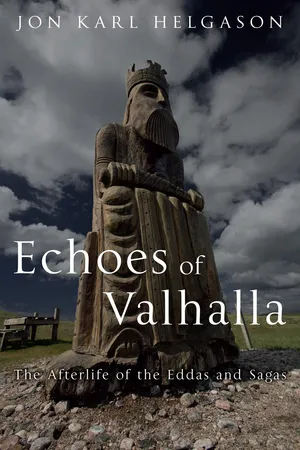
Echoes of Valhalla is a unique account of modern adaptations of the Icelandic eddas (poems of Norse mythology) and sagas (ancient prose accounts of Viking history, voyages and battles). Jón Karl Helgason looks at comic books, plays, music and films, exploring reincarnations of the Nordic gods Thor and Odin and the saga characters Hallgerd Long-legs, Gunnar of Hlidarendi and Leif the Lucky, as well as the works of the medieval writer Snorri Sturluson. He looks at Scandinavian, British and American cases, as well as German, Italian and Japanese adaptions. Examples include the cartoonists Jack Kirby and Peter Madsen, playwrights Henrik Ibsen and Gordon Bottomley, travellers Frederick Metcalfe and Poul Vad, composers Richard Wagner and Edward Elgar, rock musicians Jimmy Page and Robert Plant and film directors Roy William Neill and Richard Fleischer.
Echoes of Valhalla shows how disparate, age-old poems and prose from medieval rural Iceland have become a part of our shared cultural experience today – how the eddas and sagas themselves live on. The book will appeal to the wide audience interested in Viking mythology and history, as well as films, books, music, graphic novels.
- English
- ePUB (mobile friendly)
- Available on iOS & Android
eBook - ePub
About this book
Information
Topic
Scienze socialiSubtopic
Folklore e mitologiaONE
Thor: From Superhero to ‘Kitchin’-maid
‘She is yoo-ung, she is beautiful and . . .’, sings the dog at the piano, smiling out at the guests in a cave-like hall.1 He is part of a quintet entertaining at the wedding of the goddess Freyja and the giant Thrym in Thors brudefærd (Thor’s Wedding, 1980) by Peter Madsen, from the Danish comic book series Valhalla. The storyline is based on the eddic poem Þrymskviða (The Lay of Thrym) but the wedding band is borrowed from Jim Henson’s television series The Muppet Show. In addition to Rowlf the Dog, the musical group includes members of the Muppet rock house band Dr Teeth and the Electric Mayhem, with the drummer Animal, saxophonist Zoot, bass player Floyd Pepper and keyboardist Dr Teeth. But several elements are at odds with the Muppet pre-text. Instead of his usual red cavalry jacket, borrowed from George Harrison on the cover of the Beatles’ album Sgt Pepper’s Lonely Hearts Club Band, Pepper wears a hessian tunic and plays a lyre. Zoot also plays an old-fashioned instrument that seems to be a cross between a clarinet and the Bronze Age ‘Brudevælte lurs’. He is almost bald, and the way his pointy ears stick up suggests a common ancestry with Tolkien’s hobbits, or the Vulcans from the television series Star Trek. Dr Teeth, who usually sports a floppy purple top hat, instead wears Gandalf’s blue, pointed wizard’s hat, and there is a black gap in his upper gum where his gold tooth normally shines. With reference to the words that Zoot directed towards Charlie Parker in one episode of The Muppet Show, it is easy to imagine Madsen whispering as he finished this frame: ‘Forgive me, Jim Henson, wherever you are.’2
The Valhalla series is one of a great many examples of how the eddas have enjoyed a colourful afterlife within the genre of comics. The best-known adaptation of this kind is an American comic series devoted to the Mighty Thor. He first appeared during the 1960s in magazines issued by the American publishing company Marvel Comics. Since then he has resurfaced in various television series, films and computer games. Writing on the influence of Icelandic medieval literature on Japanese manga, Halldór Stefánsson has suggested that the artists at Marvel have ‘been instrumental in determining many people’s conceptions of ancient Nordic mythology in the English-speaking world’.3 Both in Marvel’s production and the Danish Valhalla series, the myths themselves are, however, still just one of numerous pre-texts that the artists in question have been working from. In some cases, the medieval influences seem to be operating at second or even third hand.
‘The most exciting superhero of all time’
The idea of turning Thor into a superhero is generally attributed to Stanley Martin Lieber, better known as Stan Lee, who worked as an editor at Marvel Comics in New York. Martin Goodman founded the company in 1939 as Timely Publications and it quickly became a big player on the American comic book scene. Among the popular material published by Goodman in the early years were stories about Captain America, a patriotic superhero created by Jack Kirby and Joe Simon in 1941. Stan Lee was involved in the making of some of the Captain America stories but in the 1940s he also took part in creating characters such as the Destroyer and Jack Frost. The conception of the Mighty Thor is usually traced back to 1960 when DC Comics began publishing a new series called the Justice League of America in which all the principal superheroes of that company – including Superman, Batman and Wonder Woman – play a part. Goodman asked Lee to create a parallel super team for Marvel and soon he and his colleagues had shaped a diverse group of new characters, many of whom would live on for decades. These include Spider-Man, the Hulk, Iron Man and Thor, all of whom were introduced in comic magazines between 1962 and 1963.
At around the same time, Marvel began publishing stories under the title The Avengers in which three of the above-mentioned figures joined Captain America and other superheroes in their struggle against darkness and evil. Involved with Lee in this project were, among others, his younger brother and scriptwriter Larry Lieber, and Jack Kirby, who illustrated the first comics devoted to the Hulk and Iron Man.4 Reportedly, Lieber (script) and Kirby (pencils), along with some other artists, worked with Lee on the first story about Thor, which appeared in the comic magazine Journey into Mystery #83 in August 1962. The cover shows a muscular, blond warrior in a winged helmet, standing on the edge of a high-rise in a modern city, swinging his hammer around. A spaceship hovers above his head, out of which jump armed, green stone men, one of whom has already been struck down by the hammer. ‘Introducing the Mighty Thor!’ is written in large letters to the left of the spaceship, and to the right: ‘The most exciting super hero of all time!!’
The feature story was published in the magazine in three different parts: ‘Thor the Mighty and the Stone Men from Saturn!’, ‘The Power of Thor’ and ‘Thor the Mighty Strikes Back!’ (the first title will be used here to represent all of them). The storyline, in brief, is that an American doctor, Donald Blake, is travelling through a mountainous region of Norway when the stone men land their space fleet there. Their mission is to breathe in oxygen, which gives them superhuman powers and would, in the course of time, enable them to conquer the Earth. Blake escapes into a cave where he finds an old wooden cudgel. When he hits it against a stone, the cudgel turns into a hammer and transforms the doctor into Thor, the Nordic god of thunder. After practising how to wield the hammer (to split a giant tree trunk, for example) he attacks the enemy forces, drives them away and saves the day. The story ends with their spaceships flying off, to the great surprise of American NATO soldiers who have taken up position in the area.
‘Thor the Mighty and the Stone Men from Saturn!’ could be interpreted as a modern adaptation of the myths describing Thor’s struggle against the giants of Jotunheim. In Snorra Edda we learn that Thor is ‘strongest of all the gods and men’ and that among his possessions is the hammer Mjolnir, ‘well known to frost-giants and mountain-giants when it is raised aloft, and that is not to be wondered at, it has smashed many a skull of their fathers and kinsmen’.5 In Þrymskviða, which describes the consequences of Thor’s hammer being stolen by the giant Thrym, the trickster Loki explains that the fate of the pagan gods very much depends on this instrument: ‘The giants will be settling in Asgard, / unless you get your hammer back’, he explains to Thor.6 In ‘Thor the Mighty and the Stone Men from Saturn!’ these circumstances are transposed from the fantasy world of Nordic mythology into the solar system (Asgard becomes Norway, on Earth; Jotunheim becomes Saturn) and linked to American military activity in northern Europe during the Cold War.
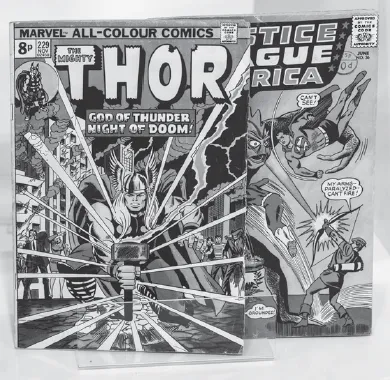
Covers of The Mighty Thor #229 (1974) and Justice League of America #36 (1965).
Thor adopts the split personality of an archetypal superhero who, half the time, also leads an ordinary life far removed from his role as saviour of mankind. In the Marvel comic, Dr Blake walks with a cane and before he finds the cudgel in the cavern, his monologue reveals that he is neither brave nor resourceful: ‘The cave is so dark – so gloomy – and airless! It seems no human has set foot in here for ages!! (sigh) I might as well wait for the Stone Men to find me – I-I’m trapped!’7 It is only with the aid of the hammer that he changes from a middle-class wimp into a masculine hero. The episode can be associated with Þrymskviða, where the loss of the hammer leads to Thor’s transformation into a woman. In the eddic poem Thrym says he is willing to return the hammer to the gods if he gets to marry the goddess Freyja. When she proves unwilling to do this, the gods dress Thor in a bridal gown and send him to the wedding in Freyja’s place. The plot ends with Mjolnir being laid in the lap of the bride, who then recovers her (or his) virile qualities:
Thor’s heart laughed in his breast,
when he, stern in courage, recognized the hammer;
first he struck Thrym, lord of ogres,
and battered all the race of giants.8
when he, stern in courage, recognized the hammer;
first he struck Thrym, lord of ogres,
and battered all the race of giants.8
The comparison drawn here does not necessarily mean that Lee, Lieber and Kirby pored over English translations of the eddas before they began creating the first Mighty Thor comics. In looking for the pre-texts these three consulted, it makes more sense to study earlier American comics in which Thor plays a significant role. Kirby was involved in several such projects for DC Comics in the 1940s and ’50s and it is customary to consider these as a part of the creative process that would later bear fruit in his collaboration with the Lieber brothers.9 The oldest story, ‘The Villain from Valhalla’, appeared in the magazine Adventure Comics #75 in the summer of 1942 and was, just like the first Captain America stories, designed by Kirby in collaboration with Joe Simon. Here, superheroes Sandman and Sandy fight a group of Vikings who visit modern-day New York. On the splash page, the bearded leader of the group can be seen standing on the banks of the East River with the Brooklyn Bridge and the Empire State Building in the background. The commanding warrior has pulled Sandy up by the hair and swings his hammer threateningly over Sandman’s head. The iconography is the same as on the cover of Journey into Mystery #83 twenty years later, except that instead of stone men equipped with guns and a spaceship we have Vikings armed with swords and a longship with a dragon prow. At the bottom of the page, the situation is elucidated:
From the misty caverns of the past rises Thor, ancient god of war . . . no kindness pulses in his body: instead only hate and savage ruthlessness guide him as he invades a modern world . . . wielding his magic hammer . . . he beats a mad tattoo upon the forces of society!10
Even if Thor here plays the role of the rogue, the story is identical to that told in ‘Thor the Mighty and the Stone Men from Saturn!’ and, indeed, in thousands of other American comics. Society struggles against the invasion of an evil force but before all is lost the protagonist manages to restore law and order. At the end of the narrative we learn that the rascals were not real Vikings from the past, but merely a group of contemporary criminals in disguise. The group’s leader is a university professor called ‘Fairy Tales’ Fenton who has combined his knowledge of mythology and technology to design a bulletproof suit and an electric hammer that can smash police cars and blast bank vaults. Chris Sims has pointed out that Kirby’s decision to present the villain as a Germanic god of battle was decidedly meaningful in the context of growing American participation in the Second World War in 1942:
Thor, the blitzkrieging Norse god that was being held up by the Nazis as the ideal of the Master Race is revealed to be just another common crook who gets the living crap kicked out of him and ends the story in traction, with the Sandman and Sandy showing up to mock him in the hospital. Is it any surprise that this is the same artist who introduced Captain America by having him punch Hitler right in the mouth?11
Another wartime comic featuring Thor that has been attributed to Kirby and Simon is ‘The Shadow of Valhalla’ published in the magazine Boy Commandos #7 in the summer of 1944. By that time, both artists had been drafted so it is uncertain to what degree the storyline, reportedly ghostwritten by Don Cameron and ghost-drawn by Louis Cazeneuve, is a part of Kirby and Simon’s oeuvre.12 The heroes of the Boy Commandos series, which had kicked off in 1942, are four orphan boys from France, England, the Netherlands and the USA who, under the leadership of Rip Carter, fight the Axis Powers on different military fronts. In ‘The Shadow of Valhalla’ the action takes place in German-occupied Norway, or more specifically in an old building where the commandos are supposed to search for artillery. It turns out that this is the castle of Valhalla, Odin’s residence, occupied by a Nazi troop. The two parties engage in a battle, causing part of the bastion to explode. At that point, the Nordic gods Thor, Freyr, Bragi and Heimdall – they all have yellow beards and are wearing Viking clothing and horned helmets as uniforms – intervene and bring the intruders to the seat of Odin. The Nazi lieutenant claims that he represents the gods’ ‘chosen leader, Hitler!’ and adds that Carter and his commandos ‘must be destroyed! Our fuehrer has ordered it! We shall be masters of the world.’13 But Odin is not impressed: ‘Who is this upstart Hitler?’ he asks. ‘I never chose him for a leader!’14 At that point Carter explains that ‘Hitler has appointed himself master of the world – and now we are fighting his armies in order to be free! We refuse to be slaves!’15 Odin decides to settle the matter between the commandos and the Germans by one-on-one combat. Luckily, Carter wins, granting him and the boys safe passage to ‘the world of life’, while Thor uses his hammer to dispatch the Nazis ‘to the world of darkness’.16 At the end of the story it is suggested that the whole episode is a dream of the American commando – his name was Brooklyn and he ‘sounded and acted a lot like Kirby’ – but that does not alter the blunt message of the story as defined by Odin: ‘Valhalla is the Norse h...
Table of contents
- Front Cover
- Half Title
- Title Page
- Copyright
- Contents
- A NOTE ON THE SPELLING OF NAMES
- Prologue
- 1 Thor: From Superhero to ‘Kitchin’-maid
- 2 Snorri: The ‘Real’ Stories
- 3 Hallgerd: A Bow-string Breaks
- 4 Gunnar: In Saddles, Armchairs and Land Rovers
- 5 Odin: From Wagner to Viking Metal
- 6 Leif: When Civilization Was Less Civilized
- Epilogue
- TIMELINE
- REFERENCES
- SELECT BIBLIOGRAPHY
- ACKNOWLEDGEMENTS
- PHOTO ACKNOWLEDGEMENTS
- INDEX
Trusted by 375,005 students
Access to over 1.5 million titles for a fair monthly price.
Study more efficiently using our study tools.
Frequently asked questions
Yes, you can cancel anytime from the Subscription tab in your account settings on the Perlego website. Your subscription will stay active until the end of your current billing period. Learn how to cancel your subscription
No, books cannot be downloaded as external files, such as PDFs, for use outside of Perlego. However, you can download books within the Perlego app for offline reading on mobile or tablet. Learn how to download books offline
Perlego offers two plans: Essential and Complete
- Essential is ideal for learners and professionals who enjoy exploring a wide range of subjects. Access the Essential Library with 800,000+ trusted titles and best-sellers across business, personal growth, and the humanities. Includes unlimited reading time and Standard Read Aloud voice.
- Complete: Perfect for advanced learners and researchers needing full, unrestricted access. Unlock 1.5M+ books across hundreds of subjects, including academic and specialized titles. The Complete Plan also includes advanced features like Premium Read Aloud and Research Assistant.
We are an online textbook subscription service, where you can get access to an entire online library for less than the price of a single book per month. With over 1.5 million books across 990+ topics, we’ve got you covered! Learn about our mission
Look out for the read-aloud symbol on your next book to see if you can listen to it. The read-aloud tool reads text aloud for you, highlighting the text as it is being read. You can pause it, speed it up and slow it down. Learn more about Read Aloud
Yes! You can use the Perlego app on both iOS and Android devices to read anytime, anywhere — even offline. Perfect for commutes or when you’re on the go.
Please note we cannot support devices running on iOS 13 and Android 7 or earlier. Learn more about using the app
Please note we cannot support devices running on iOS 13 and Android 7 or earlier. Learn more about using the app
Yes, you can access Echoes of Valhalla by Jón Karl Helgason, Jane Appleton in PDF and/or ePUB format, as well as other popular books in Scienze sociali & Folklore e mitologia. We have over 1.5 million books available in our catalogue for you to explore.