In summer 2014 the eyes of the world will be on the FIFA World Cup in Brazil, and this will be repeated in 2016 for the Olympic Games in Rio de Janeiro. Screens will likely be filled with cultural stereotypes about Latin Americans and airwaves packed with specious interpretations of Latin America’s position in the world. This book provides the historical analysis to rebut such misinterpretations and offers the reader tools with which to understand Latin America’s complex present.
From Frontiers to Football tells the history of Latin America’s engagement with global empires from 1800 to today. It is a story of repeated cycles of lessons learned and unlearned, continued dependency, victimhood and thwarted dreams. It is also a narrative of overthrown imperial designs, colonial armies defeated and new hopes expressed – inspiration for other colonized peoples across the globe. This book redresses the absence of cultural history, giving as much attention to Shakira and Pelé as to coffee producers, copper miners, government policies and covert imperialism. It avoids the polemical invectives of political interpretations, presenting a clear, readable and absorbing introduction to the history of Latin America’s interactions with the world over the last two centuries.
Latin America is at the forefront of innovation and a global centre in many social, cultural and economic activities. No longer either a frontier or a periphery, From Frontiers to Football presents a compelling and accessible portrait of a continent today.
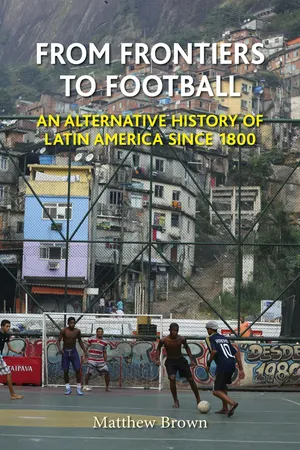
eBook - ePub
From Frontiers to Football
An Alternative History of Latin America since 1800
- English
- ePUB (mobile friendly)
- Available on iOS & Android
eBook - ePub
About this book
Information
REFERENCES
Latin America and the World: An Introduction
1 Eduardo Galeano, Open Veins of Latin America: Five Centuries of the Pillage of a Continent (London, 1973); Oscar Guardiola-Rivera, What if Latin America Ruled the World? How the South will take the North into the 22nd Century (London, 2011).
2 Charles Jones, American Civilization (London, 2007), p. 52; C. A. Bayly, The Birth of the Modern World, 1780–1914: Global Connections and Comparisons (Oxford, 2004).
3 Niall Ferguson, Empire: How Britain Made the Modern World (London, 2004); Niall Ferguson, Civilization: The Six Killer Apps of Western Power (London, 2011).
4 José Moya, ‘Introduction’, in Oxford Handbook of Latin American History, ed. Moya (Oxford, 2011); Walter Mignolo, The Idea of Latin America (Oxford, 2004).
5 Leslie Bethell, ‘Brazil and “Latin America”’, Journal of Latin American Studies, XLII/3 (2010), pp. 457–85.
6 Online at www.latinobarometro.org.
7 Moya, ‘Introduction’, pp. 4–5, 7–8.
8 The following discussion of the three broad areas borrows heavily from Moya’s explanation in his introduction to the Oxford Handbook of Latin American History. He extends the schema to cover the Americas as a whole.
9 Moya, ‘Introduction’, pp. 2–3.
10 For example Bayly, The Birth of the Modern World.
11 Moya, ‘Introduction’, p. 10.
12 Aníbal Quijano, ‘Coloniality of Power and Eurocentrism in Latin America’, International Sociology, XV/2 (2000), pp. 215–32.
13 Nestor García Canclini, Hybrid Cultures: Strategies for Entering and Leaving Modernity (Minneapolis, MN, 1995); Fernando Ortiz, Contrapunteo cubano del tabaco y el azúcar (Havana, 1940).
14 For a general overview with good coverage and detail see Teresa A. Meade, A History of Modern Latin America, 1800 to the present (Oxford, 2010), Edwin Williamson, The Penguin History of Latin America (London, 2008), or Will Fowler, Latin America since 1780 (London, 2008). Leslie Bethell, ed., The Cambridge History of Latin America (Cambridge, 1986) remains a classic reference work.
15 Marcello Carmagnani, The Other West: Latin America from Invasion to Globalization [in Italian, 2003], trans. Rosanna M. Giammanco Frongia (Berkeley, CA, 2011).
16 Ibid., pp. 116–17.
17 Jones, American Civilization, p. 89. See also Felipe Fernández-Armesto, The Americas: A Hemispheric History (London, 2003).
18 See Richard J. Evans, ‘Prologue: What is History – Now?’, in What is History Now?, ed. David Cannadine (London, 2002), pp. 1–18.
ONE: Goodbye, Colonial Worlds: Independence
1 Rafe Blaufarb, ‘The Western Question: The Geopolitics of Latin American Independence’, Hispanic American Historical Review, CXII/3 (2007), pp. 742–63; Anthony McFarlane, War and Independence in Spanish America (London, 2014).
2 Martin Robson, Britain, Portugal and South America in the Napoleonic Wars: Alliances and Diplomacy in Economic Maritime Conflict (London, 2011).
3 Klaus Gallo, Great Britain and Argentina (Basingstoke, 2001).
4 Racine, ‘“This England, This Now”: British Cultural and Intellectual Influence in Spanish America in the Independence-Era’, Hispanic American Historical Review, XC/3 (2010), pp. 423–54.
5 Simón Bolivar, ‘Letter Inviting Governments to a Congress in Panama, 7 December 1824’, reproduced in Simón Bolivar and the Bolivarian Revolution, Introduced by Hugo Chávez, ed. and trans. Matthew Brown (New York, 2009), p. 166; for his ‘final lament’: John Lynch, Simón Bolívar: A Life (New Haven, CT, 2006).
6 Simón Bolívar, ‘The Jamaica Letter’ (1815), in Simón Bolívar, ed. Brown, pp. 40–64.
7 David Brading, The First America: The Spanish Monarchy, Creole Patriots and the Liberal State, 1492–1867 (Cambridge, 1991); María Teresa Calderón and Clément Thibaud, La majestad de los pueblos en la Nueva Granada y Venezuela (1780–1832) (Bogotá, 2011).
8 Cecilia Méndez, The Plebian Republic: The Huanta Rebellion and the Making of the Peruvian State, 1820–1850 (Durham, NC, 2005).
9 Peter Blanchard, Under the Flags of Freedom: Slave Soldiers and the Wars of Independence in Spanish South America (Pittsburgh, PA, 2008).
10 David Geggus, ed., The Impact of the Haitian Revolution in the Atlantic World (Columbia, SC, 2001).
11 Rebecca Cole Heinowitz, Spanish America and British Romanticism, 1777–1826 (Edinburgh, 2010); Racine, ‘“This England, This Now”’; D.A.G. Waddell, ‘British Neutrality and Spanish–American Independence: The Problem of Foreign Enlistment’, Journal of Latin American Studies, XIX/1 (1987), pp. 1–18; John Lynch, ‘British Policy and Spanish America, 1783–1808’, Journal of Latin American Studies, I/1 (1969), pp. 1–30.
12 Gabriel B. Paquette, ‘The Brazilian Origins of the Portuguese Constitution’, in Connections after Colonialism: Europe and Latin America in the 1820s, ed. Matthew Brown and Paquette (Tuscaloosa, AL, 2013), pp. 108–38.
13 Matthew Brown, Adventuring through Spanish Colonies: Simón Bolívar, Foreign Mercenaries and the Birth of New Nations (Liverpool, 2006), pp. 13–30.
14 Charles Stephenson, The Admiral’s Secret Weapon: Lord Dundonald and the Origins of Chemical Warfare (Woodbridge, 2006).
15 David Cordingly, Cochrane the Dauntless: The Life and Adventures of Admiral Thomas Cochrane, 1775–1860 (London, 2007); Brian Vale, A War Betwixt Englishmen: Brazil against Argentina on the River Plate, 1825–1830 (London, 2001).
16 Eric Van Young, ...
Table of contents
- Front Cover
- Title Page
- Copyright
- Contents
- Latin America and the World: An Introduction
- ONE Goodbye, Colonial Worlds: Independence
- TWO Building Nations, Looking for Models
- THREE Raw Materials, Raw Wounds
- FOUR New Exchanges, New Markets
- FIVE Beneath a New Empire
- SIX Latin America in the Cold War
- SEVEN Violence and Exoticism
- EIGHT Unleashed from Empire?
- REFERENCES
- BIBLIOGRAPHY
- ACKNOWLEDGEMENTS
- PHOTO ACKNOWLEDGEMENTS
- INDEX
Trusted by 375,005 students
Access to over 1.5 million titles for a fair monthly price.
Study more efficiently using our study tools.
Frequently asked questions
Yes, you can cancel anytime from the Subscription tab in your account settings on the Perlego website. Your subscription will stay active until the end of your current billing period. Learn how to cancel your subscription
No, books cannot be downloaded as external files, such as PDFs, for use outside of Perlego. However, you can download books within the Perlego app for offline reading on mobile or tablet. Learn how to download books offline
Perlego offers two plans: Essential and Complete
- Essential is ideal for learners and professionals who enjoy exploring a wide range of subjects. Access the Essential Library with 800,000+ trusted titles and best-sellers across business, personal growth, and the humanities. Includes unlimited reading time and Standard Read Aloud voice.
- Complete: Perfect for advanced learners and researchers needing full, unrestricted access. Unlock 1.5M+ books across hundreds of subjects, including academic and specialized titles. The Complete Plan also includes advanced features like Premium Read Aloud and Research Assistant.
We are an online textbook subscription service, where you can get access to an entire online library for less than the price of a single book per month. With over 1.5 million books across 990+ topics, we’ve got you covered! Learn about our mission
Look out for the read-aloud symbol on your next book to see if you can listen to it. The read-aloud tool reads text aloud for you, highlighting the text as it is being read. You can pause it, speed it up and slow it down. Learn more about Read Aloud
Yes! You can use the Perlego app on both iOS and Android devices to read anytime, anywhere — even offline. Perfect for commutes or when you’re on the go.
Please note we cannot support devices running on iOS 13 and Android 7 or earlier. Learn more about using the app
Please note we cannot support devices running on iOS 13 and Android 7 or earlier. Learn more about using the app
Yes, you can access From Frontiers to Football by Matthew Brown in PDF and/or ePUB format, as well as other popular books in Histoire & Histoire de l'Amérique latine et des Caraïbes. We have over 1.5 million books available in our catalogue for you to explore.