‘Iconoclast’ and ‘maverick’ are the epithets perhaps most commonly attached to Robert Altman, a director who consistently pushed against the boundaries of genre. Throughout his career Altman tested the limits of what can and should be done in film, refashioning film noir in The Long Goodbye, the western in McCabe & Mrs Miller, psychological drama in Images, science fiction in Quintet and romantic comedy in A Perfect Couple. In this book, Frank Caso examines the development of Altman’s artistic method from his earliest days in industrial filmmaking to his work in television and feature films.
Altman’s work is easily recognizable to audiences, but what exactly are the distinctive components of a signature Altman film? Caso identifies and analyses more than twenty stylistic features in Altman’s body of work, tracing some – such as his use of overlapping dialogue and engagement with Christian imagery – to the very beginning of his career. He also examines Altman’s unsettling mix of offbeat comedy with violence, murder, and death; these elements not only contributed to the naturalism and ironic outlook of his work but also provided a mythic, otherworldly undertone to many of his films. This, combined with masterful technique, formed the ‘Altmanesque’ style that unites films from M*A*S*H to The Player to Gosford Park.
Robert Altman: In the American Grain maps the innovations that made Altman a master filmmaker, giving an in-depth yet expansive perspective on the work of this distinctive and ground-breaking American auteur.
- English
- ePUB (mobile friendly)
- Available on iOS & Android
eBook - ePub
About this book
Information
Subtopic
Art GeneralPART ONE
APPRENTICE AND JOURNEYMAN
1 Kansas City
BY 1925, the year of Robert Altman’s birth, Kansas City, Missouri, was firmly entrenched as the ‘Paris of the Plains’, and among those who had contributed to the city’s lofty reputation was Frank Altman Sr (originally Franz Altmann), the future film director’s grandfather, who had relocated his already thriving jewellery business there in 1882. Frank Sr eventually diversified into a number of businesses including real estate in the booming city, and within a dozen years he had a net worth of approximately $200,000.1 While Frank Sr’s self-confidence was a trait passed down to his sons and famous grandson, Robert Altman’s outsized personality closely reflected his father’s. Bernard Clement Altman (known as B.C.) was a gregarious insurance man with connections throughout Kansas City. B.C. set the tone for his son’s approach to life. He enjoyed success and encountered failure and never let the latter affect him for very long; he lived a kind of high life that under most circumstances might seem like pretence. Robert’s high-wire act was more precarious than his father’s, but then the stakes were always higher for Robert Altman: he spent most of his life avoiding Hollywood’s shoals while finding backers for more than three dozen projects.
Briefly, then, Robert Altman was born on 25 February 1925, grew up in a middle-class enclave and acquired a Roman Catholic education. His father, like his grandfather, was a mover and shaker within the Roman Catholic community of Kansas City. By the time he was at high school, though, Altman began to rebel against the religion, and he eventually graduated from the Wentworth Military Academy. Whatever military training he received at Wentworth must have served him well because he ended up as a co-pilot on a U.S. Army Air Force bomber with the 307th Bomber Group in the Pacific theatre during the Second World War. Altman flew more than 50 missions and received the Air Medal. He was a prototype of sorts for Hawkeye Pierce or Trapper John McIntyre in M*A*S*H, more friendly to the enlisted men than most officers, even fraternizing with them. By his own account Altman ‘didn’t like anything about’ the military.2
That Altman would choose to make a career in film was not so clear-cut after his return to civilian life in 1945, although one film released that year, Brief Encounter, provided him with an epiphany in which he first understood the medium as art and not purely entertainment. But breaking into the Hollywood establishment was nearly impossible for the Kansas City war veteran with few connections. He played an extra in The Secret Life of Walter Mitty (1947) and managed to sell an original story co-written with George W. George (son of the cartoonist Rube Goldberg) that was the basis for the film Christmas Eve (1947), although neither Altman nor George was credited; and another story that became Bodyguard (1948), for which they were given screen credit. Altman later admitted that he begged to write the screenplay but was rebuffed.3 Married (to LaVonne Elmer) and with a daughter, Altman returned to the friendly confines of Kansas City where he serendipitously met an old friend, Robert Woodburn, who introduced him to Forest Calvin, the owner of the Calvin Company, the leading industrial film producer in the United States. It did not hurt Altman’s prospects that the Calvin Company was located on the corner of Fifteenth and Troost streets in the seven-storey building known locally as the Altman Building.
The Calvin Company was Robert Altman’s film school. It was there that he learned the basics of his craft: writing, editing, working with actors, and camera and sound techniques under the supervision of Frank Barhydt and others. It was also in this environment that he met the woman who became his second wife, the local actress Lotus Corelli. (Altman’s marriage to LaVonne Elmer ended in 1949.) Altman’s earliest directorial effort for Calvin, the somewhat comic Honeymoon for Harriet (1948), featured Corelli as a newlywed farm housewife trying to convince her husband to take her on a honeymoon rather than purchase farm equipment.4 Altman also wrote the script for the 21-minute colour short for International Harvester. Altman claimed he was allowed to direct the film because he had come up with a method of recording its open-road dialogue.
Altman’s career at Calvin encompassed some 60 films and he remained with the company until 1956, although he took intermittent leaves of absence to move to Hollywood and pursue his dream. Each time he failed he returned to Kansas City and the Calvin Company. Among his notable Calvin films was Modern Football (1951), a short documentary (which he also wrote), sponsored by Wheaties breakfast cereal and Wilson Sporting Goods, on the rules of American football, that featured a daydream sequence.5 Dreams, of course, and the surreal atmosphere reminiscent of dreams, would be prominent in some of Altman’s later work. In 1952 he directed The Sound of Bells. It was essentially a sales and informational film in the form of a Frank Capra-esque fantasy in which Santa Claus (driving a car instead of guiding a sleigh) assists a good Samaritan gas station attendant by sending customers to the station. The jingle of bells (again reminiscent of Capra) announcing a new customer is the only soundtrack. That same year he directed King Basketball, an informational on how to improve one’s basketball technique. Altman appeared in the film’s framing device as a Hollywood director come to watch a game.
Among the films Altman directed in 1953 was The Last Mile, which opened with a scene of a condemned prisoner walking the so-called last mile to his execution. Playing on similar scenes in prison films of the 1930s and 1940s, Altman’s last-mile scene is also ironic. The film is actually about highway safety, and Altman cuts between shots of the convicted man’s footsteps and ‘spectacular car crash-ups that were the meat and potatoes of these safety films’.6 The film’s strangely made argument was that more deaths occur on highways than in prison execution chambers. At any rate, The Last Mile was visually striking enough to win national safety awards.
Crime and fast cars were on Altman’s mind a lot in 1953. Collaborating with Robert Woodburn, he directed some of the fifteen-minute segments of Pulse of the City, an anthology crime series set in Kansas City that occasionally used some of the Calvin actors. The show was broadcast over the Dumont Network from September 1953 until March 1954. Modern Baseball (also 1953) did for that sport what his earlier football and basketball films had done for theirs, namely teach fundamentals. While there was nothing as stylish as a dream sequence in Modern Baseball, it did have the attraction of cameo appearances by some well-known players and managers of the era, including Kansas City native Casey Stengel, who at the time had managed the New York Yankees to five consecutive championships. In 1954, in addition to The Builders for the Southern Pine Association, Altman directed Better Football and The Dirty Look, both of which starred the noted comedy actor William Frawley. When he appeared in these Calvin productions the 67-year-old Frawley was at the height of his fame for his role of Fred Mertz in the hit television show I Love Lucy. For The Dirty Look Altman broke new ground at Calvin. It was the company’s first picture to use three cameras. The film was sponsored by Gulf Oil and written by Altman’s boss, Frank Barhydt.
In 1955 Altman directed the noir-tinged The Perfect Crime, sponsored by the Caterpillar Corporation and the National Safety Council. As with The Last Mile, to which it is something of a prequel, The Perfect Crime makes a comparison between senseless automobile deaths and murder in American society. An unshaven young man walks into a respectable grocery store, his unkempt appearance clearly a sign of menace in the otherwise spotless store environment. To drive this point home the camera lingers on him a bit, framed in the doorway. Impatient, the young man shoves a girl away from the counter and pulls out a gun, demanding the money from the cash register. In a series of quick cuts we see the owner’s face (from a perspective looking over the thief’s shoulder), a medium shot of a stunned woman and the girl, the thief, and again the store owner, who then moves over to the cash register and removes the bills. ‘It’s only fourteen dollars’, he tells the thief. The frustrated thief then reaches across the counter and hits the store owner on the head with his gun. Seeing this the woman rushes to aid the fallen man, but the thief panics and shoots her and she collapses on the side of the counter, with only her legs extending into the frame. Meanwhile the girl begins screaming and the thief shoots her twice before running out of the store. As Mark Minett points out, Altman used rapid cutting and ‘perceptual subjectivity’ in this scene.7 The slightly too rapid editing creates the edgy feeling, while the perspective of the shooting is that of the injured store owner who has risen slightly behind the counter.
These killings, however, are not perfect crimes. There is a public outcry and the killer is caught. The perfect crime is committed by a reckless driver who crashes his car, killing his wife and child. The narrator of the film intones, ‘Yet there is no public indignation, so the killer gets away scot-free.’8 But what does this have to do with the Caterpillar Corporation, the film’s co-sponsor? Better roads, built by workers using Caterpillar equipment, in conjunction with safer driving would lead to fewer highway deaths. The Perfect Crime turned out to be the perfect industrial film of 1955. It won eighteen association awards that year.
The Magic Bond (1956) is Altman’s best-known effort at Calvin. It was sponsored by the Veterans of Foreign Wars (VFW) and delivers the kind of patriotic message for which Altman was not known. Following the opening scene (stock footage of night-time artillery fire followed by the Calvin credit and logo), the film cuts to a soldier lying on a sofa and, simultaneously, in the right foreground the back of a typist in uniform. Altman’s peripatetic camera moves closer to the soldier on the sofa while also panning first to the right and then to the left. Thus the viewer sees most of the platoon lying around a bombed-out French farmhouse as indicated by the cheesy props: wine bottles and empty wine bottles used as candle holders, a photograph on the wall of the Eiffel Tower, peeling wallpaper and a broken railing leading to the second floor. Dramatic music highlights the shot; otherwise the only sound is the clacking of the typewriter.
Suddenly, the rest of the platoon bursts in, assisting a wounded soldier who displaces the resting soldier on the sofa. The wounded soldier turns out to be the platoon sergeant (Kermit Echols), and as the film unfolds it is revealed that the sergeant was saved by the efforts of another soldier, the ‘Swede’, who lost his own life in the otherwise successful rescue. The typing stops (no overlapping here), and the sergeant recounts how the Swede ignored his order to leave him behind. As he speaks the camera pans across the faces of some of the other soldiers, providing only tight head shots so that the viewer can make no mistake about the soldiers’ emotions. The squad had been together for a long time, having forged among them a ‘magic bond’, of which the Swede made the ultimate sacrifice. A little later Altman provides a shot of the Swede lying dead in the mud. His corpse, with helmet partially off, is upside down in the frame, making it appear at once more dramatic and natural. This non-speaking role was played by Altman.
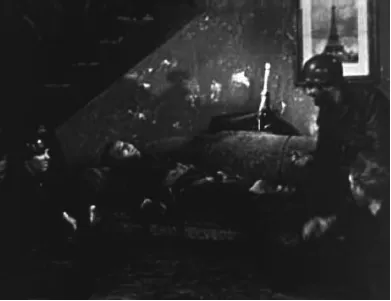
The Magic Bond: surviving members of the platoon in the abandoned farmhouse.
The sergeant then addresses the typist, implying that he is a war correspondent. After a little bantering by the squad members the camera cuts to the typewriter as the correspondent types ‘November, 1944 / Somewhere in Europe / by: Bob Considine’. This dissolves to another typewriter, and another piece of paper with the article title, ‘On the Line’. The byline is also Considine’s, and underneath that is typed ‘International News Service’, the Hearst-owned agency for which Considine worked.
The shot switches to Considine, who stops typing and speaks directly to the camera. Considine was a well-known conservative journalist and author, so it was natural that he would be chosen to narrate a film sponsored by the VFW. He discusses the ‘magic of comradeship’ he had witnessed first-hand as a correspondent during the Second World War and the Korean conflict. We also learn that Considine ‘witnessed’ the scene dramatized at the beginning of the film. While Considine, in voiceover, quickly lists the various types of ‘magic’ it ‘takes to win a war’, Altman includes stock footage of tanks, naval ships, military aircraft, even generals Eisenhower and MacArthur. Lastly, Considine returns to the magic of comradeship, which, he laments, seems to have dissipated in peacetime America.
But first there is the prime enemy – about which no loyal American had to be told twice during the mid-1950s. However, in case the viewer missed the point Altman adds parade scenes with marchers touting banners that identify them as being from the Russian Anti-Communist Center, and floats signifying the horrors of the aftermath of the failed uprising in Hungary against the Soviet-backed regime. (Not all the marchers are there to whip up patriotic fervour; Altman also includes some children carrying signs that read ‘Thank you Dr Salk’ to honour the discoverer of the polio vaccine.) But Cold War America has other enemies, and as Considine lists America’s new, peacetime foes, Altman illustrates them: juvenile delinquency, political apathy, neglect of veterans and smugness. The last is a blatant call for increased military spending to a country whose nerves were already on edge from the ongoing Cold War.
The rest of the film highlights VFW programmes to combat these enemies while a different, stentorian, narrator describes the benefits of a marbles tournament, baseball games, boy scout troops, youth clubs, a drum-and-bugle corps parade, voter turnout drives, Veterans Administration hospitals, children reciting the Pledge of Allegiance in class, the USO and anti-Communist civil defence and legislation for military defence.
Altman’s best work in the film reveals his empathy for the plight of veterans, particularly those who are disabled. One scene opens with a prosthetic hand (actually a hook back then) working the side of a lathe. The camera swings around and pulls back to show the machinist, who then stops his work to speak directly to the viewer. All the time he is speaking his prosthesis is in the frame, so that one never forgets the sacrifice he made in battle. The scene is a reflection of The Best Years of our Lives (1946), the post-war film about the travails of returning veterans and their families that featured supporting actor Harold Russell, a double amputee. No doubt viewers in 1956 watching this unnamed veteran, portrayed by the actor James Lantz, tell his story would immediately recall Russell’s fine performance.9
Interestingly, the film takes a turn towards self-realization. A man behind a grocery-store counter (perhaps the same set used in The Perfect Crime) announces that he is ‘the service officer of our post, and what that vet says is true. But it goes beyond that.’ He then describes a couple of VFW programmes before the stentorian narrator returns to describe the organization’s good works in veterans’ hospitals. We also see children playing in the playground of the VFW national home. The film is again self-reflective as the narrator mentions journalist Considine’s quest to find the answers to America’s societal problems through the VFW....
Table of contents
- Front Cover
- Half Title
- Title Page
- Copyright
- Contents
- Introduction
- PART ONE APPRENTICE AND JOURNEYMAN
- PART TWO THE ARTIST IN BLOOM
- PART THREE EXILE
- PART FOUR THE PRODIGAL’S RETURN
- REFERENCES
- BIBLIOGRAPHY
- FILMOGRAPHY AND TELEVISION WORK
- ACKNOWLEDGEMENTS
- INDEX
Trusted by 375,005 students
Access to over 1.5 million titles for a fair monthly price.
Study more efficiently using our study tools.
Frequently asked questions
Yes, you can cancel anytime from the Subscription tab in your account settings on the Perlego website. Your subscription will stay active until the end of your current billing period. Learn how to cancel your subscription
No, books cannot be downloaded as external files, such as PDFs, for use outside of Perlego. However, you can download books within the Perlego app for offline reading on mobile or tablet. Learn how to download books offline
Perlego offers two plans: Essential and Complete
- Essential is ideal for learners and professionals who enjoy exploring a wide range of subjects. Access the Essential Library with 800,000+ trusted titles and best-sellers across business, personal growth, and the humanities. Includes unlimited reading time and Standard Read Aloud voice.
- Complete: Perfect for advanced learners and researchers needing full, unrestricted access. Unlock 1.5M+ books across hundreds of subjects, including academic and specialized titles. The Complete Plan also includes advanced features like Premium Read Aloud and Research Assistant.
We are an online textbook subscription service, where you can get access to an entire online library for less than the price of a single book per month. With over 1.5 million books across 990+ topics, we’ve got you covered! Learn about our mission
Look out for the read-aloud symbol on your next book to see if you can listen to it. The read-aloud tool reads text aloud for you, highlighting the text as it is being read. You can pause it, speed it up and slow it down. Learn more about Read Aloud
Yes! You can use the Perlego app on both iOS and Android devices to read anytime, anywhere — even offline. Perfect for commutes or when you’re on the go.
Please note we cannot support devices running on iOS 13 and Android 7 or earlier. Learn more about using the app
Please note we cannot support devices running on iOS 13 and Android 7 or earlier. Learn more about using the app
Yes, you can access Robert Altman by Frank Caso in PDF and/or ePUB format, as well as other popular books in Media & Performing Arts & Art General. We have over 1.5 million books available in our catalogue for you to explore.