Blame infuses society in myriad ways. At its worst it sours and destabilizes relationships, dividing lovers, co-workers, communities and nations. In the hands of skilled propagandists blame is a potent tool for persecution; in the hands of the media it is a vehicle for creating social unease. Yet blame also safeguards moral order and legal culpability. Blame is thus both destructive and necessary.
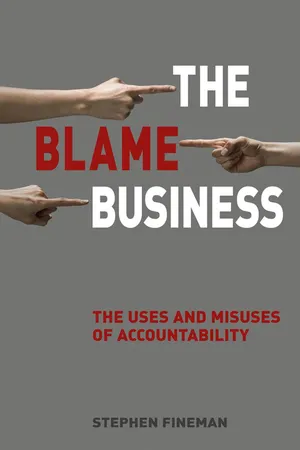
The Blame Business takes us on a fascinating journey through the landscape of blame, from ancient witch-hunts to today’s scapegoating and stigmatization, and from righteous anger to blame cultures. Stephen Fineman delves behind the scenes of public and private organizations infected with blame and profiles the people who try to hold them to account, examing the vexed issue of public accountability as politicians and corporate leaders play their ‘blame games’.
What are the limits of remorse and forgiveness? Is restorative justice the answer? This absorbing book deepens our understanding of blame and how it shapes all of our lives.
- English
- ePUB (mobile friendly)
- Available on iOS & Android
eBook - ePub
About this book
Information
Topic
Personal DevelopmentSubtopic
Business General1
Why Do We Blame?
The date was 29 February 1692; the place, Salem, Massachusetts. The two children Elizabeth Parris and Abigail Williams could have had little idea of the furore they were about to unleash. Under the steely gaze of local magistrates the children nervously pointed the finger at three women: elderly and impoverished Sarah Osborne; Tituba, a slave worker employed by Elizabeth’s Puritan father, Pastor Samuel Parris; and Sarah Good, a homeless beggar. Indoctrinated to fear witches, the girls said that the women were to blame for their fits – screaming, contortions and unpredictable behaviour – today put down to ergot, a cereal fungus.
Blaming witches for misfortunes already had a long history, embedded in religious superstitions across Europe. Between 1300 and 1600 many thousands of women were accused of witchcraft and being in league with the Devil, often on the flimsiest of pretexts. Actual trials were relatively rare, but punishment befell about half the accused, often torture and death – a draconian fate for what is now an imaginary crime. In Britain, James VI of Scotland, who became James I of England, added his own authority to the witch frenzy with his book Daemonologie. He was convinced that witches were a malign influence in his kingdom and also responsible for his own close encounters with death.
In Salem local circumstances shaped the fervour. A beleaguered Reverend Parris preached provocative sermons which did not go down well with many of his parishioners; he was fast losing moral authority. Prominent church members feared their church was seriously under attack. To Reverend Parris this was all the work of the Devil. Meanwhile, the local community was facing the threat of war, disease and poverty, further fuelling fear. All these conditions lent themselves to scapegoating: someone had to be blamed and witches fitted the bill. Tituba’s confession sealed the women’s fate. She captivated magistrates with her tales of witches flying on poles, and magic rituals to alleviate the girls’ suffering. The women were convicted of witchcraft and incarcerated in a local jail. Witch fever and paranoia continued in the region for about a year and a half, culminating in some 1,600 suspects and twenty executions.
It would be comforting to think that the belief in witches and their malevolent power is now a historical curiosity, a quirk of irrational pre-Enlightenment times, but this would be wrong. In the unsettling words of the United Nations Human Rights Council, ‘The age-old belief in the power of witchcraft is still widely held throughout Africa . . . causing great suffering to innocent people.’1 It is also present in Papua New Guinea, Saudi Arabia, India and parts of Europe. Witchcraft is blamed for all manner of troubles, from death and disease to accidents and business failure. Many of India’s poor rural communities are steeped in magic and mysticism, and personal adversity is put down to witchcraft. In 2011, for example, a family in Chhattisgarh, central India, blamed a neighbour for causing their money troubles and poor health. Eleven people stormed her house accusing her of witchcraft, blinding her and her husband by stabbing them in the eyes with scissors.2 On other occasions women accused of witchcraft have been paraded naked or killed. The tribal areas of India are rarely impacted by the law, so these events often go unreported.
The fear of witchcraft has been profitable for so-called pastor prophets, a social elite in parts of Africa, some of whom are conspicuous for their wealth and personal media channels. They claim to be able to identify ‘the possessed’ and to ‘spiritually heal’ them – for a fee. In her book Unveiling the Mysteries of Witchcraft, Pastor Helen Ukpabio explains that ‘if a child under the age of two screams in the night, cries and is always feverish with deteriorating health, he or she is a servant of Satan.’3 Her recommended treatment varies, but includes ‘curative’ oils and potions, beatings, injecting petrol in the eyes or ears, forced fasting and isolation.
Witch persecution in Europe is an under-the-radar crime. In the UK between 2002 and 2012 there were 83 investigations into faith-based child abuse, and some were linked to witchcraft, such as the fate of fifteen-year-old Kristy Bamu. He was visiting the UK with four of his sisters, staying with his eldest sister and her Congolese boyfriend in their London apartment. The couple were immersed in witchcraft and were convinced that their visitors were bent on bringing evil into their home and had come to kill them. The children were viciously attacked. Only when Kristy’s younger sisters ‘confessed’ to being witches did they escape further assault. Kristy was less fortunate; he died of his injuries.4
Myths, superstitions and fears are at the root of witch folklore. But we no longer need to believe in ‘actual’ witches to have witch-hunts – any person or group that appears to cause us problems can be witch-hunted if we can convince ourselves and others that there is sufficient reason. Ideological threat is one excuse – such as 1950s McCarthyism aimed at ‘un-Americans’ in the U.S., and the ‘contaminative influence’ of Jews and homosexuals on the Nazis. A group’s economic success in a poor or troubled country can mark it out for blame and persecution, for instance the fate of the Tutsis in Rwanda and the Asians in Uganda. The Ugandan witch-hunt was orchestrated by its president, Idi Amin, who, capitalizing on a long history of Indophobia, proclaimed that God had instructed him to expel all Asians who were ‘exploiting’ the local economy. It created a frantic exodus of some 50,000 people.
Given the frequent re-emergence of witch-hunts, it is unsurprising that survivors of persecution never entirely relax. When will I be singled out again because of my religion, sexuality, colour – or something else?
Scapegoats and Stigma
Scapegoating is central to witch-hunts and has long played a role in the way a society defends itself from its anxieties and threats. By scapegoating, people free themselves of culpability, shifting blame onto an innocent target, be it a person or a group. In the words of anthropologist James George Frazer, it is ‘a palming off upon someone else the trouble which a man shrinks from bearing himself’.5 Nations palm off their troubles on other nations, management on unions, unions on management, family members on one another. Feuding parents scapegoat their children for their own shortcomings; teenagers incriminate weaker members of their peer group for their own faults; executives accuse junior staff rather than taking the blame for their own misjudgements. Governments create scapegoats to deflect public attention from their policy defects or mistakes.
In biblical times a scapegoat was literally a goat. There was a belief that sin and ill-fortune were transferable between beings, so on the important Day of Atonement a goat would carry Israel’s guilt into the wilderness. It was expected to perish during its wanderings and thus cleanse the Children of Israel of their sins – for another year at any rate. The scapegoat ritual in ancient Greece (pharmakos) was also a purification, but via a human carrier. During periods of pestilence, famine, blight or plague, someone was drawn from the margins of society to be scapegoat – a low-class person, a criminal or a person who happened to be very ugly. The ritual was so vital to the community that the victim was carefully cosseted and fed on foods of special purity for a year before they were cast out. Then, elaborately robed, they were led through the streets to be roundly abused and finally ejected from the city. This custom was not fixed in form. One variation subjected the unfortunate male victim to a flogging seven times on his penis with wild fig branches. He was then burnt on a pyre of wood from wild trees, and finally his ashes were scattered into the sea to purify the city of its ills.6
Scapegoating people who are physically strange or different is a recurring, primitive, social impulse. Psychologist Betty Adelson recounts the Inca practice of using dwarfs as scapegoats. She tells of the fate of a dwarf captured by one of the last Inca rulers. On the occasion of the ruler’s death the dwarf was attacked by members of the grieving funeral cortège for the injustice of the loss of their ‘wonderful ruler’ and being left with a ‘miserable and luckless wretch who had not enjoyed the luck of being a man’.7 Today, in parts of East Africa, children and adults with albinism, a rare genetic defect that produces skin, eyes and hair with no colour, are cursed and ostracized as bringers of bad luck. The power of physical revulsion has not been lost on propagandists of scapegoating. During the Rwanda genocide, government broadcasts likened the Tutsis to ‘cockroaches’ to be exterminated, and the Nazis produced ugly portraits of Jews in their anti-Semitic cartoons and posters.
The Scapegoat in the Workplace
It took me about two years of frustration, anger, depression, physical exhaustion, utter detachment, fatigue and sleeplessness, to realize that I have become a ‘target’, a ‘scapegoat’ for the office dysfunction. Beginning with the Director all the way down to the mail clerk. Upon further research I realized that what I thought was only my imagination, turned out to be reality, and that others suffer the same type of silent torture, endured daily, with no one to discuss this with, especially their direct superior, because the supervisor wittingly or unwittingly condones this type of behavior. I tried appealing to my Director on an emotional level, an intellectual level, a professional level, and worst of all, a personal level, that was my second mistake.8
Victimization and scapegoating in the workplace is an enduring phenomenon. It is estimated to affect over twelve million workers across Europe and over a third of the U.S. workforce. It is a grown-up version of what happens in the school playground: picking on vulnerable or ‘different’ individuals and harassing or bullying them, often relentlessly.9 Workplace bullies now also enjoy the anonymity and disinhibition of the Internet to post demeaning or threatening messages. An Australian study reports some one in ten workers are cyber-bullied in this way, many exposed to twin-prong attacks – online and face to face.10 The victims often serve as innocent targets for an individual or work group’s frustrations and, as in the case above, feel intimidated and trapped – worn down, unable to fight back.
The abuse of power, explicitly in the formal hierarchy or implicitly within the work group, lies at the heart of bullying and harassment. In sexual harassment women are exposed to a double jeopardy: gender stereotyping and marginalization. They are, in effect, punished if they fail to live up to the feminine ideal as defined by sexist males and the norms of ‘boys’ clubs’ at work. Women who reach top positions typically have to prove themselves against male rules and tolerate a degree of sexual harassment to survive.11 Their increased formal power in the workplace provides no foolproof protection, and many report feeling isolated.
It is a truism that harassment and bullying often tell us more about the perpetrator than the victim. Indeed, when there are no obvious differences that mark out potential victims, a bully can invent some for their own purposes. Bullies’ actions are often traceable to their own past troubles, many having been bullied themselves. They act out their difficulties by diminishing others. They can appear narcissistic, emotionally cold, unable to empathize with others. Few bullies admit that what they do is bullying, but will rationalize their actions: their victim was to blame, ‘they asked for it’. Psychoanalyst Carl Jung interpreted this as an extreme version of tendencies that we all carry – a deeply rooted urge to blame others. It is self-protective; it makes us feel better because we do not have to admit personal responsibility. Jung proposed a shadow side to our character where the faults, weaknesses, insecurities, aggressions, hates and sexual impulses reside, but pushed out of our consciousness. Yet they continue to shape our behaviour in the self-righteous condemnation of others for the faults we cannot admit in ourselves.
Externalizing our frustrations and shortcomings in this manner is a kind of psychological dumping: it elevates our own status by diminishing others, and after discharging our burden we feel more at ease – for a while. Jung argued that the shadow operates at both an individual and collective level. In the latter, a group or population projects its collective shadow – economic failure, prejudices, biases, fears – onto a convenient scapegoat such as another nation or community. Jung was gloomy in his prognostications: there is no escape from the shadow; it cannot be willed away. New targets – people to blame, scapegoats – are created as old ones disappear. A ‘happy tribe’ is bought at the cost of the victim’s misery.12
Culturally entrenched bullying is self-sealing. In workplaces where stress levels are high and/or a macho culture is prized, it can be accepted sanguinely: ‘it’s not really bullying’; ‘it’s the way people are around here’; it ‘helps toughen us up’. Victims will often feel trapped in a code of silence that can only be broken by public exposure – a major crisis, a whistle-blower, media exposé, the intervention of an official regular. Anti-bullying policies are now common to many organizations, but they mean little unless they are part of the working culture. This normally means strong, zero-tolerance leadership, safe support for victims and effective penalties for perpetrators.
The Stigmatized
Stigmas define the lowest order of social prestige, originating in the ancient Greek practice of physically branding with a burn or scar those considered the dregs of society – the traitors, the criminals, the slaves. It was a permanently visible sign of inferior status and social exclusion. The technique was chillingly reproduced some 2,000 years later in the tattooed numbers on Nazi concentration camp victims, but the Nazis added their own embellishments – compulsory badges of shame produced on an industrial scale. The yellow, star-shaped ‘race defiler’ badge is commonly cited, but there were many others of different colours and shapes: a red triangle for political enemies, a green triangle for professional criminals, a brown triangle for Gypsies, a pink triangle for homosexuals and a purple triangle for Jehovah’s Witnesses.
There are people whose physical or psychological condition is their stigma, defined ‘as’ or by their condition: ‘a paraplegic’, ‘a depressive’, ‘a schizophrenic’. Their disability or difference socially marginalizes them, something they cannot remove or wish away. Other stigmas single out the ‘morally inferior’: the criminal, the prostitute, the Dalits of India, homosexuals in many parts of Africa. Precisely who is stigmatized speaks of the mores of the time and the influence of moral gatekeepers, religious and civil. The story of single motherhood is an illuminating example.
Sin...
Table of contents
- Front Cover
- Half Title
- Title Page
- Copyright
- Contents
- Introduction
- 1 Why Do We Blame?
- 2 Panics Old and New
- 3 Blame Cultures
- 4 Blaming the Organization
- 5 The Empires Strike Back
- 6 Blame Government
- 7 I’m Sorry
- 8 From Blame to Restoration
- A Final Thought: The Trouble with Blame
- References
- Bibliography
- Acknowledgements
- Index
Trusted by 375,005 students
Access to over 1.5 million titles for a fair monthly price.
Study more efficiently using our study tools.
Frequently asked questions
Yes, you can cancel anytime from the Subscription tab in your account settings on the Perlego website. Your subscription will stay active until the end of your current billing period. Learn how to cancel your subscription
No, books cannot be downloaded as external files, such as PDFs, for use outside of Perlego. However, you can download books within the Perlego app for offline reading on mobile or tablet. Learn how to download books offline
Perlego offers two plans: Essential and Complete
- Essential is ideal for learners and professionals who enjoy exploring a wide range of subjects. Access the Essential Library with 800,000+ trusted titles and best-sellers across business, personal growth, and the humanities. Includes unlimited reading time and Standard Read Aloud voice.
- Complete: Perfect for advanced learners and researchers needing full, unrestricted access. Unlock 1.5M+ books across hundreds of subjects, including academic and specialized titles. The Complete Plan also includes advanced features like Premium Read Aloud and Research Assistant.
We are an online textbook subscription service, where you can get access to an entire online library for less than the price of a single book per month. With over 1.5 million books across 990+ topics, we’ve got you covered! Learn about our mission
Look out for the read-aloud symbol on your next book to see if you can listen to it. The read-aloud tool reads text aloud for you, highlighting the text as it is being read. You can pause it, speed it up and slow it down. Learn more about Read Aloud
Yes! You can use the Perlego app on both iOS and Android devices to read anytime, anywhere — even offline. Perfect for commutes or when you’re on the go.
Please note we cannot support devices running on iOS 13 and Android 7 or earlier. Learn more about using the app
Please note we cannot support devices running on iOS 13 and Android 7 or earlier. Learn more about using the app
Yes, you can access The Blame Business by Stephen Fineman in PDF and/or ePUB format, as well as other popular books in Personal Development & Business General. We have over 1.5 million books available in our catalogue for you to explore.