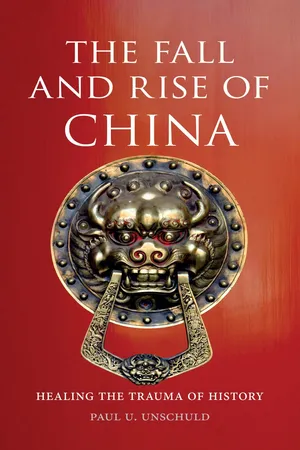
For over a century, from the First Opium War in 1839–42 to the end of the Second World War, China was repeatedly humiliated by Western imperial powers and by its smaller neighbour, Japan. For a time the Middle Kingdom seemed on the verge of becoming a pawn of foreign interests. Then, in a process unmatched in history, this great culture recovered vigorously from its seemingly hopeless plight – so much so that today the state, its leaders and its burgeoning economic and military might are globally acknowledged and not infrequently feared.
The Fall and Rise of China: Healing the Trauma of History traces the country’s development in the nineteenth and early twentieth centuries up to the present day and offers an explanation of the collective mentality that enabled China, confronted by the superiority of Western science and technology, to commit to the unsparing self-diagnosis that enabled its impressive rise and radical transformation. The country identified the aspects of Western civilization it must adopt in order to remove the cultural impediments to its own renaissance. Profoundly wounded, China prescribed for itself a therapy that followed the same principle used in Chinese medicine: that the cause lies first and foremost within oneself. Prevention and treatment must therefore always begin with one’s own deficiencies and mistakes. In this powerful polemic Paul Unschuld presents an entirely new understanding and analysis of China’s past and offers fascinating insights into its possible future.
- English
- ePUB (mobile friendly)
- Available on iOS & Android
eBook - ePub
About this book
Information
PART I
China – Zhongguo – An Empire at the Centre of the World
ONE
A Distant King is Turned Away
AT THE INSTIGATION of the British East India Company, in 1793 George III sent a delegation to China led by Lord Macartney. The British hoped to persuade the Imperial Court in Beijing to open up the vast Chinese Empire to trade with Great Britain. Laden with gifts, Macartney presented an array of goods as evidence of the economic prowess that the British hoped would impress the emperor. For its part, the Chinese court sent ships and vehicles festooned with banners reading ‘Embassy from the land of England for the delivery of tributes’ for all to see, and received the English ambassadors with ritual ceremonies of epic dimensions. The emperor spoke personally with the English ambassador. In September, however, in two edicts, the monarch conveyed to Macartney his rejection of the British proposals.
The language used in these documents eloquently illustrates the air of impregnability surrounding the Emperor Qianlong (1711–1799), one of China’s most glorious rulers, and how culturally superior the Chinese side felt. The lofty condescension with which Qianlong responded to the British petitions demonstrates the pride with which the alien Manchurian dynasty ruled its domains. After conquering China more than a century earlier the Manchu immediately recognized the greatness of the country’s culture and civilization. Knowing that they were horsemen from the north who ruled over a glorious and ancient civilization in no way stopped them from broadly identifying with their dominions.
History is littered with episodes of invaders irretrievably destroying great and venerable cultures. The Manchu did not take that path. They knew the value of the treasure they had won control of, and in the succession of the emperors Kangxi (r. 1661–1722), Yongzheng (r. 1722–35) and Qianlong (r. 1735–96, de facto until 1799) they led China to another golden age. Frontiers with neighbouring peoples were largely secured and relations with the Russian Tsarist regime handled to the benefit of both sides.
As the supreme ruler of the Middle Kingdom or zhongguo, Qianlong worded his reply to the British monarch with cool condescension, flatly rejecting Britain’s request to extend trade beyond the small southern port of Macao and the city of Canton. For reasons that to this day remain less than comprehensible, China had abruptly ended a thoroughly promising foray into long-distance seafaring many years earlier and was utterly uninterested in other countries’ products. In the eyes of the Manchu these were simple, superfluous trinkets of no benefit to China.
The edicts of Qianlong to George III speak for themselves. Given here complete, they began a process in which China first fell from the heights of cultural and economic greatness to the depths of subservience to foreign interests and finally – and uniquely among civilizations in decline – used its own strengths to rise back to power.
You, O King, live beyond the confines of many seas, nevertheless, impelled by your humble desire to partake of the benefits of our civilisation, you have dispatched a mission respectfully bearing your memorial. Your Envoy has crossed the seas and paid his respects at my Court on the anniversary of my birthday. To show your devotion, you have also sent offerings of your country’s produce.
I have perused your memorial: the earnest terms in which it is couched reveal a respectful humility on your part, which is highly praiseworthy. In consideration of the fact that your Ambassador and his deputy have come a long way with your memorial and tribute, I have shown them high favour and have allowed them to be introduced into my presence. To manifest my indulgence, I have entertained them at a banquet and made them numerous gifts. I have also caused presents to be forwarded to the Naval Commander and six hundred of his officers and men, although they did not come to Peking, so that they too may share in my all-embracing kindness.
As to your entreaty to send one of your nationals to be accredited to my Celestial Court and to be in control of your country’s trade with China, this request is contrary to all usage of my dynasty and cannot possibly be entertained. It is true that Europeans, in the service of the dynasty, have been permitted to live at Peking, but they are compelled to adopt Chinese dress, they are strictly confined to their own precincts and are never permitted to return home. You are presumably familiar with our dynastic regulations. Your proposed Envoy to my Court could not be placed in a position similar to that of European officials in Peking who are forbidden to leave China, nor could he, on the other hand, be allowed liberty of movement and the privilege of corresponding with his own country; so that you would gain nothing by his residence in our midst.
Moreover, our Celestial dynasty possesses vast territories, and tribute missions from the dependencies are provided for by the Department for Tributary States, which ministers to their wants and exercises strict control over their movements. It would be quite impossible to leave them to their own devices. Supposing that your Envoy should come to our Court, his language and national dress differ from that of our people, and there would be no place in which to bestow him. It may be suggested that he might imitate the Europeans permanently resident in Peking and adopt the dress and customs of China, but, it has never been our dynasty’s wish to force people to do things unseemly and inconvenient. Besides, supposing I sent an Ambassador to reside in your country, how could you possibly make for him the requisite arrangements? Europe consists of many other nations besides your own: if each and all demanded to be represented at our Court, how could we possibly consent? The thing is utterly impracticable. How can our dynasty alter its whole procedure and system of etiquette, established for more than a century, in order to meet your individual views? If it be said that your object is to exercise control over your country’s trade, your nationals have had full liberty to trade at Canton for many a year, and have received the greatest consideration at our hands. Missions have been sent by Portugal and Italy, preferring similar requests. The Throne appreciated their sincerity and loaded them with favours, besides authorising measures to facilitate their trade with China. You are no doubt aware that, when my Canton merchant, Wu Chao-ping, was in debt to the foreign ships, I made the Viceroy advance the monies due, out of the provincial treasury, and ordered him to punish the culprit severely. Why then should foreign nations advance this utterly unreasonable request to be represented at my Court? Peking is nearly two thousand miles from Canton, and at such a distance what possible control could any British representative exercise?
If you assert that your reverence for Our Celestial dynasty fills you with a desire to acquire our civilisation, our ceremonies and code of laws differ so completely from your own that, even if your Envoy were able to acquire the rudiments of our civilisation, you could not possibly transplant our manners and customs to your alien soil. Therefore, however adept the Envoy might become, nothing would be gained thereby.
Swaying the wide world, I have but one aim in view, namely, to maintain a perfect governance and to fulfil the duties of the State: strange and costly objects do not interest me. If I have commanded that the tribute offerings sent by you, O King, are to be accepted, this was solely in consideration for the spirit which prompted you to dispatch them from afar. Our dynasty’s majestic virtue has penetrated unto every country under Heaven, and Kings of all nations have offered their costly tribute by land and sea. As your Ambassador can see for himself, we possess all things. I set no value on objects strange or ingenious, and have no use for your country’s manufactures. This then is my answer to your request to appoint a representative at my Court, a request contrary to our dynastic usage, which would only result in inconvenience to yourself. I have expounded my wishes in detail and have commanded your tribute Envoys to leave in peace on their homeward journey. It behoves you, O King, to respect my sentiments and to display even greater devotion and loyalty in future, so that, by perpetual submission to our Throne, you may secure peace and prosperity for your country hereafter. Besides making gifts (of which I enclose an inventory) to each member of your Mission, I confer upon you, O King, valuable presents in excess of the number usually bestowed on such occasions, including silks and curios – a list of which is likewise enclosed. Do you reverently receive them and take note of my tender goodwill towards you! A special mandate.
You, O King, from afar have yearned after the blessings of our civilisation, and in your eagerness to come into touch with our converting influence have sent an Embassy across the sea bearing a memorial. I have already taken note of your respectful spirit of submission, have treated your mission with extreme favour and loaded it with gifts, besides issuing a mandate to you, O King, and honouring you with the bestowal of valuable presents. Thus has my indulgence been manifested.
Yesterday your Ambassador petitioned my Ministers to memorialise me regarding your trade with China, but his proposal is not consistent with our dynastic usage and cannot be entertained. Hitherto, all European nations, including your own country’s barbarian merchants, have carried on their trade with our Celestial Empire at Canton. Such has been the procedure for many years, although our Celestial Empire possesses all things in prolific abundance and lacks no product within its own borders. There was therefore no need to import the manufactures of outside barbarians in exchange for our own produce. But as the tea, silk and porcelain which the Celestial Empire produces, are absolute necessities to European nations and to yourselves, we have permitted, as a signal mark of favour, that foreign hongs [merchant firms] should be established at Canton, so that your wants might be supplied and your country thus participate in our beneficence. But your Ambassador has now put forward new requests which completely fail to recognise the Throne’s principle to ‘treat strangers from afar with indulgence’, and to exercise a pacifying control over barbarian tribes, the world over. Moreover, our dynasty, swaying the myriad races of the globe, extends the same benevolence towards all. Your England is not the only nation trading at Canton. If other nations, following your bad example, wrongfully importune my ear with further impossible requests, how will it be possible for me to treat them with easy indulgence? Nevertheless, I do not forget the lonely remoteness of your island, cut off from the world by intervening wastes of sea, nor do I overlook your excusable ignorance of the usages of our Celestial Empire. I have consequently commanded my Ministers to enlighten your Ambassador on the subject, and have ordered the departure of the mission. But I have doubts that, after your Envoy’s return he may fail to acquaint you with my view in detail or that he may be lacking in lucidity, so that I shall now proceed . . . to issue my mandate on each question separately. In this way you will, I trust, comprehend my meaning . . .
Your request for a small island near Chusan, where your merchants may reside and goods be warehoused, arises from your desire to develop trade. As there are neither foreign hongs nor interpreters in or near Chusan, where none of your ships have ever called, such an island would be utterly useless for your purposes. Every inch of the territory of our Empire is marked on the map and the strictest vigilance is exercised over it all: even tiny islets and far lying sand banks are clearly defined as part of the provinces to which they belong. Consider, moreover, that England is not the only barbarian land which wishes to establish . . . trade with our Empire: supposing that other nations were all to imitate your evil example and beseech me to present them each and all with a site for trading purposes, how could I possibly comply? This also is a flagrant infringement of the usage of my Empire and cannot possibly be entertained.
The next request, for a small site in the vicinity of Canton city, where your barbarian merchants may lodge or, alternatively, that there be no longer any restrictions over their movements at Aomen, has arisen from the following causes. Hitherto, the barbarian merchants of Europe have had a definite locality assigned to them at Aomen for residence and trade, and have been forbidden to encroach an inch beyond the limits assigned to that locality . . . . If these restrictions were withdrawn, friction would inevitably occur between the Chinese and your barbarian subjects, and the results would militate against the benevolent regard that I feel towards you. From every point of view, therefore, it is best that the regulations now in force should continue unchanged . . .
Regarding your nation’s worship of the Lord of Heaven, it is the same religion as that of other European nations. Ever since the beginning of history, sage Emperors and wise rulers have bestowed on China a moral system and inculcated a code, which from time immemorial has been religiously observed by the myriads of my subjects. There has been no hankering after heterodox doctrines. Even the European (missionary) officials in my capital are forbidden to hold intercourse with Chinese subjects; they are restricted within the limits of their appointed residences, and may not go about propagating their religion. The distinction between Chinese and barbarian is most strict, and your Ambassador’s request that barbarians shall be given full liberty to disseminate their religion is utterly unreasonable.
It may be, O King, that the above proposals have been wantonly made by your Ambassador on his own responsibility, or peradventure you yourself are ignorant of our dynastic regulations and had no intention of transgressing them when you expressed these wild ideas and hopes . . . . If, after the receipt of this explicit decree, you lightly give ear to the representations of your subordinates and allow your barbarian merchants to proceed to Chêkiang and Tientsin, with the object of landing and trading there, the ordinances of my Celestial Empire are strict in the extreme, and the local officials, both civil and military, are bound reverently to obey the law of the land. Should your vessels touch the shore, your merchants will assuredly never be permitted to land or to reside there, but will be subject to instant expulsion. In that event your barbarian merchants will have had a long journey for nothing. Do not say that you were not warned in due time! Tremblingly obey and show no negligence! A special mandate!2
Twenty years later, in 1816, the British crown launched a second attempt to establish formal commercial relations with the Empire of China, to place the existing – and for the British, totally inadequate – exchange of goods on a broader footing. Lord Amherst, who would go on to become Governor-General of India, was sent to follow in the footsteps of the hapless Macartney. He did not get far. After landing in Baihe he negotiated with Chinese protocol officers over the terms of an audience with Emperor Jiaqing. Amherst refused to kowtow before the emperor – that act so despised among Europeans – unless the next Chinese official to visit the king in London agreed to likewise kneel and bow his head to the ground, so as to show the British crown the same level of regard. The Chinese declined and Amherst sailed away having accomplished nothing.
By then the British East India Company had for nearly a century been exclusively managing Britain’s trade with China, which the Chinese strictly circumscribed. For various reasons, in 1834 the British government decided to revoke the private company’s monopoly and place the China trade under state control. Lord Napier was appointed the first Superintendent of Trade in Canton and immediately set about provoking the Chinese.3
The British East India Company had always kept to the Chinese trade terms, which strictly forbade foreign traders from establishing direct contacts with the Chinese bureaucracy. Their designated counterparts and negotiating partners were an exclusive guild of Chinese merchants. This guild was in turn authorized to discuss any of the foreigners’ concerns with the Chinese authorities. Ignoring these rules, Napier set out from Macao on 15 July 1834 for Canton to contact the Chinese viceroy there. At the gates of the city he conveyed to the local governor a letter that was rejected out of hand because it was not marked as a ‘petition’, as was demanded of emissaries from foreign states required to pay tributes. Napier refused to use this term, saying that it violated his country’s honour. The Chinese official had little choice but to remain unyielding, otherwise he would probably have been put to death. When Napier stubbornly insisted on a direct meeting, the viceroy showed his annoyance. He fired Napier’s Chinese servants, blocked all deliveries of food and drink and ordered soldiers to seal off the emissary’s apartment.
Whereas the dismissal of Lord Macartney forty years earlier had been worded in condescending yet diplomatically polite language, the dispute between Governor Lu and Napier degenerated into an exchange of insults. In an announcement published in Canton, Lu first expressed outrage at the Englishman’s gall for writing in terms that implied that the two sides were on equal terms. In a riposte likewise published in Canton, Napier accused the Chinese authorities of ‘perverse’ behaviour that would cause the ‘ruin of thousands of hard-working Chinese who make their living by trading with Europeans.’ Finally dropping all pretences of etiquette, Governor Lu again wrote publicly:
A lawless foreign slave, Napier, has released a statement.4 We have no idea how he, a barbaric dog of a foreign nation, could have the brazen insolence of presuming to call himself superintendent. As an alien, unci...
Table of contents
- Front Cover
- Half Title
- Title Page
- Copyright
- Contents
- Introduction
- PART I China – Zhongguo – An Empire at the Centre of the World
- PART II A Civilization in Free Fall
- PART III A Clash of Cultures?
- Conclusion
- References
- Index
Trusted by 375,005 students
Access to over 1.5 million titles for a fair monthly price.
Study more efficiently using our study tools.
Frequently asked questions
Yes, you can cancel anytime from the Subscription tab in your account settings on the Perlego website. Your subscription will stay active until the end of your current billing period. Learn how to cancel your subscription
No, books cannot be downloaded as external files, such as PDFs, for use outside of Perlego. However, you can download books within the Perlego app for offline reading on mobile or tablet. Learn how to download books offline
Perlego offers two plans: Essential and Complete
- Essential is ideal for learners and professionals who enjoy exploring a wide range of subjects. Access the Essential Library with 800,000+ trusted titles and best-sellers across business, personal growth, and the humanities. Includes unlimited reading time and Standard Read Aloud voice.
- Complete: Perfect for advanced learners and researchers needing full, unrestricted access. Unlock 1.5M+ books across hundreds of subjects, including academic and specialized titles. The Complete Plan also includes advanced features like Premium Read Aloud and Research Assistant.
We are an online textbook subscription service, where you can get access to an entire online library for less than the price of a single book per month. With over 1.5 million books across 990+ topics, we’ve got you covered! Learn about our mission
Look out for the read-aloud symbol on your next book to see if you can listen to it. The read-aloud tool reads text aloud for you, highlighting the text as it is being read. You can pause it, speed it up and slow it down. Learn more about Read Aloud
Yes! You can use the Perlego app on both iOS and Android devices to read anytime, anywhere — even offline. Perfect for commutes or when you’re on the go.
Please note we cannot support devices running on iOS 13 and Android 7 or earlier. Learn more about using the app
Please note we cannot support devices running on iOS 13 and Android 7 or earlier. Learn more about using the app
Yes, you can access The Fall and Rise of China by Paul U. Unschuld in PDF and/or ePUB format, as well as other popular books in History & Chinese History. We have over 1.5 million books available in our catalogue for you to explore.