The Euromaidan uprising in Kiev, followed by radical regime change, the annexation of the Crimea and the war in Eastern Ukraine, have shattered European security. The Western response to Russian aggression has been uncertain and hesitant in handling the unfamiliar yet large nation of Ukraine, a country with a complicated past, and one whose history is little known in the rest of Europe.
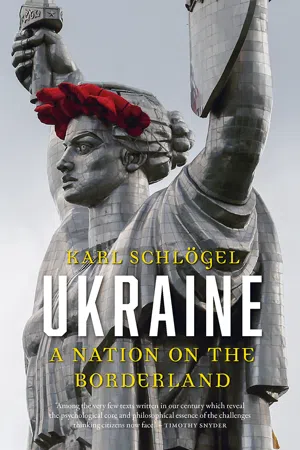
In Ukraine: A Nation on the Borderland, Karl Schlögel presents a picture of a country which lies on Europe's borderland and in Russia's shadow. In recent years, Ukraine has been faced, along with Western Europe, with the political conundrum resulting from Russia's actions and the ongoing Information War. As well as exploring this present-day confrontation, Schlögel provides detailed, fascinating historical portraits of a panoply of Ukraine's major cities: Lviv, Odessa, Czernowitz, Kiev, Kharkov, Donetsk, Dnepropetrovsk and Yalta – cities whose often troubled and war-torn histories are as varied as the nationalities and cultures which have made them what they are today, survivors with very particular identities and aspirations. Schlögel feels the pulse of life in these cities, analysing their more recent pasts and their challenges for the future.
- English
- ePUB (mobile friendly)
- Available on iOS & Android
eBook - ePub
About this book
Information
ONE
INFORMATION WAR
IN NORMAL TIMES, a writer can choose the circumstances of his work. He sets the rhythm in which he turns to his various tasks, works through a stack of books he has accumulated, constructs chapter after chapter. Everything has its time; the entire process is structured and manageable. But then there are moments, situations, that wreak havoc on a writer’s plans; he is thrown off balance and must remake his arrangements and find a new footing if he hopes to keep up with his times. The pacing of his projects is then determined by outside events. He is compelled to react, devise some sort of response, not because he wants to get in on the game, make himself heard, ‘raise his voice’, but because he has been struck, because everything – the concerns of a lifetime’s worth of study – is suddenly at stake, because he feels that, in some sense, he himself has been dealt a blow. He has no choice but to fight back – ‘strike back’ would perhaps be too strong. I found myself in such a situation when protesters were massacred on Kiev’s Maidan Nezalezhnosti or Independence Square, generally known in the West simply as ‘Maidan’, and when Vladimir Putin spouted the bald-faced lie that there was no annexation of Crimea even as we watched it happen with our own eyes.
‘Situation Room’: an English phrase that entered general parlance at some point during the last year, presumably thanks to the popular format pioneered by CNN: ‘You’re in the Situation Room, where news and information are arriving all the time. Standing by: CNN reporters across the United States and around the world to bring you the day’s top stories. Happening now . . . I’m Wolf Blitzer, and you’re in the Situation Room.’ The set-up is supposedly modelled on the White House Situation Room created under President Kennedy: a central control post where incoming information is collated and condensed in real time to provide a view of the world at a single glance.
When the world is so much with you that you can no longer go about the work you had set yourself to do, much, though perhaps not everything, is different. You stop trying to keep the news at bay; on the contrary, you depend on it, you hunger for it. If, like me, you have not given up resistance to the Internet and the pressure to be available at all times, you must rush to familiarize yourself with the web’s technologies and techniques if you want to stay current. Not out of a penchant for visual thrills or as an idle pastime but because everything rides on the next piece of news, the next event: will the chain of violence be broken, will the machine come to a halt, or will the escalation continue? Disasters are not just conceivable but real at every moment. You are sucked into the maelstrom of information, which is now available in unlimited quantities, innumerable snippets of news that are infinitely diverse, contradictory, each giving the lie to the other. Casting about for something to hold on to, you turn to the summaries, analyses, editorials, opinion pieces that follow each other in rapid succession. But they do not let you catch your breath either, as developing events make their conclusions moot before the printer’s ink has dried. You are a thousand miles away and yet right there, for thousands of eyes watch from thousands of vantage points throughout the space in which history unfolds. You are on a windowsill in a corner building overlooking an intersection in Donetsk’s Leninsky District, observing everyday life in the occupied city: armoured vehicles are moving over there, but workers are also busy building bicycle lanes, while shelling can be heard in the distance. You see the pictures from the basements that have become bomb shelters and the press conferences of the warlords who have made themselves at home in the offices of the oligarchs. The interim director of the Donetsk Opera gives interviews about the season’s repertoire. The sociologist who is forced to leave his university submits a final report on the new lines of social conflict in the city: a scholarly autopsy from the war zone.
All of this floods the study, coming in through a wide variety of channels: broadcasts on television, on Russian, Ukrainian and many other stations, and reports in newspapers that are available online – the Donetsk Times, the Kharkiv Times, the Kyiv Post, Moscow’s Novaya Gazeta. You can watch as commentators make sense of the events on the discussion programmes: Savik Schuster’s, in Russian and Ukrainian, from Kiev; the one on Dozhd, the Moscow cable channel that is surprisingly still on air; interviews on Ekho Moskvy; and the unending and virtually unchanging ritual of the talk shows on the German stations. In Germany, people somehow still do not seem to grasp what is happening in Ukraine. Then there are pictures, letters, op-ed articles, démentis – everything accumulates in the study where a writer is usually at work on books that examine the history of the space in which these news stories originate. And you know that you will never be able to keep up, and know, too, that for the time being and perhaps for a long time, you will be powerless against the gravitational pull of habit, of ignorance, of proliferating and self-perpetuating prejudices. It is a feeling of boundless impuissance. In this situation room, where the news and images from Ukraine, primarily from the contested areas, converge, it is difficult to stay cool and hold your nerve.
Destabilization is not an abstract idea: a destabilization campaign of the sort conducted by Russia is directed against the ‘authority’, the ‘sovereignty’ of a state. But the true target of destabilization is the integrity of the adversary under attack, the country’s society or, more precisely speaking, its people. The ultimate goal of a destabilization campaign against a state, a society, is to break people. To bring a country to its knees, one must bring its citizens to theirs. To force a government to surrender, one must force those who elected that government to submit, to accept submission. Escalation dominance is not something that is asserted against an abstract entity – a nation, an army, a government – but a form of ad hominem violence. Rules are dictated to someone, someone’s will is imposed on someone, someone is given an ultimatum and must respond one way or another. Of course, those on whom this conflict has been forced can opt out, choosing resignation, indifference, cynicism, defeatism. All these attitudes are material factors in the ongoing struggle over Ukraine; in the past, they have sometimes been crucial, contributing to the escalation of wars, even triggering their outbreak. One thing they have never done is prevent a war.
It is never quiet in the situation room. Breaking news is announced around the clock. Time itself has a different cast. What is happening calls for commentary, even for an intervention, but those are hardly the historian’s strengths. His métier is the longue durée, the completed series of events. He is competent when it comes to the past, to history, but his grasp of current affairs can be shaky. Current affairs are the business of the man of action who commands the tanks to advance or retreat and produces the next breaking news. He does not pause to offer explanations; those will come when all is done. The only antagonist who is a match for him is one who stands up to him – yet beyond the Ukrainians, who have no choice but to fight, such men are nowhere to be seen.
One effect of the new media is that we are always up to speed, that we have access to live images and can watch almost in real time as frontlines shift, villages and towns are captured, bridges and railway tracks are blown up. Thanks to Google Maps and satellite-based information systems, we can make out Donetsk’s main thoroughfare, the football stadium, the culture park, the airport that has been reduced to rubble. We zoom in on a steppe crossed by European route E40 and the fields into which the Malaysian passenger plane crashed. The table in my study that is usually reserved for the maps on which I locate the scenes of historic events are now covered with charts that let me navigate the theatre of the current war: Gorlovka, Enakievo, Torez, Debaltsevo, Artyomovsk and on and on. We can follow the ongoing military operations and mark the new frontlines on our maps. We read the messages and letters from the war zone on the blogs, read about what is going on in the basements and the prisons. We become mere witnesses, onlookers, observing with our own eyes and ears a battle whose outcome others determine and others pay for with their lives.
To be in the situation room is to be lonely. Every one of us must make his own sense of the flood of images and news. The world of shared certainties falls apart, and our power of judgement is challenged, a test we had hoped we would never again be subjected to. The shells that explode in the cities and towns also shatter the portraits of their urban fabrics. The present does not allow us to study the past as it ought to be studied: from a distance. In a time of war, how could one paint the sweeping view of the Dnieper from the hill on which Kiev’s Monastery of the Caves stands without opening himself to the charge of sentimentality? Portraits of cities are not wanted when the bombs fall. It is the war reporter’s time and even more the war photographer’s. Details that would otherwise be indispensable now sound like chatter, as if the speaker had more time than he knew what to do with, as if he were trying to cover up his embarrassment, as if he were oblivious of the world around him. It is an unfamiliar experience, being an eyewitness when the gloves come off. Describing battles is a craft we have never learned. Observers who offer their accounts from a distance, we are no longer needed. Our opinions have long divided us into stable camps that respected each other’s cherished commonplaces, but that stability is disintegrating, and each one of us must stake out his position in light of a new set of circumstances. This realignment requires us to make decisions. It is an individual, a molecular process: it is not an anonymous ‘society’ that positions itself anew, that confronts an unwonted situation; everyone must make his own choice. The build-up of defensive capabilities against a war fomented by others comes after a protracted and agonizing period of destabilization, fragmentation, atomization. Destabilization is how the transition to a different Europe takes place. Will we endure, will we weather this storm? These anguished questions may already be obsolete by the time the book appears in print. Notes from yesterday.
TWO
FAREWELL TO EMPIRE, FAREWELL TO RUSSIA?
THE ANNEXATION OF CRIMEA was, for me, the proverbial bolt out of the blue. Could we not have seen, or at least suspected, that it was coming? How was it possible that certain unequivocal portents were ignored or dismissed? Which mechanism of self-protection against a reality we felt to be menacing was in play? I had travelled to the Soviet Union and later to Russia on a regular basis for decades, but never once had I heard anyone say that Crimea was a ‘festering wound’, a source of constant pain for Russians. Had I been in denial, had I closed my eyes to what I did not want to know? But then in all those years, acquaintances and I had talked about all sorts of things that were on our minds. I do not remember a single conversation in Moscow or elsewhere in which Crimea was mentioned as a sore spot. It came up as a literary topos: antiquarian booksellers hawked Baedekers from the pre-revolutionary era and Soviet guides to the ‘Red Riviera’, and over time I compiled a small collection. But as a bone of contention, a controversial issue? Only one case comes to mind. I must confess that I was initially an admirer of Yury Luzhkov, the mayor of Moscow, whose gumption impressed me. I saw him as a legitimate heir to the city’s great leaders before 1917, such as Pavel Tretyakov, a patron of the arts and benefactor; Luzhkov went about Moscow’s transformation into a twenty-first-century global city with formidable energy. And so, although I knew that he was paying visits to Sevastopol, giving speeches about Crimea, collecting donations, I did not take these activities entirely seriously until my friend, the sociologist Lev Gudkov, drew my attention to the mayor’s Russian patriotism. He thought of it as dangerous, a steady campaign of provocations and challenges stabbing at Ukraine. I realized that there was a flip side to Luzhkov’s track record of success. But beyond this one instance, I never sensed the slightest concern with Crimea, let alone passionate interest in its fate. People who could afford to travel – and as the scene at Moscow’s airports showed, many people could – went on holiday not in Crimea but in Paris, Florence, the Canary Islands, Greece, the Turkish Riviera around Antalya, or Sharm el-Sheikh. What struck me on my visits to Crimea was something else: the dilapidated infrastructure once I arrived in Simferopol; the palatial Soviet-era hotels that, far from being fully booked, often sat largely deserted; the brusque tone – another holdover from the Soviet era – with which the staff at the reception desk handled guests; the cheap fireworks on the promenade in Yalta; but also the city of Sevastopol, built of white stone, spread out in the brilliant sunlight just as in Alexander Deyneka’s magnificent pictures from the 1930s. And I remember the shanties clinging to the hillsides, the settlements, I was told, of the Crimean Tatars who had recently returned in large numbers from Central Asia, where Stalin had had them deported in May 1944. So Crimea was an enchanting place out of time, a corner of the earth forgotten by history, rather than a hot spot of internal conflict or international embroilments. It was Putin who suddenly put Crimea on the map, who gave it a central part in Russian mythology and, more importantly, made its future a matter of war and peace.
Saying No to Putin
The annexation and especially Putin’s brazen denial that it had taken place made it impossible for me to receive the Medal of Pushkin, which the President of the Russian Federation has given out since the 1990s for significant contributions to promoting the study of Russian culture abroad. I wrote to the Russian ambassador in Berlin, for whom I had the highest respect, that in light of the events I found myself unable to accept the award, which I was to be given in recognition of my work (I had first been notified in November 2013). Was that a cop-out? Was I giving in to the pressure of public opinion, which was outraged by Putin’s coup de main? Was I being disloyal to Russia, even ‘betraying’ it? At the moment of supreme disappointment over the actions of the Russian leadership, would it not have been more imperative than ever to ‘keep faith’ with Russia?
Yet Russia’s policy towards Ukraine – fomenting war against her quintessential ‘sister nation’ – threatened to undo everything that had been accomplished in German-Russian relations. For me, and I think for everyone who has studied it, Russia is more than a subject of research; it is deeply woven into our personal lives. And so, the so-called Ukrainian crisis was a moment of truth, challenging us to reconsider deeply held convictions and how we had arrived at them. It called for more than a review of the scholarship of the past and the evolution of the cultural, diplomatic or business relations between the countries. It struck to the core of our dedication to dialogue, and more was at stake than merely a position that might be revised or amended. What was cast in doubt was an undertaking to which we had devoted ourselves with heart and soul, an engagement that could not have remained without consequences, that might almost be called an enchantment or entanglement. In short, this was about Russia as an integral part of our biographies; the events in Ukraine called a major part of our life’s work into question. However important and fruitful it may be to revisit the succession of felicitous German-Russian encounters as well as dramatic clashes between the countries over the past centuries, the very efforts at objectivity of such historical surveys, usually presented in chronological order, are a source of obfuscation. The main themes, the literary leitmotifs, the authors and their characters make their appearances, but the reader is left in the dark about the true mainsprings and forces of cohesion that operated and still operate in such relations. They proffer specious explanations rather than genuine illumination. These might be questions fit for private soul-searching if they did not have implications for society at large. For the stakes are considerable; clarity is needed on which stance one should take – which stance the Germans should take – on Russia’s Ukraine policy. To gauge the gravitational pull exerted by the ‘Russia complex’, we must first acknowledge it, and rather than draw up an abstract sketch of an abstract history of ideas, we might as well start with ourselves. Its power grows out of experiences no less than ideas, out of impressions no less than readings.
Growing up in the 1950s in a village in the Allgäu, a rural area in the far south of Germany, possibly the remotest corner of a country that was in some ways cut off from the wider world, I thought of Russia as a faraway land. But the graves in the cemetery and the plaque in the chapel dedicated to the memory of the village’s dead soldiers spoke a different language. They bore the names of families I knew and, next to them, those of towns or, much more often, vague and imprecise information, as though specifications of place and time had no traction in that enormous space: ‘Killed in Russia, Winter 1942’. Russia, that was war and war captivity, the subjects of conversations we children overheard, especially when, once a year, father got together with fellow soldiers who had made it out alive. Russia – more specifically, Stalingrad, Siberia – became what, using a later coinage, we would call a literal lieu de mémoire, a space fleshed out in the imagination by what I found rummaging through the not altogether very well-stocked library of the boarding school run by Benedictine monks: So weit die Füße tragen by Josef Martin Bauer, a writer who had attended my own school, and Die Armee hinter Stacheldraht by Edwin Erich Dwinger, an author I would later identify as a monumental figure of German light fiction and manufacturer of ‘Siberia as a landscape of the German soul’. At home, Russia was rarely ever spoken of. Father had ‘taken part’ in the war from 1 September 1939 – the beginning of the ‘Polish campaign’ – until the end in the spring of 1945, spending most of that time on the eastern front as a simple soldier and driver, as he said. That was where the jagged-edged black-and-white pictures came from that he kept in a tin box, pictures of the sort that German squaddies had brought home by the hundreds of thousands, even millions: blown-up bridges; pillars of smoke rising from towns whose names were sometimes recorded on the back of the photographs and which I recognized when I visited them decades later; river sceneries – the San, the Dnieper – and market squares, pigs and geese being slaughtered, the crew taking a bath in a river, the Rollbahn stretching towards an infinitely vast space. There were, too, the names of towns and transportation hubs that got stuck in the child’s mind, configuring a mental map that I retain today: Lviv, Lublin, Orsha, Kremenchuk, Kramatorsk, Stalino. Later, after my father’s death, I was able to reconstruct the entire journey that had taken him from the Allgäu to the eastern front and the wider world. It turned out that I had unknowingly travelled along the same routes.
I sighted my first ‘Russians’ on the transit motorway from Bavaria to West Berlin. The political socialization of West German pupils of the late 1950s and 1960s would not have been complete without these obligatory educational trips with funding support from the Federal Ministry of the Interior. Here lies a major difference between the experiences of growing up in East and West Germany. In the East, citizens lived in a sort of cohabitation with Russians, with barracks, athletic facilities, officers’ villas, special shops, and trains labelled ‘Wünsdorf– Saratov’ in Cyrillic letters. However hermetically sealed the world of the Soviet armed services may have been, these were part of the interior of the East German lifeworld, just as GIS, jeeps and the malls of the U.S. Army were in the West. So I encountered ‘Russians’ first in a car park outside a service area near Leipzig and then, a little later, in the ‘Druzhba’ bookstores in East Berlin, in Prague, Sofia and all the other cities I visited when I started travelling in the Eastern Bloc...
Table of contents
- Front Cover
- Half Title
- Title Page
- Copyright
- CONTENTS
- UKRAINE, OR REMAPPING EUROPE: PREFACE TO THE ENGLISH EDITION
- AUTHOR’S NOTE
- EUROPE’S UKRAINA: AN INTRODUCTION
- 1 INFORMATION WAR
- 2 FAREWELL TO EMPIRE, FAREWELL TO RUSSIA?
- 3 SEEING FOR OURSELVES: DISCOVERING UKRAINE
- 4 KIEV, METROPOLIS
- 5 AH, ODESSA: A CITY IN AN ERA OF GREAT EXPECTATIONS
- 6 PROMENADE IN YALTA
- 7 LOOK UPON THIS CITY: KHARKOV, A CAPITAL OF THE TWENTIETH CENTURY
- 8 DNEPROPETROVSK: ROCKET CITY ON THE DNIEPER AND CITY OF POTEMKIN
- 9 DONETSK: TWENTIETH-CENTURY URBICIDES
- 10 CZERNOWITZ: CITY UPON A HILL
- 11 LVIV: CAPITAL OF PROVINCIAL EUROPE
- 12 THE SHOCK: THINKING THE WORST-CASE SCENARIO
- FURTHER READING
- ACKNOWLEDGEMENTS
- PHOTO ACKNOWLEDGEMENTS
Trusted by 375,005 students
Access to over 1.5 million titles for a fair monthly price.
Study more efficiently using our study tools.
Frequently asked questions
Yes, you can cancel anytime from the Subscription tab in your account settings on the Perlego website. Your subscription will stay active until the end of your current billing period. Learn how to cancel your subscription
No, books cannot be downloaded as external files, such as PDFs, for use outside of Perlego. However, you can download books within the Perlego app for offline reading on mobile or tablet. Learn how to download books offline
Perlego offers two plans: Essential and Complete
- Essential is ideal for learners and professionals who enjoy exploring a wide range of subjects. Access the Essential Library with 800,000+ trusted titles and best-sellers across business, personal growth, and the humanities. Includes unlimited reading time and Standard Read Aloud voice.
- Complete: Perfect for advanced learners and researchers needing full, unrestricted access. Unlock 1.5M+ books across hundreds of subjects, including academic and specialized titles. The Complete Plan also includes advanced features like Premium Read Aloud and Research Assistant.
We are an online textbook subscription service, where you can get access to an entire online library for less than the price of a single book per month. With over 1.5 million books across 990+ topics, we’ve got you covered! Learn about our mission
Look out for the read-aloud symbol on your next book to see if you can listen to it. The read-aloud tool reads text aloud for you, highlighting the text as it is being read. You can pause it, speed it up and slow it down. Learn more about Read Aloud
Yes! You can use the Perlego app on both iOS and Android devices to read anytime, anywhere — even offline. Perfect for commutes or when you’re on the go.
Please note we cannot support devices running on iOS 13 and Android 7 or earlier. Learn more about using the app
Please note we cannot support devices running on iOS 13 and Android 7 or earlier. Learn more about using the app
Yes, you can access Ukraine by Karl Schlögel, Gerrit Jackson in PDF and/or ePUB format, as well as other popular books in History & World History. We have over 1.5 million books available in our catalogue for you to explore.