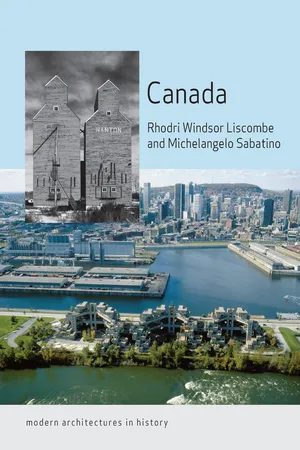
‘We shall demand of our architects a sensitive interpretation of society’s needs as well as the eloquent architectural statement’, appealed Prime Minister Pierre Trudeau in 1972. Architecture in Canada has been fashioned by the nation’s immense size, as well as its concentrated and diverse geography and demography. This richly informative history reveals how the country has contributed in no small measure to the spread of architectural modernity in the Americas and beyond.
During the twentieth century, a distinct Canadian design attitude coalesced: a liberal, hybrid, pragmatic mindset intent less upon the dogma of architectural language than on thinking about the formation of inclusive spaces and places. Taking a fresh perspective on design production and its context, Canada maps the unfolding of architectural modernity across the country, from the completion of the transcontinental railway in 1886–87 to the tumultuous interwar decades, the period of Reconstruction post-1945, and the politically conflicted era of the late 1960s and ’70s. It also examines the broad pattern of Canadian political, industrial and socio-cultural evolution, urban–suburban expansion, and the technology of building. A wide array of buildings and architects, from ARCOP, Eric Arthur and Ernest Cormier, to Brigitte Shim and Howard Sutcliffe, helps to bring to life this chronologically and thematically driven story. Canada is a unique critical account of modern and contemporary architecture in a country once defined by Voltaire as ‘a few acres of snow’.
eBook - ePub
Canada
Modern Architectures in History
- English
- ePUB (mobile friendly)
- Available on iOS & Android
eBook - ePub
Canada
Modern Architectures in History
About this book
Information
Topic
ArchitectureSubtopic
Architecture GeneralReferences
chapter one Modernity in Canada, 1886–1914
1 W. Kaye Lamb, History of the Canadian Pacific Railway (New York, 1977); Pierre Berton, The National Dream: The Great Railway, 1871–1881 (Toronto, 1970); Pierre Berton, The Last Spike (Toronto, 1971); see also Harold Innis, A History of the Canadian Pacific Railway (London, 1923); For the other transcontinental systems, see Donald MacKay, The People’s Railway: A History of Canadian National (Vancouver, 1992); Leonard Frank, A Thousand Blunders: The Grand Trunk Pacific Railway and Northern British Columbia (Vancouver, 1996). In the U.S. the first transcontinental railroad from Iowa to California was completed in 1869, connecting with existing networks in the eastern states.
2 John Whalley, Canada’s Resource Industries (Toronto, 1986); Pierre Berton, The Great Klondike Goldrush: An Omnibus (Calgary, 2007); Donat le Bourdais, Metals and Men: The Story of Canadian Mining (Toronto, 1957).
3 Elsa Lam, ‘Wilderness Nation: The Myth of Nature in Canadian Architecture’, Journal of the Society for the Study of Architecture in Canada (JSSAC hereafter), XXXIII/2 (2008), pp. 11–20.
4 Thomas Flanagan, Riel and the Rebellion: 1885 Reconsidered (Toronto, 2000).
5 Neither, in company with all but Jean-Omer Marchand among Canadians of that generation, obtained the prestigious Diplome; see Isabelle Gournay, ‘Capper, Carlu, Cormier et les autres: Mapping out and Making Sense of the Beaux-Arts Diaspora in Canada’, paper read at the 41st Conference of the Society for the Study of Architecture in Canada, Annapolis Royal, NS, 2015.
6 Laurel S. MacDowell and Ian W. Radforth, eds, Canadian Working-class History (Toronto, 1992); Richard Allen, The Social Passion: Religion and Social Reform in Canada, 1914–28 (Toronto, 1973).
7 In 1914 Alice Charlotte Malhiot became the first woman to graduate from a School of Architecture (Edmonton) followed by Esther Marjorie Hill (Toronto) in 1920. See Annmarie Adams, ‘Marjorie’s Web: Canada’s First Woman Architect and Her Clients’, in Rethinking Professionalism, ed. Janice Anderson and Kristina Huneault (Montreal, 2012), pp. 380–99.
8 Harry Black, Canadian Scientists and Inventors (Markham, ON, 1997); Susan J. Douglas, Inventing American Broadcasting, 1899–1922 (Baltimore, MD, 1987); Charlotte Gray, Reluctant Genius: Alexander Graham Bell and the Passion for Invention (New York, 2006).
9 See www.steinerag.com.
10 Contract Record and Engineering Review (CR hereafter), XXVIII (1914), respectively pp. 1098–1100 (Royal Bank); p. 94 (Dominion Bank); pp. 1436–8 (Vancouver Club); pp. 873–4 (Foundations); pp. 1435–8 (Hennebique Ferro Concrete construction); p. 87 (Canada Cement mill); pp. 1182–8 (elevator construction); pp. 938–9 (Halifax Terminal). The Canadian blend of American and British idioms in high-rise architecture is examined by David Winterton in ‘Toronto’s Edwardian Skyscraper Row’, JSSAC, XL/2 (2015), pp. 77–99. Whereas Darling was born in Scarborough, ON, Pearson came from Chesterfield, England.
11 CR, XXVIII (28 January 1914), p. 94; for Turner’s comment see 12 February 1914, pp. 196–7.
12 CR, XXVIII (7 October 1914), pp. 1511–15.
13 Stephen Leacock, Canada: The Foundations of its Future (Montreal, 1941), p. 237.
14 Geoffrey Simmins, ‘Competing Visions for Redesigning the Canadian City: Architecture, Urban Planning and Landscape Architecture, 1893–1918’, in Artists, Architects and Artisans: Canadian Art, 1890–1918, ed. Charlie Hill (Ottawa, 2013), pp. 240–69. The first legislation was the New Brunswick Town Planning Act of 1915, for which see Walter Van Nus, The Planmakers and the City: Architects, Engineers, Surveyors and Urban Planning in Canada, 1890–1939 (Toronto, 1975); see also J. Barry Cullingworth, Urban and Regional Planning in Canada (London, 2015).
15 See www.raic.org; see also Kelly Crossman, Architecture in Transition: From Art to Practice, 1885–1906 (Kingston, ON, 1987).
16 A. L. Murray, ‘Frederick Law Olmsted and the Design of Mount Royal Park, Montreal’, Journal of the Society of Architectural Historians, XXVI/3 (1967), pp. 168–71. Jean Barman, Stanley Park’s Secret: The Forgotten Families of Whoi Whoi, Kanaka Ranch and Brockton Point (Madeira Park, BC, 2005). Sean Kheraj, Inventing Stanley Park: An Environmental History (Vancouver, 2013).
17 Barbara Chisholm, Castles of the North: Canada’s Grand Hotels (Toronto, 2001); Rhodri Windsor Liscombe, ‘Nationalism or Cultural Imperialism: The Château style in Canada’, Architectural History, XXXVI (1993), pp. 127–44.
18 Anthony Barrett and Rhodri Windsor Liscombe, Francis Rattenbury and British Columbia (Vancouver, 1983).
19 Respectively, France Vanlaethem and Isabelle Gournay, eds, Montréal Metropole, 1880–1930 (Montreal, 1998); John Leroux and Thaddeus Holownia, Saint Andrews Architecture, 1604–1966 (Kentville, NS, 2010), pp. 139–45.
20 See Isabelle Gournay and France Vanlaethem, ‘The Supreme Court Building’, in The Supreme Court of Canada and its Justices, 1875–2000 (Ottawa, 2000), pp. 195–212.
21 Harold Kalman and John Roaf, Exploring Ottawa: An Architectural Guide to the Nation’s Capital (Toronto, 1983); Marion Van de Wetering, An Ottawa Album (Toronto, 1997).
22 Rosalind Pepall, ed., The Architecture of Edward and W. S. Maxwell (Montreal, 1991); see also Simmins ‘Competing Visions’ 2013, pp. 259–62 and Bernard Flaman, Architecture of Saskatchewan: A Visual Journ...
Table of contents
- Front Cover
- Half Title
- modern architectures in history
- Title Page
- Copyright
- Contents
- Introduction
- one Modernity in Canada, 1886–1914
- two Modernizing the Dominion, 1914–45
- three Modernism and Reconstruction, 1945–67
- four Modernism with a Punch, 1945–67
- five Questioning Modernism, 1967–86
- six Regenerative Modernism, 1986 to the Present
- seven Canada’s Modernist Legacy
- References
- Bibliography
- Acknowledgements
- Photo Acknowledgements
- Index
Trusted by 375,005 students
Access to over 1.5 million titles for a fair monthly price.
Study more efficiently using our study tools.
Frequently asked questions
Yes, you can cancel anytime from the Subscription tab in your account settings on the Perlego website. Your subscription will stay active until the end of your current billing period. Learn how to cancel your subscription
No, books cannot be downloaded as external files, such as PDFs, for use outside of Perlego. However, you can download books within the Perlego app for offline reading on mobile or tablet. Learn how to download books offline
We are an online textbook subscription service, where you can get access to an entire online library for less than the price of a single book per month. With over 1.5 million books across 990+ topics, we’ve got you covered! Learn about our mission
Look out for the read-aloud symbol on your next book to see if you can listen to it. The read-aloud tool reads text aloud for you, highlighting the text as it is being read. You can pause it, speed it up and slow it down. Learn more about Read Aloud
Yes! You can use the Perlego app on both iOS and Android devices to read anytime, anywhere — even offline. Perfect for commutes or when you’re on the go.
Please note we cannot support devices running on iOS 13 and Android 7 or earlier. Learn more about using the app
Please note we cannot support devices running on iOS 13 and Android 7 or earlier. Learn more about using the app
Yes, you can access Canada by Michelangelo Sabatino,Rhodri Windsor Liscombe,Sabatino, Michelangelo,Liscombe, Rhodri Windsor in PDF and/or ePUB format, as well as other popular books in Architecture & Architecture General. We have over 1.5 million books available in our catalogue for you to explore.