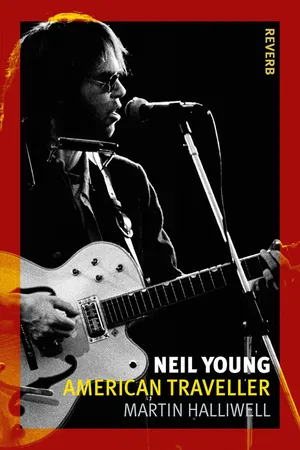
When Neil Young left his native Canada in 1966 to move to California, his journey sparked a leap in musical artistry that would come to resonate throughout North America. His fascination with American locations – from the Santa Monica Mountains to the Deep South – profoundly influenced his eclectic musical style and helped to shape the story of his generation.
Neil Young: American Traveller shows how place looms large in Young’s songs: Los Angeles is seen as the home of uptight business and lost innocence, while San Francisco is seen as the retreat Young needed from the excesses of the music industry. These locations helped craft the singer-songwriter’s distinct style, which led to his popularity as a solo artist and as a member of Buffalo Springfield, Crazy Horse and Crosby, Stills, Nash & Young.
Moving from the Canadian prairies to Young’s adopted Pacific home, Halliwell explores how place and travel affected one of North America’s most prolific recording artists of all time. Alongside discussion of Bob Dylan, Joni Mitchell, Gordon Lightfoot, the Grateful Dead, Lynyrd Skynyrd, Devo, Pearl Jam and other fellow travellers, he considers how Young’s personal journeys are entwined with a powerful feel for the American landscape. The book spans Young’s career as a singer-songwriter from his musical collaborations to his film projects, recent memoirs and his interest in technologies new and old.
Neil Young: American Traveller will appeal to the many fans of this iconic, challenging, constantly changing musician.
- English
- ePUB (mobile friendly)
- Available on iOS & Android
eBook - ePub
About this book
Information
Subtopic
Music1 MANITOBA AND ONTARIO
Neil Young arrived in Los Angeles on 1 April 1966 in a road-weary black Pontiac hearse. Affectionately named Mort II, this second hearse followed the demise of Mort, his ’48 Buick Roadmaster, when its transmission failed on a road trip the previous summer. That journey ended near Blind River, Ontario – later immortalized in the lyrics of ‘Long May You Run’ – and included Bob Clark, the new drummer of Young’s first serious band The Squires.1 The four-piece group had first formed at Kelvin High School in the prairie city of Winnipeg in early 1963 and swiftly developed a strong instrumental style, making them one of the busiest acts to play in the city’s community clubs and coffee houses. Sensing broader opportunities further afield, in autumn 1964 The Squires began playing in the fur-trading town of Fort William, now part of Thunder Bay, on the western shore of Lake Superior. For ten months they had a good run in Fort William as the house band at The Flamingo Club, returning periodically to play in Winnipeg. But the end of Mort, their makeshift tour bus, prompted them to embark on another journey, 800 miles to the southeast.
This move to Toronto in summer 1965 proved less successful. There the band renamed themselves Four to Go after finding a local group with a similar name, but they struggled to find work in the coffee houses and bars of bohemian Yorkville at the centre of Toronto’s music scene.2 Young picked up some solo acoustic gigs at the Yorkville venues the New Gate of Cleve and the Riverboat but, frustrated at being in an unknown band, he set his sights elsewhere. After his next group The Mynah Birds split in February 1966, when American singer Ricky James Matthews was busted for avoiding the draft (during the recording of the band’s debut album in Detroit), Young’s desire to travel heightened. ‘I knew I had to leave Canada’, he later said, ‘and the sounds I was hearing and the sounds I liked were coming from California. I knew if I went down there I could take a shot at making it.’3
Young often talks decisively about his reasons for leaving Canada, but the musical impetus to do so was complex. A defining moment in his development as a singer-songwriter was seeing Bob Dylan on the Canadian TV show Quest in 1964, especially because Dylan’s rasping voice contrasted starkly with the slick vocal arrangements of the typical band. Dylan was not just a distant icon: he twice visited Toronto in 1965 to rehearse with The Hawks in September (they renamed themselves The Band after touring with Dylan in 1966) and to play at Massey Hall in November. Young did not see him live on either occasion, but the Minnesotan’s electric folk had a lasting effect. An early indication of this is The Squires’ performance of Dylan’s ‘Just Like Tom Thumb’s Blues’ in Killington, Vermont in October 1965. This travelling song about a displaced northerner who encounters corruption and sickness in Mexico set a travelling tone for the callow Canadian musician, and he chose to reprise the track for his two-song set at Dylan’s 30th Anniversary Concert in 1992.4
Young’s musical sensibility was honed by a number of visiting American acts that played at the cluster of cafés and bars in Yorkville, such as the Southern blues duo Sonny Terry and Brownie McGhee, but of equal importance was his contact with Canadian musicians. These included Joni Mitchell (they first met when Young took a trip to Winnipeg in December 1965; she lived in Detroit during her short-lived marriage and she left for New York around the time he went to California); Gordon Lightfoot (he had spent fourteen months in Los Angeles as a jazz student in the late 1950s and became the headline act at the 120-seater Riverboat Coffee House when it opened in 1965); and Ian and Sylvia Tyson (the pair left Toronto for New York in 1962 and had released four albums by the time Young arrived in Yorkville, including Early Morning Rain, named after Lightfoot’s 1964 song). Although Lightfoot returned to Canada in 1960 after an uninspiring time in Los Angeles, these musical journeys suggest that there were limited opportunities in Toronto, despite the convergence of talent on Yorkville, the Canadian version of Greenwich Village.
The most important encounter for shaping Young’s travel plans was his meeting with Texas-born Stephen Stills, who performed with The Company (a spin-off from Stills’s first band, the Au Go-Go Singers) at the Fourth Dimension Club in Fort William in April 1965. Stills had travelled extensively as a child and teenager and absorbed a number of musical influences, including folk and blues from the Deep South and Latin American rhythms from spells in Costa Rica and Panama. This version of travelling music proved exciting for the twenty-year-old Canadian. After sharing the bill at The Flamingo Club, Young and Stills expressed their admiration for each other’s musical versatility. Stills thought Young’s songwriting was primitive, but he later noted that he was ‘doing the same thing I wanted to do … playing folk music with an electric guitar. And Neil had such an interesting, intense attitude.’5 The pair agreed to play together in the future and planned to meet in Manhattan, but it took a year before they found each other again in Los Angeles.6
We might see Young’s trip to California in March 1966 as a punctuation mark dividing his Canadian and American years. But his musical development was in transit from an early age, with Canada functioning both as a horizon and a point of departure, as it did when the Young family travelled by car for extended breaks in the early 1950s from cold Omemee, Ontario, to tropical New Smyrna Beach, Florida, to aid Neil’s recuperation from polio.7 It is significant that two tracks on The Squires’ only recorded single of November 1963, ‘The Sultan’ and ‘Aurora’, hint at exotic places, particularly as ‘The Sultan’ opens and closes with a clashing gong and ‘aurora’ is intoned mysteriously at the end of the song.8 Reflecting the tight instrumental arrangements of The Shadows, The Ventures and The Fireballs, the mixture of skiffle rhythms, duelling guitars and surf pop brought a feeling of elsewhere to the long winters of Manitoba.
Another important track in Young’s early repertoire was the contemporary folk song ‘High Flying Bird’, written by West Virginian Billy Edd Wheeler. The Squires performed the song in 1964 and it even became the band’s name briefly. A track recorded by Stephen Stills with the Au Go-Go Singers, ‘High Flying Bird’, focuses on the desire to fly free and the reality of being rooted to the ground. The song proved very popular – it was recorded by Jefferson Airplane in 1966 and performed by Richie Havens during his opening act at the Woodstock Festival – and Young chose to revive The Squires’ version nearly 50 years later for his Americana album. On this 2012 recording his anguished voice conveys the coal miner’s despair as he looks up longingly at the soaring bird. However, the driving electric guitars suggest that the bird’s powerful wing beat at least offers some hope for the singer’s suffering. There is no explicit geographical reference, but the lyrics suggest that the rise and fall of the sun is accompanied by what one might imagine to be the bird’s migratory flight southwards. The imagery of ‘High Flying Bird’ echoes through a number of Young’s early compositions: in the melancholic Buffalo Springfield song ‘Expecting to Fly’, for example, the singer stumbles to the ground as his departing love readies herself for flight. This is not dissimilar to Dylan’s ‘Just Like Tom Thumb’s Blues’, where moving forward feels like ‘drifting backward’, but in Young’s early songs this is often expressed via shifting time signatures and the tension between an urge to take flight and frustrating inertia.9
His early interest in Elvis Presley, Bob Dylan, The Shadows and The Beatles did not mean that Young’s influences were only from the U.S. and UK. The Canadian folk revival was also an important factor in his musical development and he would have been aware of the Folk Songs of Canada collection published by folklorist Edith Fowke in 1954 (she had her own CBC radio show, Folk Sounds, from 1963), the Folkways album Folk Songs of Ontario (1958) and the first Mariposa Folk Festival, held in Orillia, Ontario, in August 1961, which included many Yorkville bands and featured Ian & Sylvia as the headline act. More specifically, some of Young’s earliest Canadian recordings were reworked for Buffalo Springfield; the lead singer of Winnipeg band The Guess Who, Randy Bachman, was a lasting influence on his guitar style; and he cited Ian & Sylvia’s migration ballad ‘Four Strong Winds’ as his favourite folk song, rerecording it for his Comes a Time album.
Canadian topographies and themes continued to inflect Young’s songs up to his 2012 album Psychedelic Pill – including the plainest statement of his national and regional origins in ‘Born in Ontario’ – and in his return to the Canada of his past in Jonathan Demme’s 2011 film Neil Young Journeys. Young has described this periodic return to his early years as ‘flashes of things in my past … images here and there that are about Canada’.10 Just as Ernest Hemingway claimed that he could not write about his home state of Michigan until he was far away in Europe, Young had neither the perspective nor the technique to link together these ‘flashes’ and ‘images’ until he set out on his defining journey in early 1966.11
In his book Neil Young: Don’t Be Denied (1993), a study of Young’s early musical experiences, John Einarson claims that Young never left Canada behind and that movement and displacement marked his formative years in Ontario and Manitoba. This was especially true of 1960. Following the separation of his parents, Scott and Edna Young, the fourteen-year-old Neil travelled with his mother (known as Rassy) to start a new life in her home town of Winnipeg. Young’s journey to California in 1966 was thus not his only life-defining road trip. His early years were full of moving: the 80-mile trip from the small town of Omemee (then with a population of 750) to the metropolis of Toronto (population 1.5 million); the recuperative vacations to Florida; the long trip northwest from Toronto to Winnipeg; then 80 miles east from the prairie city to the emerging music scene of Fort William; and a further 500 miles to Toronto for eight months, before the longer continental journey south and west. Young’s interest in geography emerged subtly in his formative years in favour of a mode of introspective songwriting that quickly outgrew the tight style of The Squires, even though he tried to expand their repertoire with idiosyncratic versions of the folk standards ‘Oh! Susanna’ and ‘Tom Dooley’.
The theme of childhood and growing up was a frequent subject of Young’s early lyrics and carried over into the music he composed during his four years in Los Angeles. We can locate this most obviously in his alto vocal style which, in its ‘hesitant, whiny, masculine and feminine’ timbre (as Rickie Lee Jones describes it), evokes the uncomfortable transition between childhood and adulthood, while conveying ‘all the sadness and unresolved’ angst of being a teenager.12 Childhood is a state of mind for Young, sometimes bewildering and uncomfortable and at other times a place of surprise and wonder. This is conveyed in the Ontario chapter of Waging Heavy Peace, in which Young moves from describing the L-shaped layout of his train set in his bedroom in Omemee to his medical treatment when he contracted polio at age six in 1951.13 This does not mean that childhood could not be happy and exuberant. We see such a mood expressed in his foreword to a book of Canadian rural photography, Down Home (1997), in which Young remembers hunting turtles, fishing for perch and admiring colourful pansies as a child in a local Omemee store.14
Musically, this spirit is best expressed in his 1968 song ‘I Am a Child’. This Buffalo Springfield track is often seen as a retort to Richie Furay’s ‘A Child’s Claim to Fame’, which appears to accuse Young of indulging in ‘make believe’. ‘I Am a Child’ suggests that childhood contains hidden comforts and even a stubborn resilience in the face of adult pressures. But Young’s reflections on childhood are typically marked by alienation. Even the protective space of ‘I Am a Child’ shifts from the comforting blue of the sky and sea to the troubling question ‘what is the color when black is burned?’ This arresting image darkens the song and links to Young’s first recorded vocal track with Buffalo Springfield, ‘Burned’, which conveys the discomfort of being thrust into the public limelight. Childhood is rarely a bounded space for Young and it is often characterized by awkward transition and a melancholic sense of time passing – a mood to which he returned in his sentimental mid-1980s track ‘My Boy’, on which he wonders why his son Zeke’s childhood is vanishing so rapidly.
His best-known song about growing up, ‘Sugar Mountain’, was written as he approached his nineteenth birthday while staying in Victoria Hotel in Fort William, but he rarely performed it at the time as it was not a good fit for The Squires. The song treats both childhood and adulthood as psychological states of displacement, leading a 1970 reviewer to describe it as ‘five and a half minutes of Young and his guitar weeping away acoustically’.15 His folky guitar style highlights a longing to return to a lost place that the singer feels he is forced to leave prematurely. The central image of ‘Sugar Mountain’ is simultaneously appealing and cloying: both a snowy landscape and a fairground attraction, signalled by the references to barkers, candy floss and colourful balloons. The appearance of a ‘girl just down the aisle’ who passes the singer a secret message and the excitement of smoking for the first time convey the joys of growing up, but also indicate that he cannot rediscover the juvenile space for which he longs. The song travels from the protective parental image of the first verse to the leave-taking in the final verse when the singer announces that he needs to be alone. In this way ‘Sugar Mountain’ is typical of Young’s autobiographical style. It feels intensely personal, but its insistent second-person address (‘You can’t be twenty’ living on Sugar Mountain) speaks to post-pubescent worries about growing up. Tellingly, his vocal inflection means that, without the lyrics to hand, it is hard to work out if he sings ‘can’t’ or ‘can’, suggesting that one can indulge in childhood delights for a while longer.
This ambivalence is reflected in another of Young’s early songs, which was to become half of Buffalo Springfield’s first double A-side. The recorded version of ‘Nowadays Clancy Can’t Even Sing’ is sung melodically by Richie Furay, whom Young had first met in Manhattan in October 1965 while trying to locate the whereabouts of Stephen Stills, around the time of an unsuccessful demo of seven songs at Elektra Records. Furay’s vocal on ‘Clancy’ possesses a lilting poignancy, but Young’s version, which he performed solo in Toronto and occasionally after Buffalo Springfield split, is more melancholic. Jimmy McDonough likens the song’s composition to writer William S. Burroughs’s and film-maker Nicholas Roeg’s cut-up methods – in which logical connections between words, ideas and images are stretched – but he argues that Young’s expression is more ‘powerfully primitive’ and conveys a ‘naive, almost preposterous beauty’.16 Tracing the logic in the sequence of images in ‘Clancy’ is frustrating. The song does not follow a regular pattern of growing up and it is not as time-bound as Joni Mitchell’s ‘The Circle Game’, written in response to ‘Sugar Mountain’ and in which the child ages with each new verse. Nonetheless, there is an emotional arc to ‘Clancy’, as the indignant surprise of the first line – ‘Hey, who’s that stompin’ all over my face?’ – blends...
Table of contents
- Front Cover
- Half Title
- Title Page
- Copyright
- CONTENTS
- PREFACE
- INTRODUCTION: TWISTED ROAD
- 1 MANITOBA AND ONTARIO
- 2 LOS ANGELES
- 3 THE DEEP SOUTH
- 4 NORTHERN CALIFORNIA
- 5 DREAM TRAVELLER
- 6 SONIC JOURNEYS
- CONCLUSION: HUMAN HIGHWAY
- Chronology
- References
- Bibliography
- Discography
- Filmography
- Acknowledgements
- Photo Acknowledgements
- Index
Trusted by 375,005 students
Access to over 1.5 million titles for a fair monthly price.
Study more efficiently using our study tools.
Frequently asked questions
Yes, you can cancel anytime from the Subscription tab in your account settings on the Perlego website. Your subscription will stay active until the end of your current billing period. Learn how to cancel your subscription
No, books cannot be downloaded as external files, such as PDFs, for use outside of Perlego. However, you can download books within the Perlego app for offline reading on mobile or tablet. Learn how to download books offline
Perlego offers two plans: Essential and Complete
- Essential is ideal for learners and professionals who enjoy exploring a wide range of subjects. Access the Essential Library with 800,000+ trusted titles and best-sellers across business, personal growth, and the humanities. Includes unlimited reading time and Standard Read Aloud voice.
- Complete: Perfect for advanced learners and researchers needing full, unrestricted access. Unlock 1.5M+ books across hundreds of subjects, including academic and specialized titles. The Complete Plan also includes advanced features like Premium Read Aloud and Research Assistant.
We are an online textbook subscription service, where you can get access to an entire online library for less than the price of a single book per month. With over 1.5 million books across 990+ topics, we’ve got you covered! Learn about our mission
Look out for the read-aloud symbol on your next book to see if you can listen to it. The read-aloud tool reads text aloud for you, highlighting the text as it is being read. You can pause it, speed it up and slow it down. Learn more about Read Aloud
Yes! You can use the Perlego app on both iOS and Android devices to read anytime, anywhere — even offline. Perfect for commutes or when you’re on the go.
Please note we cannot support devices running on iOS 13 and Android 7 or earlier. Learn more about using the app
Please note we cannot support devices running on iOS 13 and Android 7 or earlier. Learn more about using the app
Yes, you can access Neil Young by Martin Halliwell in PDF and/or ePUB format, as well as other popular books in Media & Performing Arts & Music. We have over 1.5 million books available in our catalogue for you to explore.