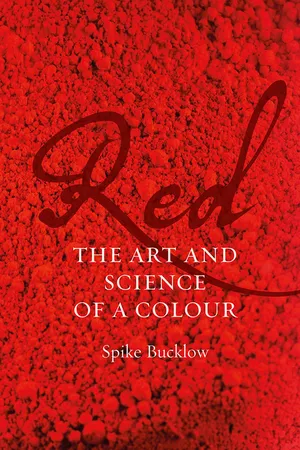
Red grabs your attention. Today we associate red with danger, sex, anger and more, yet the colour was once so significant that things which have a profound impact upon our lives were widely called red, even though they are often not red at all.
Spike Bucklow takes us from a 34,000-year-old shaman burial dress to the iPhone screen, exploring the myriad of purposes we have put red to as well as the materials from which it comes. The pursuit of the colour drove medieval alchemy and modern chemistry alike, and red has been found in insects, tree resins, tar, earths and excitable gases. It is associated with earth, blood and fire, with the holy, with national flags and powerful ideologies.
Red is a material and cultural history that makes one see this colour afresh, a crucial part of the human visual world.
- English
- ePUB (mobile friendly)
- Available on iOS & Android
eBook - ePub
About this book
Information
Topic
ArtSubtopic
Art GeneralREFERENCES
Introduction
1 Geoffrey of Monmouth, The History of the Kings of Britain [c. 1136] (V, vii, 3), trans. L. Thorpe (London, 1966), pp. 171–4. Red and white flowers are not mixed by some as, for them, the combination evokes the ‘blood and bandages’ of wartime.
2 J. W. von Goethe, Elective Affinities [1809], vol. II, chap. 2, trans. R. J. Hollingdale (Harmondsworth, 1978), p. 163.
3 Ibid., p. 164.
4 Ibid., vol. II, chap. 4, p. 180.
5 J. Blower, ‘Monuments and Memento Mori in Goethe’s Elective Affinities’, Future Anterior, VII/2 (2011), pp. 37–48.
6 B. Faure, The Red Thread: Buddhist Approaches to Sexuality (Princeton, NJ, 1998).
7 L. C. Jones, ‘The Evil Eye among European-Americans’, Western Folklore, X/1 (1951), p. 12.
8 Oxford English Dictionary, online version, www.oed.co.uk (2014).
9 A. Conan Doyle, ‘A Study in Scarlet’, in The Stories of Sherlock Holmes (London, 1904), vol. I, p. 45.
10 C. Ginzburg, ‘Morelli, Freud and Sherlock Holmes: Clues and the Scientific Method’, History Workshop, IX (1980), p. 12. Sigmund Freud also knew of Goethe’s red thread and referred to it in his book Jokes and their Relation to the Unconscious (Redditch, 2013). See C. Ginzburg, ‘Family Resemblances and Family Trees: Two Cognitive Metaphors’, Critical Inquiry, XXX/3 (2004), p. 539.
11 P. Bayard, Sherlock Holmes Was Wrong, trans. C. Mandell (New York, 2008), pp. 30–53.
12 Ludwig Wittgenstein, Remarks on Colour, ed. G.E.M. Anscombe, trans. L. L. McAlister and M. Schättle (Berkeley, CA, 1979), p. 16e.
13 Matthew 27:28, Luke 23:11, Mark 15:17 and John 19:2.
14 M. Bimson, ‘Cosmetic Pigments from the “Royal Cemetery” at Ur’, Iraq, XLII/1 (1980), pp. 75–7; A. Lucas, ‘Cosmetics, Perfumes and Incense in Ancient Egypt’, Journal of Egyptian Archaeology, XVI (1930), pp. 41–53.
15 Ovid, Rem. Am. 351, in K. Olson, ‘Cosmetics in Roman Antiquity: Substance, Remedy, Poison’, The Classical World, CII/3 (2009), p. 296.
16 Olson, ‘Cosmetics’, pp. 291–310.
17 Pliny the Elder, Natural History, Book XXVIII, chap. 28, trans. H. Rackham (London, 1968), vol. VIII, p. 77.
18 H. D. Betz, The Greek Magical Papyri in Translation, Including the Demotic Spells (Chicago, IL, 1996), pp. 167–9.
19 Herodotus, The Histories, trans. R. Waterfield (Oxford, 1998), vol. II, p. 99.
20 F. Gunn, The Artificial Face: A History of Cosmetics (Newton Abbot, 1973), pp. 53–69.
21 F. E. Dolan, ‘Taking the Pencil out of God’s Hand: Art, Nature and the Face-painting Debate in Early-modern England’, PMLA, CVIII/2 (1993), pp. 224–39.
22 G. P. Lomazzo, A Tracte Containing the Artes of Curious Paintinge, Caruinge and Buildinge [1598], trans. R. Haydocke (Farnborough, 1970), p. 127.
23 L. S. Marcus, J. Mueller and M. B. Rose, eds, Elizabeth I: Collected Works, 1533–1603 (Chicago, IL, 2000), letter of 15 May 1549, p. 35.
24 A similar problem afflicted some portraits by Sir Joshua Reynolds two centuries later.
25 N. Williams, Powder and Paint (London, 1957), p. 17.
26 Melissa Hyde, ‘The “Makeup” of the Marquise: Boucher’s Portrait of Pompadour at her Toilette’, Art Bulletin, LXXXII/3 (2000), pp. 453–75.
27 C. Palmer, ‘Brazen Cheek: Face-painters in Late Eighteenth-century England’, Oxford Art Journal, XXXI/2 (2008), pp. 197–213.
28 In a similar reaction against French formal gardens, the English adopted Lancelot ‘Capability’ Brown and Humphry Repton’s contrived, but apparently natural, style of landscaping.
29 Williams, Powder and Paint, p. 98.
30 In fact, London’s air had been choking and sulphurous for some centuries and Elizabeth I refused to enter London in 1598 because of the stench of burning sea coal. See Calendar of State Papers, Domestic Series, of the Reigns of Edward VI, Mary, Elizabeth, 1547–1580, ed. R. Lemon (London, 1856), p. 612.
31 London Journal Fashions, no. 98, p. 11, cited in Williams, Powder and Paint, p. 106.
32 Williams, Powder and Paint, pp. 107–33.
33 Anon., ‘Cosmetics Not to be Rationed, Regardless of War Emergency’, Science News Letters, XXXIX/17 (1941), p. 271.
ONE Animal Reds
1 R. Fletcher, ‘Myths of the Robin Redbreast in Early English Poetry’, American Anthropologist, II/2 (1889), pp. 97–118.
2 P. de Bolla, Art Matters (Cambridge, MA, 2001), p. 2.
3 A. Chrisafis, ‘Head Two’, The Guardian, 4 July 2002, p. 1. (The head in question was from Marc Quinn’s first cast and the newspaper’s frontpage headline referred to an adjacent article on the decapitation of Margaret Thatcher’s statue, appropriately entitled ‘Head One’.)
4 V. Mazel et al., ‘Identification of Ritual Blood in African Artefacts’, Analytical Chemistry, LXXIX/24 (2007), pp. 9253–60; D. Fraser et al., ‘Characterisation of Blood in an Encrustation of an African Mask’, Analyst, 138 (2013), pp. 4470–74.
5 R. Chenciner, Madder Red: A History of Luxury and Trade (Richmond, 2000), pp. 181, 193.
6 R. de Clari, La Conquête de Constantinople, ed. P. Lauer (Paris, 1924), p. 117, cited in S. Kinoshita, ‘Animals and the Medieval Culture of Empire’, in Animal, Vegetable and Mi...
Table of contents
- Front Cover
- Half Title
- Title Page
- Copyright
- Contents
- Introduction
- ONE Animal Reds
- TWO Eastern Trees
- THREE Fruits of the Earth
- FOUR Mysterious Reds
- FIVE Reds for a Better Life
- SIX Brave New Reds
- SEVEN Crossing the Red Line
- EIGHT Red Meanings
- NINE Red Earth
- TEN Red Blood
- ELEVEN Red Fire
- TWELVE Red Passions
- REFERENCES
- BIBLIOGRAPHY
- ACKNOWLEDGEMENTS
- PHOTO ACKNOWLEDGEMENTS
- INDEX
Trusted by 375,005 students
Access to over 1.5 million titles for a fair monthly price.
Study more efficiently using our study tools.
Frequently asked questions
Yes, you can cancel anytime from the Subscription tab in your account settings on the Perlego website. Your subscription will stay active until the end of your current billing period. Learn how to cancel your subscription
No, books cannot be downloaded as external files, such as PDFs, for use outside of Perlego. However, you can download books within the Perlego app for offline reading on mobile or tablet. Learn how to download books offline
Perlego offers two plans: Essential and Complete
- Essential is ideal for learners and professionals who enjoy exploring a wide range of subjects. Access the Essential Library with 800,000+ trusted titles and best-sellers across business, personal growth, and the humanities. Includes unlimited reading time and Standard Read Aloud voice.
- Complete: Perfect for advanced learners and researchers needing full, unrestricted access. Unlock 1.5M+ books across hundreds of subjects, including academic and specialized titles. The Complete Plan also includes advanced features like Premium Read Aloud and Research Assistant.
We are an online textbook subscription service, where you can get access to an entire online library for less than the price of a single book per month. With over 1.5 million books across 990+ topics, we’ve got you covered! Learn about our mission
Look out for the read-aloud symbol on your next book to see if you can listen to it. The read-aloud tool reads text aloud for you, highlighting the text as it is being read. You can pause it, speed it up and slow it down. Learn more about Read Aloud
Yes! You can use the Perlego app on both iOS and Android devices to read anytime, anywhere — even offline. Perfect for commutes or when you’re on the go.
Please note we cannot support devices running on iOS 13 and Android 7 or earlier. Learn more about using the app
Please note we cannot support devices running on iOS 13 and Android 7 or earlier. Learn more about using the app
Yes, you can access Red by Spike Bucklow in PDF and/or ePUB format, as well as other popular books in Art & Art General. We have over 1.5 million books available in our catalogue for you to explore.