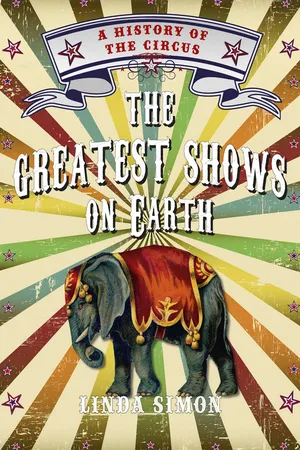
Now available in paperback, The Greatest Shows on Earth takes us from eighteenth-century hippodromes in Britain to intimate one-ring circuses in nineteenth-century Paris, where Toulouse-Lautrec and Picasso became enchanted by aerialists and clowns. We meet P. T. Barnum, James Bailey and the enterprising Ringling Brothers, who created the golden age of American circuses. We explore contemporary transformations of the circus, from the whimsical Circus Oz in Australia to New York City's Big Apple Circus. Circus people are central to the story: trick riders and tightrope walkers, sword swallowers and animal trainers, contortionists and clowns – these are the men and women who create the sensational, raucous, titillating and incomparable world of the circus.
Beautifully illustrated, rich in historical detail and full of colourful anecdotes, Linda Simon's vibrant history is as enchanting as a night at the big-top itself.
- English
- ePUB (mobile friendly)
- Available on iOS & Android
eBook - ePub
About this book
Information
Topic
HistoireSubtopic
Histoire socialeREFERENCES
INTRODUCTION
1 Hermine Demoriane, The Tightrope Walker (London, 1989), pp. 25–6.
2 Nathaniel Hawthorne, 4 September 1838, Passages from the American Note-books (Boston, MA, 1891), p. 192.
3 John Evelyn, quoted in Kenneth Richards and Laura Richards, The Commèdia dell’Arte (Oxford, 1990), p. 23.
4 E. E. Cummings, ‘The Adult, the Artist and the Circus’, E. E. Cummings: A Miscellany (New York, 1958), p. 47.
5 George Speaight, A History of the Circus (London, 1980), p. 161.
6 George Van Hare, Fifty Years of a Showman’s Life (London, 1888), p. 59.
7 Naomi Ritter, Art as Spectacle: Images of the Entertainer since Romanticism (Columbia, MO, 1989), pp. 3–4.
8 Ibid., p. 2.
9 Joanne Joys, The Wild Animal Trainer in America (Boulder, CO, 1983), p. 265.
10 Josephine DeMott Robinson, The Circus Lady (New York, 1980), pp. 2–3.
11 Kenneth Little, ‘Talking Circus, not Culture: The Politics of Identity in European Circus Discourse’, Qualitative Inquiry, 1/3 (September 1995), p. 358, n. 3.
12 William Dean Howells, A Boy’s Town (New York, 1890), p. 95.
13 The Knickerbocker, XIII/1 (January 1839), quoted in Matthew Wittmann, Circus and the City: New York, 1793–2010 (New Haven, CT, 2012), p. 188.
14 Joys, The Wild Animal Trainer, p. 227.
15 E. B. White, ‘The Ring of Time’, Points of My Compass (New York, 1954), pp. 51–5.
16 Quoted in Ritter, Art as Spectacle, p. 314.
17 Edward Hoagland, ‘Circus Music’, Sex and the River Styx (White River Junction, VT, 2011), p. 84.
18 Ibid., p. 87.
19 American Sunday School Union, The Circus (Philadelphia, PA, 1846), pp. 11, 12.
20 American Sunday School Union, Slim Jack (Philadelphia, PA, 1847).
21 C. David Heymann, A Woman Named Jackie (New York, 1989), p. 30.
22 Robinson, The Circus Lady, p. 1.
ONE
TRICK RIDERS
TRICK RIDERS
1 Charles Montague, Recollections of an Equestrian Manager (London, 1881), p. 99.
2 H. Barton Baker, ‘Philip Astley’, Belgravia (June 1879), p. 473.
3 Handbill, London, 1786. Eighteenth Century Collections Online, Gale Research, document no. CW3305300803, www.gdc.gale.com.
4 Charles Dickens, ‘Philip Astley’, All the Year Round (27 January 1872), p. 206.
5 Ibid., p. 207.
6 ‘Dead Circuses and Vanished Playhouses’, Saturday Review (15 July 1893), p. 67.
7 Dickens, ‘Philip Astley’, p. 210.
8 Quoted in James S. Moy, ‘Entertainments at John B. Ricketts’s Circus, 1793–1800’, Educational Theatre Journal, XXX/2 (May 1978), p. 188.
9 Marius Kwint, ‘The Legitimization of the Circus in Late Georgian England’, Past and Present, 174 (2002), pp. 86, 88.
10 Ruth Manning-Sanders, The English Circus (London, 1952), p. 49.
11 New York Daily Times (16 May 1853), p. 4.
12 Nicola A. Haxell, ‘“Ces Dames du Cirque”: A Taxonomy of Male Desire in Nineteenth-century French Literature and Art’, Modern Language Notes, XXV/4 (2000), p. 795.
13 Shauna Vey, ‘The Master and the Mademoiselle’, Theatre History Studies, XXVII (2007), pp. 39–59.
14 Thomas Frost, Circus Life and Circus Celebrities (London, 1881), p. 126.
15 Marsden Hartley, Adventures in the Arts (New York, 1921), pp. 177–9.
16 Nellie Revell, Spangles (New York, 1926).
17 Baker, ‘Philip Astley’, p. 471.
TWO
CIRQUES INTIMES
CIRQUES INTIMES
1 Anne Roquebert, ‘Last Work’, in Toulouse Lautrec, ed. Richard Thomson et al. (New Haven, CT, 1991), p. 486.
2 Julia Frey, Toulouse-Lautrec: A Life (New York, 1994), p. 471.
3 Quoted in Corinne Bellow, ed., Lautrec by Lautrec (New York, 1964), p. 205.
4 Henry Miller, The Smile at the Foot of the Ladder [1948] (New York, 1959), p. 48.
5 Phillip Dennis Cate, ‘The Cult of the Circus’, in Pleasures of Paris...
Table of contents
- Front Cover
- Half Title
- Title Page
- Copyright
- CONTENTS
- INTRODUCTION
- ONE TRICK RIDERS
- TWO CIRQUES INTIMES
- THREE THE BIGGEST TENTS
- FOUR CAVALCADES
- FIVE WITHOUT A NET
- SIX BEASTS
- SEVEN CLOWNS
- EIGHT FEATS
- NINE PRODIGIES
- TEN TRANSFORMATIONS
- REFERENCES
- SELECT BIBLIOGRAPHY
- ACKNOWLEDGEMENTS
- PHOTO ACKNOWLEDGEMENTS
- INDEX
Trusted by 375,005 students
Access to over 1.5 million titles for a fair monthly price.
Study more efficiently using our study tools.
Frequently asked questions
Yes, you can cancel anytime from the Subscription tab in your account settings on the Perlego website. Your subscription will stay active until the end of your current billing period. Learn how to cancel your subscription
No, books cannot be downloaded as external files, such as PDFs, for use outside of Perlego. However, you can download books within the Perlego app for offline reading on mobile or tablet. Learn how to download books offline
Perlego offers two plans: Essential and Complete
- Essential is ideal for learners and professionals who enjoy exploring a wide range of subjects. Access the Essential Library with 800,000+ trusted titles and best-sellers across business, personal growth, and the humanities. Includes unlimited reading time and Standard Read Aloud voice.
- Complete: Perfect for advanced learners and researchers needing full, unrestricted access. Unlock 1.5M+ books across hundreds of subjects, including academic and specialized titles. The Complete Plan also includes advanced features like Premium Read Aloud and Research Assistant.
We are an online textbook subscription service, where you can get access to an entire online library for less than the price of a single book per month. With over 1.5 million books across 990+ topics, we’ve got you covered! Learn about our mission
Look out for the read-aloud symbol on your next book to see if you can listen to it. The read-aloud tool reads text aloud for you, highlighting the text as it is being read. You can pause it, speed it up and slow it down. Learn more about Read Aloud
Yes! You can use the Perlego app on both iOS and Android devices to read anytime, anywhere — even offline. Perfect for commutes or when you’re on the go.
Please note we cannot support devices running on iOS 13 and Android 7 or earlier. Learn more about using the app
Please note we cannot support devices running on iOS 13 and Android 7 or earlier. Learn more about using the app
Yes, you can access The Greatest Shows on Earth by Linda Simon,Simon, Linda in PDF and/or ePUB format, as well as other popular books in Histoire & Histoire sociale. We have over 1.5 million books available in our catalogue for you to explore.