America needs better options for resolving potential crisesIn recent years, the Pentagon has elevated its concerns about Russia and China as potential military threats to the United States and its allies. But what issues could provoke actual conflict between the United States and either country? And how could such a conflict be contained before it took the world to the brink of thermonuclear catastrophe, as was feared during the cold war?
Defense expert Michael O'Hanlon wrestles with these questions in this insightful book, setting them within the broader context of hegemonic change and today's version of great-power competition.
The book examines how a local crisis could escalate into a broader and much more dangerous threat to peace. What if, for example, Russia's "little green men" seized control of a community, like Narva or an even smaller town in Estonia, now a NATO ally? Or, what if China seized one of the uninhabited Senkaku islands now claimed and administered by Japan, or imposed a partial blockade of Taiwan?
Such threats are not necessarily imminent, but they are far from inconceivable. Washington could be forced to choose, in these and similar cases, between risking major war to reverse the aggression, and appeasing China or Russia in ways that could jeopardize the broader global order.
O'Hanlon argues that the United States needs a better range of options for dealing with such risks to peace. He advocates "integrated deterrence," which combines military elements with economic warfare. The military components would feature strengthened forward defenses as well as, possibly, limited military options against Russian or Chinese assets in other theaters. Economic warfare would include offensive elements, notably sanctions, as well as measures to ensure the resilience of the United States and allies against possible enemy reprisal.
The goal is to deter war through a credible set of responses that are more commensurate than existing policy with the stakes involved in such scenarios.
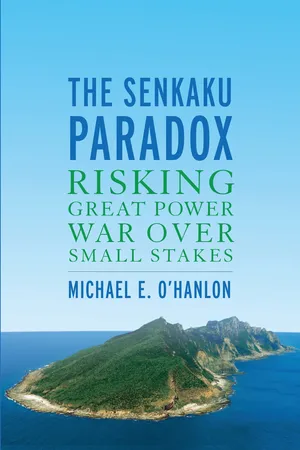
- 280 pages
- English
- ePUB (mobile friendly)
- Available on iOS & Android
eBook - ePub
About this book
Information
APPENDIX 1
The So-Called Revolution in Military Affairs, 2000–20
THIS APPENDIX SEEKS TO ESTABLISH a benchmark and both reaffirm and refine a method for forecasting future change in military-related technologies by first examining what has transpired in roughly the first two decades of the twenty-first century. Taking this approach helps improve and validate the methodology that is employed in the text’s main chapters to see ahead into the 2020s and 2030s when assessing trends in warfare—and thus to evaluate national security options for the United States.
The appendix’s category-by-category examination of military technology mirrors that employed in a book I published in 2000, Technological Change and the Future of Warfare (though it really should have been titled The So-Called Revolution in Military Affairs, because I was largely challenging the then popular notion that a military revolution of historic importance was afoot). Much of the research foundation of that book was an examination of twenty-nine different technologies in an attempt to gauge which might undergo revolutionary change by 2020. Drawing on basic concepts of physics, scrutiny of the scientific and engineering literature on various types of technological research, and consultation with experts, including personnel at several of the nation’s major weapons laboratories, I concluded that only two of the twenty-nine technologies were likely to undergo truly revolutionary change. Those two were computer hardware and computer software. I predicted that technologies in another eight categories—chemical sensors, biological sensors, radio communications, laser communications, robotics, radiofrequency weapons, nonlethal weapons, and biological weapons—would likely witness a high degree of change. The remaining nineteen categories of key military technologies, many of them sensor technologies or major components of weapons platforms such as ground combat vehicles, aircraft, ships, and rockets, seemed likely to advance at only modest or moderate rates (table A1-1).1
To establish a baseline for predicting future change, I first revisit the taxonomy from the 2000 book, attempting to “grade my own homework,” as the original 2000–20 period of forecasted change is now nearly over. With that as a baseline, in appendix 2 I attempt to peer ahead from 2020 to 2040, in effect repeating the exercise with a method that has been time-tested and also improved, in response to those areas of technological change where my predictions were less accurate. As with the 2000 book, my assessments employ the same three gradations of anticipated technological innovation—revolutionary, high, and modest/moderate.
In very broad outline, the findings of this appendix are as follows. First, the relatively cautious assessment that I offered in the earlier book of where technological innovation would likely take us from 2000 through 2020 has been generally borne out. There has been a great deal of innovation since 2000, but most of it could not be described as revolutionary. That was the central argument of the 2000 book, and it appears to have been validated by events of the ensuing years.
Several key categories of military technology are illustrative in this respect. The age of space, stealth, and precision strike had already arrived by 2000; progress has surely continued since then, yet it has been progress mostly of degree rather than of kind. And tasks that were difficult at the turn of the twenty-first century, even for very advanced militaries, remain generally difficult today, including missile defense, most dimensions of antisubmarine warfare (ASW), and most aspects of infantry combat.
Some things have changed a great deal. The use of remotely piloted aerial vehicles, armed and unarmed, for example, has increased greatly and the tools have been fine-tuned. Other types of robotics have also improved greatly, and miniaturized satellites have become much more widespread. But what is generally striking is that these developments have occurred in niche areas of military operations (though important, they are niche areas just the same) and have generally not displaced the other kinds of systems that preceded them. By such standards, innovation might be better viewed as evolutionary rather than revolutionary.
TABLE A1-1 Projected Advances in Key Deployable Technologies, 2000–2020
| Moderate | High | Revolutionary | |
| Sensors | |||
| Chemical sensors | X | ||
| Biological sensors | X | ||
| Optical, infrared, and UV sensors | X | ||
| Radar and radio sensors | X | ||
| Sound, sonar, and motion sensors | X | ||
| Magnetic detection | X | ||
| Particle beams (as sensors) | X | ||
| Computers and communications | |||
| Computer hardware | X | ||
| Computer software | X | ||
| Radio communications | X | ||
| Laser communications | X | ||
| Projectiles, propulsion, and platforms | |||
| Robotics | X | ||
| Missiles | X | ||
| Explosives | X | ||
| Fuels | X | ||
| Jet engines | X | ||
| Internal combustion engines | X | ||
| Rockets | X | ||
| Ships | X | ||
| Armor | X | ||
| Stealth | X | ||
| Other weapons | |||
| Radiofrequency weapons | X | ||
| Nonlethal weapons | X | ||
| Biological weapons | X | ||
| Other weapons of mass destruction | X | ||
| Particle beams (as weapons) | X | ||
| Electric guns | X | ||
| Lasers | X | ||
| Long-range kinetic energy weapons | X |
Source: Michael O’Hanlon, Technological Change and the Future of Warfare (Brookings, 2000).
Note: The terms moderate, high, and revolutionary are subjective and somewhat imprecise. In general terms, technologies showing moderate advances might improve their performance by a few percent or at most a couple of tens of percent in terms of speed, range, lethality, or other defining characteristics between 2000 and 2020. Those in the “high” category will be able to accomplish tasks on the battlefield far better than before, perhaps 50 to 100 percent better, to the extent improved performance can be so quantified. Finally, technology categories in which revolutionary advances occur will be able to accomplish important battlefield tasks that they cannot now even attempt.
To the extent my earlier approach produced inaccurate results, it was in the two areas of robotics and cybersecurity. The robotics revolution of the last twenty years has la...
Table of contents
- Cover
- Title Page
- Copyright
- Dedication
- Contents
- Acknowledgments
- Map of Europe
- Map of the Indian Ocean Basin
- Map of the Western Pacific
- One. Introduction
- Two. Plausible Scenarios
- Three. China and Russia Scenarios in 2040
- Four. Military Elements of Integrated Deterrence
- Five. Integrating Economics into War Plans
- Six. Conclusion and Recommendations
- Appendix 1. The So-Called Revolution in Military Affairs, 2000–20
- Appendix 2. Forecasting Change in Military Technology, 2020–40
- Notes
- Index
Trusted by 375,005 students
Access to over 1.5 million titles for a fair monthly price.
Study more efficiently using our study tools.
Frequently asked questions
Yes, you can cancel anytime from the Subscription tab in your account settings on the Perlego website. Your subscription will stay active until the end of your current billing period. Learn how to cancel your subscription
No, books cannot be downloaded as external files, such as PDFs, for use outside of Perlego. However, you can download books within the Perlego app for offline reading on mobile or tablet. Learn how to download books offline
Perlego offers two plans: Essential and Complete
- Essential is ideal for learners and professionals who enjoy exploring a wide range of subjects. Access the Essential Library with 800,000+ trusted titles and best-sellers across business, personal growth, and the humanities. Includes unlimited reading time and Standard Read Aloud voice.
- Complete: Perfect for advanced learners and researchers needing full, unrestricted access. Unlock 1.5M+ books across hundreds of subjects, including academic and specialized titles. The Complete Plan also includes advanced features like Premium Read Aloud and Research Assistant.
We are an online textbook subscription service, where you can get access to an entire online library for less than the price of a single book per month. With over 1.5 million books across 990+ topics, we’ve got you covered! Learn about our mission
Look out for the read-aloud symbol on your next book to see if you can listen to it. The read-aloud tool reads text aloud for you, highlighting the text as it is being read. You can pause it, speed it up and slow it down. Learn more about Read Aloud
Yes! You can use the Perlego app on both iOS and Android devices to read anytime, anywhere — even offline. Perfect for commutes or when you’re on the go.
Please note we cannot support devices running on iOS 13 and Android 7 or earlier. Learn more about using the app
Please note we cannot support devices running on iOS 13 and Android 7 or earlier. Learn more about using the app
Yes, you can access The Senkaku Paradox by Michael E. O'Hanlon in PDF and/or ePUB format, as well as other popular books in Politica e relazioni internazionali & Politica asiatica. We have over 1.5 million books available in our catalogue for you to explore.