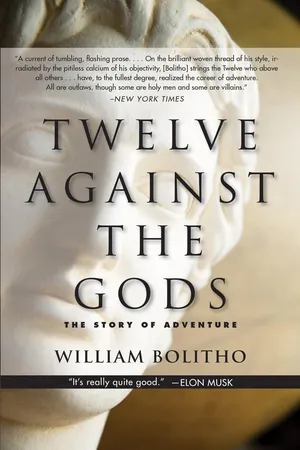
An instant bestseller when first published in 1929—biographies of twelve bold individuals from history and what they did to separate themselves from the pack.
In his trademark journalist style, author William Bolitho details the lives of twelve great adventurers—Alexander the Great, Casanova, Christopher Columbus, Mahomet, Lola Montez, Cagliostro (and Seraphina), Charles XII of Sweden, Napoleon I, Lucius Sergius Catiline, Napoleon III, Isadora Duncan, and Woodrow Wilson. Bolitho elucidates both the struggles and successes that made these figures so iconic, and demonstrates how they all battled convention and conformity to achieve enduring fame and notoriety.
"We are born adventurers," Bolitho writes, "and the love of adventures never leaves us till we are very old; old, timid men, in whose interest it is that adventure should quite die out. This is why all the poets are on one side, and all the laws on the other; for laws are made by, and usually for, old men." Though his essays are nearly one hundred years old, they encompass the timeless values of perseverance, bravery, and strength of spirit that have proven to resonate with the pioneers and thought leaders of today.
"It's really quite good." —Elon Musk
"
Twelve Against the Gods provides an interesting perspective on what drove and impeded this group of adventurers . . . A good read for anyone who's interested in history or looking to find some motivation to switch things up and break the rules." —Áine Cain,
Business Insider
"I think
Twelve Against the Gods is also very appropriate for this day and age. We need adventurers, and there still are a lot of adventurers." —China Ryall, daughter of William Bolitho
- 344 pages
- English
- ePUB (mobile friendly)
- Available on iOS & Android
eBook - ePub
About this book
Information
IV.
Mahomet
Geography, as Columbus has explained, is Adventure’s rich game preserve, where any muff with a gun may hope for sport in the season. But in her less accessible domains, the deserts and forests of the spirit, there are the tracks of big game for the boldest hunters. The religious adventurer does not often fill his bag. But he has camped out with Mystery. He deserves listeners even if he never won disciples. The greatest of them have been further than Columbus, further than Sir John de Mandeville, or Lemuel Gulliver; they have made the grand Dante circuit of Heaven and Hell. They have lived on this little earth like an island, and made up their night fires to scare away the noises of the interstellar dark. There was one of these, who, throughout his supernatural expedition, kept quite sane, and even a little stupid, which is the quality of robust sanity, so that his whole route and what happened to him is clear and dramatic.
This was the celebrated Mahomet, who sealed his letters to the emperors of the world: “Mahomet, Apostle of God.” He was at the beginning a poor relation of a powerful family, who lived in the decaying caravan town of Mecca, on the highroad through the suburbs of the Old World, Arabia. The modern literary Arabia is a paradise of passion, liberty, and dates, but in the year of Mahomet’s birth, A.D. 570, the situation was less enticing. It seemed that after a remarkable historical burst, the destiny of the Semite people who inhabited it was ended, and that the whole race, in its varieties of Jew, Babylonian, and Ishmaelite, or Arab, was doomed to the vegetative obscurity of mere Bedawinism, from which only its strategic geography, on the intersection of the great land routes between Europe, Asia and Africa, and remarkable talents for ecstatic poetry had for many brilliant centuries lifted it. All that remained of the magnificence of Babylon was a horde of bandits, the Al Hira, who gave a sort of blackleg service to the power of Persia. In the Syrian north, they served Byzantium and a large variety of Christian trinities. The Jews after their ferocious and horrible resistance to the conquest of Titus had partly trekked to the south, in compact, sullen tribes, or embarked for their vast European adventure. There were small strong kingdoms of them round all the major oases of the desert as far as the Yemen, the Happy Arabia of the ancients, where everything the luxury of Europe desired grew in abundance. They were especially numerous along the great road that flanked the impassable steppe of the interior along between the mountains and the Red Sea. The rest of the inhabitants, the Arabs proper, had in those days no prestige; part of them lived at the depots and halts of the route, and engaged (as we shall see) partly in lodging, feeding and robbing the travellers, who passed; partly in the diminishing transport industry, by convoying the caravans between Damascus and Aden. The rest, when they had the chance, shared in this work or starved in their tents, or when their inveterate inter-tribal wars permitted, formed bands and held up the highroads. Arabia therefore, as a whole, as far as it concerns us—that is, excluding the fertile Yemen—lived on the transcontinental road traffic. But this was steadily degenerating, ever since a cool and thoughtful Ptolemy, Greek Pharaoh of Egypt, tired of the robbery and murder of his merchants, invented a sea-service to Abyssinia and India, which was gradually throttling its expensive rival, the Arab land route. So, in the time of Mahomet the rich caravan cities of the north were fallen into abandonment and ruin; Petra, Jerash, and Philadelphia. Medina and Mecca, the latter the half-way house between Arabia Felix and Arabia Petraea, the “Lucky Arabia” of the south, and the “Stony Arabia” of the north, still struggled for a living. This Mecca was a town of some thousands of citizens, situated in a critical pass of the mountain wall by which Arabia abuts on the Red Sea. The whole region is salt and barren; even the date palm, the only plant that can endure both freezing and scorching, will not grow there. After all these years that the riches of three continents have poured ceaselessly into this wretched place, there are no gardens, and a stunted bush is a civic pride. The component reasons for the existence of Mecca were: first, the trade road—the “incense route”; a well of tepid water—the holy Zem-Zem; a fair for camel-leather and slaves; and the Ka’ba. No one can see which was first. Immemorially, a meteor fell in this valley. It is a reddish-black stone, semi-circular, six inches high, eight broad, today polished with myriads of kisses; but still showing on its surface the molten wrinkles which appeared to its first worshippers a name and a message in the unknown script of the gods of the sky who threw it down. Perhaps before Alexander, or even Rameses, this Black Stone had been found and reverently built into the corner of a cubic temple, the Ka’ba or Cube, and those who came to the fair worshipped it, or its worshippers held a fair—which first no one can say. Such sacred stones were not rare in Arabia, but the Black Stone had a certain preeminence. Connoisseurs in idolatry made long journeys to see it.
This Cube is the centre of Mahomet’s adventure. Naturally, since no Arab can make a right angle, it was then and is today in its reconstruction, crooked, on the splay; about forty feet high, long and broad, with a door that has always been a tall man’s height above the ground, and only to be reached with a ladder—perhaps because of the floods which are an annual plague of the place. In Mahomet’s time this Ka’ba was furnished inside with images; the biggest was the idol Hobal who stood on a pit where the treasures of the cult were stored. Another idol, or more probably another name for this Hobal, was Al-Lat, or Al-Lah.
A few cubits from this Cube was the well Zem-Zem. Its water is brackish and luke-warm. Mahomet’s grandfather, Abd al-Muttalib, rediscovered it and found in it two golden gazelles and several complete suits of armour that had been buried there by the antique dynasty of Jurhum, who had walled all up in a defeat hundreds of years before. This Abd al-Muttalib was the head of his clan, and an important personage in the whole Koreish, the tribe who mainly owned and held the town. Eight years before his death the affairs of Mecca went through a catastrophe. The black King of Abyssinia, then as now a Christian, was incited by the Emperor of Byzantium, his co-religionist, to avenge some persecution of missionaries (probably by a Jewish tribe) and sent an expedition, in which was a war-elephant, to destroy Hobal, Al-Lat the Cube, the Black Stone and Mecca. In the passes of the mountains an epidemic of small-pox came on his army, who turned back. This is the War of the Elephant, an essential element of the Mahometan legend, and resulted in an increase of the reputation of the old shrine, with a spurt in the declining fortunes of the tourist industry of the town. Abd al-Muttalib as the discoverer of Zem-Zem shared largely in these, for he and his family enjoyed the revenue of the supply of holy water, and also it appears of some sort of monopoly of the catering to the pilgrims.
In these circumstances Mahomet was born. His father Abdullah died while he was in arms, leaving no fortune; but Abd al-Muttalib spared enough from the budget of his huge family to put the baby out to wet nurse among a friendly tribe of Bedawin in the vicinity. The legends about his boyhood are neither credible nor interesting. He looked after the goats, and from time to time had some sort of epileptic fits. When he was old enough he returned to Mecca. His mother was dead; his grandfather Abd al-Muttalib soon followed, confiding young Mahomet to the care of two uncles, one poor and noble, Abu-Talib; one rich and dull, Al-Abbas. The former took the youngster with him in a caravan to Damascus, which journey no doubt had an educative influence but ended in financial loss.
These men of Mecca had no developed form of government. The richest or most ferocious among them no doubt had some sort of personal precedence in the civic debates, in which all the tribesmen had a right to be present. They were still regulated by that curious and archaic institution of the vendetta, without some insight into which Mahomet’s ascendant career will be difficult to understand. In our own days, its survival among the Italians, the Corsicans, and other backward races seems the very definition of civil disorder; but in its youth it is, on the contrary, an embryonic policy, without which, in the absence of any other system of order, life among peoples with the temperaments of Arabs or Anglo-Saxons (for we too seem to have begun with it) would be impossible even for professional bandits. The substitution of the term of “corporate revenge” perhaps makes this easier to see. Mecca was occupied by two tribes, the Khozaa, and the Koreish. Mahomet was a Koreishite. Each of these tribes was in turn made up of families or clans; the most important in Koreish were the Hashimites and the Omeiyads, closely related and impassably separated by blood and history. Mahomet was a Hashimite; his grandfather the holy caterer, Abd al-Muttalib, had been its head. Every native of the town was a member of one of these factious families or owned by one of them as a slave; in every individual’s misdeeds or wrongs his family were implicated by tradition, custom, and that strongest of all motives for a fight, self-respect, or vanity. Thus there were two checks on murderous and thievish instincts; one the positive fear of skin-vengeance “to the third and fourth generation,” the other the restraint often itself violent of his fellow clansmen against any act that would be revenged on them indiscriminately, as well as on its doer.
Social life in Old Mecca therefore might be likened to that of the boot-legging world of Chicago; characters, tastes, and occupations have a certain impudent resemblance; but the Meccan experience was wider and bitterer, very likely, so that life there stepped cautiously, and even politeness was not unknown. But underneath this pleasing resultant of countless feuds, the old inviolability of vendetta remained; no reason could hold off its assistance to a clan member if he was attacked, and Mahomet in the years of his unpopularity had his clan behind him, unbelievers though most of them were.
On top of this law of disorder hard times had laid the beginnings of another peace. After all, the Meccans lived more and more on pilgrims as the caravan traffic declined, and even an Arab idolator hated to find himself disturbed in his prayers at the Ka’ba by some murderous riot that marked another stage in a local quarrel in which he was not concerned. Donnybrook never attracted a good class of tourists. After centuries of discussion the Meccans under the leadership of the Koreish had agreed and advertised that for four months in the year there should be a sacred peace in the town and its suburbs, during which no weapon might be carried; a moratorium of vendetta. These holy months were at first timed to coincide with the fair, that is, autumn when the date crop was in and food was cheap. But owing to the imperfection of the lunar calendar this coincidence gradually split, until to the baffled dismay of the Meccan people they saw the holy months each year falling later. In the time of Mahomet they fell in high summer, when even water was scarce.
The first public event in Mahomet’s life was a breach of this annual truce, known to Koranists as the “Sacrilegious War.” It fell in his twentieth year. A creditor of one of the Koreish took a monkey to the fair, seated himself in a prominent place and began shouting: “Who will give me such another ape and I will give him my claim on such a one?” naming his debtor one of the Koreish with his full pedigree and many picturesque and poetical comments. A Koreishite brave came up and lopped off the animal’s head; everyone rushed to arms or to safety and the row continued far into the night. That year the holy months were as busy as a Ghetto on a Sunday; there were even pitched battles, in one of which Mahomet took place. He refers to his share without much enthusiasm—he was never a fighting man. “I remember,” said the Prophet, “being present with my uncles in the Sacrilegious War. I discharged some arrows at the enemy and I do not regret it.” This affair undid most of the good that came from the advertisement of the Victory of the Elephant. Business was bad in Mecca for twenty years after.
Meanwhile young Mahomet went into store as a salesman of agricultural produce. His condition did not satisfy him. When he received an offer of marriage from a rich widow who had employed him in a caravan expedition as driver, he accepted eagerly. This was Khadija, daughter of Khuweilid. She was forty years old and had been twice married. Mahomet was twenty-five years old.
Though there was never any portrait of the Prophet, the minutest peculiarities of his appearance have been piously preserved by the faithful. He was a small man, but he caught the eye. Usually he was taciturn, and more and more subject to fits of abstraction, when he heard or saw nothing. But he could be agreeable, rather boisterous company. When he spoke he turned his whole body and not only his head; when he laughed, which was not seldom, he opened his huge mouth, like a crocodile, so that his gums and all his teeth were visible, and his eyes disappeared. These were piercing but blood-shot; he used to paint his eyelashes with kohl and antimony to make them appear more lustrous. He dyed his beard, some say red, some yellow, and was fond of loudly colored linen clothes, though he abhorred silk, which “was invented so that women could go naked in clothes.” He had a great shout; both his anger and his mirth were explosive. He had a curious gait, very important, as “if he was descending a steep and invisible hill.”
He now lived in a storied house, in the notable quarter, overlooking the central square, and the Ka’ba and the well Zem-Zem. The sudden change in his circumstances from a counter-hand to the leisured husband of a capitalist, which made his company tolerated in the groups of leaders when they discussed town affairs, first made him compare, and then think. Those who underestimate the almost infallible effects of such a change on a meditative mind, working like an enforced induction, may believe the story that a single curious event occurring at this time changed Mahomet—noun into Mahomet—verb. The old Ka’ba after a severe flood began to fall in ruins; the notables decided to risk the high-tension taboo on its substance and rebuild it. One Ab-Walid had the courage to be the first to touch the holy wall. He seized a pick-ax, gave one stroke, then fled. All retired from the place until next morning to see if anything happened to him. When they found he was still alive, the work proceeded. But at the end, when it came to the question of re-sealing the Black Stone, there was a bad dispute, all the clans claiming the honor for themselves. Finally they agreed to abide by the decision of the first man to appear in the square. This chanced to be Mahomet; he delivered his judgment very nicely. First he took off his mantle and spread it on the ground. On this he placed the stone, and kissed it. Then he asked a chief to come forward from each of the four chief clans, each to take a corner and lift it to the proper height. Mahomet himself guided it into place.1
However it happened, by the natural mechanism of circumstance or by some such faltering hazard, Mahomet began then to think about the town’s affairs; to worry about the decline of the pilgrimage and its causes; to hang on the groups of local leaders who discussed remedies in informal parliament on the stony street corners, or sheltered against the wind under the lee of the Ka’ba itself.
The start of Mahomet’s adventure, or in its more usual synonym, the basis of the Mahomedan religion, is this preoccupation of his with the fortunes of his native town. Squeamish pedantry may object to the triviality of the phrase which fits nevertheless with a precision no other can give: Mahomet was a “home-town booster,” and this conception will unlock the many obscurities of his life and his doctrine, which the most subtle theological speculations and the most careful minutiae of history are incapable of coping with. The door by which he enters is: “How can we attract the who...
Table of contents
- Twelve Against the Gods
- Copyright
- William Bolitho: A Memoir by Walter Lippmann
- Introduction
- I. Alexander the Great
- II. Casanova
- III. Christopher Columbus
- IV. Mahomet
- V. Lola Montez
- VI. Cagliostro (and Seraphina)
- VII. Charles XII of Sweden
- VIII. Napoleon I
- IX. Lucius Sergius Catiline
- X. Napoleon III
- XI. Isadora Duncan
- XII. Woodrow Wilson
- Connect with Diversion Books
Trusted by 375,005 students
Access to over 1.5 million titles for a fair monthly price.
Study more efficiently using our study tools.
Frequently asked questions
Yes, you can cancel anytime from the Subscription tab in your account settings on the Perlego website. Your subscription will stay active until the end of your current billing period. Learn how to cancel your subscription
No, books cannot be downloaded as external files, such as PDFs, for use outside of Perlego. However, you can download books within the Perlego app for offline reading on mobile or tablet. Learn how to download books offline
Perlego offers two plans: Essential and Complete
- Essential is ideal for learners and professionals who enjoy exploring a wide range of subjects. Access the Essential Library with 800,000+ trusted titles and best-sellers across business, personal growth, and the humanities. Includes unlimited reading time and Standard Read Aloud voice.
- Complete: Perfect for advanced learners and researchers needing full, unrestricted access. Unlock 1.5M+ books across hundreds of subjects, including academic and specialized titles. The Complete Plan also includes advanced features like Premium Read Aloud and Research Assistant.
We are an online textbook subscription service, where you can get access to an entire online library for less than the price of a single book per month. With over 1.5 million books across 990+ topics, we’ve got you covered! Learn about our mission
Look out for the read-aloud symbol on your next book to see if you can listen to it. The read-aloud tool reads text aloud for you, highlighting the text as it is being read. You can pause it, speed it up and slow it down. Learn more about Read Aloud
Yes! You can use the Perlego app on both iOS and Android devices to read anytime, anywhere — even offline. Perfect for commutes or when you’re on the go.
Please note we cannot support devices running on iOS 13 and Android 7 or earlier. Learn more about using the app
Please note we cannot support devices running on iOS 13 and Android 7 or earlier. Learn more about using the app
Yes, you can access Twelve Against the Gods by William Bolitho in PDF and/or ePUB format, as well as other popular books in History & Historical Biographies. We have over 1.5 million books available in our catalogue for you to explore.