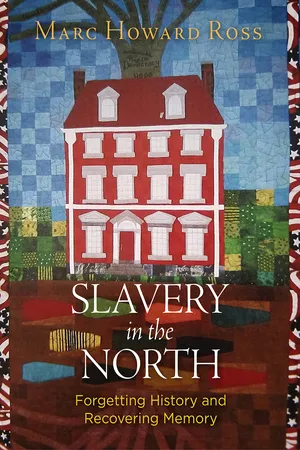
In 2002, we learned that President George Washington had eight (and, later, nine) enslaved Africans in his house while he lived in Philadelphia from 1790 to 1797. The house was only one block from Independence Hall and, though torn down in 1832, it housed the enslaved men and women Washington brought to the city as well as serving as the country's first executive office building. Intense controversy erupted over what this newly resurfaced evidence of enslaved people in Philadelphia meant for the site that was next door to the new home for the Liberty Bell. How could slavery best be remembered and memorialized in the birthplace of American freedom? For Marc Howard Ross, this conflict raised a related and troubling question: why and how did slavery in the North fade from public consciousness to such a degree that most Americans have perceived it entirely as a "Southern problem"?
Although slavery was institutionalized throughout the Northern as well as the Southern colonies and early states, the existence of slavery in the North and its significance for the region's economic development has rarely received public recognition. In Slavery in the North, Ross not only asks why enslavement disappeared from the North's collective memories but also how the dramatic recovery of these memories in recent decades should be understood. Ross undertakes an exploration of the history of Northern slavery, visiting sites such as the African Burial Ground in New York, Independence National Historical Park in Philadelphia, the ports of Rhode Island, old mansions in Massachusetts, prestigious universities, and rediscovered burying grounds. Inviting the reader to accompany him on his own journey of discovery, Ross recounts the processes by which Northerners had collectively forgotten 250 years of human bondage and the recent—and continuing—struggles over recovering, and commemorating, what it entailed.
- 320 pages
- English
- ePUB (mobile friendly)
- Available on iOS & Android
eBook - ePub
About this book
Information
Publisher
University of Pennsylvania PressYear
2018Print ISBN
9781512826128
9780812250381
eBook ISBN
9780812295283
Chapter 1
Collective Memory
All history is retrospective. We’re always looking at the past through the lens of later developments. How else could we see it? We see ourselves, as subjects, among those later developments.
—Louis Menand, “The Elvic Oracle,” New Yorker, November 16, 2015
It is tempting to think about collective memories simply as the sum of individual memories, but the two types are stored quite differently and have very different “life histories.” Individual memories are idiosyncratic. They are socially rooted but are stored in individual brains through neurological processes that are still somewhat mysterious, though they have become better understood in recent years. When individuals die, their memories are lost forever unless these have been recorded or passed on to others. However, collective memories are stored entirely differently, and individuals and groups often access them for hundreds of years or more. They exist in narratives that are recounted to the young and old alike, in images created by artists, photographs, films and television shows, books, musical compositions, statues, monuments, memorials, museums, buildings, ritual events, former battlefields, and other sacred sites. In some cases, the memories stored are explicit in their messages, while others are more metaphorical and require interpretations that can, and do, shift over time. The messages found in these cultural expressions are not necessarily enduring, however, and they require active contemporary engagement, interpretation, and accessibility to remain emotionally meaningful, even when they are initially “set in stone” and intended to be eternal. Places associated with people and events both sacred and mundane are another crucial device for the preservation of collective memories (Connerton 1989; Nora 1989; Ross 2009a).
Historian Alon Confino defines collective memory as “a subjective experience of a social group that essentially sustains a relationship of power. Simply stated, it is who wants whom to remember what and why” (1997: 1393). Confino also points out that, “One of the significant contributions of memory studies has been to explore how the construction of the past, through a process of invention and appropriation, affected the relationship of power within society” (1997: 1393).1 Collective memories are about emotionally salient events and persons in the past that have particular relevance to how a group understands itself and the challenges it faces in the present and future. These accounts are not simply trivial historical details about the past. They convey crucial social, political, and moral lessons that can be important resources in present struggles. This means that collective memories are, as Trouillot argues always incomplete (Trouillot 1995: 49–52). Blight makes a similar point when he says, “Collective memory should be seen as a set of practices and ideas embedded in a culture, which people learn to decode and convert into their identities” (2002).
Some authors interested in this topic focus on the difference between popular memory and history, the latter of which emphasizes facts, specific events, and truths (as positivists use the term), and an “objective” past that can be found in documents and other artifacts such as archaeological evidence.2 People generally understand the past by situating it within their social framework and developing a more subjective understanding of it through popular narratives and accounts. They experience it through the eyes and minds of participants in the events and their descendants (Rosenzweig and Thelen 1998; Olick, Vinitzky-Seroussi, and Levy 2011). For others, however, the distinction is not so clear once they explore the constructed and selective use of historical “facts.” Trouillot (1995: 3–8) questions the utility of the extreme positions of both the positivist and constructivist models, arguing: “Whereas the positivist view hides the tropes of power behind a naïve epistemology, the constructivist one denies the autonomy of the sociohistorical process. Taken to its logical end point, constructivism views the historical narrative as one fiction among others” (Trouillot 1995: 6).
Recent interest in collective memory extends back to Maurice Halbwachs and the Annales School in France in the mid- to late twentieth century. Their work focused on social history and memories and mentalities outside the purview of the official state histories of formal institutions, wars, and kings. These historians saw it as crucial to understand “the system of beliefs and collective representations, myths, and images with which people in the past understood and gave meaning to their world” (Confino 2011: 37). Young (1993: 6), citing Halbwachs, also argues “that both the reasons for memory and the forms memory takes are always socially mandated.”
An oversimplified distinction between objective history and subjective popular memory also fails to recognize that both are built on particular narratives. These narratives include plausible explanations about the past, as found in culturally accessible locations such as archives, school texts, films, commemorative events, family stories, and emotionally significant sacred places, which are also the foundations for public history. For Confino, the distinction between history and memory is complicated because history, like memory, is socially and culturally constituted, even though “Historians create narratives about the past with the intention of telling truthful stories. The truth of their stories is never stable, for it is socially and culturally constructed, and their stories can never tell the whole truth about the past. . . . Yet memory and history converge, because historians have been the great priests of the nation-state, as well as other groups and identities, thus shaping their memory via history” (Confino 2011: 43).
Opinions differ as to the extent to which there needs to be consensus about content for a memory to truly qualify as “collective.” We can certainly identify events, people, and groups in many societies about which many people have clear memories, either from direct experience or from learning about them from others. At the same time, because many people remember the exact same large-scale events and important individuals differently, there is invariably significant diversity in what exactly is remembered and the specific emotions associated with these memories.
Consider the strong beliefs and emotions in the collective memories of four events from American history: the founding of the United States, the Civil War, World War II, and the Vietnam War. The first two of these events are beyond the personal experiences of anyone alive today or their immediate ancestors, while the two twentieth-century wars are in the living memory of many Americans, either through their own experiences or through the accounts of family members and friends who lived through them.3 There is wide consensus in how Americans think about the founding of the country in the late eighteenth century and in their understanding of World War II, but there are significant differences in both the content and emotions concerning the Civil War and Vietnam. For example, the specific memories of the American Civil War and the lessons drawn from it are strikingly divergent in the North and South and among whites and Blacks. In addition, the content and affect have changed over time for some people. Yet all four of these events are the object of collective memory, even though in two of the cases there is lower consensus around the content and emotions associated with them. The key point in terms of collective memory is that most Americans have knowledge and feelings about all four of these events, as opposed to the Mexican War, the Spanish-American War—or slavery in the North.
The same question about consensus arises when we study what people share in the same culture (Ross 2009b). They do not have identical beliefs or engage in the same behaviors, because there is invariably within-group diversity in any community (Norton 2004; Ross 2009b). Cultures are not membership groups such as labor unions or states that provide membership or identity cards that quickly signal whether someone is or is not included. By themselves, shared beliefs or actions do not tell us all we want to know about shared cultural identities. Hence, people may hold common views or engage in similar actions but consider themselves part of very different cultural traditions. Conversely, people who are part of the same culture may hold diverse views on many issues or engage in very different behaviors. Anthropologist Robert LeVine (1984), building on Clifford Geertz (1973), argues that culture is best understood as a shared system of meanings—what some describe as mutually intelligible schema or worldviews—rather than homogeneity of particular practices or specific beliefs. While there is significant within-culture variation in thoughts, feelings, and behaviors, what people share are common systems of meaning—understandings of the symbols and representations they communicate (LeVine 1984: 68).
Collective memories, like culture, are formed and persist through social interaction, as Halbwachs, the French sociologist, emphasized in his still influential analysis of collective memory (Halbwachs [1950] 1997). Halbwachs, Olick (1999: 335) points out, “reminds [us] that it is only individuals who remember, even if they do much of the remembering together. Group memberships provide the materials for memory and prod the individual into recalling particular events and forgetting others. Groups can even produce memories in individuals of events that they never ‘experienced’ in any direct sense.”
Halbwachs underscores the importance of institutions, social frameworks, and specific practices—especially rituals and commemorative activities—that reinforce the acquisition, retention, and power of memories of certain past events and the forgetting of others (Middleton and Edwards 1990; Olick and Robbins 1998; Olick 1999; Fogu and Kansteiner 2006; Lebow 2006). As Young (1993: xi) points out, “If societies remember, it is only insofar as their institutions and rituals organize, shape, even inspire their constituents’ memories.”
What matters from the past shifts over time, not only because groups add new events and experiences to their collective memories but also because of changing ways they reinterpret and utilize the distant past in light of present challenges. Forgotten collective memories are sometimes recovered and remembered as contemporary interests and needs shift. For example, since the 1970s (and the television series Roots and the best-selling Alex Haley novel on which it was based) many African Americans became more interested in learning about their African ancestors. They traveled to “the motherland” and had DNA tests to learn the specific origins of their enslaved African ancestors. In some cases, this has quickened their interest in African history, dress, language, and cuisine. A growing number of festivals feature African themes and cultures in the United States, in both the North and South.
Olick, Vinitzky-Seroussi, and Levy (2011: 18) suggest that “it is impossible for individuals to remember in any coherent and persistent fashion outside of group contexts; these are necessary social frameworks of individual memory.” “The invention of tradition” examines how the past and memories of it are constructed and revised over time, and in a variety of settings. This line of thought emphasizes that rituals are not produced spontaneously, any more than the memories associated with them (Hobsbawm and Ranger 1983; Ranger 1997). They remind us that important national (and other) holiday celebrations and festivals such as July 14 (Bastille Day in France) or July 12 (which marks the Battle of the Boyne for Protestants in Northern Ireland) were not widely celebrated until more than a century after the events they commemorate. They developed in the Third French Republic and among the Protestants in Northern Ireland, respectively, only when they served the needs of political and social groups in these societies. Similarly, memories surrounding important historical figures and places are rarely static and can readily and dramatically change as needs and conditions shift over time (Schwartz 1991, 1997, 2000).
We too easily read history backward. For example, the Liberty Bell in Philadelphia was not called by that name in July 1776, when it was rung to mark the public reading of the Declaration of Independence. Similarly, the Confederate Battle flag has acquired multiple meanings over time. Early after the Civil War it was viewed as a soldier’s flag and often was displayed in cemeteries where Confederate soldiers were buried. Shortly after World War II, however, it was regularly displayed in more political contexts; first in 1948 by Strom Thurmond, then the governor of South Carolina, when he ran for president as a Dixiecrat, and his supporters wanted to demonstrate their strong opposition to integration (Coski 2005). This symbolic connection only intensified after the Brown v. Board of Education decision in 1954, when it became part of some state flags. The flag’s political use has continued in many parts of the South for decades. It was not until the 2015 massacre in Charleston’s Emanuel African Methodist Episcopal Church that many conservative white Southern politicians were willing to call the flag a racist symbol of slavery and agree to remove it from public displays, as happened on the South Carolina capitol grounds, followed by the removal of four prominent Confederate monuments in New Orleans in 2017.
Collective memories are socially constructed accounts that change in response to contemporary political events and social conditions. “Historians routinely warn against practices of inventing, reinventing, and reconstructing the past in the service of the present, but this is precisely what is encouraged—indeed celebrated—in the case of collective remembering” (Wertsch and Roediger 2008: 320). School textbooks in some regions of the United States, for example, have added more images and texts devoted to the experiences of African Americans. Today the civil rights movement gets significant coverage and its leaders are often discussed in detail. It’s as if there was a sudden realization that their lives were part of American history and the experiences of white males were not the only ones who mattered in the country (Fitzgerald 1979). But in regions such as the South, the amount of coverage has changed more slowly.4
Of course, historians often alter or shift their narratives—either intentionally or unintentionally—since they are also products of particular cultural and political communities. Similarly, public history also changes over time. In the end, neither memories nor historical accounts are set in stone, despite the efforts of monument builders and others to create unchanging and inviolable legacies. At the same time, the assertion that the past can be constructed and reconstructed does not mean that all accounts are equally plausible, equally capable of initial acceptance or of persistence over time. There are some real limits to what can and cannot be effectively constructed at any point in time, because available materials are structured and finite, restraining social and individual choice as Schudson (1989) points out. As a result, once the past is enshrined in a particular way, it can be hard, but certainly not impossible, to alter. Changes to narratives must make sense to be acceptable (Blair, Dickinson, and Ott 2010: 14)
To understand how Americans think about the past, historians Rosenzweig and Thelen (1998) asked a national sample what the past means to them and posed questions about how they use it. The answers they received support Halbwachs’s ideas about the role of social structure in shaping what people know about the past and how their memories of it are shaped. Their data emphasize the importance of personal—and especially family—networks in providing both cognitive and emotional accounts about the past that connect proximate memories to more distant ones. Rosenzweig and Thelen also found that group identities matter in filtering the past and how it is used. For example, Blacks are more likely than whites to refer to their ancestors collectively—not just the ones to whom they are directly related—and to see their own histories as a microcosm of the group experience.
In sum, they found that memories that matter are both cognitive and affective; there is variation in content within and between groups even when people share mutually intelligible frames and meanings to interpret events; for most of us, events and people who can be connected cognitively and emotionally to our own life experiences are the most significant ones; racial and ethnic identities sometimes play an important role in shaping particular memories; written histories and school textbooks are not as salient as accounts from family and friends; and personally experienced historical sites and museums are more important in developing collective memories than school texts and many media presentations, which are often seen as either distant or biased (Rosenzweig and Thelen 1998).
Collective memories are found in narratives groups tell about themselves, in social enactments and representations that occur in ceremonies and rituals, and in public and commemorative landscapes and the objects associated with them. In thinking about slavery in the North, it is clear that there is a dearth of all three, which can variously be viewed as a cause or a product of the absence of collective memories of slavery in the region. These kinds of narratives and social enactments tend to have a snowball effect. For example, since the early 1990s, more sites of slavery in the North have been rediscovered, followed by archaeological finds, museum exhibits, and television shows on the topic, and public awareness of Northern slavery has clearly risen.
Who shares collective memories and how are these groups defined? If we begin with a particular group of people—large or small—we can ask what memories are held in common. Or we can start with individuals and ask which memories they share with others. Which approach makes the most sense depends on the questions being asked (Confino 2011: 48). The first approach is most relevant if one is interested in the collective memories found in groups of family members or those in local communities, work groups, gender groups, age cohorts, or those in larger collectivities such as those defined around ethnic, racial, or national identities. Using this approach would reveal that all human groups, of whatever size and composition, have certain collective memories with which a large proportion of its members are familiar, in part because they share cultural frames and systems of meaning. Memories of important people and prominent events such as some elections, assassinations, traumatic natural and human-made disasters, and wars are widely shared. Acts of bravery and heroism and sporting and entertainment events are also remembered by large numbers of people in the same generation or country, although in many cases these memories are ephemeral and not enduring. At the same time, there is internal diversity among people in large collectivities, such as religious, ethnic, o...
Table of contents
- Cover
- Half title
- Title
- Copyright
- Dedication
- Contents
- List of Illustrations
- Preface
- Introduction
- Chapter 1. Collective Memory
- Chapter 2. Surveying Enslavement in the North
- Chapter 3. Slavery and Collective Forgetting
- Chapter 4. Enslaved Africans in the President’s House
- Chapter 5. Memorializing the Enslaved on Independence Mall
- Chapter 6. The Bench by the Side of the Road
- Chapter 7. Burial Grounds as Sites of Memory Recovery
- Chapter 8. Overcoming Collective Forgetting
- Epilogue
- Notes
- Works Cited
- Index
- Acknowledgments
Trusted by 375,005 students
Access to over 1.5 million titles for a fair monthly price.
Study more efficiently using our study tools.
Frequently asked questions
Yes, you can cancel anytime from the Subscription tab in your account settings on the Perlego website. Your subscription will stay active until the end of your current billing period. Learn how to cancel your subscription
No, books cannot be downloaded as external files, such as PDFs, for use outside of Perlego. However, you can download books within the Perlego app for offline reading on mobile or tablet. Learn how to download books offline
Perlego offers two plans: Essential and Complete
- Essential is ideal for learners and professionals who enjoy exploring a wide range of subjects. Access the Essential Library with 800,000+ trusted titles and best-sellers across business, personal growth, and the humanities. Includes unlimited reading time and Standard Read Aloud voice.
- Complete: Perfect for advanced learners and researchers needing full, unrestricted access. Unlock 1.5M+ books across hundreds of subjects, including academic and specialized titles. The Complete Plan also includes advanced features like Premium Read Aloud and Research Assistant.
We are an online textbook subscription service, where you can get access to an entire online library for less than the price of a single book per month. With over 1.5 million books across 990+ topics, we’ve got you covered! Learn about our mission
Look out for the read-aloud symbol on your next book to see if you can listen to it. The read-aloud tool reads text aloud for you, highlighting the text as it is being read. You can pause it, speed it up and slow it down. Learn more about Read Aloud
Yes! You can use the Perlego app on both iOS and Android devices to read anytime, anywhere — even offline. Perfect for commutes or when you’re on the go.
Please note we cannot support devices running on iOS 13 and Android 7 or earlier. Learn more about using the app
Please note we cannot support devices running on iOS 13 and Android 7 or earlier. Learn more about using the app
Yes, you can access Slavery in the North by Marc Howard Ross in PDF and/or ePUB format, as well as other popular books in History & North American History. We have over 1.5 million books available in our catalogue for you to explore.