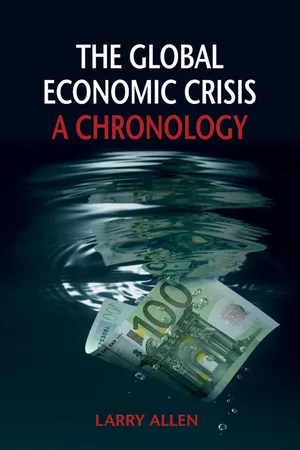
From Greece scrambling to meet Eurozone austerity measures to America’s sluggish job growth, there is every indication that the world has not recovered from the economic implosion of 2008. And for many of us, the details of what led to the recession – and why it has continued – remain murky. Economic historian Larry Allen enlightens us in The Global Economic Crisis, offering an insightful and nonpartisan chronology of events and their consequences and illuminating the interlocked economic processes that lay beneath the crisis. He describes and explains the changing nature of the global financial system, central bank policies, housing bubbles, deregulation, sovereign debt crises and more.
The timeline begins with the economic crisis in Japan in the late 1990s, asking whether Japan’s experience could be an indicator of the outcome of the recession and what it can teach us about managing a sluggish economy, before giving a comparative look at the economies of Brazil, China and India. Many elements have contributed to the ongoing crisis, including the introduction of the euro, the growth of new financial instruments such as securitization, collateralized debt obligations and credit default swaps, interest rate policies and the housing boom and subprime mortgage fiasco.
Lucid and informative, The Global Economic Crisis provides an impartial explanation to anyone seeking to understand the current state – and future – of the world’s economy.
- English
- ePUB (mobile friendly)
- Available on iOS & Android
eBook - ePub
About this book
Information
REFERENCES
ONE Overview
1 Will Durant, The Story of Philosophy (Garden City, NY, 1927), p. 46.
2 Francis Bacon, The New Atlantis (Chicago, 1952), p. 207.
3 Francis Bacon, Essays (New York, 1942), p. 102.
4 Milton Friedman, “The Monetary Theory and Policy of Henry Simons,” in The Optimum Quantity of Money and Other Essays, (Chicago, 1969), pp. 81–93.
TWO Twilight of the Japanese Miracle
1 Arthur Link, ed., The Papers of Woodrow Wilson, vol. VI (Princeton, NJ, 1969), p. 168.
2 Masahiko Takeda and Philip Turner, “The Liberalization of Japan’s Financial Markets: Some Major Themes," Bank for International Settlements BIS Economic Papers, no. 34 (1992).
3 Ibid.
4 W. W. Rostow, The World Economy: History and Prospect (Austin, TX, 1978), p. 418.
5 Japan/U.S. Foreign Exchange Rate, www.economagic.com, accessed 6 November 2012.
6 Henry George, Progress and Poverty: An Inquiry into the Cause of Industrial Depressions and of Increase of Want with Increase of Wealth, The Remedy (New York, 1935) p. 268.
7 Christopher Wood, “Enduring Myth,” Economist, CCCXVII/7684 (8 December 1990), pp. 9–15.
8 “Gently May do It”, Economist, CCCXVII/7679 (3 November 1990), pp. 19–21.
9 Kenichi Ohmae, “Business Forum: Tokyo’s Soaring Property Prices: If They Fall, So Will Our Stock Markets," New York Times (11 October 1987).
10 “Gently May do It,” Economist.
11 Robert L. Cutts, “Power from the Ground Up: Japan’s Land Bubble” Harvard Business Review, LXVIII/3(1990), pp. 164–72.
12 Ibid.
13 Elisabeth Bumiller, “The Japanese Art of Buying”, Washington Post (17 December 1989), p. A3.
14 Ibid.
15 “Demolition Time in Japan’s Property Market,” Economist, CCCXVII/7684 (8 December 1990), pp. 83–4.
16 “Gently May do It,” Economist.
17 “The Cracks Spread and Widen; The Euro Zone’s Debt Crisis,” Economist, CCCXCV/8680 (1 May 2010), p. 63.
18 G. Eisenstodt, “Wooosh!" Forbes, CXLVIII/14 (1991), pp. 113–14.
19 Statistics Bureau, Director-General for Policy Planning of Japan, Tokyo, www.stat.go.jp, accessed 7 November 2012.
20 Eisenstodt, “Wooosh!”
21 IMF, World Economic Outlook Database (October 2012), www.imf.org.
22 “Leaders: Back from the Dead; Japanese Banks,” Economist, CCCXCVIII/8722 (26 February 2011), p. 13.
23 IMF, World Economic Outlook Database (October 2012), www.imf.org.
24 Ibid.
THREE Financial Revolution
1 Sir Nicholas Goodison, “How London Can Remain on Top,” FT.com, Financial Times (26 October 2006), p. 1.
2 Joe Nocera, “Poking Holes in a Theory on Markets,” New York Times (5 June 2009), p. 1.
3 Pankaj Jain, “Financial Market Design and the Equity Premium: Electronic Versus Floor Trading,” Journal of Finance, LX/6 (2005), pp. 2,955–85.
4 “Five Years Since the Big Bang,” Economist, CCCXXI/7730 (26 October 1991), pp. 23–5.
5 Ibid.
6 Peter Truell and Matthew Winkler, “UK Set Today For ‘Big Bang’ Amid Questions: Rocky Start Seen as London Moves Toward Uniting Local, Foreign Markets,” Wall Street Journal (27 October 1986), p. 1.
7 James Sterngold, “The Big Bang that Never Was,” New York Times (16 May 1993), p. 1.
8 “Bang, Pop, or Sputter?” Economist, CCCXLVII/8067 (9 May 1998), special section, pp. 29–31.
9 “MS in Financial Engineering,” at http://ieor.columbia.edu, accessed 5 November 2012.
10 Bank of International Settlements, Semiannual OTC Statistics at end-December 2011 (September 2012), www.bis.org.
11 International Swaps and Derivatives Association, “ISDA Market Survey (Annual Only, PDF), 1987-present" www.isda.org/statistics, accessed 9 November 2012.
12 Nelson Schwartz and Julie Creswell, “Who Created this Monster?” New York Times (23 March 2008), p. 1.
13 Da...
Table of contents
- Front Cover
- Half Title
- Title Page
- Copyright
- Contents
- PREFACE
- ONE OVERVIEW
- TWO TWILIGHT OF THE JAPANESE MIRACLE
- THREE FINANCIAL REVOLUTION
- FOUR EUPHORIA IN THE HOUSING MARKET
- FIVE PERILS OF TAMING INFLATION
- SIX GLOBAL BANKING AND FINANCIAL CRISIS
- SEVEN THE REBIRTH OF KEYNESIAN ECONOMICS
- EIGHT CHINA AND INDIA KNOCK AT THE DOOR
- NINE COMMODITY PRICES TAKE FLIGHT
- TEN THE WEAKENING OF THE LABOR MARKET
- ELEVEN STRING OF SOVEREIGN DEBT JITTERS
- TWELVE THE LONG ROAD BACK
- REFERENCES
- BIBLIOGRAPHY
- ACKNOWLEDGMENTS
- INDEX
Trusted by 375,005 students
Access to over 1.5 million titles for a fair monthly price.
Study more efficiently using our study tools.
Frequently asked questions
Yes, you can cancel anytime from the Subscription tab in your account settings on the Perlego website. Your subscription will stay active until the end of your current billing period. Learn how to cancel your subscription
No, books cannot be downloaded as external files, such as PDFs, for use outside of Perlego. However, you can download books within the Perlego app for offline reading on mobile or tablet. Learn how to download books offline
Perlego offers two plans: Essential and Complete
- Essential is ideal for learners and professionals who enjoy exploring a wide range of subjects. Access the Essential Library with 800,000+ trusted titles and best-sellers across business, personal growth, and the humanities. Includes unlimited reading time and Standard Read Aloud voice.
- Complete: Perfect for advanced learners and researchers needing full, unrestricted access. Unlock 1.5M+ books across hundreds of subjects, including academic and specialized titles. The Complete Plan also includes advanced features like Premium Read Aloud and Research Assistant.
We are an online textbook subscription service, where you can get access to an entire online library for less than the price of a single book per month. With over 1.5 million books across 990+ topics, we’ve got you covered! Learn about our mission
Look out for the read-aloud symbol on your next book to see if you can listen to it. The read-aloud tool reads text aloud for you, highlighting the text as it is being read. You can pause it, speed it up and slow it down. Learn more about Read Aloud
Yes! You can use the Perlego app on both iOS and Android devices to read anytime, anywhere — even offline. Perfect for commutes or when you’re on the go.
Please note we cannot support devices running on iOS 13 and Android 7 or earlier. Learn more about using the app
Please note we cannot support devices running on iOS 13 and Android 7 or earlier. Learn more about using the app
Yes, you can access The Global Economic Crisis by Larry Allen,John Rennie Short in PDF and/or ePUB format, as well as other popular books in Economics & Business General. We have over 1.5 million books available in our catalogue for you to explore.