eBook - ePub
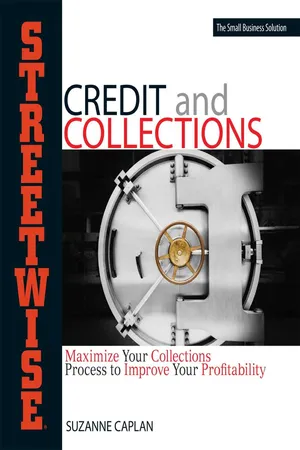
Streetwise Credit And Collections
Maximize Your Collections Process to Improve Your Profitability
- 352 pages
- English
- ePUB (mobile friendly)
- Available on iOS & Android
eBook - ePub
Streetwise Credit And Collections
Maximize Your Collections Process to Improve Your Profitability
About this book
The credit and collection function of any business is the nerve center of the company. If proper records aren't kept and receivables closely monitored, a company will have difficulty maintaining its cash flow and operations. Streetwise Credit and Collections provides you with the skills to manage your company's financial obligations, collect due payments, and avoid falling into debt.
Streetwise Credit and Collections includes complete state-by-state requirements for small claims court, and sections on the applicable laws, statute of limitations, and legal interest rates that may be charged. The appendices contain information necessary for all businesses that grant credit, including the Equal Credit Opportunity Act and the Fair Debt Collection Practices act.
Includes advice on:
Streetwise Credit and Collections includes complete state-by-state requirements for small claims court, and sections on the applicable laws, statute of limitations, and legal interest rates that may be charged. The appendices contain information necessary for all businesses that grant credit, including the Equal Credit Opportunity Act and the Fair Debt Collection Practices act.
Includes advice on:
- Securing credit and granting it
- Setting credit policies for your customers
- Hiring a collections agency as necessary
Frequently asked questions
Yes, you can cancel anytime from the Subscription tab in your account settings on the Perlego website. Your subscription will stay active until the end of your current billing period. Learn how to cancel your subscription.
No, books cannot be downloaded as external files, such as PDFs, for use outside of Perlego. However, you can download books within the Perlego app for offline reading on mobile or tablet. Learn more here.
Perlego offers two plans: Essential and Complete
- Essential is ideal for learners and professionals who enjoy exploring a wide range of subjects. Access the Essential Library with 800,000+ trusted titles and best-sellers across business, personal growth, and the humanities. Includes unlimited reading time and Standard Read Aloud voice.
- Complete: Perfect for advanced learners and researchers needing full, unrestricted access. Unlock 1.4M+ books across hundreds of subjects, including academic and specialized titles. The Complete Plan also includes advanced features like Premium Read Aloud and Research Assistant.
We are an online textbook subscription service, where you can get access to an entire online library for less than the price of a single book per month. With over 1 million books across 1000+ topics, weāve got you covered! Learn more here.
Look out for the read-aloud symbol on your next book to see if you can listen to it. The read-aloud tool reads text aloud for you, highlighting the text as it is being read. You can pause it, speed it up and slow it down. Learn more here.
Yes! You can use the Perlego app on both iOS or Android devices to read anytime, anywhere ā even offline. Perfect for commutes or when youāre on the go.
Please note we cannot support devices running on iOS 13 and Android 7 or earlier. Learn more about using the app.
Yes, you can access Streetwise Credit And Collections by Suzanne Caplan in PDF and/or ePUB format, as well as other popular books in Business & Business General. We have over one million books available in our catalogue for you to explore.
Information
Why Credit
Is a Business
Necessity
Part one
Part two
Part three
Part four
Part five
Part two
Part three
Part four
Part five
Chapter 1 How Credit Creates Leverage
Chapter 2 Securing Credit from Vendors
Chapter 3 Providing Credit to Business Customers
Chapter 4 Credit Takes You Global
Chapter 5 Providing Credit to Consumers
The Leverage to Start a Business
In the operation of your business, you will be not only a grantor of credit but a seeker of outside sources of capital and, it is hoped, a recipient of credit. We usually associate the obtaining of loans with banking institutions, but it is important to realize that receiving credit from vendors is also a form of loan to your company. And because banks are actually in the business of granting credit, they can serve as good models for learning the basics of how to judge the ability of a customer to pay.
Building a growing business requires capital at the outset, even before there are any meaningful revenues coming in. Often this money comes from the ownerās investment, but any business that seeks significant growth will require outside sources of credit. This means that the assets you have purchased can be leveraged in order to fund additional growth, from inventory to wages. āLeverageā means that you use future revenue to secure current needs.
The best example of this type of financing is with the purchase of real property, whether in the form of a personal residence or a business building. You leverage your current cash and future earnings to make a purchase for current use.
Understanding Leverage Ratios
As a business owner in the position of seeking credit, you do not want to borrow more than you can pay back over time (assuming that your profits and cash flow will meet projections). And as a credit grantor to your own customers, you do not want to allow them to get in over their heads, in terms of running up debt that they will not be able to pay back over the next few months or years. Credit problems spring up more often from an inability to pay than from any unwillingness to do so. Using existing collateral to borrow cash is permissible but if the leverage (the debt to equity) is too high, the earned cash flow will not be sufficient to retire debt within its terms. When assets are inventory or material that will be sold, the leverage can be higher than with assets such as equipment or buildings.
Cash Is a Timing Issue
Cash flows through a business on a continuing basis, although there are times and circumstances when the outflow exceeds the inflow. In a new venture, the expense of asset purchases will not be immediately returned by way of cash income. Instead, the funding for your business will likely take the form of owner investment or long-term borrowing from a bank.
You will pay back this principal from future profits.
The other challenge your company may face is from the depletion of capital due to a period of operating losses. This type of situation is unlikely to be remedied by any borrowing of funds, since banks will not fund a loan to cover losses. The cash will have to come from outside investment or from the sale of any unneeded assets. The better prepared you are for the cash flows in and out of a business, the better you will be able to meet the credit needs of serving your customers.
In circumstances in which your business cash is invested in inventory, in work in process, or in accounts receivable acquired as a result of sales, the resulting imbalance of funds may reasonably be replaced by bank lending. As the cash begins to flow in, the loans are paid down or can be paid off entirely. Bank funds are then used over the short-term to smooth out the timing of cash inflow. Such borrowing is usually through a line of credit that can be drawn on as needed.
Retaining Profits May Rebalanced Cash
When your company has a prolonged period of profits that creates a positive cash flow, it is usually good policy to keep the cash in a money-market account that is readily accessible. Often the first instinct of business owners is to increase the salaries or draws for themselves and perhaps other managers, or to purchase some expensive new equipment. But being conservative with expenses in order to build a cash cushion is sounder business practice. If the new equipment is necessary and will offer a payback over time, consider going to your bank for a loan to facilitate the investment while conserving your internal cash to carry you through possible slow times. A business out of cash is a business out of choices. Overspending is a behavior to watch out for in your customers as well. Customers who are spending lavishly may be using up all of their cash reserves.
Turning Assets into Collateral
Many seasonal businesses build inventory prior to their big selling season. They may buy material over a period of months and try to pay for it when the bills come due, even if that is long before any goods are sold. This practice usually strains the cash flow of your business. Instead the inventory (assuming that it is current and will be sold) can be used as collateral for a loan.
Your growing accounts receivable are also assets that may be used as collateral to secure a loan. All of your noncash items that will convert to cash within six months are eligible. This type of short-term borrowing is undertaken to add cash funding to cover slow times. As inventory is liquidated and customers pay their bills, you will be able to retire your loan. Most banks are willing to make short-term loans where there is a reliable likelihood of early payback.
Only Current Accounts Receivables Are Eligible
Most lenders will require a current aging of your receivables (a chart of what debts are 30, 60, 90 and more than 90 days out) to determine the value of your collateral available to support a loan. Some will verify the credit worthiness of your customers as one of the criteria for the loan limit they are willing to advance. If a big customer becomes a credit problem to you, you are likely to become one to the bank. Train yourself to collect receivables promptly from your customers.
The other issue a lender will consider is the date of your customer invoices. Any charge that is over sixty days old (and assumed to be thirty days past due) will not be eligible as loan collateral. Typically, neither will any other outstanding or future sales to delinquent customers. This policy should be instructional for you since if sixty days have passed without your being paid for goods or services, there is an increased risk you wonāt be paid. Banks apply these rules, and you should do so as well. You want the next sale but not if the previous one has yet to be paid for.
Using Other Peopleās Money (OPM) to Make Money
A profitable business seeking to grow a larger venture will have a need for cash from outside sources to leverage its concept or skills. In addition to working with traditional lenders, you can negotiate to partner with your vendors for extended terms of payment, which as mentioned earlier is really another form of receiving a loan. As money comes in that you would typically use to pay a vendorās bills, you canāwith the vendorās approvalāuse your capital to continue building inventory in order to increase your future sales. And in turn you can increase your purchases from that vendor as a result of its forbearance.
This strategy works better for a retail or wholesale distribution company whose cash is tied up in short-term investment, that is, in selling products that will be turned back into cash in a reasonable period of time, usually less than sixty to ninety days. Consider the shelf life of your product if you are thinking about asking a vendor for extended terms. Money owed on obsolete inventory is unlikely to be paid.
OPM = Outside Investors
When the need for capital is for purposes of longer-term investment (such as in equipment or technology development), the source to use may be an outside investor who is willing to put capital at risk for the possibility of high return. Bank loans and lines of credit are, according to their stated terms, obligations that must be retired. Investment in a business, on the other hand, is not guaranteed. Rather, an expectation of payoff may be tied to future profitability or to an exit strategy (such as a public offering or sale of the company). This ability to leverage resources is necessary for any business with an aggressive growth plan. The difference between a business investment and a loan is that the former is at risk and the latter is secured by collateral or a promise to pay regardless of outcome.
Your Bank as a Source of Credit
Most banks offer a variety of loan products and credit services that you can use to fund your business. In addition to (typically) longer-term secured loans and shorter-term lines of credit, you may also be able to secure a bank-issued credit card that enables you to make small purchases or fund travel and entertainment expenses; you can then choose to pay the bill in full each month or over time. Careful use of such additional capital can assist your cash flow as well. Remember, however, that the cost of this type of credit is higher than that of most others.
Your Bank May Provide Credit Processing
Most banks are looking for business customers who will take advantage of various se...
Table of contents
- Cover Page
- Title Page
- Copyright Page
- Contents
- Acknowledgments
- Introduction
- Part One: Why Credit Is a Business Necessity
- Part Two: An Effective Credit Policy
- Part Three: Putting Policy into Practice
- Part Four: Aggressive Collections
- Part Five: The Art of Credit
- Epilogue
- Appendixes