Stephan Schiffman's 101 Successful Sales Strategies
eBook - ePub

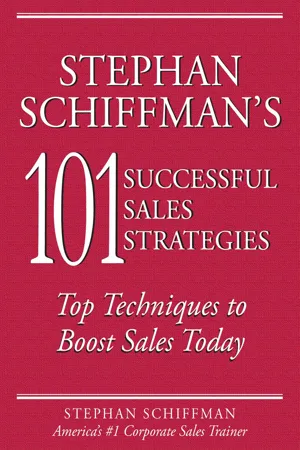
Stephan Schiffman's 101 Successful Sales Strategies

Top Techniques to Boost Sales Today

  1. 272 pages
  2. English
  3. ePUB (mobile friendly)
  4. Available on iOS & Android
eBook - ePub

Stephan Schiffman's 101 Successful Sales Strategies

Top Techniques to Boost Sales Today

About this book

Believe in the power of miracles...

"A special little book, an antidote to the stress, fury, and unfeelingness of many people's hurried, everyday lives." --Newsday

"Judith Leventhal and Yitta Halberstam amaze and inspire with their incredible-but-true story collections...of wondrous true coincidences." --People

"Small Miracles is a book you'll love and cherish for a long time to come. It will make you aware of similar events that are happening to you--those touches of grace that, when we think to look for them, bless us all." --Belle
Frequently asked questions

Yes, you can cancel anytime from the Subscription tab in your account settings on the Perlego website. Your subscription will stay active until the end of your current billing period. Learn how to cancel your subscription.
No, books cannot be downloaded as external files, such as PDFs, for use outside of Perlego. However, you can download books within the Perlego app for offline reading on mobile or tablet. Learn more here.
Perlego offers two plans: Essential and Complete
  • Essential is ideal for learners and professionals who enjoy exploring a wide range of subjects. Access the Essential Library with 800,000+ trusted titles and best-sellers across business, personal growth, and the humanities. Includes unlimited reading time and Standard Read Aloud voice.
  • Complete: Perfect for advanced learners and researchers needing full, unrestricted access. Unlock 1.4M+ books across hundreds of subjects, including academic and specialized titles. The Complete Plan also includes advanced features like Premium Read Aloud and Research Assistant.
Both plans are available with monthly, semester, or annual billing cycles.
We are an online textbook subscription service, where you can get access to an entire online library for less than the price of a single book per month. With over 1 million books across 1000+ topics, we’ve got you covered! Learn more here.
Look out for the read-aloud symbol on your next book to see if you can listen to it. The read-aloud tool reads text aloud for you, highlighting the text as it is being read. You can pause it, speed it up and slow it down. Learn more here.
Yes! You can use the Perlego app on both iOS or Android devices to read anytime, anywhere — even offline. Perfect for commutes or when you’re on the go.
Please note we cannot support devices running on iOS 13 and Android 7 or earlier. Learn more about using the app.
Yes, you can access Stephan Schiffman's 101 Successful Sales Strategies by Stephan Schiffman in PDF and/or ePUB format, as well as other popular books in Business & Business General. We have over one million books available in our catalogue for you to explore.

Information

Publisher
Adams Media
Year
2005
eBook ISBN
9781440500879

Strategy #28

Know Why Your Company's No. 1 Account Bought from You

Do you know why your company's top customer bought from you?
If you don't, you should.
You should know, and be able to discuss, exactly how much that deal is worth, what led that account to closure, and what's on the horizon in your company's relationship with that customer. You should know when the company decided to buy. You should know what they decided to buy. And you should know who made the decision.
This is mandatory whether you closed the deal yourself, or whether a colleague closed the deal.
The contacts at your prospect companies will be interested in these facts. So master them! Pick up the phone right now and call whomever you have to call in the organization to figure out why your largest account (the account that now generates X thousand dollars a year) decided to buy.
You should then share as many details as you can of this sales success story during meetings with prospects. (Make sure that you do not violate the confidentiality requirements of your top customer.)The story will break the ice and give you credibility.
Once you've mastered the details of your company's number-one account, get the details behind as many of your “top” clients or customers as you possibly can.
Sometimes salespeople assume that the only success stories they can or should share with prospects are those they had some direct role in bringing about. In other words, they imagine that if they didn't personally close the deal, they have no “right” to offer the details behind a customer's decision to use their company's service. What a mistake! The minute you walk in the door, you already have the right to share every success story your company ever generated! Be sure you take full advantage of that right.
When we train new salespeople for our sales training organization, you can bet we don't make them wait a month or two, in order to close a deal personally, before they start talking about the benefits we've delivered to clients like Aetna, Boise Office Solutions, LexisNexis, Clearnet, and Sprint. We clear the details of those stories with our clients, give them to our people, and make absolutely sure that they know them and are comfortable discussing them at a moment's notice!

Strategy #29

Handle the Leads That “Fall into Your Lap” with Care

It's a dream come true. You are on the job, minding your own business, when suddenly someone calls, seemingly out of the blue, and virtually asks you for business. Wow!
I know what the first temptation is. You want to close the sale. Life is tough enough; you spend all day building, establishing, persuading. Now along comes The Sale You Deserve and you are sure as heck not going to let it slip through your fingers. So you start to move in.
Don't.
It will take some discipline. Let us be honest: It will take a lot of discipline. But if you really want to move the lead from the other end of the receiver to your commission check, I promise you that the surest way to do it is to take a deep breath, count to three, and follow a few simple steps.
1. Back off and establish some kind of relationship. If this really is someone you have never spoken to before, you do not know whether a brisk let's-get-right-down-to-business, of-course-we-can-solve-your-problem approach is going to work. It may backfire spectacularly, and often has. So exchange a few pleasantries; get a feeling for the kind of person you are talking to.
2. Find out what is going on. Say, “I am really glad you got in touch with me; listen, do you mind if I ask what prompted your call?” This is very important! You have no idea exactly what you are dealing with yet; no sale exists in a vacuum. Things may not be what they seem! Sometimes people call, sound like they are going to sign on with you, but really need generous amounts of tender loving care. Establish your surroundings; get the information. Do not succumb to the temptation to sell — it may be too early.
3. Ask to set up an in-person appointment or otherwise secure a slot on the person's calendar for some point within the next two weeks. Yes, you should do this even if the person tries to close the sale himself on the phone. (Unless, of course, you are involved in telemarketing.)
You need to establish a personal bond, and you need to get the person to invest more time and energy into the relationship.
Do not assume you have a “sure thing.” The truth of the matter is, these types of calls do not always turn into revenue. For one thing, people may simply be shopping around to a number of different vendors. Move the relationship forward, and try to get face to face. If you do so, your efforts will pay off handsomely.

Strategy #30

Know How to Make Your Product or Service Fit Someplace Else

How can you adapt an existing product or service to satisfy a new situation? In my seminars, I talk about product/service “malleability.” The word means “flexibility” or “capacity of being adapted.”
Dentists use gold and silver for fillings because of the malleability of those metals. They are easily manipulated, and provide a complete, secure fit over and within a cavity. Along the same lines, you might want to think about the ways your product or service can be adjusted or customized for new prospects in order to help you meet specific requirements and goals.
Let's take a look at a simple example. Suppose you are in the paper clip business. How many ways do you think you could use paper clips? Obviously, you can think of a paper clip as a small metal item used to fasten sheets of paper together. But if you stop and think about it for a moment, you will realize that people use paper clips for all kinds of different purposes. Some people twist them into makeshift cotter pins; some people use them to clean out hard-to-reach places on office equipment; some people use them to fix eyeglasses; some people make decorative chains out of them. I personally have used two paper clips as a tiny clamp to extract a stubborn disc that would not eject from my computer's drive.
There are probably a hundred different uses for a paper clip besides holding sheets of paper together. Are there a hundred different uses for your product or service that you may not have considered before? Before you dismiss the possibility, keep in mind that you do not need a hundred to boost your sales. You need just one good idea.
Baking soda is for cooking, right? Well, it can be. But for some strange reason the Arm & Hammer people made a big deal about running those ads promoting its use as a refrigerator deodorizer. By the way, do you know anyone who uses baking soda that way now? My bet is that they did not before the people at Arm & Hammer started that ad campaign.
Ask yourself:
Does what you sell work in only one way? Or can you adjust it? Can you make it serve some new purpose or function? Can you present it in a different light or to a different group of people? The key lies in opening your own mind to new possibilities, then following through.
Successful salespeople work with their prospects and customers to develop creative new answers to the questions “What do you do?” and “How can we help you do it better?”
A story I tell during training programs shows how that final question can develop naturally during the interview phase. A few years ago, a museum was unable to get its insurance for precious works of art to kick in during a critical period of time — the period after paintings on loan had arrived at the museum's central facility but before the assessor could inspect and catalogue them.
A sales rep for an instant camera company made a multiple-unit sale to the facility, but she didn't do it by asking “Why don't you use instant cameras in your operations?” Nobody at the museum had thought about using instant cameras, so she wouldn't have gotten a constructive response by asking a question like that. She found out during an interview about the objective of a particular decision-maker to make those dangerous three-to four-day lags between arrival and insurance coverage go away. Then, based on her thoughtful, open-minded discussions with her contact, she made a proposal. “Based on what you've told me here today, it sounds like you might be able to use a couple of our instant cameras to catalogue your recent arrivals. You could overnight the photos and logs to your insurance carrier, save their representative a trip, and get your coverage in place within forty-eight hours. That's what a lot of the other museums we've worked with have found makes sense.”
It worked! But it wouldn't have if the rep hadn't found out what the museums did before launching into a preprogrammed spiel. The same goes for you. The more you find out about each and every area of a prospect's business that has some possible connection to what they do, the more likely they are to find a new selling possibility.
Successful salespeople never stop asking:
• What does the person do?
• How does he or she do it?
• When does he or she do it?
• Where does he or she do it?
• Why does he or she do it that way?
• How can I help him or her do it better?
And they never stop thinking of ways they can turn the answers to those questions into new applications and solutions.

Strategy #31

Pretend That You Are a Consultant — Because You Are

Treat all your sales work as a consulting assignment. Many years ago, I found myself hopelessly stuck while working for a new prospect. I was trying to develop a program for him and things simply were not working out. So here is what I did. I said, “Charlie, rather than go any further with this, let me think about what we talked about here and then come back next week with a couple of ideas. Then, if you like them, we can continue our discussion.” He agreed to that; I eventually closed the sale.
It was shortly after that meeting that I realized what I had done. I had taken the same approach I would normally take with a client who is simply asking for an evaluation of the problems on his firm's sales desk. I had taken the “sell” sign down for a moment and come to grips with the fact that since I did not yet have an adequate assessment of the prospect's problems, I could not offer him a solution.
There is a catch to selling from the mindset of the consultant. You have to be willing to stop and think once in a while.
The best salespeople are professional problem solvers. If you sell cars, you should consider yourself in the business of solving transportation problems. If you sell copiers, then you should consider yourself in the business of solving photocopying problems. If you sell cellular phones, then you should consider yourself in the business of solving communication problems. But you have to know and understand the problem first before you can try to solve it. You have to be willing to walk in the door without any preconceived notions as to how best to solve the problems you have identified.
For many salespeople, the consultant principle can be put on an even simpler footing. If you sell to other companies, you should consider yourself in the business of solving profitability problems. That is the key concern you will ultimately be addressing: how to increase profitability. Everything you do, every proposal you offer, should lead eventually to the goal of your client's firm increasing its level of profitability. Weigh your goals and your approaches against this standard and you will have gone a long way toward achieving sales success.
If you are not interested in helping people solve problems, then I am going to respectfully suggest that you are not in the right business. If you cannot break everything you do down into something that helps another person reach an important goal, you will either base your sales on manipulating others, or fail to persuade prospects that you are offering anything of value. Either path leads inexorably to burnout and/or constant rejection. You definitely do not need that.
The dictionary defines “consult” as “to seek advice, information, or guidance from.” To me, this definition encapsulates exactly the relationship between a qualified prospect and a professional salesperson. You as a salesperson are there to advise the prospect as to the ways you can help solve existing problems. You are there to provide all the necessary information relative to solving those problems.
Act like a consultant … because that's what you really are!

Strategy #32

Ask for the Next Appointment While You Are on the First Visit

This is one of the easiest pieces of advice to follow in this entire book. Yet it is also a step that the majority of salespeople routinely ignore. Many are even afraid to take it, even though they know it has done wonders for others!
A young salesperson once actually said to me, “Steve, that's not my place. I'm in the prospect's office. He's showing me a courtesy by seeing me in the first place. If I'm going to go back there for a second visit, the prospect should ask me.”
Baloney!
You initiated the contact in the first place. You have made it clear at every point in the process that your objective is to help the prospect. You have demonstrated that you are interested primarily in solving new problems for him. Why on earth shouldn't you ask the prospect for the next appointment so you can show how you would implement the solution!
You did not set the initial appointment for your health. You did it because you had an objective: helping to solve the prospect's problem with your product or service. You still have that objective. Therefore, it is altogether appropriate for you to ask to move the process along to the next stage before the meeting adjourns.
Unless you receive a firm unequivocal “no” during the first meeting — and even then you can ask whether or not you made a mistake of some kind — there will always be a next stage to talk about. And the best possible time to set the appointment for discussing that stage is while you are face to face with the prospect. You both have your calendars within reach. You both have pens or pencils handy. What other time would you choose to set your next meeting? What on earth would induce you to leave that room without knowing when you will next meet with this person?
“Okay, Mr. Jones; I think we've gone about as far with this as we can today. I'm excited about this and I'll tell you why. I think there's a chance that we may have a match between what you do and what we do. What I would like to do is meet with you and one of my team members to show you exactly what we can do for your company. How's Friday the 15th at 2:00?”
Listen for the response. There has to be a response of some kind! Then work from there with the information you receive.

Strategy #33

Create a New Plan with Each New Prospect

I go through a little monologue each time I meet a new prospect. I say, “Here is someone new. Here is someone I have never met before. What am I going to do that will be a little different with this person?”
It may be routine for you, but the prospect you are dealing with has never gone through the sales cycle with you before. One of the best ways I know of to combat that “here I go again” sensation (and that is a danger for even the very best salespeople) is to produce a customized, written plan for this particu...

Table of contents

  1. Cover Page
  2. Title Page
  3. Copyright
  4. About the Author
  5. Contents
  6. Introduction
  7. Acknowledgments
  8. Be Obsessed
  9. Listen
  10. Empathize
  11. Don't See the Prospect as an Adversary
  12. Don't Get Distracted
  13. Take Notes
  14. Follow Up
  15. Keep in Contact with Past Clients
  16. Plan the Day Efficiently
  17. Look Your Best
  18. Keep Sales Tools Organized
  19. Take the Prospect's Point of View
  20. Take Pride in Your Work
  21. Beware of Trying Too Hard to “Convince”
  22. Never Underestimate the Prospect's Intelligence
  23. Keep Up to Date
  24. Know the Four Steps of a Sale
  25. Use People Proof
  26. Act Like an Equal — Because You Are One
  27. Don't Get Fooled by “Sure Things”
  28. Don't Take Rejection Personally
  29. Understand the Importance of Prospecting
  30. Never Focus on the Negatives
  31. Get Competitive
  32. Communicate That You Are a Person to Be Trusted
  33. Take the Lead
  34. Engage the Prospect
  35. Know Why Your Company's No. 1 Account Bought from You
  36. Handle the Leads That “Fall into Your Lap” with Care
  37. Know How to Make Your Product or Service Fit Someplace Else
  38. Pretend That You Are a Consultant — Because You Are
  39. Ask for the Next Appointment While You Are on the First Visit
  40. Create a New Plan with Each New Prospect
  41. Ask for Referrals
  42. Show Enthusiasm
  43. Give Yourself Appropriate Credit
  44. Tell the Truth (It's Easier to Remember)
  45. Sell Yourself on Yourself — Get Motivated!
  46. Start Early
  47. Read Industry Publications (Yours and Your Clients')
  48. Give Speeches to Business and Civic Groups
  49. Pass Along Opportunities When Appropriate
  50. Take Responsibility for Presentations That Go Haywire
  51. Control the Flow
  52. Build Leadership Skills
  53. Prepare for the Objections You'll Hear
  54. Discover What People Are Communicating Through Their Stories
  55. Look Honestly at Your Job and Yourself
  56. Tell Everyone You Meet Who You Work for and What You Sell
  57. Keep Your Sense of Humor
  58. Beware of Bad Advice on the Internet
  59. Use Company Events to Move the Relationship Forward
  60. Follow the “Yes”
  61. Know When to Say, “I Didn't Anticipate That”
  62. Beware of “Casual Friday”
  63. Ask Key Questions about Your Best Accounts
  64. Find Out What's Changed
  65. Use E-mail Intelligently
  66. When in Doubt, Ask for the Appointment
  67. Raise Tough Issues Yourself
  68. Use an Effective Strategy for Getting Return Phone Calls
  69. Don't Bring Everything!
  70. Don't “Product Dump”
  71. Move Beyond “Slapshot”
  72. Master PIPA — and Learn the Art of Conducting a Great First Meeting
  73. Review Your Most Important Questions Before the Meeting
  74. Don't Present Too Early
  75. Verify Your Information
  76. Ask Yourself the Right Questions
  77. Prepare for the Meeting Properly
  78. Work Your Way up the Ladder
  79. Get Real — Strategize Two Weeks in Advance
  80. Don't Get Distracted by “Yes” Answers
  81. Never Walk Away Without Asking for Some Kind of Action
  82. Never Make a Presentation You Don't Think Will Close
  83. Always Have a Backup Plan
  84. Never Kid Yourself
  85. Take Immediate Action
  86. Take Quiet Time to Think
  87. Seize Opportunities
  88. Be Punctual
  89. Return Calls Within Twenty-Four Hours
  90. See Everyone at Least Once
  91. Know When to Retreat
  92. Know How to Develop Interdependent Relationships
  93. Know When Not to Be Dependent
  94. Consider Yourself to Be a Messenger of Change
  95. Prioritize, Don't Apologize
  96. Notice What's Around You
  97. Ask about the Cow
  98. Always Try to Move the Sale to the Next Step
  99. Replenish Your Prospect Base Intelligently
  100. Look at the Lights of Two Cars Ahead
  101. Ask “Does This Make Sense?”
  102. Put the Prospect's Interests First
  103. Prospect Effectively
  104. Follow the Nine Principles of Cold Calling
  105. Use Fallbacks
  106. Know Your Ratios
  107. Don't Try to Close
  108. Start Making Sense