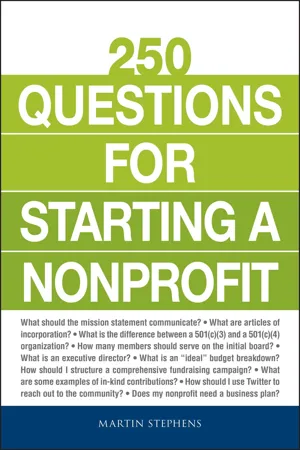
250 Questions for Starting a Nonprofit
eBook - ePub

250 Questions for Starting a Nonprofit

  1. 208 pages
  2. English
  3. ePUB (mobile friendly)
  4. Available on iOS & Android
eBook - ePub

250 Questions for Starting a Nonprofit

About this book

An essential guide to launching a nonprofit organization!

From budgets to bylaws, 250 Questions for Starting a Nonprofit provides you with the knowledge you need to make a plan, set realistic goals, and obtain sustainable financing for your nonprofit. This easy-to-understand guide walks you through each step of the process with Q&As that show you how to turn a grassroots idea into a federally recognized organization. Inside, you'll find detailed explanations on:
  • The differences and similarities between organizations and corporations
  • Publicizing and advertising through social media
  • Using crowdsourcing sites like Kickstarter to raise money
  • Forming the initial board of directors and filing incorporation documents
  • Attracting the best volunteers and staff members
With the expert advice in 250 Questions for Starting a Nonprofit, you will transform your vision into a thriving nonprofit organization.

Frequently asked questions

Yes, you can cancel anytime from the Subscription tab in your account settings on the Perlego website. Your subscription will stay active until the end of your current billing period. Learn how to cancel your subscription.
No, books cannot be downloaded as external files, such as PDFs, for use outside of Perlego. However, you can download books within the Perlego app for offline reading on mobile or tablet. Learn more here.
Perlego offers two plans: Essential and Complete
  • Essential is ideal for learners and professionals who enjoy exploring a wide range of subjects. Access the Essential Library with 800,000+ trusted titles and best-sellers across business, personal growth, and the humanities. Includes unlimited reading time and Standard Read Aloud voice.
  • Complete: Perfect for advanced learners and researchers needing full, unrestricted access. Unlock 1.4M+ books across hundreds of subjects, including academic and specialized titles. The Complete Plan also includes advanced features like Premium Read Aloud and Research Assistant.
Both plans are available with monthly, semester, or annual billing cycles.
We are an online textbook subscription service, where you can get access to an entire online library for less than the price of a single book per month. With over 1 million books across 1000+ topics, we’ve got you covered! Learn more here.
Look out for the read-aloud symbol on your next book to see if you can listen to it. The read-aloud tool reads text aloud for you, highlighting the text as it is being read. You can pause it, speed it up and slow it down. Learn more here.
Yes! You can use the Perlego app on both iOS or Android devices to read anytime, anywhere — even offline. Perfect for commutes or when you’re on the go.
Please note we cannot support devices running on iOS 13 and Android 7 or earlier. Learn more about using the app.
Yes, you can access 250 Questions for Starting a Nonprofit by Martin Stephens in PDF and/or ePUB format, as well as other popular books in Business & Business General. We have over one million books available in our catalogue for you to explore.

Information

Publisher
Adams Media
Year
2014
eBook ISBN
9781440584558
PART I
Getting Started

Chapter 1
THE BASICS

#1. Why nonprofits?

When problems and issues arise in communities, the people in those communities come together to fix them. Often such movements are led by organizers, whose job it is to bring together like-minded people. For any group of people to make lasting change, there must be some form of organization, a structure that will enable them to raise money, set an agenda, and carry out tasks in service of that agenda.
This is what a nonprofit does.
If you’re involved in a nonprofit, you aren’t doing this organizing to make a profit as you might if you were working in a corporation. What’s important to you is the goal of the nonprofit. Your passion may be for the local community or it may be about a national or global entity. Whatever the case, your nonprofit brings together people with shared interests who want to accomplish something. To that end, they’ve formed a legal entity in which all profits are returned to the organization and the community it serves.
No one questions the need for many of the services that nonprofits or charities assume as necessary for healthy, vibrant communities, so the government grants a lot of leeway in recognition of the sacrifices that individuals involved in nonprofits are willing to make. The government understands that nonprofits exist because of their members’ passion for a cause.
However, regulations governing every aspect of forming and operating a nonprofit organization have become complex. Books such as this one can help you understand and cope with this mountain of rules; as well, you can draw on the expertise of business professionals.

#2. What is a nonprofit?

To understand fully what a nonprofit corporation is, it helps first to understand what a for-profit corporation is. A corporation is a unique legal entity recognized by state and federal governments as completely separate from the people who own it. Corporations are viewed as though they were people, with many of the same rights and privileges, although technically many of the companies only exist on paper.
For-profit corporations have five essential components:
  1. They may have “limited liability,” meaning investors in the corporation can only lose (or are only liable for) the amount of money they have invested, rather than potentially losing everything they own.
  2. They maintain a “continuity of existence,” which means that the corporation can literally exist forever, well beyond the lifetimes of the founders or current owners.
  3. They offer an “ease of ownership transfer” through the sale of shares, rather than selling the actual business.
  4. They have the ability to raise money or capital through expanded ownership. In other words, if more shares are sold or more partners are brought in, there is no limit to the amount of money that can be raised—and of course, lost.
  5. They offer shareholders the ability to profit from the growth of the business through the increased value of their shares, when shares are sold on the open market, or through the payment of dividends based on the profit the corporation has generated.
Nonprofit corporations share many of these characteristics. However, unlike for-profit corporations, in which individual owners, partners, or shareholders may personally benefit from the organization, in a nonprofit corporation no individual may directly benefit from any “profit” generated by the organization. Rather, the money generally considered “profit” must be turned back into the organization to continue its work.
Nonprofit organizations can and do make money, although, as stated previously, this money must be returned to the corporation. Nonprofits may also hire staff, engage private consultants, and operate as does any other corporation; the important distinction is that salaries or fees of employees must be established as set amounts rather than—as in a for-profit company—based on the corporation’s financial performance. A sliding-scale compensation structure that depends on the success of the organization would place employees, especially officers, in the position of directly benefiting from the organization. This would be contrary to the tax code and in all probability cause the nonprofit to lose its tax-exempt status.

#3. What are the three main types of nonprofits?

There are three main categories of nonprofit corporations. Under these three categories are more familiar subcategories:
  1. The public benefit corporation includes the generally understood charitable organizations and social welfare organizations such as those with a 501(c)(3) or a 501(c)(4) classification.
  2. The mutual benefit corporation, which is not public, might include groups such as homeowners’ associations and private foundations.
  3. The great other, which includes fraternal societies, labor organizations, farm bureaus, social clubs, veterans’ organizations, cemetery companies, credit unions, and the many other organizations listed under section 501(c) of the Internal Revenue Service code.

#4. What is the difference between a 501(c)(3) and a 501(c)(4) organization?

First, let’s look at the similarities. Both are exempt from paying federal income tax; both must be operated as nonprofits; and are restricted from allowing any individual or shareholder to benefit financially from the work of the organization. In fact, because those particular rules are so similar, any organization that qualifies for 501(c)(3) status also qualifies for 501(c)(4) status.
A 501(c)(4) meets three criteria:
  1. The group is a civic league or organization that is not organized for profit but is operated exclusively for the promotion of social welfare.
  2. The group is a local association of employees, the membership of which is limited to the employees of a designated person or persons in a particular municipality.
  3. The net earnings of the group are devoted exclusively to charitable, educational, or recreational purposes.
You’ll note some similarities to the requirements for the 501(c)(3) status—in particular that the group is, in fact, operating as a not-for-profit. The big differences involve what types of activities the group plans to undertake, with particular focus on political activities.
Whereas a 501(c)(3) is not permitted to advocate for a political candidate or ballot initiative, a 501(c)(4) may do so, as long as the activities fall within its primary purpose. The tradeoff is that contributions to a 501(c)(4) are tax deductible only if the organization is a government agency or is involved in public service. Otherwise, contributions may not be deducted from the personal income tax of the contributor.
If you meet all the other requirements pertaining to both classifications, are not planning to be directly involved in political campaigns, will not be lobbying to a large degree, and plan to solicit tax-deductible donations, consider applying for the 501(c)(3) status.
If, on the other hand, you meet all the other requirements pertaining to both classifications but do plan on being actively involved in political campaigns, will be conducting extensive lobbying, and understand that your contributors will generally not be able to deduct those contributions, then consider the 501(c)(4). Some groups have formed two separate tax-exempt organizations, allowing one part of their organization (the c-3) to fully comply with the lobbying and campaigning restrictions and focus solely on the educational component, while the other (the c-4) conducts political outreach and activities.

#5. What are the federal nonprofit categories?

It’s likely that a 501(c)(3) or a 501(c)(4) classification will be all that is needed for your nonprofit. However, there may be situations where it may be advantageous for you to apply for another determination in addition to a primary classification. As your organization grows to maturity and everyone involved becomes comfortable with the opportunities and the limitations of your tax-exempt status—or if you find your operations are expanding beyond your original mission—you should seek other exemptions, or perhaps form another organization.
The following table shows the current federal nonprofit categories. Each has precise rules governing how funds may be collected, whether contributors may also claim tax deductions for their donations, who may or may not participate in the organization, how money may be spent, and exactly what kinds of reporting are required to maintain nonprofit status.
Types of Nonprofit Organizations
Section of IRS Code Type of Organization
501(c)(1) Corporations organized under an act of Congress
501(c)(2) Title-holding companies
501(c)(3) Religious, charitable, educational groups
501(c)(4) Groups that promote social welfare
501(c)(5) Labor, agriculture associations
501(c)(6) Business leagues
501(c)(7) Social and recreational clubs
501(c)(8) Fraternal beneficiary societies
501(c)(9) Voluntary employees’ beneficiary associations
501(c)(10) Domestic fraternal societies
501(c)(11) Teachers’ retirement funds
501(c)(12) Benevolent life insurance associations
501(c)(13) Cemetery companies
501(c)(14) Credit unions (not established by Congress)
501(c)(15) Mutual insurance companies
501(c)(16) Corporations to finance crop operations
501(c)(17) Supplemental unemployment benefit trusts
501(c)(18) Employee funded pension trusts
501(c)(19) War veterans’ organizations
501(c)(20) Group legal services organizations
501(c)(21) Black lung trusts
501(...

Table of contents

  1. Title Page
  2. Table of Contents
  3. Introduction
  4. Part I: Getting Started
  5. Part II: It’s All in the Details
  6. Part III: Moving Forward
  7. Appendix: List of Questions
  8. Copyright
  9. Table