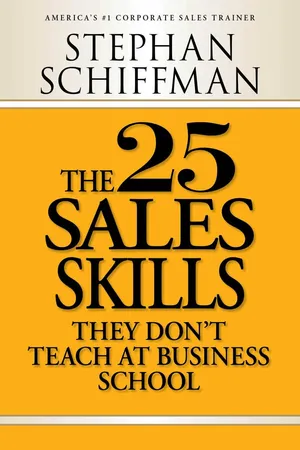
The 25 Sales Skills
eBook - ePub

The 25 Sales Skills

They Don't Teach at Business School

  1. 128 pages
  2. English
  3. ePUB (mobile friendly)
  4. Available on iOS & Android
eBook - ePub

The 25 Sales Skills

They Don't Teach at Business School

About this book

Master the skills you can't learn in a classroom!

You can break into today's cutting-edge sales force--and become a leader. All it takes is learning Stephan Schiffman's essential skills. Honed to perfection over decades of experience, his techniques will make you a top sales performer.

From the man who's trained more than a half-million salespeople, these are the secrets you won't learn in any classroom. Now they're yours for the taking and will put you on the fast track to career advancement. With Schiffman at your side, you can build a successful sales future for your company and yourself.
Frequently asked questions

Yes, you can cancel anytime from the Subscription tab in your account settings on the Perlego website. Your subscription will stay active until the end of your current billing period. Learn how to cancel your subscription.
No, books cannot be downloaded as external files, such as PDFs, for use outside of Perlego. However, you can download books within the Perlego app for offline reading on mobile or tablet. Learn more here.
Perlego offers two plans: Essential and Complete
  • Essential is ideal for learners and professionals who enjoy exploring a wide range of subjects. Access the Essential Library with 800,000+ trusted titles and best-sellers across business, personal growth, and the humanities. Includes unlimited reading time and Standard Read Aloud voice.
  • Complete: Perfect for advanced learners and researchers needing full, unrestricted access. Unlock 1.4M+ books across hundreds of subjects, including academic and specialized titles. The Complete Plan also includes advanced features like Premium Read Aloud and Research Assistant.
Both plans are available with monthly, semester, or annual billing cycles.
We are an online textbook subscription service, where you can get access to an entire online library for less than the price of a single book per month. With over 1 million books across 1000+ topics, we’ve got you covered! Learn more here.
Look out for the read-aloud symbol on your next book to see if you can listen to it. The read-aloud tool reads text aloud for you, highlighting the text as it is being read. You can pause it, speed it up and slow it down. Learn more here.
Yes! You can use the Perlego app on both iOS or Android devices to read anytime, anywhere — even offline. Perfect for commutes or when you’re on the go.
Please note we cannot support devices running on iOS 13 and Android 7 or earlier. Learn more about using the app.
Yes, you can access The 25 Sales Skills by Stephan Schiffman in PDF and/or ePUB format, as well as other popular books in Business & Business General. We have over one million books available in our catalogue for you to explore.

Information

Publisher
Adams Media
Year
2002
Print ISBN
9781580626149
eBook ISBN
9781440501982

Skill #1

Beware of Bad Advice on the Internet

How much should I trust what I read on the Internet about sales?
The Internet has changed the way many people sell. Few of us could have imagined, six or seven years ago, how easy it would become to gain access to some of the most vital daily selling information. Researching a company? You can now check for its Web site easily. Hungry for new leads? Dozens of online resources can point you toward new people and companies to contact. Looking for advice on how to improve your selling technique? Hundreds of (self-appointed) sales experts are only a click away.
And this is where you can get yourself into trouble. Too many sales “gurus” use their sites to dispense advice that can sabotage the job of building a relationship with your prospect. Consider the following:
Bad advice: Don’t work with the prospect to develop a plan that “makes sense”—instead, use pressure tactics. A site we visited encouraged salespeople to ask this question when face to face with a hesitant contact: “Now, don’t you agree that this product can help you or would be of benefit to you?” Ouch. A better approach Would be to ask, “What exactly are you trying to get accomplished in this area?”
Bad advice: Find the pain. Several sites we encountered advised salespeople to use questions to plant subliminal “hints” designed to get prospects to reveal that they actually hate their current vendor. Examples: “Do you also worry about … ?” “How tough a position does that put you in?” Instead of trying to find the pain—which may or may not exist—salespeople should focus on finding out what the prospect actually does.
Bad advice: “Always be closing.” This outdated maxim showed up as constructive advice on more than one of the sales sites we visited, as did any number of manipulative closing “tricks” that will quickly destroy emerging relationships. More pragmatic advice: “Always be asking questions.” At the conclusion of an in-depth information-gathering period—which should occupy 75 percent of any sales process—you can present a plan that makes sense to the other person, and close by asking, “It makes sense to me—what do you think?”
The bottom line: It’s too easy to set up a Web site—which makes it hard to find a good one with relevant, responsible information for salespeople. Beware of the advice you take from the Internet.

Skill #2

Use Company Events to Move the Relationship Forward

“I’ve lost ground with a couple of former prospects who asked me to ‘keep in touch’ the last time I spoke to them. I want to win some action in these relationships after a few dormant weeks (or months!). How do I do it?”
“Thanks for calling to confirm—but I’m afraid I’m going to have to cancel our meeting for next week. We’ve decided to put a hold on all our spending in this area for now. We’ll be reevaluating in a couple of months. Keep in touch, all right?”
It’s part of the sales landscape—a law as dependable as gravity No matter how effective, persuasive, or experienced a given salesperson is, some percentage of that person’s promising leads will turn into “opportunities.” These are static contacts that aren’t moving through the sales process and can’t be counted on to provide income—at least for the time being.
The question really isn’t whether contacts will fall into the “opportunity” category but what steps to take when they do. How do you reignite interest and generate activity within your list of “cold” prospects? Canadian sales representative Gino Sette came up with an interesting strategy.
Gino decided to write a letter to every prospect who had decided not to buy from him over a given period. Basically, the letter said this: “It was a pleasure meeting with you a while back to talk about what your company was doing. Even though we were unable to move forward at that time, I’m still thinking about you.”
Gino then invited each “cold” contact to sit in at one of his company’s upcoming events. “This will give you an opportunity to evaluate, firsthand how applicable what we do is to your business environment,” he wrote. “Attached is a list of all upcoming training where my clients have approved outside observers. I’ve also included a brief description of each of the programs.”
According to Gino, he got calls from prospects who were very interested in observing specific programs, even though they had initially declined his firm’s services.
The letter-writing strategy had another application as well. Gino decided to write to each member of his active client base and extend the same invitation. The letter began as follows: “First of all, let me thank you for allowing us to work with you and XYZ Company. We are very excited to have you as part of our client list, as you are a significant player. It is for this reason that I would like to extend the following invitation to you …”
As his flurry of return calls proved, Gino’s innovative letter technique is an effective way to win back (or solidify) your position on the to-do lists of your customers and inactive leads. His idea can be adapted to training programs, open houses, media events, and any number of other occasions.
The bottom line: Send your “cold” leads—and your customers invitations to upcoming company events.

Skill #3

Stop Spinning Your Wheels with People Who Don’t Really Want to Work with You—and Start “Following the Yes”

“I’m spending too much time with leads that don’t seem to turn into anything. How can I tell who’s really interested in working with my organization?”
First and foremost, let’s define what we mean by “prospect.” A prospect is someone who is willing to take an active step—demonstrated by a specific time commitment—to talk seriously about the possibility of working with you.
That’s an extremely important definition. Do yourself—and your career—a favor: Commit it to memory!
The most effective salespeople learn to spot people who aren’t giving them a clear “yes” answer to follow, and distinguish those people from the rest of the world. The trick is to understand that the relevant “yes” answers take many important forms before the close, but virtually always include some kind of time commitment:
“Yes, I’ll meet with you next Tuesday at three o’clock.”
“Yes, I’ll introduce you to my boss next Monday morning.”
“Yes, I’ll take a look at your notes and tell you what works and what doesn’t. Let’s schedule a conference call.”
“Yes, I’ll schedule a meeting with the full committee. When are you free?”
“Yes, we’d like you to start on January first.”
No book can teach you how to make a prospect do something he or she doesn’t want to do. If you follow the advice that appears below, however, you will make the most of your time and maximize the number of prospects who decide to tell you what to do—by giving you business.
Three Steps to Following the Yes
Here are the three steps you can take right now to begin following the yes.
Step One. Make a habit of “throwing out the ball” (suggesting a Next step) to a number of people each and every day.
If you’re uncertain what your target number should be, read Cold Calling Techniques (That Really Work!) or take D.E.I.’s course in appointment making. Either way, you’ll work through the numbers thoroughly to set your daily prospecting goals. (“Throwing out the ball” might sound like this: “I’d love to get together with you to talk about what we’ve done with the XYZ Company. Can we meet Tuesday at three o’clock at your office?”)
(By the way, if you’re interested in taking advantage of on-line courses in Appointment Making, Prospect Management, or High Efficiency Selling, you can find out more about those training resources at www.dei-sales.com. Our Web site offers full-scale on-line overviews of all of our in-person training programs.)
Step Two. Learn to distinguish “sounds like YES” answers from “actual YES” answers.
“Actual YES” answers are ones in which the person agrees to a clear next step with you, complete with date and time, that’s scheduled for the near future (typically, within the next two weeks). “Actual YES” answers could sound like this:
You: Can we get together Wednesday at two o’clock to talk about this further?
Prospect: Wednesday’s no good for me; what about Friday morning?
Or they could sound like this:
You: Why don’t you and I meet with your supplier next week to set up a plan?
Prospect: You know what? That’s a great idea. When are you free?
Step Three. Treat everything that’s not an “actual YES” as though it were an “actual NO.”
Here’s the really critical point: Stop wasting time with people who are not actually moving through the sales process with you. So even if the person says, “Call me sometime next month,” we put that person lower on the priority list than someone who says, “Let’s talk next Monday at two o’clock.”
The bottom line: Invest your time wisely, move on to someone new, and stop spinning your wheels.

Skill #4

Harness the Power of “I Didn’t Anticipate That”

“I just had the worst meeting of my life had no idea what to say when the rospect shot me down. What do you o in a situation like that?”
The most successful salespeople work from the principle that all responses are anticipated. What does that mean? It means that, as professionals, we’ve had enough conversations with enough people over the years to develop a reliable sense of what’s likely to happen next during an exchange with a prospect or customer. Put more bluntly, experienced salespeople don’t get taken by surprise all that often. If that’s a fact of sales life—and it is—we can actually use this principle to our advantage in turning around the negative responses we hear.
Consider the following scenario. Alan, a young sales representative in the telecommunications industry, meets with Bill, a middle-aged MIS director at a Fortune 100 company. At the end of a good first meeting, Alan says to the prospect, “I’d like to get together with you again so I can show you a preliminary proposal—an outline of what we might be able to do for you. Why don’t we set a meeting for next Tuesday at three o’clock?” And then the roof seems to fall in.
“Alan,” Bill says, “it’s been nice talking to you, and you’re certainly working on some interesting projects, but let me save us both some time. I’ve been in charge of telecom here for fifteen years, and I have a pretty good idea of what your company has to offer. I really don’t think there’s a match here. But if you want to, you can go ahead and mail your information to me, and I’ll call you back if I’m interested. “
Suppose Alan were to try to explain why what he wanted to outline in the preliminary proposal would be perfect for Bill’s organization? How would that go over? More than likely. Bill would get annoyed. He might even suggest that Alan do a little more homework about his industry before attempting to continue the conversation. But consider another approach, one that emphasizes Alan’s experience in the world of sales, levels the playing field, and points the relationship in a positive direction.
Suppose that, when Bill puts up a roadblock by saying something like, “Go ahead and mail the information to me instead,” Alan looks a little startled. There’s a brief pause. Then Alan says, “Gee, I really didn’t anticipate that you would say that.”
What happens next? Ninety-five times out of a hundred, if Alan says that and stops talking. Bill will ask a neutral question—like, “Really, why not?” Suddenly, the playing field is level!
Alan can now say, “Well, frankly, our conversation was going so well, I really expected a different outcome. Can you help me out? Should I ...

Table of contents

  1. Cover Page
  2. Title Page
  3. Contents
  4. Introduction: The Hidden Sales Curriculum
  5. Skill #1. Beware of Bad Advice on the Internet
  6. Skill #2. Use Company Events to Move the Relationship Forward
  7. Skill #3. Stop Spinning Your Wheels with People Who Don’t Really Want to Work with You — and Start “Following the Yes”
  8. Skill #4. Harness the Power of “I Didn’t Anticipate That”
  9. Skill #5. “Beware Casual Friday”
  10. Skill #6. Ask Key Questions about Your Best Accounts
  11. Skill #7. Find Out What’s Changed
  12. Skill #8. Use E-mail Intelligently
  13. Skill #9. When in Doubt Ask for the Appointment
  14. Skill #10. Don’t Try to Close
  15. Skill #11. Raise Tough Issues Yourself
  16. Skill #12. Get More Return Phone Calls
  17. Skill #13. Don’t Bring Everything!
  18. Skill #14. Don’t “Product Dump?”
  19. Skill #15. Beyond “Slapshot” Selling
  20. Skill #16. Master PIPA (Learn the Art of First Meeting)
  21. Skill #17. Get Prospects to Open Up to You
  22. Skill #18. Prepare Questions ahead of Time!
  23. Skill #19. Don’t Present Too Early
  24. Skill #20. Verify Your Information
  25. Skill #21. Ask Yourself the Right Questions
  26. Skill #22. Know What You Want before You Even Walk in the Door
  27. Skill #23. Work Your Way up the Ladder
  28. Skill #24. Close the Sale
  29. Skill #25. Avoid the Ten Most Common Mistakes
  30. Epilogue: Don’t Kid Yourself
  31. Also Available
  32. Copyright