Get Hired Fast!
eBook - ePub

Get Hired Fast!

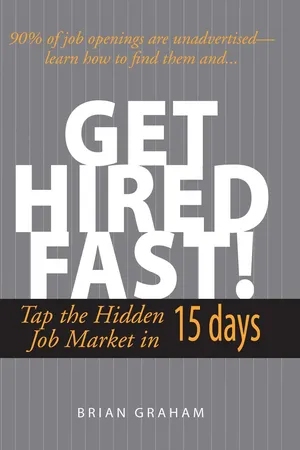
Tap The Hidden Job Market In 15 Days

  1. 224 pages
  2. English
  3. ePUB (mobile friendly)
  4. Available on iOS & Android
eBook - ePub

Get Hired Fast!

Tap The Hidden Job Market In 15 Days

About this book

The Job Search Technique Most Recommended by Top Career Counselors

You lost your job six months ago. You've emailed 90 resumes. You've scoured the job boards and the help wanted ads. You've called recruiters, old bosses, former coworkers...but nothing. You're scared. You're beginning to think there are no jobs out there. But there ARE jobs. And you can get one of them--if you're willing to try the job search technique that most people are too timid to try.

If you're one of 9 million Americans looking for a job, you don't want to go 12 to 24 months without a job offer (as many do). The trick is to tap into the hidden job market--where 90 percent of the jobs really are!

Get Hired FAST! shows you how to use a direct-calling strategy that will generate at least three interviews in three weeks. It gives you a 15-day Action Plan, complete with charts, scripts, and other tools that will enable you to use the direct-calling technique like a professional.

This no-holds-barred book also includes insider advice on how to ace the interview once your calling strategy pays off, negotiate the best offer, and keep the job once you get it.

Get Hired FAST! shows you where and how to identify key contacts in target companies, how to uncover crucial data about target companies, how to script calls to hiring managers in advance--and handle any scenario, from voicemail to conversations with contacts' staffers.
Frequently asked questions

Yes, you can cancel anytime from the Subscription tab in your account settings on the Perlego website. Your subscription will stay active until the end of your current billing period. Learn how to cancel your subscription.
No, books cannot be downloaded as external files, such as PDFs, for use outside of Perlego. However, you can download books within the Perlego app for offline reading on mobile or tablet. Learn more here.
Perlego offers two plans: Essential and Complete
  • Essential is ideal for learners and professionals who enjoy exploring a wide range of subjects. Access the Essential Library with 800,000+ trusted titles and best-sellers across business, personal growth, and the humanities. Includes unlimited reading time and Standard Read Aloud voice.
  • Complete: Perfect for advanced learners and researchers needing full, unrestricted access. Unlock 1.4M+ books across hundreds of subjects, including academic and specialized titles. The Complete Plan also includes advanced features like Premium Read Aloud and Research Assistant.
Both plans are available with monthly, semester, or annual billing cycles.
We are an online textbook subscription service, where you can get access to an entire online library for less than the price of a single book per month. With over 1 million books across 1000+ topics, we’ve got you covered! Learn more here.
Look out for the read-aloud symbol on your next book to see if you can listen to it. The read-aloud tool reads text aloud for you, highlighting the text as it is being read. You can pause it, speed it up and slow it down. Learn more here.
Yes! You can use the Perlego app on both iOS or Android devices to read anytime, anywhere — even offline. Perfect for commutes or when you’re on the go.
Please note we cannot support devices running on iOS 13 and Android 7 or earlier. Learn more about using the app.
Yes, you can access Get Hired Fast! by Brian Graham in PDF and/or ePUB format, as well as other popular books in Personal Development & Careers. We have over one million books available in our catalogue for you to explore.

Information

Publisher
Adams Media
Year
2005
Print ISBN
9781593372637
PART
ONE


When the Rules Don’t Work,
Change the Game: Why Direct Calling
Works When Nothing Else Does
CHAPTER
ONE

This Used to Be Easy—What Happened?

Last time you needed a job, you posted your resume on Monster.com and got six calls the first day. You’re just as qualified now—but the phone isn’t ringing. This chapter will explain why jobs can be hard to find, and why you need to adapt your job-search strategies to uncover the ones that are out there.

Remember the “good old days”? A few years ago, finding a job was simple: You posted your resume on Monster.com, put the word out to your friends, sent hard copies of your resume to a few companies, and got in touch with the recruiters who’d been pestering you for months. Then you ordered a pizza, sat down with a good book, and waited for the phone to ring.
Usually, you didn’t have to wait long. Back then, employers hired nearly everyone in sight, and workers—especially those in high-tech jobs—could name their price. With the dot-com boom in full swing, and employment hovering at 4 percent (and only 1.3 percent in places like Silicon Valley), employers were desperate, offering huge signing bonuses and high salaries to anyone with skills. They’d even pay their staff thousands of dollars just for referring new employees.
That was then. Now, just a few years later, it’s a new world. Fortunately, we’re emerging from the shadow of the latest recession and recovering from the terrible hits our country took at the start of the new millennium: the tragedy of September 11, the dot-com crash, the scandals that brought down major corporations. Hiring is picking up, and we’re getting back to normal—but it’s a “new normal,” and the job market will never be the same again.
Hope on the Horizon?
All signs indicate that the job market will be unpredictable for several years to come. Even experts can’t forecast what’s going to happen over the short term, because so many forces are acting on the economy and the employment market. However, one thing seems fairly certain: If you can hang on until 2010 or so, you’ll probably have it made. That’s because Baby Boomers are hitting retirement age, and, before the decade is out, they’ll leave millions of job slots empty. The National Association of Manufacturers recently released a white paper forecasting a “skilled worker gap” that will begin appearing in 2005 and increase to 5.3 million workers by 2010, and 14 million by 2020. Generations X and Y are simply too small to replace that many employees. Thus, with luck, the job seekers of the year 2010 will get to turn the tables on employers, and once again call the tune when it comes to salaries, perks, and benefits.
Why? For one reason, we’re learning how to be more productive— that is, how to do the same amount of work (or even more) with fewer resources, including fewer people. Hundre ds of new technologies, from self-serve grocery lines to self-restoring computer networks, are allowing companies to cut staffs without cutting service. That’s good news for corporations, but it’s bad news for highly qualified people who suddenly find themselves out of a job.
Another seismic shift is occurring as a result of globalization, with millions of other people finding that their jobs are still needed—but not in the United States. America is now in the throes of a “structural” change in the job market, with hundreds of thousands of information technology, software engineering, manufacturing, and call center jobs leaving America for India, China, and other offshore sites. Gartner, a top research firm, predicts that in the very near future, one out of every ten jobs with U.S.–based information-technology vendors or service providers will move out of the country; Forrester Research predicts that, by the year 2015, an additional 3.3 million white-collar jobs will move overseas. And the losses are not confined to the tech sector. Manufacturing and call center jobs are being out-sourced, while other fields such as accounting, architecture, medical dictation, and even radiology are losing jobs to offshoring.
That leaves more people, many of them highly qualified and accustomed to excellent salaries and great benefits, scrambling for the dwindling number of jobs that can’t be outsourced. The result is that many people with expensive college degrees and years of experience are finding it nearly impossible to get a job. Of course, if you’re one of these people, you don’t need to be told this. You’re living it firsthand.
Is It Going to Get Better?
Yes and no. In general, it looks like the bear market for job hunters is over. But many of the jobs lost due to structural changes aren’t coming back in quantity any time soon.
While some fields will prosper for the foreseeable future—now is a great time to be a nurse or a home health care provider, for instance— people in many formerly “bulletproof” fields, from accounting to architecture to financial advising, are discovering that the economic rebound isn’t translating into easy job-hunting. And many people who are currently employed are finding that even in a job market recovery, their companies still expect long hours of overtime work in exchange for inadequate wages and benefits—a fact that’s likely to be true for some time to come.
Even though the large-scale Baby-Boomer retirement will ease job market strains down the road, that’s little consolation for people who need a job now. If you’re in a field hard-hit by restructuring, automation, or outsourcing, it could be a buyer’s market for the next few years when it comes to hiring.
Where Does That Leave You?
If you’re one of the millions of Americans looking for a job, or you’re trapped in a dead-end job you hate, the current situation leaves you in trouble if you’re relying solely on traditional job-hunting techniques. The tried-and-true methods that always worked before aren’t working as well any more for people in job fields undergoing structural changes, and they aren’t likely to work in the future—at least the near future. That’s because as the job market changes, so do the hiring methods of companies and the strategies of recruiters.
Here are four recent changes in the hiring process that have made traditional job-search techniques ineffective for many people:
Change #1: Human resources departments often won’t read your resume
Four years ago, if you sent a resume to the human resources department of a company, you had a good chance of getting a call, especially if you worked in a high-tech field. Today, however, you may be going up against hundreds, or even thousands, of highly qualified candidates who are doing the same thing. Even a strong resume may not help you, because many HR departments were pared to the bone during the recent recession, leaving almost no one to manage the daily flood of letters and e-mails from job seekers. In bad economic times, administrative workers who don’t directly generate revenue often get cut in the first round of layoffs. Frequently, HR staffs are severely downsized, and some smaller companies eliminate their HR staffs almost entirely—a trend that takes time to reverse, even when the economy picks up.
This has two consequences. One, of course, is that fewer people are available to screen resumes and identify good prospects. Another more subtle effect is that, with fewer in-house recruiters (or, often, none at all) focusing on long-term corporate goals, companies lose their vision and hire only enough people to keep the day-to-day operations going. Other goals—bringing in new talent with a fresh perspective or keeping a company on the cutting edge of its industry— go out the window. It’s shortsighted, and eventually it will hurt these businesses, but for now it’s a fact of life.
However, corporate shortsightedness isn’t the only reason that your resume won’t land on the desk of the person you need to impress. Another reason is that in the age of the Internet, it’s easy for job seekers to shotgun resumes to hundreds of companies. The result is an avalanche of applications for every open position, and even corporations with healthy human resources staffs can’t begin to give serious consideration to the stacks of resumes they receive. Intel, for example, gets 15,000 to 20,000 resumes each month, and Google receives 1,000 every day.
Most large companies feed these resumes into automated Applicant Tracking Systems that parse the information and feed it into a database. If you’ve used the right formatting tricks, which are discussed later on in the book, the facts on your resume will probably make it in there—but so will data from thousands of other candidates. Hidden in amongst that mass of bits and bytes, your resume will be as lost as the proverbial needle in a haystack.
Worse yet, the data in Applicant Tracking Systems quickly becomes unwieldy, so HR staffs often purge “old” resumes after a few months. The result is that thousands of resumes never make it into a database, or are deleted before ever being read by a human being. Thus, of the hundreds of carefully crafted letters and resumes you’re likely to send during your quest for a job, only one or two dozen—if you’re lucky— are going to get a serious reading.
Using a company’s online application process is equally frustrating. Most online forms force you to strip your accomplishments down to bare bones (“check your three primary skill areas,” “list your last two positions”) so that your data can be parsed electronically, meaning that you’ll sound no different or better than every other sales manager or Web designer who’s applying for a job.
Change #2: Recruiters might not be much help
Don’t count on third-party recruiters to find you a job. Today’s recruiters are inundated with resumes, and it’s their job to field a few candidates quickly—not to wade through all those resumes to find the best candidates. You’ll probably find to your dismay that the same recruiters who cultivated you during the boom times won’t give you the time of day now, if you’re in a field that’s no longer in huge demand.
TALE from the TRENCHES
I spoke recently with a senior level accountant who had interviewed with three prospective employers. “Most of the interviewers acted as if they were doing me a favor by even talking with me,” he told me. “Things sure have changed since a few years ago.” He told me that two of the companies never provided any follow-up at all after his interviews. The final company sent him a “thanks, but no thanks” e-mail.
His story is one of thousands with the same theme. Only a select number of companies, and a select number of recruiters, do the right thing by treating applicants as politely during candidate gluts as they do during candidate shortages.
This might seem unfair, but look at it from the recruiter’s point of view. If a recruiter gets 120 resumes from technical writers, and the first dozen resumes in that stack are excellent, the payoff for wading through the rest of the stack is almost nonexistent. A few years ago, the jobs-to-candidates ratio was so high that recruiters could place virtually any qualified employee in a good position, so they took nearly all comers and worked at cultivating long-term relationships with many of their candidates. Now, with the pool of jobs dwindling in several once-hot fields, recruiters are scrambling to attract employers rather than candidates, because the latter (unfortunately for job hunters) are in good supply.
Change #3: Job boards aren’t what they used to be
A few years ago, you could get a job within weeks (or even days) simply by posting your resume on Monster, Dice, FlipDog, or other job boards. It wasn’t unusual for candidates in high-demand fields to get a dozen calls on the first day of posting a resume.
These days, however, you may be shocked when you visit the job boards, list your keywords, and hit the “search” button. If you’re in one of the fields undergoing cataclysmic shifts due to mechanization or outsourcing, you’ll probably discover that instead of hundreds of listings in your field, there are only a few dozen that appear to fit your skills—if you’re lucky. You’re also likely to discover that a significant percentage of these listings are for jobs that are already filled.
There are a number of reasons for this. One reason, of course, is that in a number of fields affected by structural changes, there are fewer job openings overall. Another is that with human resources departments decimated in recent years, most HR staffs are so overworked that maintaining job boards is now a low-level priority. Many positions never get posted at all, many others do not accurately reflect the jobs they’re advertising, and many never get removed when they’re filled.
As a result, the number of real positions advertised on job boards can be depressingly small (and often does not accurately reflect the actual number of openings at the firms posting the jobs). Frequently, highly qualified job hunters respond to dozens or even hundreds of listings without ever gettin...

Table of contents

  1. COVER PAGE
  2. TITLE PAGE
  3. COPYRIGHT PAGE
  4. DEDICATION
  5. CONTENTS
  6. ACKNOWLEDGMENTS
  7. PART ONE: When the Rules Don’t Work, Change the Game: Why Direct Calling Works When Nothing Else Does
  8. PART TWO: The Fifteen-Day Direct-Calling Campaign: Your Game Plan for Success
  9. PART THREE: Following Through: How to Nail the Job
  10. PART FOUR: Take Control of Your Future: How to Enhance Your Job Security—And Your Long-Term Career Security