Poems in the Manner Of
eBook - ePub

Poems in the Manner Of

  1. 160 pages
  2. English
  3. ePUB (mobile friendly)
  4. Available on iOS & Android
eBook - ePub

Poems in the Manner Of

About this book

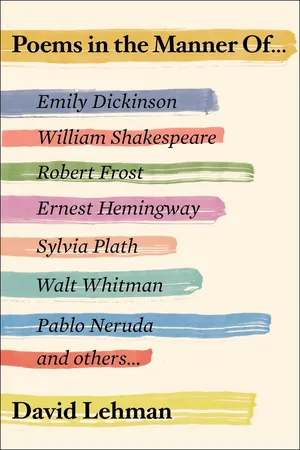
Poems in the Manner Of is an illuminating journey through centuries of writers who continue to influence new work today, including that of respected poet and series editor of The Best American Poetry David Lehman. "Very few writers can actually shape how you see the world. David Lehman is such a writer, " says Robert Olen Butler. Now the Best American Poetry series editor and New School writing professor channels, translates, and imagines a collection of "poems in the manner of" Emily Dickinson, Robert Frost, Shakespeare, W.B. Yeats, Rilke, William Carlos Williams, and more.Lehman has been writing "poems in the manner of" for years, in homage to the poems and people that have left an impression, experimenting with styles and voices that have lingered in his mind. Finally, he has gathered these pieces, creating a striking book of poems that channels poets from Walt Whitman to Sylvia Plath and also calls upon jazz standards, Freudian questionnaires, and astrological profiles for inspiration.Intelligent and sparkling, this is a great gift for poetry fans and a useful resource for creative writers. These are poems of wit and humor but also deep emotion and clear intelligence, informed by Lehman's genuine and knowledgeable love of poetry and literature. From Catullus and Lady Murasaki to Wordsworth, Neruda, Virginia Woolf, W.H. Auden, and Charles Bukowski, Poems in the Manner Of shows how much life there is in poets of the past. And like Edward Hirsch's How to Read a Poem and Robert Pinsky's Singing School, this book gives you more than poetry. Whether you're reading for pure enjoyment or examining how a poet can use references and influences in their own work, Poems in the Manner Of is a treasure trove of literary pleasures and food for thought.
Frequently asked questions

Yes, you can cancel anytime from the Subscription tab in your account settings on the Perlego website. Your subscription will stay active until the end of your current billing period. Learn how to cancel your subscription.
No, books cannot be downloaded as external files, such as PDFs, for use outside of Perlego. However, you can download books within the Perlego app for offline reading on mobile or tablet. Learn more here.
Perlego offers two plans: Essential and Complete
  • Essential is ideal for learners and professionals who enjoy exploring a wide range of subjects. Access the Essential Library with 800,000+ trusted titles and best-sellers across business, personal growth, and the humanities. Includes unlimited reading time and Standard Read Aloud voice.
  • Complete: Perfect for advanced learners and researchers needing full, unrestricted access. Unlock 1.4M+ books across hundreds of subjects, including academic and specialized titles. The Complete Plan also includes advanced features like Premium Read Aloud and Research Assistant.
Both plans are available with monthly, semester, or annual billing cycles.
We are an online textbook subscription service, where you can get access to an entire online library for less than the price of a single book per month. With over 1 million books across 1000+ topics, we’ve got you covered! Learn more here.
Look out for the read-aloud symbol on your next book to see if you can listen to it. The read-aloud tool reads text aloud for you, highlighting the text as it is being read. You can pause it, speed it up and slow it down. Learn more here.
Yes! You can use the Perlego app on both iOS or Android devices to read anytime, anywhere — even offline. Perfect for commutes or when you’re on the go.
Please note we cannot support devices running on iOS 13 and Android 7 or earlier. Learn more about using the app.
Yes, you can access Poems in the Manner Of by David Lehman in PDF and/or ePUB format, as well as other popular books in Literature & Poetry. We have over one million books available in our catalogue for you to explore.

Information

Publisher
Scribner
Year
2017
Print ISBN
9781501137396
eBook ISBN
9781501137419
Subtopic
Poetry
Part One
The unexpurgated Catullus is the most bawdy and profane of poets. He hurls insults with brutal candor and makes the reader feel like doing the same.
Images

Two Poems in the Manner of Catullus

1. To a Critic
You made the mistake of praising my pain,
Flavius. This the connoisseurs of cool,
whose approval you seek and shall never gain,
could not condone. You should have known better.
They made you feel like a fool.
You joined in the laughter but it felt bitter.
And ever since you have panned
all work of my hand
with the result that I, too, despise you,
and I do not wish you well.
Yet I took no pleasure when I heard Junius tell
Calista your wife had cuckolded you
with her yoga teacher the same week
you faced a tax audit and ate a steak
with a side of fried poison, missed your train
and lost your job. I feel your pain,
Flavius. Not even a shmuck
like you deserves such lousy luck.
2. To a Rival
More beautiful than daffodils
in February or the face
that is always turned away
from the earth was Diana
a dance major at the High
School of Performing Arts
whose legs were long when
skirts were short, and what
was she doing with you
Junius, lecherous bastard who
tried to fuck every girl he met:
how could she fall for your shit?
Though I was born with a stutter,
Junius, I will denounce you yet
and win awards for my oratory
in a full session of parliament
When Ezra Pound translated Li Po, arguably the greatest poet in China’s Tang dynasty, he revolutionized two things at once: the craft of translation and the tone of modern poetry. He set the precedent that allows poets to translate from languages they do not know.
Images

Poem in the Manner of Li Po

In the Tai-T’ien mountains
the master has gone who knows where
I search for his absence
With wine I, too, am absent
from the night
Petals fall after the storm
down secret streams I see
the ghost of a yellow moon
There are other heavens
than are known to you and me
When I read Lady Murasaki’s Tale of Genji in New York in 1973, what enchanted me most was the notion that you could punctuate a narrative with a haiku, a little like the way an aria punctuates an opera.
Images

Poem in the Manner of Lady Murasaki

In the mist and gloom of twilight the prince, disguised in civilian clothes, approached Masuda Pond. Under a large gray rock glinting in the sunlight with brown, green, red, and blue layers of stone, he left a note for the young wife to decipher:
In the Eighth Month the nights grow long,
But the moon comes nearer than wind to the land.
Abandoned by her husband, who had traveled to the mainland on orders of his warlord, the Akashi lady blushed with an intensity of longing that surprised and frightened her. She thought:
I wonder who lives the fulfilled life:
The faithful wife or the ghost of her desire?
It was then that Genji remembered the shell of the locust: hollow, inanimate, yet it gave him the strength to confront a world of unrest. He gave the shell, attached to a long reed, to a boy who had earned his trust, and told him to bring it to the abandoned lady.
The wind carries my words to you,
Though you hear only the wind in the reeds.
And she of the white cheeks thought:
To be remembered is to be loved
If only until the frost nips the leaves.
Though the murmuring crowd expected him in Lotus Hall for the forty-ninth-day lamentations, Genji contrived to return to Masuda Pond. He dressed his lieutenant in his red satin robes and his ivory mask for the procession of scrolls. Then he trained the younger man for the ceremony, down to the minutest details. The apprentice imitated his master as a translator imitates a noble author of renown. When the day came, the congregants felt the spirit of Genji among them as they prayed for a bounty of grace. Disguised as a peasant Genji himself crossed the Uji River at daybreak and descended upon the bald scholar who had tutored him in Chinese poetry. To his mentor he confided his misgivings:
The lady has a single tear on her cheek, her husband gone,
But shall the prince reveal his love and not his name?
Slowly the elderly scholar and his eternal student sipped their Gyokuro tea. The prince said two words: ā€œjade dew.ā€ Delighted, his old professor ventured the opinion that the lady in question understood that the man comforting her had a secret identity. But (he added) ā€œshe is too well-bred to demand an explanation.ā€
In the house of the ā€œevening faces,ā€ the maidservants wondered what had happened to the Akashi lady. Had the wanton son of ChĆŗko Province spirited her off to the ā€œcloud of smokeā€?
Genji suppressed a laugh. He wrote:
The lake is a cloud of smoke,
But there is no light in the mist of morn
On Masuda Pond, there followed three days of blissful serenity and no noise except the tunes of birds, the chirp of insects, the wind in the reeds, the belching frogs.
When Man and Woman speak without words
They hear the secret music of the world.
When the three days ended, the Akashi lady cried. Despite her protests, Genji returned her to her cabin and bade her swear to greet her husband with a feast upon his return from the wars.
The prince let no one see him weep. Disguising his handwriting he wrote on a fallen leaf:
Autumn will end, all things must end,
But when summer returns with her robes, shall I cease to cry?
Iago’s cunning use of the phrase ā€œput money in thy purseā€ (Othello, act 1, scene 3) inspired these variations in the spirit of that cruel rhetorician.
Images

Poem in the Manner of Iago

Put money in thy purse,
Thy purpose make money.
As brokers sell short
and buy on the dips—
As waiters wait for tips—
As litigants in court
rake in the chips—
Make money thy end,
By all means make money.
*
Let poverty be a curse
for others to bear
with dust on their lips
and ash in their hair
Let the buyer beware
Put thy trust
in no friend
even if he swear
Do what you must
But make money.
*
You will die
and when you lie
beneath the ground
you will hear no sound
Go ahead, right some wrongs,
write speeches or fatuous folk songs
Reserve an expensive hearse
Put money in thy purse,
I say make money.
The most famous statement of advice from a father to a son is Polonius’s speech to Laertes in Hamlet with its injunction ā€œto thine oneself be true.ā€ From Polonius’s ā€œneither a borrower nor a lender be,ā€ I derived ā€œneither a follower ...

Table of contents

  1. Cover
  2. Introduction
  3. Part One
  4. Part Two
  5. Part Three
  6. Part Four
  7. Part Five
  8. Acknowledgments
  9. About David Lehman
  10. Copyright