
- 288 pages
- English
- ePUB (mobile friendly)
- Available on iOS & Android
eBook - ePub
About this book
A former paramedic’s "thrilling, captivating" (Booklist), and mordantly funny account of a decade spent as a first responder in Atlanta saving lives and connecting with the drama and occasional beauty that lies inside catastrophe.
In the aftermath of 9/11 Kevin Hazzard felt that something was missing from his life—his days were too safe, too routine. A failed salesman turned local reporter, he wanted to test himself, see how he might respond to pressure and danger. He signed up for emergency medical training and became, at age twenty-six, a newly minted EMT running calls in the worst sections of Atlanta. His life entered a different realm—one of blood, violence, and amazing grace.
Thoroughly intimidated at first and frequently terrified, he experienced on a nightly basis the adrenaline rush of walking into chaos. But in his downtime, Kevin reflected on how people’s facades drop away when catastrophe strikes. As his hours on the job piled up, he realized he was beginning to see into the truth of things. There is no pretense five beats into a chest compression, or in an alley next to a crack den, or on a dimly lit highway where cars have collided. Eventually, what had at first seemed impossible happened: Kevin acquired mastery. And in the process he was able to discern the professional differences between his freewheeling peers, what marked each—as he termed them—as “a tourist,” “true believer,” or “killer.”
Combining indelible scenes that remind us of life’s fragile beauty with laugh-out-loud moments that keep us smiling through the worst, A Thousand Naked Strangers is an absorbing read about one man’s journey of self-discovery—a trip that also teaches us about ourselves.
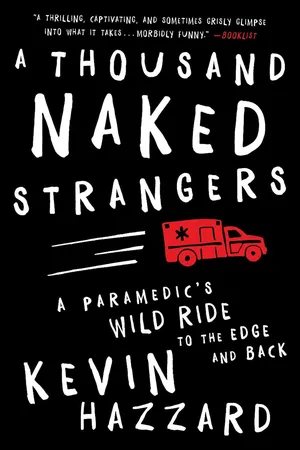
In the aftermath of 9/11 Kevin Hazzard felt that something was missing from his life—his days were too safe, too routine. A failed salesman turned local reporter, he wanted to test himself, see how he might respond to pressure and danger. He signed up for emergency medical training and became, at age twenty-six, a newly minted EMT running calls in the worst sections of Atlanta. His life entered a different realm—one of blood, violence, and amazing grace.
Thoroughly intimidated at first and frequently terrified, he experienced on a nightly basis the adrenaline rush of walking into chaos. But in his downtime, Kevin reflected on how people’s facades drop away when catastrophe strikes. As his hours on the job piled up, he realized he was beginning to see into the truth of things. There is no pretense five beats into a chest compression, or in an alley next to a crack den, or on a dimly lit highway where cars have collided. Eventually, what had at first seemed impossible happened: Kevin acquired mastery. And in the process he was able to discern the professional differences between his freewheeling peers, what marked each—as he termed them—as “a tourist,” “true believer,” or “killer.”
Combining indelible scenes that remind us of life’s fragile beauty with laugh-out-loud moments that keep us smiling through the worst, A Thousand Naked Strangers is an absorbing read about one man’s journey of self-discovery—a trip that also teaches us about ourselves.
Frequently asked questions
Yes, you can cancel anytime from the Subscription tab in your account settings on the Perlego website. Your subscription will stay active until the end of your current billing period. Learn how to cancel your subscription.
No, books cannot be downloaded as external files, such as PDFs, for use outside of Perlego. However, you can download books within the Perlego app for offline reading on mobile or tablet. Learn more here.
Perlego offers two plans: Essential and Complete
- Essential is ideal for learners and professionals who enjoy exploring a wide range of subjects. Access the Essential Library with 800,000+ trusted titles and best-sellers across business, personal growth, and the humanities. Includes unlimited reading time and Standard Read Aloud voice.
- Complete: Perfect for advanced learners and researchers needing full, unrestricted access. Unlock 1.4M+ books across hundreds of subjects, including academic and specialized titles. The Complete Plan also includes advanced features like Premium Read Aloud and Research Assistant.
We are an online textbook subscription service, where you can get access to an entire online library for less than the price of a single book per month. With over 1 million books across 1000+ topics, weāve got you covered! Learn more here.
Look out for the read-aloud symbol on your next book to see if you can listen to it. The read-aloud tool reads text aloud for you, highlighting the text as it is being read. You can pause it, speed it up and slow it down. Learn more here.
Yes! You can use the Perlego app on both iOS or Android devices to read anytime, anywhere ā even offline. Perfect for commutes or when youāre on the go.
Please note we cannot support devices running on iOS 13 and Android 7 or earlier. Learn more about using the app.
Yes, you can access A Thousand Naked Strangers by Kevin Hazzard in PDF and/or ePUB format, as well as other popular books in Literature & Literary Biographies. We have over one million books available in our catalogue for you to explore.
Information
BOOK THREE
Top of the World
21
Do No (Serious) Harm
A man stabs a woman in the chest. He does it with a dull pocketknife, rusted and grimy from a decade spent in his pants pocket. She screams and staggers backward, trailing blood through a crack house thatās beyond filthy, urban decay taken to a hellish extreme. To the junkies and dealers, this place is home. To the neighborhoodās elderly and infirmāpovertyās hostagesāitās a haunted house. Windows broken or missing. Door long since kicked in. Water leaking through the roof that warps the floors and turns the plaster walls into mush. A toilet no longer connected to the outside world, filled and overflowing with unimaginable waste. A rotating cast of crackheads turned genderless by desperation, who, with their lips blistered from white-hot crack pipes, give five-dollar blow jobs.
So what if a woman is stabbed in the chest? Itās just another day in the Zoo.
This is the first call I run after upgrading from EMT to medic. My first call working for Grady. Iām sitting in the passenger seat, uniform too new to fit right, with a studied look of nonchalance. The day the notice arrived in the mail that Iād passed my paramedic exam, I applied at Grady. As luck would have it, they were hiring. I underwent a physical, a written test, and a practical evaluation, smiled through an interview, then deposited my sign-on bonus. We spent three weeks in a classroom learning the Grady Way, then another three with field training officers, putting it into practice. Now Iām speeding through the streets, trying to focus but unable to think through the sirenās scream. Weāre in the Bluffāthe very part of town that Pike railed about three years ago during my ride-alongsāon our way to a crack house known as the Zoo, a place so notorious that someone has taken the time to spray-paint the words over the missing front door. As Biggie once said, if you donāt know, now you know.
We pull up on-scene and walk through the house, but the patient is no longer here. We find her a block away, shirtless and screaming, fingers crack-burned, lips crack-burned, pants wet from God knows what. She has a red flower of flesh bursting out from her left breast. I try to listen to her lungsāostensibly to see how far the knife has penetrated into the chest wall, and whether her chest cavity is filling with air or blood. In reality, I just need something to do. My hands tremble, my heart flutters, thereās a weakness in my stomach. I listen but hear nothing. Which could be bad. It could also be that weāre surrounded by noises: the distant whirl of a siren, the scream of the patient, the insistent yelling of the bystanders, the shouts of the drug dealers as they warn each other of approaching cops.
Iām starting to panic. I run through Chrisās list of rules and land on āNever let āem see you sweat.ā I take a deep breath, followed by a longer exhale. Itās not helping. The patient is still screaming. My partner is waiting for direction, but not for long. If I donāt make a decision and set the chain of events into motion, sheāll begin to act on her own, and thereās no recovering from that. The call will be out of sequence, and worse, when itās over, word will spread that I froze. To nut up, as they call it, is an act of paralysis, and it would leave an indelible black smudge on my reputation. No one would want to work with me, and those forced to would never trust me. All of this is in danger of happening, seems destined to happen, whenāwithout warning, without provocationāthe patient turns and runs. Disappears between two houses. I look at my partner, and she looks at me. Before either of us can say a word, a cop walks up behind us and says, āDid you see the tits on that broad?ā
The day Chris passed down to me those three rules, he also gave me his clipboard. Itās the clipboard we carried with us on every call, through every house, every situation we went through. It was the dented reminder of the confidence Iād built and the experience Iād gained in our time together. After he gave it to me I turned it in my hands, felt its heft. I opened it and took out the patient pen. Chris yanked on the end, and it farted. We both laughed.
Months later, Iām laughing once againāthis time with a cop I donāt know and at a patient whoās all mine. As we stand in the street watching the patientāshirtless, pendulous breasts swinging in the heatārun in and out of view, I add a fourth rule: Look for the weird and take time to laugh. My mind has been so crowded with the practicalities of medicine that Iāve forgotten why Iām here in the first place. And itās this. So I can stand in the street and witness this moment. I smile. I laugh. My hands stop trembling. I motion for the cop to go one way around the house and for my partner to go the other. They flush her out, and Iām waiting. Sheās still yelling, and it occurs to me that itās not only unlikely but impossible to scream with your lungs punctured and filling with blood. This isnāt serious. We take her to the ambulance and away from the chaos. She stops yelling but keeps talking. Still alive, still panicking, still very high on crack.
We do a quick assessment, and it turns out she was only stabbed in the boob. Still, it looks nasty. The human bodyāhers, mine, everyoneāsāis basically sausage. Puncture the skin, really puncture it, and fatty tissue explodes out like a pink mushroom cloud. It stays that way, wobbling like chewed bubble gum, until itās stuffed back in and the hole is closed. Itās neither practical nor hygienic to do this in an ambulance. I would never get the wound clean enough and in the end sheād wind up with a big festering boob. Which really isnāt ideal. So I put a clean dressing on it while the cop tries to figure out what happened. The conversation loops around and around until it comes out that her boyfriend caught her smoking his crack, and well, the rest we know. The boyfriendās name is Fat-Fat, and the victim doesnāt want to press charges. The cop hops out and closes the door. My partner puts the truck in gear, and we roll away.
When itās all over, my partner and I laugh and then run more calls. Sheās unaware how close I was to coming unglued, how close she was to issuing my death sentence by telling everyone that Iām no good.
⢠⢠ā¢
It continues like this day after day, calls coming in and me on the very edge of panic. Itās only a matter of time before the Big One shows up. Every new medic knows his first real test is out there, so I waitāhalf dreading it, half breathless with anticipation. When other medics speak, I hang on every word, peppering them with questions. I try to be discreet, but my desperation shows. What did you do? Howād you know to do that? What were the signs? Had you seen someone catch on fire before, or was the treatment something you learned in school? Iām looking for answers or help or peace of mindāan indication that Iāll be able to handle the moment when itās my turn. I casually solicit tips and advice, anything thatāll tell me what I should already know, what Iām paid to know. For my peers, weāre talking shop and telling war stories. Everyone else is looking for a laugh; Iām looking for advice.
Then one day it arrives. My first real test comes without warning, as just another call, though itās not. This stranger, the one whose death will fall in my lap, appears from nowhere to read my fortune and decide whether my future holds a transfer to a quiet fire service or a decade of riding out the madness on an ambulance.
My partner and I are sitting around talking when the call comes in. Our radio crackles with static and then the wordsāperson shot, multiple wounds. My skin goes cold. Sheās twenty-nine, and sheās been shot six times at close range. What that isābeing shot six times at close rangeāis beyond malice or anger. Itās pure hate. Itās death by a loved one. It happens on the far edge of town.
Weāre a long way out when the dispatch comes in, and with traffic, weāre slow to arrive. I hop out of the truck, and even from here I can see her, floating in a thick pool of blood thatās congealed into red pudding. The crowd is screaming, all emotion and panic. They know the victim and the perp, they know the police canāt control them. Over the shouting, I hear the patient gurgling through blood and clenched teeth. This is the real thing. Someone has been shot but not killed, and now Iām here, alone, to deal with it. My partner is competent but new, and just an EMT, so itās all on me. No one to fall back on, no one to help, no time to think. The patient, my patient, is dying.
We lower the stretcher. Sheās nothing but holes, blood, and a pair of brown eyes locked to the right and staring at a serious brain bleed. Someone is screaming for everyone to back up, to stop touching us, to give us room. I think itās my partner, but it could be me. Itās hard to say. My brainās in a blender. I suction the patientās mouth, watch blood swirl up the tubing. Then we strap her to a backboard and the stretcherās up and moving. More suctioning. In the ambulance, air conditionerās blowing warm air. Counting holes. Ventilating. Suctioning. Finding more holes. An IV in each arm. Fluids. Lots of fluids. A call to the hospital interrupted by a seizure. Enough seizure-stopping Versed to put down a horse. Finally, serenity.
Right before we get to the hospital, I do a final count for holes. Three in her chest, one in the neck, one in the face. Iāve slipped a hand under her head to check for head shots when her eyes pop open. I let go. Her eyes close. I press again. Her eyes pop open. Thereās a firefighter riding with us, and we look at each other as it becomes clear: My finger has slipped through a bullet hole and into her skull, and whatever Iām poking in there is making her eyes open and close. I say thatās probably not good, and he nods. āNo, I donāt think thatās good.ā
āIām not gonna do that again.ā
āProbably best.ā
At the hospital, sheās quickly assessed, further sedated, intubated, and taken to surgery.
The woman dies a little while later, though her boyfriendābarricaded in his apartmentāhangs on for a few more hours. We clean the truck, restock what we used, and go back in service. We run more calls. Iām not good yet, but I can lay to rest the question of whether Iāll panic when the Big One comes. I am and always will be a Grady medic.
22
The Private Life of a Public Hospital
Grady isnāt a hospital. Itās a trauma center and a stroke center, a burn unit, a psychiatric facility, an enormous public resource. Itās a creaking bureaucracy, underfunded, overburdened, and struggling to pay its bills. Its campus is dotted with clinics and sprawls across an immodest number of city blocks in downtown Atlanta. So itās a hospital, yes. But itās more than that.
Grady is an ecosystem. Swirling around it at all hours of the night are creatures from every level of the food chain. Thereās a woman who lives in the bus enclosure out front and sings at the top of her lungs. Sheās not singing songs but hymns, and when we arrive in the morning, we arenāt merely punching in to workāweāre receiving communion. Out in the streets, just beyond Gradyās front doors, are ambulances, doctors, nurses, visitors, the homeless, half-medicated lunatics and patients whoāve dragged their IV poles outside to smoke. Huddled together on the sidewalksāwhich are dotted with chewing gum and droplets of blood and the occasional human turdāare anxious family circles praying for loved ones, and the local news reporter whoās camped out because something tragic has happened. Something tragic always happens.
Thereās a McDonaldās beneath the parking deck. Hospital trash is taken out a few yards from the ramp where ambulances bring patients in. This ramp is new. The old one was smaller and faced a different direction and was bordered on one side by a wall. Regularsāvagrants and homeless and down-on-their-luck localsāwould sit on the wall and smoke cigarettes. Every time an ambulance came in, theyād clap and cheer. That wall became known as the Rooter Wall, the people perched on its ledge Rooters. To this day, patients transported repeatedly to Grady are called Rooters, and everyone who works here walks a fine line between love and hate when it comes to Rooters.
All this before we get inside.
Grady was built in 1892, and the original building still stands. The main hospital is much newer and infinitely larger and was once segregated into two facilities: one for whites, the other for blacks. Jim Crow is gone but not by much, and poor blacks, ever mindful of their separate-but-equal past, still refer to the hospitalāthe place they were born, where theyāre healed, and eventually, where theyāll dieāas the Gradys.
Thereās a main entrance with an atriumāmarble floors and high ceilings, a receptionist, mounted plaquesābut anyone sick, anyone coming by ambulance, enters through triage. Triage is a three-ring circus, and its main attraction is the human body gone suddenly, maybe irrevocably, wrong. Triage is run by two nurses, and at any given time itās occupied by a couple dozen patients in various states of need. The main floor is home to the waiting room and its hundreds of souls in limbo. Itās also home to the ECCāwhat youād call the ER. The Red Zone houses trauma; the Blue Zone houses medical. Both have a couple dozen rooms, plus twice as many informal hall spots where patients end up, despite having been shot, because someone has confirmed the wound isnāt life-threatening. The Red Zone includes the trauma bays where the most critically injured are treated. Itās also home to Red Obs, which is a cramped parking lot for violent psych patients too sedated or too in need of medical help to head upstairs.
The Blue Zone has no trauma bays, but it has the CPR room, four critical-care rooms, an asthma room, and the hospitalās detention area. Prisoners from the city or county jail, the men locked up in the federal penitentiary, all get handcuffed to a bed and brought to detention.
The ECC is a wild place overflowing with patients, competitive doctors, overworked nurses, and a ballooning coterie of support staff. It was built in the nineties, designed to replace an ER that took the worst the city had to offer, that functioned with a chaotic precision and whose tile walls sported a handful of bullet holes until it was demolished.
The cafeteria is on the second floor; labor and delivery is on the fourth. Every time a baby is bornāa child known from that moment on as a Grady Babyāa lullaby is played over the hospitalās PA system so everyone knows another life has entered the world. This city has a lot of Grady Babies, thousands, and the song has announced the arrival of so many for so long that halfway through, it fades and hiccups only to gain strength toward the end.
The morgue is in the basement. The psych ward is on thirteen.
Grady is a strange place and very much a part of this cityās fabric. The EMS department is no different. Wearing a Grady uniform, driving a Grady ambulance, gets me into and (more important) out of countless dangerous situations. People walking down the street, all of them Rooters, many of them Grady Babies, stop and wave as we drive by. Hey there, Grady is yelled every day from every frayed corner of this city. But itās not easy. The call volume is enormousāover a hundred thousand a yearāand the patients (mostly homeless, many drunk) are a handful. Turnoverās so high that people whoāve been around a while wonāt speak to me until Iāve made it six months. Thatās the first threshold. If I havenāt been fired or quit o...
Table of contents
- Cover
- Epigraph
- Prologue
- Book One: A Change of Plans
- Book Two: Fresh Meat
- Book Three: Top of the World
- Book Four: The Fall
- Epilogue
- Acknowledgments
- About the Author
- Copyright