
- 416 pages
- English
- ePUB (mobile friendly)
- Available on iOS & Android
eBook - ePub
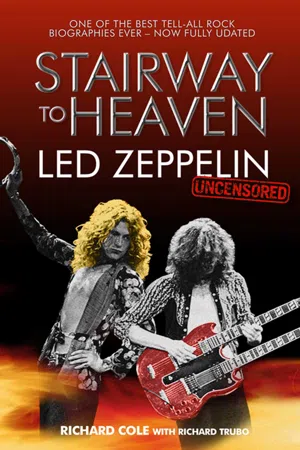
Stairway To Heaven
About this book
The most powerful, popular and enduring rock band of all time, the excitement of Led Zeppelin's music was matched only by the fever pitch of their off-stage antics. In hotel rooms and stadiums, in a customized private Boeing 707 jet and country estates, tour manager Richard Cole saw it all - and here tells it all in this close-up, down-and-dirty, no-holds-barred account. This revised edition brings readers up to date on the lives and careers of the band members, whose wild excesses, bizarre lifestyles and ground-breaking music are now the stuff of legend.
Frequently asked questions
Yes, you can cancel anytime from the Subscription tab in your account settings on the Perlego website. Your subscription will stay active until the end of your current billing period. Learn how to cancel your subscription.
No, books cannot be downloaded as external files, such as PDFs, for use outside of Perlego. However, you can download books within the Perlego app for offline reading on mobile or tablet. Learn more here.
Perlego offers two plans: Essential and Complete
- Essential is ideal for learners and professionals who enjoy exploring a wide range of subjects. Access the Essential Library with 800,000+ trusted titles and best-sellers across business, personal growth, and the humanities. Includes unlimited reading time and Standard Read Aloud voice.
- Complete: Perfect for advanced learners and researchers needing full, unrestricted access. Unlock 1.4M+ books across hundreds of subjects, including academic and specialized titles. The Complete Plan also includes advanced features like Premium Read Aloud and Research Assistant.
We are an online textbook subscription service, where you can get access to an entire online library for less than the price of a single book per month. With over 1 million books across 1000+ topics, weâve got you covered! Learn more here.
Look out for the read-aloud symbol on your next book to see if you can listen to it. The read-aloud tool reads text aloud for you, highlighting the text as it is being read. You can pause it, speed it up and slow it down. Learn more here.
Yes! You can use the Perlego app on both iOS or Android devices to read anytime, anywhere â even offline. Perfect for commutes or when youâre on the go.
Please note we cannot support devices running on iOS 13 and Android 7 or earlier. Learn more about using the app.
Yes, you can access Stairway To Heaven by Richard Cole in PDF and/or ePUB format, as well as other popular books in Media & Performing Arts & Music. We have over one million books available in our catalogue for you to explore.
Information

CRASH LANDING
Richard, something bad has happened to one of your Led Zeppelin boys.â
Julio Gradaloni had a grim expression on his face as he nervously shuffled through his briefcase, finally pulling out a newspaper and placing it on the table in front of us.
âWhat do you mean?â I asked him, feeling some anxiety starting to chill my body. âWhatâs happened?â
Julio was my attorney, a stocky, no-nonsense lawyer in his middle fifties. He was sitting across from me in the visiting room at Rebibia Prison near Rome. I had been imprisoned there for nearly
two monthsâon suspicion of terrorism, of all things. During those weeks behind bars, I was bewildered and frustrated, desperately and futilely trying to convince the police and prosecutors
that my arrest had been some kind of blunder, that I was no more likely to blow up buildings in Italy than would the Pope himself. But on this particular morning in late September 1980, Julio took
my mind off my own problems.
âOne of your musicians has died,â Julio said, trying to remain as composed as possible.
âDied!â I froze. After nearly twelve years as tour manager of Led Zeppelin, the four members of the bandâJimmy Page, Robert Plant, John Paul Jones, and John Bonhamâhad
become like brothers to me.
Neither Julio nor I said anything for a few seconds. Then I stammered, âWas itâwas it Pagey?â Jimmy is so frail, I thought, so weak. Maybe the cocaine, the heroin had finally taken their toll. Jimmyâs body must have just given out.
Julio wasnât making eye contact, perusing the Italian newspaper, preparing to translate the article about Led Zeppelin for me.
âNo,â he said in a steady tone of voice. âNot Jimmy Page. Hereâs what the article says. âJohn Bonham, drummer of Led Zeppelin, was found dead yesterday in the home
of another member of the world-famous rock band. . . .â â
Julio continued to read. But after that first sentence, I stopped hearing his words. I became numb, braced my hands against the table, and bowed my head. I swallowed hard, and could feel my
heart palpitating.
âBonham is dead,â I began repeating silently to myself. âShit, I just canât believe it. Not Bonzo. Why Bonzo?â
I leaned back in my chair. There must be some mistake, I thought. It doesnât make sense. Heâs so strong. What could possibly kill him?
I interrupted Julio in midsentence. âDoes the newspaper say what he died of? Was it drugs?â
âWell,â Julio said, âthey donât know yet. But they say he had used a lot of alcohol that day. It sounds like he drank himself to death.â
Julio tried to change the subject. He wanted to talk with me about my own case. But I just couldnât. âLetâs do it another day, Julio,â I mumbled. âIâm not
thinking too clearly right now.â
I barely remember walking back to my cell. I crawled onto my bunk and stared silently at the sixteen-foot-high ceilings. I had this queasy feeling in my gut while pondering life without Bonham .
. . without those high-voltage drum solos, his contagious laugh, and the sense of adventure that propelled us through many long nights of revelry.
âAre you all right?â one of my cell mates, Pietro, finally asked over the din of a nearby transistor radio.
âIâm not sure,â I told him. âOne of my friends has died.â
My cell mates tried to be comforting, but I wasnât particularly receptive to their words. Finally, with an onslaught of emotions rushing through me, I snapped. Throwing a pillow against
one of the walls, I shouted, âDamn it! Here I am rotting in this fucking jail for something I didnât do! I wasnât even with my friend when he died!â
I began pacing the cell. âMaybe I could have done something to help him. Maybe I could have kept him from self-destructing.â
It had already been a difficult two months in that prison cell. I had been put through a forced withdrawal from a heroin addiction, enduring many uncomfortable days and nights of nausea, muscle
cramps, body aches, and diarrhea, while trying to figure out how I was going to extricate myself from the bum rap that had put me behind bars. One minute, I had been relaxing at the Excelsior, one of Romeâs most elegant hotels; the next, policemen with their guns drawn had burst into my room, accusing me of a terrorist attack that had occurred 150 miles away.
Since then, my day-to-day existence had become difficultâeven before the stunning news about John Bonham.
In the days and weeks after Bonzoâs death, I received several letters from Unity MacLaine, my secretary in Zeppelinâs office. âThe coronerâs report,â she wrote,
âsays that Bonzo suffocated on his own vomit. It says he had downed 40 shots of vodka that night. They call it an âaccidental death.â â
Bonham had died at Jimmyâs home, the Old Mill House, in Windsorâa home Pagey had purchased earlier in the year from actor Michael Caine. The band had congregated there on September
24 to begin rehearsals for an upcoming American tour, scheduled to start in mid-October 1980. Beginning early that afternoon, John had started drinking vodkas and orange juices at a nearby pub
before overindulging in double vodkas at Jimmyâs home. His behavior became erratic, loud, and abrasive. He bitched about being away from home during the nineteen-date American tour.
When John finally passed out well past midnight, Rick Hobbs, Jimmyâs valet and chauffeur, helped him into bed. Rick positioned the Zeppelin drummer on his side, placed a blanket over him,
and quietly closed the bedroom door.
The next afternoon, John Paul Jones and Benji Le Fevre, one of the bandâs roadies, tiptoed into the bedroom where Bonham was sleeping. Benji shook Bonzo, first gently, then more
vigorously, but was unable to arouse him. Panicking, Benji feverishly checked Bonhamâs vital signs. But there were none. He wasnât breathing. He didnât have a pulse. His body was
cold.
When the ambulance arrived, the attendants repeatedly tried to resuscitate Bonham as his fellow musicians looked on in horror. Nothing worked. He may have been dead for hours.
After a lengthy voyage that began in 1968, Led Zeppelin had crash-landed. This was the band that had redefined success in rock music, whose record sales and concert receipts
turned them into overnight millionaires and the biggest drawing card in rock music. This was the band that played such high-spirited, dynamic, wall-to-wall musicâand performed with such
confidence and such charismaâthat concert tours were sold out just hours after tickets went on sale. Standing ovations and endless encores became ordinary. Harems of excited young
girlsâwhose adrenaline would surge at the mere mention of Led Zeppelinâfought for the chance to fulfill the bandâs every sexual fantasy and fly with them on their private jet, the
Starship, where a bedroom provided privacy, and drugs and booze helped heighten their senses.
I had been Led Zeppelinâs tour manager from the beginning, since their first American concert at the Denver Coliseum in 1968, where they opened for Vanilla Fudge.
Over the course of the next twelve years, I had been with them on every tour and at every concert until almost the endâscheduling flights and hotel accommodations, helping to choose concert
sites, planning details from the size of the stage to the height of the crash barriers, providing show-no-mercy, paramilitarylike security, escorting girls to the rooms of the band members, and
keeping Zeppelin nourished with drugs. In the process, I had seen them evolve into a powerhouse force in the music industry.
But John Bonhamâs death proved that there was nothing omnipotent about Led Zeppelin. Their music might live forever, but they had paid a terrible price.

THE DOWNFALL
I saw John Bonham for the last time just days before I had left for Italy in summer 1980. We met at a pub called the Water Rat on the Kingâs Road, after an evening rehearsal in which the band was preparing for a summer European tour. While John and I drank Brandy Alexanders, I grumbled about Peter Grant, the bandâs manager, sending me to Italy to kick my heroin habit rather than accompanying the band on their upcoming tour.
âDonât worry,â John said, âyouâll get off that shit and be back with us before the summerâs over.â
When we left the pub, John took me for a ride in a Ferrari Daytona Spider convertible he had bought two days before. As he dropped me off in front of the pub, I turned to Bonzo.
âDo you realize that this European tour will be the first Zeppelin gigs Iâve ever missed?â I told John. âI hope you bastards miss me.â
Bonzo smiled. âVery unlikely, Cole,â he quipped. âDonât count on it.â Then he asked, âHow pissed off are you at Peter?â
âVery pissed off. But I also know that I need to get off smack once and for all. And so do you, Bonzo.â
Bonham laughed. âItâs not a problem for me,â he said with exuberance. âIf it becomes a problem, Iâll just quit!â
Even though I wanted to go on the European tour, I also recognized that I was losing interest. As good as Led Zeppelinâs music continued to be, I could see the organization beginning to suffocate in its own personal turmoil. For me, the hassles were starting to outweigh the joys.
In the early years of Zeppelin, we had been a close, six-man unit, with Peter and me providing the support for the four musicians. There was real joy in seeing the fame of the band mushroom so quickly, which translated into enormous financial rewards and the chance to live an incredible fantasy lifestyle that a bunch of musicians from mostly working-class backgrounds found irresistible and intoxicating.
But from the inside, the signs of Led Zeppelinâs disintegration began to surface in the late 1970s. Jimmy, Bonzo, and I were becoming increasingly caught up in the quagmire of drugs, enough to really anger Robert and John Paul. âYouâre one of the people in charge of this operation,â Robert once told me. âAnd it makes us nervous to see whatâs going on. Canât you see whatâs happening?â
I thought Robert was crazy. From the earliest years, Zeppelinâs concert tours had always been drenched in alcohol . . . champagne, beer, wine, Scotch, Jack Daniels, gin . . . and brimming with drugs, even though we rarely paid for any of the illegal substances. Drugs for the band were often given to me by fans, by friends, who would knock on my hotel room door, hand me a bagful of cocaine or marijuana, and say something like, âWe have a present for you.â The band rarely turned anything down.
When Bonzo, Jimmy, and I began using smack, no one aggressively intervened, even when it started having a noticeable impact. Jimmy became so caught up in his drug habit that he sometimes showed up an hour or two late for rehearsals. Bonzoâs behavior, already unpredictable, became more volatile. As for me, I was buying heroin from dealers within a few hundred feet of Peterâs office in London and was becoming less attentive to my day-to-day responsibilities in the Zeppelin organization. I still felt I was in control, but I wasnât; Iâm sure Bonham and Pagey were deteriorating, too.
By 1980, Peter and I were constantly at each otherâs throats. Peter never fired me, but we werenât getting along at all. He was fed up with my heroin habit and gave me an ultimatum.
âPick where you want to go to clean yourself up, and Iâll pay for it,â Peter said. âBut youâre not going to bring down this organization with you.â
At times, the thought of getting away actually sounded appealing. Particularly while we were on tour, Peter wanted to know where I was and what I was doing at every moment of every day. I felt I was on the spot all the time, and I didnât like it. âWhy are you bugging me?â I would scream at him. My drug use was making me paranoid.
I even thought of quitting. But at the same time, I was unwilling to give up the glamorous life-style of limousines, luxurious hotel suites, drugs, and groupies.
Peter was an intimidating presence, a mammoth man, overweight, with an unkempt beard and a fast-receding hairline. More important, he was a hands-on, loyal manager who knew every twist and turn of the music industry. He deserved nearly as much credit for the bandâs international success as the musicians themselves.
As for Bonham, I began seeing a very nasty side of him at timesâan anger built on frustrationâthat grew out of his own mixed feelings about Led Zeppelin itself. He loved playing with the worldâs number one band, and he glowed when critics called him the top drummer in the business. But with increasing frequency, he resented having to go out on the road or showing up for a particular concert when he just wasnât in the mood. Like the rest of the band, Bonham no longer needed to play for the money. So when his state of mind just wasnât in sync with catching a plane to the next gigâwhen his big heart and his loneliness for his family would make him ache to be back homeâhe would say to me, âItâs becoming harder to be somewhere where I donât want to be. Iâll follow through because people are depending on me. But someday soon, Iâm going to give it all up. I have to.â
Bonhamâs thirty-minute drum solosâwhich sometimes left the drumskins torn and his hands bloodiedâwere a way of getting out all that anger and all that pain.
Jimmy Page was just as complex, although his commitment to the band never wavered. Because Zeppelin was his baby, his creation, his enthusiasm remained strong. But his health was a constant worry to those of us around him, thanks to a vegetarian diet that sometimes bordered on malnutrition. He appeared frail and was more prone to colds than the rest of us. Still, his passion never ebbed onstage.
Jimmy and I were very close during the early days of Zeppelin, although we spent much less time together in the later years. Offstage, we had once shared an excitement for art collecting, but as I began spending more of my money on drugs, I could no longer afford to indulge my own artistic interests, and so Jimmy and I drifted apart. He never seemed particularly impressed with his own wealth, perceiving it as a means of buying him seclusionâand maintaining his cocaine and heroin habits. But more than anything, music and Led Zeppelin were his real loves.
Through all the bandâs travails, John Paul Jones somehow emerged unscathed. When he dabbled in drugs, it seemed to be more out of curiosity than anything else, and never to excess. He was almost always level-headed and in control. He was also reclusive, even on the road, often content to be by himself, away from the chaos and the excesses that he may have seen bringing Led Zeppelin down. He avoided much of the bandâs craziness, and his marriage survi...
Table of contents
- Cover
- Half-title page
- Title page
- Copyright page
- Dedication page
- Contents
- ACKNOWLEDGMENTS
- INTRODUCTION: THE ROCK REVOLUTION
- 1 CRASH LANDING
- 2 THE DOWNFALL
- 3 ROBERT
- 4 BONZO
- 5 JOHN PAUL
- 6 JIMMY
- 7 PRESIDING OVER A ROCK FUNERAL
- 8 A NEW START
- 9 WELCOME TO AMERICA
- 10 LIFE ON THE ROAD
- 11 BACK TO REALITY
- 12 LED WALLET
- 13 A TASTE OF DECADENCE
- 14 FAST TRACK
- 15 FISH STORIES
- 16 GREAT DANE
- 17 PHANTOM PERFORMANCE
- 18 âNAME YOUR PRICEâ
- 19 âTHOSE ZEPPELIN BASTARDSâ
- 20 HANDCUFFS
- 21 FRIENDS
- 22 THE WATER BUG
- 23 BACKSLIDING
- 24 âSTAIRWAY TO HEAVENâ
- 25 NOSE JOB
- 26 SMALL TIME
- 27 âDICK SHOTSâ
- 28 EASTERN ANTICS
- 29 GOING DOWN UNDER
- 30 BEDROOM PLAY-BY-PLAY
- 31 RISKY BUSINESS
- 32 HEROIN
- 33 HOUSES OF THE HOLY
- 34 âIT DOESNâT GET ANY BETTERâ
- 35 GAY BARS AND DUDE RANCHES
- 36 CALIFORNIA BOUND
- 37 THE STARSHIP
- 38 THE ROBBERY
- 39 PUT âEM IN THE MOVIES
- 40 âHORS DâOEUVRES, ANYONE?â
- 41 THE KING
- 42 CLAPTON
- 43 ZEPPELIN REVISITED
- 44 DANCING DAYS
- 45 THE LEGENDS
- 46 TAXED OUT OF ENGLAND
- 47 THE NIGHTMARE ON RHODES
- 48 THE LONG ROAD HOME
- 49 THE JINX
- 50 DESPONDENCY
- 51 THE BEGINNING OF THE END
- 52 THE SĂANCE
- 53 LAST LEG
- 54 MOURNING
- 55 COMING BACK
- 56 BONZO
- 57 GOOD TIMES, BAD TIMES
- AFTERWORD
- LED ZEPPELIN DISCOGRAPHY
- INDEX
- LIST OF ILLUSTRATIONS