A Book About Love
eBook - ePub

A Book About Love

  1. 304 pages
  2. English
  3. ePUB (mobile friendly)
  4. Available on iOS & Android
eBook - ePub

A Book About Love

About this book

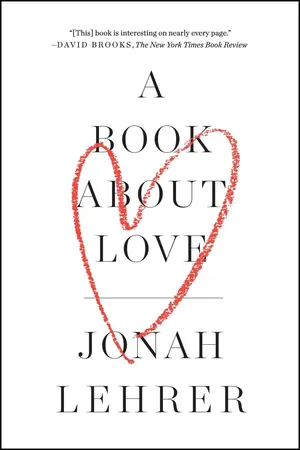
Number one bestselling science writer Jonah Lehrer explores the “only happiness that lasts”—love—in a book that “is interesting on nearly every page” (David Brooks, The New York Times Book Review).

Weaving together scientific studies from clinical psychologists, longitudinal studies of health and happiness, historical accounts and literary depictions, child-rearing manuals, and the language of online dating sites, Jonah Lehrer’s A Book About Love plumbs the most mysterious, most formative, most important impulse governing our lives.

Love confuses and compels us—and it can destroy and define us. It has inspired our greatest poetry, defined our societies and our beliefs, and governs our biology. From the way infants attach to their parents, to the way we fall in love with another person, to the way some find a love for God or their pets, to the way we remember and mourn love after it expires, this book focuses on research that attempts, even in glancing ways, to deal with the long-term and the everyday.

The most dangerous myth of love is that it’s easy, that we fall into the feeling and then the feeling takes care of itself. While we can easily measure the dopamine that causes the initial feelings of “falling” in love, the partnerships and devotions that last decades or longer remain a mystery. “Lehrer uses scores of detailed vignettes to traverse a complicated intellectual landscape, eventually arriving at modern theories of love…He is a talent” (USA TODAY), and A Book About Love decodes the set of skills necessary to cultivate a lifetime of love. Love, Lehrer argues, is not built solely on overwhelming passion, but, fascinatingly, on a set of skills to be cultivated over a lifetime.
Frequently asked questions

Yes, you can cancel anytime from the Subscription tab in your account settings on the Perlego website. Your subscription will stay active until the end of your current billing period. Learn how to cancel your subscription.
No, books cannot be downloaded as external files, such as PDFs, for use outside of Perlego. However, you can download books within the Perlego app for offline reading on mobile or tablet. Learn more here.
Perlego offers two plans: Essential and Complete
  • Essential is ideal for learners and professionals who enjoy exploring a wide range of subjects. Access the Essential Library with 800,000+ trusted titles and best-sellers across business, personal growth, and the humanities. Includes unlimited reading time and Standard Read Aloud voice.
  • Complete: Perfect for advanced learners and researchers needing full, unrestricted access. Unlock 1.4M+ books across hundreds of subjects, including academic and specialized titles. The Complete Plan also includes advanced features like Premium Read Aloud and Research Assistant.
Both plans are available with monthly, semester, or annual billing cycles.
We are an online textbook subscription service, where you can get access to an entire online library for less than the price of a single book per month. With over 1 million books across 1000+ topics, we’ve got you covered! Learn more here.
Look out for the read-aloud symbol on your next book to see if you can listen to it. The read-aloud tool reads text aloud for you, highlighting the text as it is being read. You can pause it, speed it up and slow it down. Learn more here.
Yes! You can use the Perlego app on both iOS or Android devices to read anytime, anywhere — even offline. Perfect for commutes or when you’re on the go.
Please note we cannot support devices running on iOS 13 and Android 7 or earlier. Learn more about using the app.
Yes, you can access A Book About Love by Jonah Lehrer in PDF and/or ePUB format, as well as other popular books in Psychology & Emotions in Psychology. We have over one million books available in our catalogue for you to explore.

Information

1

ATTACHMENT

If I can stop one heart from breaking,
I shall not live in vain.
—EMILY DICKINSON1
JOHN BROADUS WATSON didn’t believe in love. He was one of the most influential psychologists of the twentieth century,2 yet Watson insisted that the feeling was just a fantasy, a fairy tale, a four-letter word used to sell lipstick and sonnets and movie tickets. If love were real, he said, then it must be measurable, a cause with tangible effects. But Watson concluded that love was not like that—it could not be held in the hand or weighed on a scale—and so he declared it an empty cliché, as useless as poetry.
His doubt led to a discovery. When Watson said that love was not real, other scientists tried to prove that it was, and that no subject mattered more.

The Scientist

Watson was born, in 1878, into a destitute family. His mother, Emma, was a devout Baptist. His vagabond father loved whiskey and disappeared for weeks at a time to drink in the backwoods of South Carolina.3 They scratched out a living as tenant cotton farmers; Watson remembered laboring as a young child, “handling tools, half-soling shoes and milking cows.”4 He was bullied as a boy and then became a bully.5 Fighting, specifically with African-Americans, was one of his “favorite going-home activities.” He never went to high school because the local county didn’t have a public one.
But Watson wasn’t held back by his childhood. A self-styled truth-teller, he described his life as a testament to the possibilities of the modern age, a time in which people started to shed their old superstitions. After enduring five “bitter” years at the local college,6 Watson sent a letter to the president of the University of Chicago, promising to be an “earnest student.”7 The letter worked. In 1900, Watson headed north with $50 to his name, determined to prove his worth and change the world.8
Although Watson had intended to study philosophy at Chicago, the subject “wouldn’t take hold.” (He seems to have failed his class on Kant.)9 However, Watson soon became enchanted with experimental psychology, a young field that matched his ambitions. Human nature had always been a mystery, a subject full of myth and lore, but experimental psychology promised to finally reveal the truth. It could show us who we really are.10
Like many of these new psychologists, Watson began by stripping us down, searching for the simplest laws of the mind. In his 1913 manifesto, “Psychology as the Behaviorist Views It,” he declared that researchers had wasted too much time chasing after ideas that couldn’t be quantified, such as love and consciousness.11 They’d squandered centuries speculating about emotions and dreams and other airy nothings. Watson argued, quite rightly, that any real science had to be rooted in measurement. That meant focusing on behavior, studying the link between stimulus and response and ignoring everything in between. “The behaviorist . . . recognizes no dividing line between man and brute,” Watson wrote.12 Every living thing is just a reinforcement machine, responding to the primal incentives of food and sex.13
This strict view of psychology turned Watson into an academic star, a symbol of progress and potential. (Among young psychologists, Watson was hailed as a “second Moses,” leading his field out of the wilderness.)14 Before long, he was chair of the Johns Hopkins psychology department and, at the age of thirty-six, the youngest president of the American Psychological Association. But Watson was only getting started—his real goal was to apply his new science to the practical questions of everyday life. His most famous experiment featured “Little Albert,” a nine-month-old infant.15 First, Albert was exposed to the sight of a white rat. As expected, the baby boy reacted to the rodent with curiosity, reaching out to touch the animal. However, after the rat was paired with a loud noise—Watson clanged on a steel bar, held behind the infant’s head—Albert grew to fear every kind of furred thing, including rabbits, dogs, a sealskin coat, and even a Santa Claus mask. The lesson of the experiment was that fear, like every other emotion, was a learned reflex. Children didn’t love their mothers. They simply paired her face with the pleasure of milk, just as Albert learned to pair the fur with a feeling of fear.16 The theory was compelling, and the Little Albert paper would become one of the most frequently cited studies in American psychology textbooks.17
Watson’s collaborator on these experiments was a young graduate student named Rosalie Rayner. During their research, John and Rosalie began having a passionate affair. Unfortunately for Watson, his wife discovered a stash of their letters, which would be released during their divorce trial. The affair became a public scandal, featured on the front pages of Baltimore newspapers. Watson and Rayner’s correspondence was full of behaviorist language, an awkward attempt to describe their emotions in “objective” terms: “Every cell I have is yours individually and collectively,” he wrote. “My total reactions are positive and towards you. So likewise each and every heart reaction.”18 Forced to choose between his science and his love, Watson resigned from Hopkins. It was an ironic choice for a scientist who had spent years insisting that love was not real and certainly couldn’t influence our behavior.
But Watson was not one to stay down. He soon reinvented himself as a popularizer of behaviorism, a salesman for science.I He remained convinced that a psychology focused on observable facts—and not the invisible urges of emotion—could transform society, creating a world of maximum happiness. His first popular book was a primer on child care, since he believed that parenting was still mired in the mistakes of “emotionalism.” (Watson dedicated the book to “The first Mother who brings up a happy child.”) First published in 1928, Psychological Care of Infant and Child became a bestseller and remained the definitive guide to parenting until Dr. Benjamin Spock’s Common Sense Book of Baby and Child Care was published in 1946. (In a laudatory early review, Bertrand Russell proudly endorsed Watson’s child-care techniques, while even Watson’s critics admitted that “Watsonism has become gospel and catechism in the nurseries and drawing rooms of America.”)19 The appeal of the book was obvious: Watson pitched it as an empirical guide to parenting, a how-to manual inspired by the careful study of “more than five hundred infants” at Johns Hopkins Hospital.
So what could parents learn from this science? Watson’s fundamental message was that love wasn’t just overrated—it was unsafe. In one chapter, “The Dangers of Too Much Mother Love,” Watson insisted that all the kissing and coddling of parents reinforced the very behavior it was supposed to prevent. For instance, when a child cries, the typical mother reacts with soothing affection, which only encourages the child to cry more. (The tenderness rewards the bad behavior.) The result, Watson wrote, is “invalidism,” which will “wreck your adult son or daughter’s vocational future and their chances for marital happiness.”
Instead of loving our children, Watson advised that we treat them like coworkers. “Shake hands with them in the morning,” he wrote. “In a week’s time, you will find how easy it is to be perfectly objective with your child and at the same time kindly. You will be utterly ashamed of the mawkish, sentimental way you have been handling it.”20 Watson’s ultimate goal was to do away with parents altogether: he imagined an America in which infants were raised in scientific nurseries, with trained caretakers doling out rewards and punishments in response to the babies’ behavior. While some mothers might protest such a system—isn’t love a natural instinct?—Watson dismissed their concerns. “Only one thing will bring out a love response in the child—stroking and touching its skin, lips, sex organs and the like,” Watson wrote. “This is the clay out of which all love—maternal, paternal, wifely or husbandly—is made. Hard to believe? But true.”21
Watson’s science of parenting no longer seems scientific. Yet, his theories of love continue to influence our lives. They endure as a collection of parental techniques—Watson has been credited with inventing the time-out as a form of punishment22—and as a larger belief that children need boundaries, and not boundless affection. What’s more, the experimental tools that Watson helped invent—his obsession with rat mazes, reinforcement, and quick changes in behavior—are still the central tools of modern psychology. If a phenomenon can’t be quantified or dissected or reduced to a list of molecular ingredients, then we assume it doesn’t exist. The study of the mind remains a study of what can be measured in the lab.
But the real legacy of Watson’s popular science is a belief about human beings. The behaviorist argued that what the poets called love was merely a sentimental lie, used to disguise a more primal set of pleasures. It was time to admit that we are just Darwinian machines, driven by a short list of biological rules and base instincts.23 Life is not romantic. Life is sex and death and survival.
Watson’s cynicism has the tang of truth. It seems like one of those disenchanting facts that science is always discovering: the earth is a lonely speck, floating at the edge of the Milky Way; man is a brute, made of monkey parts; the universe is just dust and old starlight. Maybe love is like that, too—another marvel ruined by too much reality.
But was Watson right? Is love really make-believe? What’s at stake in this debate is nothing less than the nature of human nature. If we are just a bundle of learned habits and selfish genes, a wet computer made of dopamine and instinct, then lovers are fools. Our most intimate relationships are made of flimsy stuff. What’s worse, believing in love is a dangerous illusion, a romantic mistake that leads us to spoil our kids, ruin our marriages, and become the sort of neurotic people who need pills and therapy to cope with existence. We waste our lives chasing a fiction. No wonder we aren’t happy.
Of course, if love is real—if the feeling is more than a cultural trope or a chemical trick—then it remains our great consolation, a source of meaning in a meaningless world. The poets are right. Love is a feeling we can’t live without.

The Young Thief

John Bowlby was born on February 26, 1907, the fourth child and second son of Sir Anthony Bowlby, a baronet and surgeon to King George V. John Bowlby’s childhood was typical of the British upper class. John and his siblings were raised almost entirely by a procession of wet nurses, nannies, and governesses on the top floor of a London town house.24 Every afternoon, the children spent a single hour with their mother; John recalled having to get dressed up in silk shirts and velvet shorts for the occasion.25 Amid all this luxury, what Bowlby remembered most was the loneliness, describing his childhood as leaving him “sufficiently hurt but not sufficiently damaged.”26 During infancy, Bowlby was cared for by a sweet young nursemaid named Minnie. When Bowlby was four, Minnie left the household. He never got over the loss. “For a child to be looked after entirely by a loving nanny and then for her to leave when he is two or three, or even four or five, can be almost as tragic as the loss of a mother,” Bowlby would later write.27
At the age of eight, Bowlby and his older brother were sent to boarding school. It was a miserable experience; Bowlby was desperately homesick.28 Nevertheless, he survived his education and, while an undergraduate at Cambridge University, chose to study medicine like his father.29 But Bowlby wasn’t interested in surgery or the royal court. Instead, he decided to pursue the new field of psychoanalysis, as he’d become convinced that Freudian theory could transform the lives of troubled children. After completing his psychiatric training, Bowlby began working at the Child Guidance Clinic, a mental hospital for youth in North London.30 He cared for children with all sorts of conditions, from hysteria to violence. Bowlby, however, grew most interested in those sent to the clinic for “thievery.”31 (These children had repeatedly been caught stealing or destroying property.) In addition to giving these young thieves a battery of cognitive tests, Bowlby and the social workers asked them questions about their parents and siblings.32 Their stories were heartbreaking: Fred’s mother “shouts and terrifies the children,” while Winnie’s father “often beat her.” Cyril’s mother “openly stated that she wished he had died instead of the baby,” while Kathleen’s mother “had curious sexual ideas about the children and had been seen thrashing the dogs in a sadistic way.”33
These sad stories were not unique to the thieving children. Rather, t...

Table of contents

  1. Cover
  2. Epigraph
  3. Author’s Note
  4. Introduction: Habituation
  5. 1. Attachment
  6. 2. The Abraham Principle
  7. 3. The Marriage Plot
  8. 4. Moments of Grace
  9. 5. On Memory
  10. 6. Going On
  11. About Jonah Lehrer
  12. Notes
  13. Copyright