
- 240 pages
- English
- ePUB (mobile friendly)
- Available on iOS & Android
eBook - ePub
About this book
A revelatory, redemptive, and “wild...juicy” (Rolling Stone) memoir from the lead guitarist of the legendary hard rock band Def Leppard—the first ever written by one of its members—chronicling the band’s extraordinary rise to superstardom and how they maintained it for three decades.
Meet Phil Collen. You may know him as the lead guitarist in Def Leppard, whose signature song “Pour Some Sugar on Me” is still as widely enjoyed as when it debuted in 1988. Maybe you’ve heard of him as the rock star that gave up alcohol and meat more than twenty-five years ago. Most likely you’ve seen him shirtless—in photos or in real life—flaunting his impeccably toned body to appreciative female fans.
But it wasn’t always like this. Collen worked his way up from nothing, teaching himself guitar from scratch and slogging it out in London-based pub bands for years; that is, until Def Leppard formed and transformed from unknowns to icons, from playing openers in near-empty arenas to headlining in those same stadiums and selling them out every night. But as Collen discovered, true overnight success is a myth. Like the other band members, he had to struggle and fight his way to the top; in the end, he says, “our work ethic saved us.” Just as it still does.
Adrenalized is an amazing underdog tale featuring a bunch of ordinary working-class lads who rose to mega-stardom, overcoming incredible obstacles—such as drummer Rick Allen losing an arm in a car crash and the tragic death of guitarist Steve Clark, Phil’s musical soul mate. Featuring personal, never-before-seen photos of Collen and his band mates on stage and off, Adrenalized is a fascinating account of the failures, triumphs, challenges, and rock-solid dedication it takes to make dreams come true.
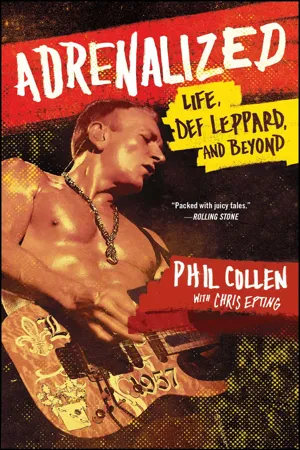
Meet Phil Collen. You may know him as the lead guitarist in Def Leppard, whose signature song “Pour Some Sugar on Me” is still as widely enjoyed as when it debuted in 1988. Maybe you’ve heard of him as the rock star that gave up alcohol and meat more than twenty-five years ago. Most likely you’ve seen him shirtless—in photos or in real life—flaunting his impeccably toned body to appreciative female fans.
But it wasn’t always like this. Collen worked his way up from nothing, teaching himself guitar from scratch and slogging it out in London-based pub bands for years; that is, until Def Leppard formed and transformed from unknowns to icons, from playing openers in near-empty arenas to headlining in those same stadiums and selling them out every night. But as Collen discovered, true overnight success is a myth. Like the other band members, he had to struggle and fight his way to the top; in the end, he says, “our work ethic saved us.” Just as it still does.
Adrenalized is an amazing underdog tale featuring a bunch of ordinary working-class lads who rose to mega-stardom, overcoming incredible obstacles—such as drummer Rick Allen losing an arm in a car crash and the tragic death of guitarist Steve Clark, Phil’s musical soul mate. Featuring personal, never-before-seen photos of Collen and his band mates on stage and off, Adrenalized is a fascinating account of the failures, triumphs, challenges, and rock-solid dedication it takes to make dreams come true.
Frequently asked questions
Yes, you can cancel anytime from the Subscription tab in your account settings on the Perlego website. Your subscription will stay active until the end of your current billing period. Learn how to cancel your subscription.
No, books cannot be downloaded as external files, such as PDFs, for use outside of Perlego. However, you can download books within the Perlego app for offline reading on mobile or tablet. Learn more here.
Perlego offers two plans: Essential and Complete
- Essential is ideal for learners and professionals who enjoy exploring a wide range of subjects. Access the Essential Library with 800,000+ trusted titles and best-sellers across business, personal growth, and the humanities. Includes unlimited reading time and Standard Read Aloud voice.
- Complete: Perfect for advanced learners and researchers needing full, unrestricted access. Unlock 1.4M+ books across hundreds of subjects, including academic and specialized titles. The Complete Plan also includes advanced features like Premium Read Aloud and Research Assistant.
We are an online textbook subscription service, where you can get access to an entire online library for less than the price of a single book per month. With over 1 million books across 1000+ topics, weâve got you covered! Learn more here.
Look out for the read-aloud symbol on your next book to see if you can listen to it. The read-aloud tool reads text aloud for you, highlighting the text as it is being read. You can pause it, speed it up and slow it down. Learn more here.
Yes! You can use the Perlego app on both iOS or Android devices to read anytime, anywhere â even offline. Perfect for commutes or when youâre on the go.
Please note we cannot support devices running on iOS 13 and Android 7 or earlier. Learn more about using the app.
Yes, you can access Adrenalized by Phil Collen,Chris Epting in PDF and/or ePUB format, as well as other popular books in Medien & darstellende Kunst & Musikbiographien. We have over one million books available in our catalogue for you to explore.
Information
Subtopic
Musikbiographien{ 1 }
I came into this world on December 8, 1957, in Hackney, a London borough located in East London. A day or so after being born at the Mothersâ Hospital of the Salvation Army on Lower Clapton Road, I was brought home to 223 Boundary Road, London, where I would spend a large chunk of my life until 1983, when I went on tour with Def Leppard. It was a small row house in a working-class neighborhood that was considered to be pretty rough. It didnât seem like that at the time because I had nothing to compare it to. My dad, Ken Collen, was actually born in Wales, even though he grew up in East London. He was a lorry driver (or a truck a driver, as theyâre known in the States) his entire life. He loved driving, so even when he wasnât working, it wasnât a chore for him to drive us all over the place. Weâd call it a âbusmanâs holiday.â Thatâs an old British phrase that describes a vacation on which you still do the same kind of activity youâd normally do in your job. My mum, Connie Collen (nĂ©e Wheeler), was from nearby Leytonstone. She became a housewife as soon as I was born, and we spent lots of time together while my dad was off on his frequent driving trips for work. I was the only child theyâd ever have. As far as my mum was concerned, the sun rose and fell on my arse. My grandmother, my mumâs motherâNan, as I called herâstayed with us because my mum needed a bit more help. My mumâs two older sisters, Dorothy and Rosie, were really strong women. (My wife, Helen, and I recently went to visit my auntie Dorothy. She was ninety-two, vegetarian, and doing great.) My mum was weaker physically, suffering from a variety of ailments, including asthma (which I think I psychologically inherited from her) and scarlet fever. So my nan was there to lend a hand even after my mum got married.
All of East London was very working classâHackney, Walthamstow, Leyton, and Leytonstone. Our small house and these surrounding neighborhoods became my universe as a youngster. I had a paper round, like a lot of other kids, so each day I would set off on foot around the neighborhood delivering a variety of different papers to dozens of families.
Early on, I lived what I think was probably a very similar experience for lots of other English kids of that period. I had a dog, Coffee, who was a Jack Russellâbeagle mix. I was about four or five years when I got Coffee. I was always so paranoid that heâd run out the door and get hit by a car. This compounded the asthma. As a kid in school I played a lot of football (or soccer) like everyone else, and we played in the huge area of grassland on the western bank of the River Lea called the Hackney Marshes. In fact, Hackney Marshes is where my dad first took my training wheels off my bike. The place was later to become a part of the 2012 Olympic stadium. Talk about expanding your universe. The West Ham (my team), Arsenal, and Tottenham teams were all within striking distance, and all the kids supported one of those. Leyton Orient, another football club, was walking distance from my house, but no one supported them because the poor fuckers were in the Third Division. My dreamâlike that of all British kidsâwas to play professional football.
One of my fondest memories of growing up is of the weekends and holidays that we would take to Southend, Jaywick, Clacton-on-Sea, or Canvey Island, places at the end of the Thames Estuary, where the Thames filters into the North Sea. Even though these places were barely an hour away from home, people of limited means could escape there from the city and feel as though they had entered some exotic playground. Iâve read recently that Jaywick is today considered one of the most deprived areas in the country, but at the time, those trips represented adventure, escapism, and my love of travel.
My parents smoked liked troopers. They were completely unaware of the hideous side effects this would have on their sickly child and how it was probably making my asthma worse. Swimming was suggested by my doctor to relieve my asthma because he refused to place me on an inhaler for fear of me becoming reliant on the drugs. I loved to swim and was swimming about a mile by the time I was eight years old. I actually became a fairly decent swimmer and diver and joined several swim teams while I was in school.
As I was growing up, my parents taught me (like many other postâSecond World War kids) to appreciate what you have and not to harp on about what you donât have. They were very frugal and I know a lot of that stems from the lean years they spent during the war in England. That mentality seeped everywhere, even down to what we ate. As with most families at the time, our diet wasnât quite what I would call healthy, but then again, we managed to survive on British sustenance. That is to say, lots of braised beef, along with plenty of mashed and boiled potatoes. Then of course there was also what we Brits called pork scratchings or pork cracklings (also known as pork rinds), which were just basically fried and roasted pork fat; another pig delicacy was dripping, which was congealed fat spread on a slice of bread. So once again, I had nothing to compare all of this to until I had my first curry.
I would have conversations with my mum, sitting in our small kitchen while she peeled potatoes for dinner. I would sit there quietly as she told me stories about the war with a certain love and pride in her voice even as she recounted in great detail what it was like to be a child and live through the Blitz in 1940 and 1941, when the Germans launched massive and sustained strategic bombings all across the United Kingdom, when more than one million London houses were destroyed or damaged and more than 40,000 civilians were killed. My mum and her family would hop from bomb shelter to bomb shelter throughout her neighborhood, and by forces of both luck and common sense, they managed to survive.
As the adage goes, what didnât kill everyone made them stronger, and my parents were living proof of that, as were many other people in our neighborhood. My mum always stressed to me how the war and severe rationing made people pull together and how proud she was of her countryâs ironclad patriotism. To this day, this is a big part of who I am. I will always go around my house looking for lights and/or water to turn off and such, due to the fact that both of my parents instilled in me this sense of never wasting anything. When you grow up taking one bath a week to conserve water and rationing your meals because you never knew when things could be taken away from you, it reminds you that itâs always a good idea to conserve and not take anything for granted.
One of my closest friends, Gary Saint, lived in the next street over. Iâd known Gary since we were about eight years old. Heâd be at my house all the time. Heâd even come on my parentsâ weekend trips to Jaywick and remained a loyal friend well into our adult lives together. There was a group of us that hung out together, like kids do. I remember it being a wonderful childhood, where members of our little gang were within shouting distance of each otherâs houses.
To anyone passing by, Boundary Road and the surrounding area looked like the countless other gray and dreary English cityscapes. But it was a thriving, colorful place, inhabited and enhanced by people of many cultures. We all lived alongside many immigrants from the Indian subcontinent and the Caribbean, including a huge influx of Jamaicans, who brought with them the sound of reggae, which would influence many musicians in the 1960s. As I walked home from school each day, the air was thick with the aromas of many different and wild-smelling foods. All the various kinds of pungent curries and spices, fresh ginger, and those mouthwatering, aromatic smells gave our neighborhood a rich, ethnic flavor (both figuratively and literally). That is not to say we didnât have our fair share of racism on our streets. Many Brits harbored deep anger toward the influx of Indians and Pakistanis, who were encouraged to come to the country for work. They called it Paki-bashing. I knew kids who were singled out and attacked simply because they were Indian or Pakistani. I never understood it.
Being around people of different ethnic groups was nothing new to me. My mumâs oldest sister, my auntie Dorothy, had three daughtersâmy first cousins. They were all married to black men. So a part of my family is multiracial. To me it was strange to see the separatism of races pushed by propaganda. Nothing new there. It was no surprise that white-bread Britain, with its strong Anglo-Saxon foundation, would have a problem with the newly integrated brown population.
By the early 1960s, when I was just seven or eight years old, I started listening to the radio as if it were this great and brilliant discovery. It was the radio that opened a whole new world, and that world was named the Beatles. I became obsessed with Paul, John, Ringo, and George, pretty much like every other kid with a pulse back then. I loved their songs, how the guys looked, everything. I remember that thrill of sitting in our front room waiting for any song by the Fab Four to come on the radio. As soon as it did, my friend Terry from next door and I would go to the shed (aka âthe stageâ) behind my house and pretend that we were John Lennon and Paul McCartney, substituting tennis rackets for guitars and donning plastic Beatle wigs that were popular then. Often to the annoyance of our neighbors, weâd cry out our own strangled versions of âI Want to Hold Your Handâ and âTwist and Shout.â
The mid-1960s were absolutely mind-blowing in terms of what one could find on the radio, and not just the Beatles. And not just on the BBC, which actually had a fairly limited selection of music. No, to find what was really going on, we tuned in to underground broadcasting outlets. There was Radio Luxembourg and pirate radio stations that offered some remarkable sonic lifelines from America, including artists like the Beach Boys, Aretha Franklin, Stevie Wonder, and all of the big Motown artists of the day. Pirate radio was broadcasted illegally, without a license, by ships anchored miles off the coast of England. Radio Caroline, Wonderful Radio London, Swinging Radio Englandâthese fantastically mysterious stations kept us all completely plugged in to music that was part of the âSwinging Londonâ scene that had begun to flourish in the mid-1960s. You had the British Invasion, which included the Beatles, Stones, Kinks, the Who, and the Small Faces. You had psychedelic rock from Jimi Hendrix (Iâm claiming Hendrix because he broke in England first) to Cream and Pink Floyd and others. And you had mod fashions and sexy pop tarts like Jean Shrimpton, Penelope Tree, and Twiggy. All of these converged in London Town in one huge, swirling orgy of culture, fashion, and especially music.
It was in this atmosphere that you felt something important was shifting. One day you would hear âLike a Rolling Stoneâ for the very first time. Then you might hear âSatisfactionâ or âMy Generation.â It was the 1959 Colin MacInnes novel about London, Absolute Beginners, brought to life. The ground was shaking. There was something charged and intoxicating in the air. London seemed to be the center of it. Living in Walthamstow and with it being a suburb, we did not have direct contact with all the glittery, seductive charms of Swinging London, but it did trickle down to us in the way of music. I had a partner in crime who explored this new amazing world with me, my cousin Dave Wheeler.
Itâs hard to measure the influence Dave had on me. He was two years older than me, so it was a bit like having an older brother. Being an only child, I never had that sort of older sibling to influence me, shape me, or even corrupt me. But thankfully Dave did all those things. Dave was my mumâs oldest brother Georgieâs son and he lived in a tower block just paces off Boundary Road.
Dave and I actually went out with two sisters who were two years apart. My girlâs name was Kim Taylor. She was dark-haired and considered my first girlfriend. Dave was going out with her older sister, Pat. But even more important than that, Dave exposed me to a wild, all-you-could-eat musical buffet that affects me to this very day. He wasnât just a big fan of musicâhe also had access to rare and wonderful under-the-counter bootleg albums back then, trawling vinyl shops throughout Londonâs East End to procure some of the finest illegal concert recordings known to man. These vinyl treasures announced themselves differently than regular albums. Forget the slick packaging. Weâre talking a plain white cardboard sleeve, usually with a color-mimeographed piece of cover art scotch-taped on the front. They looked and felt like contrabandâsonic tabooâand Dave treasured his hot wax. I always preferred the real recordings, but the artists that he exposed me to were the real magicâHendrix, Zeppelin, the Stones, Floyd, and of course Deep Purple, all of which he blasted out of his stereo. A bunch of us would go up to his mum and dadâs flat and greedily absorb it all.
When I was about fourteen years old, I had an epiphany. I remember seeing David Bowie and the Spiders from Mars on Top of the Pops. They were playing this type of music that just spoke to me. It seemed that Bowie was directly writing songs for my group of friends. I had never heard or seen anything like Bowie in my life. It was all brand-newâtotally androgynous. Since I was a sponge, it was ultimately cool. Although Bowie spearheaded the glam rock movement, along with Marc Bolan of T. Rex, the real hook was the amazing songs and melodies that Bowie wrote. Then there was the fact that he obviously didnât give a fuck about how people perceived the way he looked, even though it was a very contrived concept. When I first saw Little Richard, I was too young to know that he was effeminate. But when I saw Bowie, he overdid the androgyny and was wearing glitter, colored hair, and girlsâ clothes. It was certainly nothing anyone in England had seen before. As a teenager trying to discover myself, I thought that this seemed like a gang I could belong to. Then there was the amazing look and playing of his guitarist, Mick Ronson, which totally hooked me.
When I later saw David Bowie and the Spiders from Mars on The Old Grey Whistle Test, it further sealed the deal for me. The Old Grey Whistle Test was a music television show that ran on BBC Two, and Iâm sure that besides me, it influenced many other kids of my generation. The beauty of The Old Grey Whistle Test was that it was all very low-key. Bands would perform their songs in a very plain-looking studio without lots of production, which forced you to really focus on the music. There was no studio audience, so you could practically hear a pin drop between songs. To this day I love looking up clips from the show on YouTube. Itâs sort of like time stands still. As soon as I hear the opening title musicâa cool, groovy, harmonica-based song called âStone Fox Chaseâ by the Nashville band Area Code 615âIâm back to being that wide-eyed boy in the living room. The sound of that opening was just so rootsy. You knew you were going to get an untarnished view of whatever artists happened to be on the program that week. The showâs original host when it started back in 1971 was Richard Williams, but on this magical night in 1972, the laid-back âWhisperingâ Bob Harris (as he was known) by then had taken the helm. The program took its strange name from an old Tin Pan Alley phrase. According to legend, agents would have the doormen for the building come in and listen to a song and see if it was worthwhileâthe âtestâ was whether the âold greyâ folks could whistle the tune.
All I remember is Bowie playing an acoustic guitar and Mick Ronson playing his famous Les Paul banging out âQueen Bitch.â The interesting thing was that as different and new as his image was, he didnât look like some dude wearing makeup. He looked like David Bowie. The whole visual thing Bowie gave off combined with his expression of the music made him seem like part of some exclusive club I desperately wanted to belong to. Of course Bowie was speaking to me. The first line of âQueen Bitchâ was, âIâm up on the eleventh floor and Iâm watching the cruisers below . . .â and Daveâs family lived on the eleventh floor.
The Old Grey Whistle Test, by the way, would go on to host lots of other legendary performances as I got older. Itâs where Bob Marley and the Wailers made their very first British TV appearance. I also remember seeing Stevie Marriott and Humble Pie and Bill Withers, among many other legendary performers, not to mention, later, a performance by a band called Girl, of which I would soon become a member. But of all of the artists that I saw on the Whistle Test no one dazzled, dazed, and amazed me the way David Bowie did. Thanks to him, in one single moment, my world went from black-and-white to color.
If seeing Bowie on television was a landmark moment for me, then so was the day that Dave and I went to our first live rock concert. Neither one of us had ever seen a live show, so this was a big deal. We went to see Deep Purple, who in 1972 were one of my favorite bands. They were out on the road for their Machine Head tour, and they were playing at the Sundown Brixton (now known as O2 Academy Brixton), a former movie house that dated back to 1929. It was (and still is) a classic-looking theater, held about 3,000 or so and was built to feel like an amphitheater set in an Italian garden. It had just been refurbished for concerts, and this night, September 30, was actually to be the very first rock-and-roll show held at the venue. A christening of sorts, in more ways than one, and we were going to be there to experience it.
I donât remember queuing up, but we stumbled in and were front row, propping up the stage. We were totally excited. Even the opening act, Glencoe (crap name, crap band), freaked me out because I had never seen a live band before. So when drummer Ian Paice, bassist Roger Glover, singer Ian Gillan, keyboardist Jon Lord, and especially lead guitarist Ritchie Blackmore strolled onstage, it honestly left me breathless. Ritchie Blackmore stood right in front of me. It was surreal. I think people tend to forget that in the pre-MTV world rock stars truly were godlike, mythical figures of lore that were quite different than mere mortals. There they were, just as they appeared on the album covers and in the magazines. Flesh and blood. Deep Purple. I was just trying to take it all in.
From the opening number, âHighway Star,â I was completely mesmerized. They played everything. âSmoke on the Water,â âSpace Truckinâ,â and more. It was loud, thunderous, and energizing. Pushed up front against the wooden stage I could see, feel, hear, and practically taste each note as it was played. What I saw Ritchie Blackmore do that nightâthe range of styles he displayedâwas stupefying. He played classical, jazz, blues, rock and rollâhe just blew me away. As I reached up toward him, he slapped my hand.
At the end of the show, as they plowed through the encore, âLucille,â Blackmore smashed his Fender Strat on the stage. I was euphoric. Actually, sitting here now thinking about that night, words canât really describe how I felt. I may have left my body. Oh my God, I thought. Thatâs what I want to do! I want to be that guy up there!
Many professional musicians will reflect upon a specific time when they saw their future, their destiny, their fate, whatever you want to call it, all converge in one spectacular and explosive moment. This was mine. Ironically, it wasnât until many years later when Def Leppard played the Brixton Academy that I realized it was the same building as the former Sundown and that the reason I played guitar on that side of the stage was because that was where Blackmore had played. It was actually really freaky looking out on the audience and remembering that this was the first place I had ever been to a show. Then there I was, on the same stage, looking out at the audience. Years after attending my first show, I was looking at Made in Japanâa live Deep Purple album recorded in Japanâand I said to myself, Hey, these fans donâ...
Table of contents
- Cover
- Dedication
- Chapter 1
- Chapter 2
- Chapter 3
- Chapter 4
- Coda
- Photographs
- About Phil Collen and Chris Epting
- Index
- Copyright