
- 368 pages
- English
- ePUB (mobile friendly)
- Available on iOS & Android
eBook - ePub
About this book
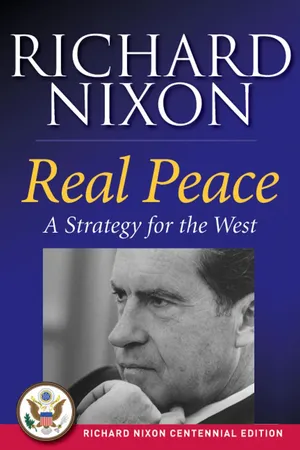
One of Richard Nixon's most incisive works on American foreign policy, Real Peace argues that lasting peace can only be achieved through "hard-headed détente"—a pragmatic mixture of military preparedness, effective arms control, and improved East-West economic ties.
Frequently asked questions
Yes, you can cancel anytime from the Subscription tab in your account settings on the Perlego website. Your subscription will stay active until the end of your current billing period. Learn how to cancel your subscription.
No, books cannot be downloaded as external files, such as PDFs, for use outside of Perlego. However, you can download books within the Perlego app for offline reading on mobile or tablet. Learn more here.
Perlego offers two plans: Essential and Complete
- Essential is ideal for learners and professionals who enjoy exploring a wide range of subjects. Access the Essential Library with 800,000+ trusted titles and best-sellers across business, personal growth, and the humanities. Includes unlimited reading time and Standard Read Aloud voice.
- Complete: Perfect for advanced learners and researchers needing full, unrestricted access. Unlock 1.4M+ books across hundreds of subjects, including academic and specialized titles. The Complete Plan also includes advanced features like Premium Read Aloud and Research Assistant.
We are an online textbook subscription service, where you can get access to an entire online library for less than the price of a single book per month. With over 1 million books across 1000+ topics, we’ve got you covered! Learn more here.
Look out for the read-aloud symbol on your next book to see if you can listen to it. The read-aloud tool reads text aloud for you, highlighting the text as it is being read. You can pause it, speed it up and slow it down. Learn more here.
Yes! You can use the Perlego app on both iOS or Android devices to read anytime, anywhere — even offline. Perfect for commutes or when you’re on the go.
Please note we cannot support devices running on iOS 13 and Android 7 or earlier. Learn more about using the app.
Yes, you can access Real Peace by Richard Nixon in PDF and/or ePUB format, as well as other popular books in Política y relaciones internacionales & Gobierno estadounidense. We have over one million books available in our catalogue for you to explore.
Information
THE KEYS TO REAL PEACE
The door to real peace must be unlocked. Two keys are required to open it. The United States has one; the Soviet Union has the other. Unless the superpowers adopt a new live-and-let-live relationship, the world will not see real peace in this century. If we fail to work toward that end, suicidal war is inevitable. If we succeed in reaching it, not only does world war become avoidable, but world peace becomes possible. Working against each other, the superpowers will enter a spiral of escalating differences that could lead to war. Working together, they can be an irresistible force for peace not only for themselves but for others as well.
Never has real peace been so necessary and yet so difficult to achieve. The stark truth is that the ideologies and the foreign policies of the superpowers are diametrically opposed. The struggle between the Soviet Union and the United States is between an avowedly and manifestly aggressive power and an avowedly and manifestly defensive one, between a totalitarian civilization and a free one, between a state that is frightened by the idea of freedom and one that is founded on it.
The United States wants peace; the Soviet Union wants the world. Our foreign policy respects the freedom of other nations; theirs tries to destroy it. We are interested in peace as an end in itself; they are interested in it only if it serves their ends. The Soviets pursue those ends unscrupulously, by means short of all-out war. They lie, cheat, subvert governments, disrupt elections, subsidize terrorists, and wage wars by proxy. For the Soviets, peace is a continuation of war by other means.
Russians and Americans can be friends. But the governments of the Soviet Union and the United States can never be friends because their interests are irreconcilable. The peace we seek cannot be based on mutual friendship. It can only be grounded on mutual respect for each other’s strength.
We will continue to have political differences that will drive us apart. We must also recognize, however, that the United States and the Soviet Union have two common interests that can draw us together. As the world’s two greatest military powers, we both want to avoid a major war that neither of us would survive. As the world’s two major economic powers—each with enormous resources and capable people—we can cooperate in ways that could benefit both of us immensely.
We must not delude ourselves into believing that the East-West struggle is the result of a giant misunderstanding that can be overcome if we sit down and talk it over. We can form Soviet-American friendship societies or tip vodka glasses with Kremlin leaders, but it will not lead to peace. That approach assumes the Soviets share with the West a “sincere” desire for peace. But as Ambassador Charles Bohlen told me in 1959, “Trying to determine whether the Soviet leaders are sincere about anything is a useless exercise.” Pointing to a coffee table, he added, “They are pure materialists. You can no more describe them as being sincere than you could describe that table as being sincere.”
If our differences are so intractable, is peace possible? Our differences make a perfect, ideal peace impossible, but our common interests make a pragmatic, real peace achievable. We are entering a new phase of the East-West struggle. In view of the verbal missiles rocketing between Washington and Moscow, we might conclude that the chances for peace are remote. But if we look beyond the rhetoric to the realities, we can be more optimistic. The table is set for a breakthrough toward real peace.
In working for peace, we must not pursue the unachievable at the expense of the attainable. Neither we nor the Soviets can compromise our basic values. Only if we recognize that we are not going to settle our differences can we avoid going to war over them. The most we can hope to achieve is an agreement establishing peaceful rules of engagement for our continuing conflict. If we cannot walk arm-in-arm down the road toward peace, we must try at least to walk side-by-side.
• • •
The enormous military strength and the aggressive policies of the Soviet Union lead many in the West to conclude that the prospects for peace are virtually nonexistent. Their concerns are justified, and I have addressed them in The Real War. But our analysis of the Soviet position cannot stop with their troop and weapons count. In designing our foreign policy, we must know not only our adversary’s strengths, but also his weaknesses. We must not wallow in despair about Soviet might, for then we will fail to focus our attention on Soviet vulnerabilities.
No man knows the strengths and weaknesses of the Soviet Union better than Yuri Andropov. For fifteen years he was the head of the KGB, the Soviet espionage and police apparatus. There he received reports from the vast network of Soviet agents at home and abroad and travelled extensively throughout the Eastern bloc. We can be certain that as he steps up to bat, he knows the score, knows the other team, knows how to play the game, and is prepared to put more than pine tar on his bat.
The West knows little about Andropov himself. When he came into power, he was the subject of intense speculation in the West. Some media observers suggested that he was a closet liberal, a pussycat who would be easy to deal with because he liked American jazz and drank Scotch rather than vodka. Such commentators are forever confusing style with substance. They are suckers for style because style is their bread and butter. In the 1950s, they dismissed Nikita Khrushchev as a lightweight because he spoke bad Russian, drank too much, wore ill-fitting clothes, and had crude manners. They were wrong about Khrushchev, and they are wrong about Andropov. Anyone who claws his way to the top in the murderous jungle warfare of the Soviet hierarchy is bound to be a formidable adversary. Only the strong survive and reach the top in communist regimes.
We know this for sure about Andropov. He is an intelligent, dedicated, ruthless communist who shares the global ambitions of every Soviet dictator since the Bolshevik Revolution. Those who expect the Soviet Union to moderate its belligerence as soon as Andropov consolidates his power are deluding themselves.
Fortunately, however, he is a hard-headed pragmatist, not a madman. This makes him less dangerous in the short run but potentially more dangerous in the long run, unless we develop pragmatic policies that will affect his interests.
Andropov knows the strengths of the Soviet Union. He can point to some significant achievements over the past decade. Since 1974, over 100 million people have come under communist domination or have been lost to the West. Most ominously, the Soviets have gained superiority over the West in the most powerful and accurate nuclear weapons, land-based strategic and intermediate-range ballistic missiles.
Today the Soviets, through their Cuban and Nicaraguan surrogates, are threatening to make Central America the next East-West battleground. Through their Libyan proxies, they are advancing in Central Africa. They are inching, via Afghanistan, toward the Persian Gulf. Through their support of Syria and the radical Palestinians, they are trying to exacerbate the Arab-Israeli conflict. By supporting both Iran and Iraq they are positioning themselves to pick up the pieces after that war in the oilrich Persian Gulf. Their propaganda machine is operating at full throttle, helping fuel the disarmament movement in Western Europe and thus continuing their 35-year-old campaign to divide the West against itself. The overall picture they present to the West is one of enormous power that backs up a menacing, expansionist foreign policy.
But Andropov is no fool. He is also aware of the profound weaknesses of the Soviet Union. Its economy is in desperate shape. Western economies have been through some rough seas, but the Soviet economy is dead in the water. The growth rate is plummeting. Productivity is dropping. Absenteeism, corruption, malingering, and drunkenness are rife. The standard of living is sinking, so much so that the life expectancy of Russian men is actually going down. The average wage of workers in the Soviet Union is lower than Brazil’s minimum wage. Japan, with one-half the population of the Soviet Union, less arable land than California, no oil and very few natural resources, has a gross national product almost as large as that of the Soviet Union and a per capita income three times as high.
Andropov’s vastly overblown military budget only increases the problem. It is twice as large as ours in terms of the proportion of GNP it consumes. That creates an enormous drag on the economy, reducing the incentives for individuals to produce goods and limiting potential future growth. After 60 years of big promises and poor performance, the stark truth is there for all to see. Soviet socialism does not work.
The ideology of communism has lost its appeal. Communists have never won a majority in a free election anywhere in the world. The crisis in Poland is only the most visible example of the popular discontent that is heating up just beneath the surface and threatens to boil over throughout Eastern Europe and in the Soviet Union itself. A scene I remember from my trip to Poland in 1959 illustrates this. Even now I can see the members of a crack Polish honor guard standing on a flatbed truck, cheering, and raising their hands in the “V-for-victory” sign as our motorcade left the Warsaw airport. The Kremlin’s military planners are daydreaming if they are counting on the loyalty of Polish troops in the event of a war in Europe.
Never in history has an aggressive power been more successful in extending its domination over other nations and less successful in winning the approval of the people of those nations. As has been the case since the end of World War II, millions of refugees are on the move today. The traffic is all one way—from communism to freedom.
The costs of Soviet conquests are a massive drain on its desperately weak economy. The British may have been enriched by their empire, but the Soviets are being impoverished by theirs. Andropov must pour huge economic resources into his empire to keep his shaky political investments afloat. Cuba costs him $14 million a day. Angola, Ethiopia, Vietnam, and Nicaragua cost him over $5 million a day. Afghanistan has cost him millions of dollars and thousands of casualties. The resistance Soviet puppet regimes are meeting in Afghanistan, Angola, Mozambique, Ethiopia, and Nicaragua proves that the Soviet Union is increasingly unable to digest what it swallows.
On its Western front, the Soviet Union faces a newly united NATO. America’s allies, without whom a comprehensive peace would be impossible, are acting with vision and strength under the leadership of conservatives like Margaret Thatcher and Helmut Kohl and anti-Soviet socialists like François Mitterrand and Bettino Craxi. The alliance is united behind a program to redress the European balance of power by deploying American Pershing II and cruise missiles. The Soviet propaganda campaign has failed. Andropov must now know that these deployments will begin by the end of the year unless he concludes an arms control agreement in Geneva.
On its Eastern front, the Soviet Union faces its greatest long-term challenge: Under the leadership of Yasuhiro Nakasone, Japan, an economic giant but a military pygmy, is beginning to address the question of improving its national defenses. China, still a potential enemy, is not a military threat to the Soviet Union today. But it looms as an awesome danger for the future because of its one billion people and enormous resources. As historical determinists, the Soviets look at events with the long term in mind. For them, threats in the future are problems in the present.
Andropov can boast of great gains for the Soviet Union in the Third World, but his position with the world’s major powers must give him pause. Mao Zedong’s military manual called for isolating the cities by capturing the countryside. Andropov’s policy is right out of Mao’s book. He seeks to strangle the industrial West by cutting off its supply of key resources from the Third World. This strategy might work in the long run, but its most profound immediate effect is to isolate the Soviet Union. Andropov has no allies among the major nations of the world. He faces potential adversaries in Western Europe, Japan, China, Canada, and the United States. Together these countries represent over 60 percent of the world’s economy and present the Soviet Union with the grim prospect of having to face powerful enemies on two fronts.
When Andropov totals up the balance sheet of Soviet strengths and weaknesses, he cannot be encouraged. The debits are the tremendous problems he confronts both inside and outside his country. The assets are his military power. Great as they are, his assets are ill-suited to solving his problems.
Andropov is motivated by personal factors as well. He is a man in a hurry. He is ten years older than Brezhnev was when he came to power, eight years older than Khrushchev, 23 years older than Stalin. No one questions his mental alertness, but his physical health is suspect. And while he has taken the reins of the Soviet government, he is not yet firmly in the saddle. He needs a foreign policy initiative.
He has to be looking for ways to deal with his problems or at least to mitigate them. That fact makes the prospects for real peace great. Putting it simply, both sides want peace—the United States because we believe in peace, the Soviets because they need it.
The time is ripe for a deal.
• • •
If war in the nuclear age is so disastrous and if economic cooperation is so beneficial, it would seem that striking a deal for peace should be a natural. But that is not the case. The Soviet leaders are not the same kind of people we are. Their political system promotes individuals who view the world in a completely different way and who put an entirely different value on human life.
As Russians, they will weep over the millions of deaths their country suffered in World War II. But as communists, they will defend the actions of a government that killed millions of other Russian citizens. In meeting with Soviet leaders, I often thought of Dr. Jekyll and Mr. Hyde as the warm, friendly Russian of our social conversations transformed himself into a cold, heartless communist as we got down to business. Within minutes, someone who appears to be a warm-hearted pacifist turns into a ruthless thug.
There are many views about how we should deal with the Soviet leadership. At one extreme, we have the superhawks. They argue that because the Soviets are in deep trouble and are out to do us in by any and all means, we should build up military superiority and try to isolate them by cutting off all trade and negotiations. If we do that, they contend, the rotten Soviet economy will eventually collapse, bringing down the communist system with it.
That is an appealing scenario, but not a realistic one. The superhawks are correct in recognizing the Soviets for what they are. But while their premise is correct, their conclusion is wrong. The Soviet system will not collapse. The Kremlin leaders have never won a free election, but they are masters at getting and keeping power. They have ruthlessly squeezed their people with brutally austere economic policies before, and they will do so again if that is necessary to keep themselves in power. Confrontation and isolation can strengthen a dictatorship. Hard-headed negotiation and contact with the outside world can weaken it.
The superhawks also fail to realize that in a democracy it is impossible to sustain such a policy. The American people and our allies in Europe will shoulder the burden of armaments and bear the risks of military conflict only if they believe their leaders are actively trying to reduce international tensions. The people need to be given hope, for without hope the support for defense expenditures will crumble and the pressure for an ill-considered accommodation with the Soviets will build.
Even if we assume that the superhawks’ policy would work and would command the sustained support of the American people, we would still be wrong to adopt it. It is irresponsible for the world’s two greatest military powers not to have maximum communication with each other and not to try to negotiate their disputes. This would put our relations in a highly combustible atmosphere of semi-belligerency, with both sides building up armaments without restraint while firing salvos of hot rhetoric. Our interests would inevitably rub together in the powder kegs of the world like the Middle East, possibly sending off the spark which would ignite a nuclear war.
Sir William Slim, a Governor-General of Australia and one of Britain’s greatest generals in World War II, made this point in a conversation with me 30 years ago. He was a dedicated anti-communist, but he was also a realist. He believed even then, when the United States had overwhelming nuclear superiority over the Soviet Union, that we should move from confrontation toward negotiation. He told me, “We must break the ice. If we don’t break it, we will all get frozen into it so tight that it will take an atom bomb to break it.”
In contrast to the superhawks, we have the superdoves at the other extreme. They argue that the Soviet Union fears the United States and arms only because we arm. They excuse virtually every instance of Soviet aggression, from the Cuban missile crisis to the invasion of Afghanistan, on the basis of the Kremlin’s need to feel safe from an aggressive West. They contend that if we reassure them that we want peace, they will cease to prepare for war. They say that if we set a peaceful example—by cutting our defense budget—the Soviets will do likewise.
They are wrong. By portraying the Soviet Union as a defensive power beset by foes on all sides, they are doing the same thing Abraham Lincoln wryly accused his political opponents of doing when they twisted his policy statements to serve their purposes: “Turning a horse chestnut into a chestnut horse.” A major nuclear power is not threatened by Afghan tribesmen and a country fearful of invasion by its European neighbors does not project its military power into southern Africa and the western hemisphere.
President Carter, with the best of intentions, followed the advice of the superdoves until the Soviets invaded Afghanistan. He cancelled, delayed, or cut back one after another of our arms procurement programs and made a series of conciliatory gestures toward the Soviets. The Kremlin leaders reacted by increasing their arms programs and pushing forward with their armed conquests.
Unlike the superhawks, the superdoves do not recognize the Soviets for what they are. Their argument is flawed at its premise and leads to a dangerous conclusion. We do not have to convince the Soviet leaders that we want peace. They know that. What we need to do is convince them that they cannot win a war. If we take the superdoves’ advice, war would become more likely because the risks for an aggressor would be less.
There is also a third group—the defeatists. They argue that we are “better red than dead.” They look with horror upon the awesome power of nuclear weapons, see communism as the wave of the future, and conclude that we are better off capitulating quietly. They have little faith in the strength of Western ideals, and value them still less.
What they fail to recognize is that there is a...
Table of contents
- Cover
- Dedication
- Introduction
- The Myths of Peace
- The Keys to Real Peace
- Nato and Japan
- China
- The Third World
- Peaceful Competition
- Author’s Note
- Copyright