The Neoconservatives
eBook - ePub

The Neoconservatives

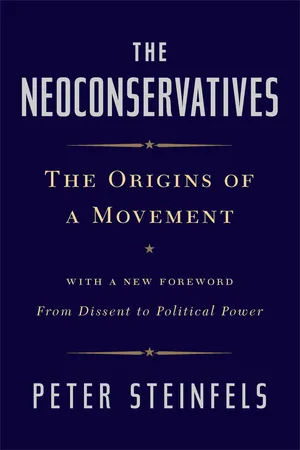
The Origins of a Movement: With a New Foreword, From Dissent to Political Power

  1. 384 pages
  2. English
  3. ePUB (mobile friendly)
  4. Available on iOS & Android
eBook - ePub

The Neoconservatives

The Origins of a Movement: With a New Foreword, From Dissent to Political Power

About this book

In 1979, Peter Steinfels identified a new movement and predicted it would be the decade's most enduring legacy to American politics. In a new Introduction he describes its evolution from a reaction to Sixties' social change into an entrenched political force promoting an assertive, even belligerent, foreign policy. The Neoconservatives traced the origins and described the beliefs of a movement that had barely been labeled. Four decades later, the neoconservatives have become the "neocons, " advising presidential candidates, manning think tanks, churning out books, op-eds, TV interviews, and policy proposals. They played a key role in pushing the nation into the war in Iraq and continue to argue for an assertive American foreign policy, whether toward Iran, Afghanistan, North Korea, or China, that does not hesitate to act unilaterally with military power. The Neoconservatives probes the roots of this movement as it describes its early days with portraits of Irving Kristol, Daniel P. Moynihan, Daniel Bell, Nathan Glazer, Samuel Huntington, and others. Peter Steinfels was the first critic to understand and gauge an emerging philosophy that would grow into an enduring force at the forefront of American foreign policy making. The Neoconservatives is an important contribution to our political history.
Frequently asked questions

Yes, you can cancel anytime from the Subscription tab in your account settings on the Perlego website. Your subscription will stay active until the end of your current billing period. Learn how to cancel your subscription.
At the moment all of our mobile-responsive ePub books are available to download via the app. Most of our PDFs are also available to download and we're working on making the final remaining ones downloadable now. Learn more here.
Perlego offers two plans: Essential and Complete
  • Essential is ideal for learners and professionals who enjoy exploring a wide range of subjects. Access the Essential Library with 800,000+ trusted titles and best-sellers across business, personal growth, and the humanities. Includes unlimited reading time and Standard Read Aloud voice.
  • Complete: Perfect for advanced learners and researchers needing full, unrestricted access. Unlock 1.4M+ books across hundreds of subjects, including academic and specialized titles. The Complete Plan also includes advanced features like Premium Read Aloud and Research Assistant.
Both plans are available with monthly, semester, or annual billing cycles.
We are an online textbook subscription service, where you can get access to an entire online library for less than the price of a single book per month. With over 1 million books across 1000+ topics, we’ve got you covered! Learn more here.
Look out for the read-aloud symbol on your next book to see if you can listen to it. The read-aloud tool reads text aloud for you, highlighting the text as it is being read. You can pause it, speed it up and slow it down. Learn more here.
Yes! You can use the Perlego app on both iOS or Android devices to read anytime, anywhere — even offline. Perfect for commutes or when you’re on the go.
Please note we cannot support devices running on iOS 13 and Android 7 or earlier. Learn more about using the app.
Yes, you can access The Neoconservatives by Peter Steinfels in PDF and/or ePUB format, as well as other popular books in Politics & International Relations & North American History. We have over one million books available in our catalogue for you to explore.

CHAPTER ONE

Introduction: The Significance of Neoconservatism

The premises of this book are simple. First, that a distinct and powerful political outlook has recently emerged in the United States. Second, that this outlook, preoccupied with certain aspects of American life and blind or complacent toward others, justifies a politics which, should it prevail, threatens to attenuate and diminish the promise of American democracy. Third, that this outlook has nonetheless produced telling critiques of contending political views and provocative analyses of specific political proposals; it has devoted its attention to fundamental questions its rivals have frequently overlooked; and it deserves, accordingly, a thoughtful, extensive, and careful evaluation.
Hundreds of books have been written on the political developments of the sixties, the civil rights movement, student radicalism, and the counterculture. Yet, oddly enough, that decade’s most enduring legacy to American politics may be the outlook forged in reaction to sixties turbulence, an outlook fierce in its attachment to political and cultural moderation, committed to stability as the prerequisite for justice rather than the other way around, pessimistic about the possibilities for long-range, or even short-range, change in America, and imbued with a foreboding sense of our civilization’s decline.

From Liberalism to Neoconservatism

It has not even been easy to settle upon a label for this outlook, in itself a sign of the unfamiliar constellation of attitudes it displays. By the beginning of 1976, the terms “neoconservative” or “new conservative” had gained a certain degree of currency; they were accepted good-humoredly by some adherents of the viewpoint, though not without protests that they still thought of themselves as traditional liberals. The very fact that they were good-humored in this protest was revealing. A few years ago they would have clung adamantly to their identification as liberals (as in fact other recipients of the neoconservative label continued to do). Now, “conservative” had lost its sting for them; they merely remarked that none of these nametags mattered very much. Neoconservative or not, they did protest that it was they who had held their political viewpoint constant while others had gone astray. “All about us canvas tore and cables parted,” wrote Daniel Patrick Moynihan in nautical style—though, still the old sea dog, he admitted in another place that this constancy might also have involved a certain degree of change: “Correcting course in a storm is a way of staying the course.”
The question of what is “new,” if anything, about neoconservatism is not trivial. It bears on the manner in which this phenomenon is studied and discussed. By emphasizing their continuity with traditional liberalism, by suggesting that they are only being faithful to old struggles and eternal verities, the neoconservatives displace the burden of examination from their own ideas to those of the supposed innovators, their adversaries. On the other hand, many of the neoconservatives’ critics are no more disposed to grant the newness of this outlook. For them it is just the same old conservatism; what is new is its advocacy by these spokesmen, most of them former liberals and even former socialists. Again the burden of examination is removed from the ideas, this time to be placed on the men themselves, on their renegade status, on their motivation for sliding to the Right.
It is my contention that the neoconservatives deserve both parts of their label. In the American context their distinctive role, both for good and for ill, is to be a conservative force. I say this in full awareness of their repeated proclamations of fidelity to liberalism. It is by now a commonplace that America is the liberal society par excellence, that we have worked out our history almost entirely within the framework of this one tradition, and that it is now so ingrained we hardly know how to think and talk, at least about public matters, outside of it. Peter Berger has recently added to these observations the corollary that “the contemporary American ideology of conservatism is deeply and unmistakably liberal in inspiration”; Berger predicts that in America “the politically practical options will all be within the ideological ambience of the liberal ‘family.’ ” With all this I largely agree. Yet it should not be forgotten that liberalism itself contains important conservative elements. This is true not only in the United States, where liberalism had no feudal aristocracy to combat but was itself the ethos to be conserved. It was also true of the original liberal theorists and of their view of humanity.
Classical seventeenth- and eighteenth-century liberalism, Sheldon Wolin has reminded us,
was a philosophy of sobriety, born in fear, nourished by disenchantment, and prone to believe that the human condition was and was likely to remain one of pain and anxiety. . . . We have become so accustomed to picturing liberalism as a fighting creed, outfitted for storming the ramparts of privilege, that we find it difficult to entertain the hypothesis that Lockian liberalism was fully as much a defense against radical democracy as an attack on traditionalism. In France and the United States as well, liberalism emerged as a post-revolutionary reaction.
It is this side of liberalism which the neoconservatives reemphasize. But that is not all they do. In some instances they go beyond the boundaries of liberalism, certainly to Burkean conservatism and sometimes even to socialism, in their critique of current reality—and of current liberalism. To be faithful to certain liberal values, they have discovered that liberalism itself does not suffice. It is the resulting admixture of themes, from liberal, conservative, and socialist traditions, that qualifies their view as both “conservative” and “new.” Indeed one should not be surprised to see an American conservatism emerging from a liberal background; given our singularly liberal tradition, it is precisely that which vouches for the significance and rootedness of the new outlook.
Since neoconservatism is in many ways a product of the sixties, it might be useful to compare it with the other political metamorphoses of that decade. Sixties radicalism, at least among its wider following in the civil rights and antiwar movements, was an outgrowth of activity that was simply aimed at making a liberal society cease acting illiberally. It was only as the questions pressed—why does a liberal society act so illiberally? why is it so resistant to efforts to make it conform to its own principles?—that many people sought answers beyond the liberal framework. In parallel fashion, the neoconservatives, for their part, set out to defend liberalism from the radicals’ attack. As they did so, however, they were faced with the question, why had a liberal society produced a wave of political criticism which they perceived (in many cases quite accurately) as so illiberal and destructive? Having begun as defenders of liberalism, they too ended, to some degree, as critics of it. That explains why, when the specific conflicts of the sixties had largely abated, political debate did not return to the status quo ante. Peter Berger is surely right in saying that politics in America will continue to be an affair within the liberal “family.” Those unambiguously outside of that family, like the violent revolutionary Marxists or the Dadaist anarchists of the late sixties, will have no significant role in our politics. But families change over time; different branches drift apart. Practical politics may continue to be played out on that wide field called liberalism. But political thought is moving steadily in two directions. There are those, like democratic socialists, who feel they must reach beyond contemporary liberalism in order to fulfill its promises. And there are those, like the neoconservatives, who feel they must reach beyond contemporary liberalism to preserve its heritage.

A Party of Intellectuals

It is time to be more specific. Who, exactly, are the neoconservatives? They are, to begin with, a party of intellectuals. Newsweek magazine reports:
In intellectual circles, the social thinkers who were once the driving force of Democratic liberalism—men like Arthur Schlesinger, Jr. and John Kenneth Galbraith—have been upstaged by a group of “neoconservative” academics, many of them refugees from the liberal left, including Daniel Bell, Nathan Glazer, Irving Kristol, James Q. Wilson, Edward Banfield, Seymour Martin Lipset and Sen. Daniel P. Moynihan of New York.
The geography of the intellectuals’ world is a geography of journals, and Newsweek quite rightly links the neoconservatives with two journals that have distinguished themselves as vehicles for the new outlook.
Commentary, the monthly published by the American Jewish Committee, has been one of a handful of leading intellectual forums; until the rise of The New York Review of Books, probably no other journal of serious and extended discussion of politics and culture had as wide a readership. The Public Interest, on the other hand, is a relative newcomer, founded in 1965 and oriented toward the analysis of public issues in the “nonideological” perspectives of the social sciences.
By no means should every contributor to these journals be considered a neoconservative, but a core of regulars has, as Moynihan would say, set and stayed the course. Besides an editorial by Irving Kristol and Daniel Bell, the first issue of The Public Interest featured articles by Daniel Moynihan, Robert Nisbet, Martin Diamond, Bell, Robert M. Solow, Nathan Glazer, and several others. Ten years later, in the Bicentennial issue, one finds articles by Irving Kristol, Daniel Moynihan, Robert Nisbet, Martin Diamond, Daniel Bell, and Nathan Glazer. Also in the Bicentennial issue, which has something of a neoconservative convention about it, are Samuel P. Huntington, Aaron Wildavsky, Seymour Martin Lipset, and James Q. Wilson, a contributor since the second issue and now on the journal’s Publication Committee. Robert M. Solow is also now a member of the Publication Committee. Many of the same writers appear in Commentary, whose editor, Norman Podhoretz, launched a frontal assault against the New Left, the counterculture, and all their pomps and works in the late sixties. One also finds there Milton Himmelfarb, Walter Laqueur, Midge Decter, Paul Seabury, Sidney Hook, Diana Trilling, Edward Shils, Peter Berger, Michael Novak, Bayard Rustin, and a group of younger political activists who have emerged from “Social Democrats, U.S.A.,” the militantly anti-Communist rump of Norman Thomas’s old Socialist Party. One might continue to rattle off names: Roger Starr, Edward C. Banfield, Peter Drucker, Ithiel de Sola Pool, Daniel Boorstin, Lewis S. Feuer, Arnold Beichman, Ben J. Wattenberg, and numerous other social scientists. Three outstanding scholars, recently dead, who could be justly associated with neoconservatism were Alexander Bickel, Richard Hofstadter, and Lionel Trilling. Of the list of “The Seventy Most Prestigious Contemporary American Intellectuals (1970)” that Charles Kadushin constructed in his book on The American Intellectual Elite, I would count about one out of every four as a neoconservative.
To describe the neoconservatives as, first, a party of intellectuals is to run the risk that among many Americans their significance would be immediately dismissed. Exactly the contrary ought to be the reaction. Alexis de Tocqueville, after noting the way that political theorists and not princes, ministers, and great lords had been the shapers of the events leading to the French Revolution, went on to note the lesson for other times:
What political theory did here with such brilliance, is continually done everywhere, although more secretly and slowly. Among all civilized peoples, the study of politics creates, or at least gives shape to, general ideas; and from those general ideas are formed the problems in the midst of which politicians must struggle, and also the laws which they imagine they create. Political theories form a sort of intellectual atmosphere breathed by both governors and governed in society, and both unwittingly derive from it the principles of their action.
Today, if anything, rather than being done “more secretly and slowly,” the process is done more openly and rapidly. Intellectuals serve as advisers to officeholders and political candidates, write speeches, propose programs, draft legislation, serve on special commissions. The mass media amplify their ideas to a wider public, though not without considerable distortion. In all this the intellectuals have two functions. As experts in particular fields relevant to public policy they work out the details of political measures. But as traffickers in society’s symbols and values, as keepers of its memories, as orchestrators of its spectacles and images, and, in de Tocqueville’s words, as political theorists and shapers of general ideas, intellectuals are legitimators. What will be the agenda of public concerns? Where will one set the outer limits of the “responsible” opinion to which busy decision-makers should attend? Will the credibility of this or that set of policies, or of the schools of thought behind them, be eroded or maintained—or will they be eliminated from serious consideration altogether? The dueling in intellectual journals, the rallying of like-minded thinkers at conferences or in new organizations, the shifts of power within disciplines are all elements in this process of legitimation. So, one might add, is the quality of scholarship and the cogency and eloquence of argument.
The precise paths by which this legitimation proceeds, the concrete ways in which an intellectual atmosphere is created, are intriguing to follow. Daniel Bell writes a book, and a syndicated columnist appropriates its theses for his Bicentennial musings. Irving Kristol derides a “new class” of liberal intellectuals for its snobbish attitude toward a business civilization, and Mobil Oil incorporates this idea in its public relations advertising. Alexander Bickel, Yale Law School professor, writes an article on the failure of school integration in the North, and a White House aide refers to it twice in a 1970 memo to Nixon arguing that “the second era of Re-Construction is over; the ship of integration is going down; it is not our ship . . . and we ought not to be aboard.”
On questions like school integration and busing, courts are influenced not only by the reasoning in law journals but by extrapolations from sociological findings, which in turn are subject to the shifting moods in the social sciences. The idea that Great Society programs “failed” works its way from technical evaluation studies to debunking articles by scholar-consultants to politicians’ speeches and pundits’ columns.
The political mood may also promote changes in intellectual life, and these flow back to consolidate the new politics. The McCarthy era, for example, saw a nearly complete change in the scholars reviewing China studies for The New York Times and the New York Herald Tribune. At these two papers, the group who had done over 80 percent of the reviewing in this field between 1945 and 1950 reviewed not a single book after 1952.
Clearly questions of legitimation and creation of an intellectual atmosphere exist at different levels. There are short-run questions of getting a politician’s ear or promoting a new departure in policy, as Daniel Moynihan attempted to do with the Family Assistance Plan, the proposal for substituting a guaranteed income for welfare that Moynihan “sold” to Richard Nixon. There are medium-run questions of national mood or prevailing attitudes over a range of issues—the Cold War in the fifties or the “rediscovery” of poverty in the sixties. Finally there are long-run questions of sensibility and moral principles—the change in attitude toward weakness and suffering which marked Victorian “earnestness” or the growing attachment to equality which de Tocqueville ranked as the fundamental characteristic of modernity. To ascribe the initiative in all such changes, small and large, to intellectuals would be silly; and virtually no one, except possibly intellectuals themselves, has been tempted to do so. But when people repeat that politics is the art of the possible, the temptation is quite in the other way, to forget the crucial role that thinkers and writers and artists have in defining, for practical men, just what is possible.

Links with Power

Yet it will not do justice to the special position of the neoconservatives to describe them simply as a party of intellectuals, as though that fact alone justified their claim to our attention. The neoconservatives are a powerful party of intellectuals. Their reputations are solid; they speak from the elite universities—Harvard, Berkeley, MIT, Chicago, Stanford. They are prolific: in 1975 and 1976, for example, Midge Decter excoriated Liberal Parents, Radical Children; James Q. Wilson blessed us with his Thinking About Crime; Robert A. Nisbet peered through the Twilight of Authority; Seymour Martin Lipset and Everett Carll Ladd, Jr., studied the politics of the professoriate in The Divided Academy; Nathan Glazer argued that affirmative action has become Affirmative Discrimination; Herman Kahn challenged the limits-of-growth pessimists in The Next 200 Years, and Daniel Bell pondered The Cultural Contradictions of Capitalism. This list, though it contains books seriously received, widely discussed, and consisting altogether of a remarkable tour d’horizon of America’s problems, can barely suggest the currency of the neoconservatives’ ideas. Many of these books, in fact, bring together material which was published not only in Commentary and The Public Interest, but in The New York Times Sunday Magazine, Atlantic Monthly, Encounter, Change, Science, and Daedalus.
Neoconservatives have frequently complained of a liberal “oppositionist” bias in the media. Their own position in the media, however, has never been weak, and now grows increasingly stronger. Besides Commentary and The Public Interest, they have long-lasting ties with Encounter, The New Leader, American Scholar, and Foreign Policy. They turn up in TV Guide as well as Reader’s Digest, Fortune, Business Week, and U.S. News & World Report. At Time and Newsweek, neoconservatism often appears as the comfortable middle ground between these magazines’ traditional conservatism and their liberal flirtation of the late sixties. Even supposed citadels of liberalism are open to neoconservatives. New Republic shares a number of writers—and attitudes, especially on foreign affairs—with Commentary. Neoconservative themes are sounded regularly in Harper’s Magazine, by its editors as well as contributors; the same is true for The Washington Monthly. Journals like New York Magazine and Esquire, though symbols of a cultural...

Table of contents

  1. Cover
  2. Dedication
  3. Foreword to the New Edition: From Dissent to Political Power
  4. 1. Introduction: The Significance of Neoconservatism
  5. 2. The Road to Neoconservatism
  6. 3. What Neoconservatives Believe
  7. 4. The Neoconservative Style
  8. 5. Irving Kristol, Standard-Bearer
  9. 6. Daniel Patrick Moynihan, Professional Politician
  10. 7. Daniel Bell, Theoretician and Moralist
  11. 8. Intellectuals, the Heart of the “New Class”
  12. 9. Equality and Social Policy
  13. 10. Democracy and Expertise
  14. 11. Conclusion: The War for the “New Class”
  15. About Peter Steinfels
  16. Notes
  17. Index
  18. Copyright