The Best American Poetry 2014
eBook - ePub

The Best American Poetry 2014

  1. 240 pages
  2. English
  3. ePUB (mobile friendly)
  4. Available on iOS & Android
eBook - ePub

The Best American Poetry 2014

About this book

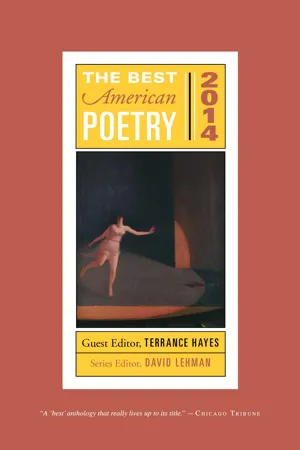
National Book Award–winning poet Terrance Hayes selects the poems for the 2014 edition of The Best American Poetry, "a 'best' anthology that really lives up to its title" ( Chicago Tribune ). The first book of poetry that Terrance Hayes ever bought was the 1990 edition of The Best American Poetry, edited by Jorie Graham. Hayes was then an undergrad at a small South Carolina college. He has since published four highly honored books of poetry, is a professor of poetry at the University of Pittsburgh, has appeared multiple times in the series, and is one of today's most decorated poets. His brazen, restless poems capture the diversity of American culture with singular artistry, grappling with facile assumptions about identity and the complex repercussions of race history in this country. Always eagerly anticipated, the 2014 volume of The Best American Poetry begins with David Lehman's "state-of-the-art" foreword followed by an inspired introduction from Terrance Hayes on his picks for the best American poems of the past year. Following the poems is the apparatus for which the series has won acclaim: notes from the poets about the writing of their poems.
Frequently asked questions

Yes, you can cancel anytime from the Subscription tab in your account settings on the Perlego website. Your subscription will stay active until the end of your current billing period. Learn how to cancel your subscription.
At the moment all of our mobile-responsive ePub books are available to download via the app. Most of our PDFs are also available to download and we're working on making the final remaining ones downloadable now. Learn more here.
Perlego offers two plans: Essential and Complete
  • Essential is ideal for learners and professionals who enjoy exploring a wide range of subjects. Access the Essential Library with 800,000+ trusted titles and best-sellers across business, personal growth, and the humanities. Includes unlimited reading time and Standard Read Aloud voice.
  • Complete: Perfect for advanced learners and researchers needing full, unrestricted access. Unlock 1.4M+ books across hundreds of subjects, including academic and specialized titles. The Complete Plan also includes advanced features like Premium Read Aloud and Research Assistant.
Both plans are available with monthly, semester, or annual billing cycles.
We are an online textbook subscription service, where you can get access to an entire online library for less than the price of a single book per month. With over 1 million books across 1000+ topics, we’ve got you covered! Learn more here.
Look out for the read-aloud symbol on your next book to see if you can listen to it. The read-aloud tool reads text aloud for you, highlighting the text as it is being read. You can pause it, speed it up and slow it down. Learn more here.
Yes! You can use the Perlego app on both iOS or Android devices to read anytime, anywhere — even offline. Perfect for commutes or when you’re on the go.
Please note we cannot support devices running on iOS 13 and Android 7 or earlier. Learn more about using the app.
Yes, you can access The Best American Poetry 2014 by David Lehman,Terrance Hayes in PDF and/or ePUB format, as well as other popular books in Literature & American Poetry. We have over one million books available in our catalogue for you to explore.

Information

Publisher
Scribner
Year
2014
Print ISBN
9781476708171
eBook ISBN
9781476708188

CONTRIBUTORS’ NOTES AND COMMENTS


SHERMAN ALEXIE was born in 1966 and grew up in Wellpinit, Washington, on the Spokane Indian Reservation. His first collection of stories, The Lone Ranger and Tonto Fistfight in Heaven (1993), won a PEN/Hemingway Award. In collaboration with Chris Eyre, a Cheyenne/Arapaho Indian filmmaker, Alexie adapted a story from that book, “This Is What It Means to Say Phoenix, Arizona,” into the screenplay for the movie Smoke Signals, which won the Audience Award and Filmmakers Trophy at the 1998 Sundance Film Festival. His most recent books are the poetry collection Face from Hanging Loose Press, and War Dances, stories and poems from Grove Press. Blasphemy, a collection of new and selected stories, appeared in 2012 from Grove Press. The Absolutely True Diary of a Part-Time Indian, a novel, appeared from Little, Brown Books for Children. He is lucky enough to be a full-time writer and lives with his family in Seattle.
Of “Sonnet, with Pride,” Alexie writes: “Pride of Baghdad, by Brian K. Vaughan and Niko Henrichon, is a graphic novel that tells the true story of a pride of lions that escaped during the Iraq War and were subsequently killed by U.S. soldiers. Well, I suppose ‘true story’ is a loose definition of the book since we enter into the minds of the lions and various other animals. In any case, it’s a tragic novel. I have reread it often. And think of it quite often, too, so when Seattle’s Recovery Café, a drug and alcohol addiction treatment facility for homeless and low-income people, asked me to write them a poem, I immediately thought of those lost and hungry lions. I don’t often write occasional poems, and don’t know that I’d ever written a good occasional poem, but this one seems to have lasting power. We’re all soul-hungry, right? Well, this poem does its best to make us consider and reconsider the universal nature of soul-hunger.”
RAE ARMANTROUT was born in Vallejo, California, in 1947. She is a professor of poetry and poetics at the University of California, San Diego. Wesleyan University Press has published all her recent books. They include Just Saying (2013), Money Shot (2011), Versed (2009), and Next Life (2007). A new book, Itself (in which “Control” appears), will be published by Wesleyan in 2015. She has received the Pulitzer Prize.
Armantrout writes: “ ‘Control’ begins with the experience of learning (or trying to learn) to meditate. The first stanza reproduces the instructor’s advice that we should ‘set obtrusive thoughts aside.’ The third, fifth, and eighth stanzas develop my responses to this experience while the second, fourth, sixth, and seventh stanzas present the obtrusive thoughts as fragments of the debris field of American media culture. For instance, I recently heard a politician say, ‘It takes an American to do really big things.’ He was talking about our space program, which, of course, is being systematically defunded.”
JOHN ASHBERY was born in Rochester, New York, in 1927. He has published more than twenty collections of poetry, most recently Quick Question (Ecco, 2012), as well as numerous translations from the French, including works by Pierre Reverdy, Arthur Rimbaud, Raymond Roussel, and several volumes of poems by Pierre Martory. Collected French Translations, a two-volume set of his translations (poetry and prose), was published in 2014 (Fararr, Straus and Giroux). He exhibits his collages at the Tibor de Nagy Gallery (New York). He was the guest editor of The Best American Poetry 1988, the initial volume in the series.
ERIN BELIEU was born in Omaha, Nebraska, in 1967. She has four poetry collections, all from Copper Canyon Press: Infanta (1995), One Above & One Below (2000), Black Box (2006), Slant Six (2014). She is a professor in the creative writing program at Florida State University and is a member of the poetry faculty at Lesley University’s low-residency MFA program in Cambridge, Massachusetts. She is also cofounder of VIDA: Women in Literary Arts and the artistic director for the Port Townsend Writers Conference.
On “With Birds,” Belieu writes: “The very best thing about our home in Tallahassee is that it’s presided over by a three-hundred-year-old live oak. She’s a beauty, with a trunk fifteen feet around and limbs that stretch two houses in either direction. Of course, because of her size, she also serves as a superhighway for the many critters living in north Florida’s canopy.
“I work on our deck most mornings, and in that time I’ve been reminded often and none too gently how unromantic nature is. The impulse for ‘With Birds’ came when I heard a meaty thump and looked up to find a good-sized slab of bloody snake carcass lying decapitated on the deck next to me. No doubt one of the hawks or barred owls that surround our house was clumsy with breakfast that morning. There is also the issue of one particularly loud and luckless cardinal—a ‘blast-beruffled plume’ sort of fellow—who often shrieks nonstop pick-up lines from atop our fence while I’m trying to work. So I think of ‘With Birds’ as an affectionate complaint. But, really, I like having all the wild things around me.”
LINDA BIERDS was born in Wilmington, Delaware, in 1945. She is the author of nine books of poetry: Roget’s Illusion (Putnam’s, 2014); Flight: New and Selected Poems (Putnam’s, 2008); First Hand (Putnam’s, 2005); The Seconds (Putnam’s, 2001); The Profile Makers (Henry Holt, 1997); The Ghost Trio (Henry Holt, 1994); Heart and Perimeter (Henry Holt, 1991); The Stillness, the Dancing (Henry Holt, 1988); and Flights of the Harvest-Mare (Ahsahta Press, 1985). She has won the PEN/West Poetry Prize, the Consuelo Ford Award from the Poetry Society of America, the Virginia Quarterly Review’s Emily Clark Balch Poetry Prize, and fellowships from the National Endowment for the Arts, the Ingram Merrill Foundation, the Guggenheim Memorial Foundation, and the John D. and Catherine T. MacArthur Foundation. She is a Byron W. and Alice L. Lockwood Professor in the Humanities at the University of Washington in Seattle.
Of “On Reflection,” Bierds writes: “For some time I’ve been interested in the scientist Michael Faraday, and I’ve been particularly enchanted by a series of lectures that he delivered in 1860 at the Royal Institution of Great Britain. Although written for children, the lectures attracted people of all ages, drawn by Faraday’s enthusiasm and warmth, and by his conviction that common objects within our lives are often the best illustrators of scientific truths.
“One day I was looking through an old edition of World Book Encyclopedia and came across an entry on the mirror. The contributor’s style was so similar to Faraday’s, so clear and unassuming, that I could easily imagine Faraday repeating his words—and the poem was born. The pantoum form, with its mirroring lines, seemed a natural choice.”
TRACI BRIMHALL was born in Little Falls, Minnesota, in 1982. She is the author of Our Lady of the Ruins (W. W. Norton, 2012) and Rookery (Southern Illinois University Press, 2010). Her work has received fellowships from the Wisconsin Institute for Creative Writing, the King/ChĂĄvez/Parks Foundation, and the National Endowment for the Arts.
Of “To Survive the Revolution,” Brimhall writes: “Even as a child I was interested in the question of survival. I loved books in which young people had to learn wilderness skills in hopes of lasting long enough to be rescued. To my adult mind, the question has become a moral one—would I harm someone who was attacking me to ensure my own survival? Could I kill that person? Would I harm or kill someone who wasn’t trying to do me harm if it meant I would live? This is the idea I engaged with in ‘To Survive the Revolution.’ The poem takes place during the Brazilian coup d’etat in the 1960s. I’ve tried to imagine my way into a life and set of circumstances that would force me to make that choice—whether to hurt someone else or die.”
LUCIE BROCK-BROIDO was born in Pittsburgh, Pennsylvania, in 1956. She attended Johns Hopkins University where she earned her BA and MA in 1979. In 1982, she received her MFA in poetry from the School of the Arts at Columbia University. She has published four volumes of poetry, all with Alfred A. Knopf: A Hunger (1988), The Master Letters (1995), and Trouble in Mind (2004); her most recent collection, Stay, Illusion (Knopf, 2013), was a finalist for both the National Book Award and the National Book Critics Circle Award. She is also the editor of Letters to a Stranger, the collected poems of Thomas James (Graywolf Press, 2008). In 2010, Carcanet brought out her selected poems, Soul Keeping Company, in the United Kingdom. She has won a Guggenheim Fellowship, two National Endowment for the Arts Awards, the Witter-Bynner Prize from the American Academy of Arts and Letters, and the Massachusetts Book Award. She is director of poetry in the School of the Arts at Columbia and lives in New York City and Cambridge, Massachusetts.
Brock-Broido writes: “ ‘Bird, Singing’ is an elegy for the poet Jason Shinder. In real life, he was often known as ‘Jay.’ Many of his intimates called him Jay Bird. Over the years, I began to call him, simply: Bird. He was in flight all the time.
“One of the many gifts he left me: inside a tiny red & yellow box, there is an even smaller wicker cage, an architecture of elegance. Inside the cage, on a little wicker bar, there is a miniature song bird with a feathered tail. There’s a key to wind up the creature, which—when wound—begins to sing until, in a few moments, his time runs out. Its song is so beautiful that, to this day, I can barely stand to listen to it. But I do.
“I’ve kept the box it came in, too. On the front, in gold letters, it says: Songing Bird. I have a hunch it was first written in Japanese, translated into French, through Yiddish, to Polish, through Russian, and, finally, into American.
“The gold bees in the poem came by way of Mandelstam. The term ‘onion snow’ refers to the last snowfall at the end of winter. You can know it was the last, of course, only in hindsight—once it is really spring. In the poem, somehow Bird & I wound up in April, and in Prague (where I have never been); I don’t know how.”
JERICHO BROWN was born in Shreveport, Louisiana, in 1976. He once worked as a speechwriter for the mayor of New Orleans (Marc Morial from 1998 to 2002 and Ray Nagin in 2002). Brown is an assistant professor at Emory University. His poems have appeared in journals and anthologies including The American Poetry Review, jubilat, Oxford American, The New Republic, The New Yorker, Ploughshares, and 100 Best African American Poems. His first book, Please (New Issues Poetry & Prose, 2008), won the American Book Award, and Copper Canyon Press published his second book, The New Testament, in September 2014.
Brown writes: “I am ever fascinated by all the people who like ‘Host’ but have never met a man via jack’d, grindr, or adam4adam.com. I’m hoping this poem’s appearance here lends power to my conviction that there is very little universal about poetry other than the marvelous music it makes in the mind and the mouth. And I trust this poem speaks for itself in its attempts to investigate desire, sexuality, and masculinity.”
KURT BROWN (1944–2013) was the founding director of the Aspen Writers’ Conference and founding director of Writers’ Conferences & Centers. He served on the board of Poets House in New York for six years. He was the editor of Drive, They Said: Poems about Americans and Their Cars (1994), Verse & Universe: Poems about Science and Mathematics (1998), and coeditor with his wife, poet Laure-Anne Bosselaar, of Night Out: Poems about Hotels, Motels, Restaurants and Bars (1997). In addition, he was the editor of The Measured Word: On Poetry and Science (2001), and a coeditor of the tribute anthology for the late William Matthews, Blues for Bill (2005). He was also coeditor, with Harold Schechter, of Conversation Pieces: Poems that Talk to Other Poems (2007) and Killer Verse: Poems of Murder & Mayhem (2011). His first two full-length collections, Return of the Prodigals and More Things in Heaven and Earth, were published by Four Way Books. Fables from the Ark (WordTech) won the 2003 Custom Words Prize. His most recent collections, Time-Bound (2012) and I’ve Come This Far to Say Hello: Poems Selected and New (2014), were published by Tiger Bark Press. His memoir, Lost Sheep: Aspen’s Counterculture in the 1970s: A Memoir, came out from Conundrum Press; and Eating Our Words: Poets Share Their Favorite Recipes is due out from Tupelo Press in 2014. With Laure-Anne Bosselaar he translated the Flemish poet Herman de Coninck’s The Plural of Happiness (2006). He taught at Sarah Lawrence College, Georgia Tech, and Westminster College in Salt Lake City, Utah. He died in Santa Barbara, California, in June, 2013.
CACONRAD was born on January 1, 1966. He is the author of six books, including ECODEVIANCE: (Soma)tics for the Future Wilderness (Wave Books, 2014), A Beautiful Marsupial Afternoon (Wave, 2012), and The Book of Frank (Wave, 2010). A 2014 Lannan Fellow, a 2013 MacDowell Fellow, a 2012 UCROSS Fellow, and a 2011 Pew Fellow, he conducts workshops on (Soma)tic poetry and Ecopoetics.
Of “wondering about our demise while driving to Disneyland with abandon,” Conrad writes: “This poem is from a series I call TRANSLUCENT SALAMANDER, forthcoming in ECODEVIANCE: (Soma)tics for the Future Wilderness (Wave Books, 2014). It was written at UCROSS Ranch in Wyoming, a magnificent artist residency where I constructed eighteen of my own constellations at night, later combing my constellation notes to locate the language for eighteen poems. I used crystals given to me by poets Elizabeth Willis and Bhanu Kapil when taking the initial notes, and for the editing process I would begin by eating fruit infused with music from Missy Mazzoli’s now famous Cathedral City CD. I would infuse the fruit by placing my laptop on the floor with the fruit, then play a track of Mazzoli’s music as loud as I could, covering fruit and laptop with a basket, then pillows, blankets, towels, and a large comforter. Then I would quickly eat the fruit and begin editing my constellation notes for the poems. We are all collaborators with one another in many ways, deliberate or not, and my poems are always a thank-you to everyone around me.”
ANNE CARSON was born in Canada and teaches ancient Greek for a living. Her recent publications include Red Doc (Alfred A. Knopf) and Nay Rather (Sylph Editions).
Carson writes: “ ‘A Fragment of Ibykos Translated 6 Ways’ was an exercise in translation undertaken just to see where it would go. It was certainly the hardest thing I did all year.”
JOSEPH CERAVOLO (1934–1988) was born in Astoria, Queens, and lived in New Jersey. He studied with Kenneth Koch at The New School. He was the author of six books of poetry and won the first Frank O’Hara Award. He earned his living as a civil engineer. The Collec...

Table of contents

  1. Cover
  2. Foreword by David Lehman
  3. Introduction by Terrance Hayes
  4. Sherman Alexie, “Sonnet, with Pride”
  5. Rae Armantrout, “Control”
  6. John Ashbery, “Breezeway”
  7. Erin Belieu, “With Birds”
  8. Linda Bierds, “On Reflection”
  9. Traci Brimhall, “To Survive the Revolution”
  10. Lucie Brock-Broido, “Bird, Singing”
  11. Jericho Brown, “Host”
  12. Kurt Brown, “Pan del Muerto”
  13. CAConrad, “wondering about our demise while driving to Disneyland with abandon”
  14. Anne Carson, “A Fragment of Ibykos Translated 6 Ways”
  15. Joseph Ceravolo, “Hidden Bird”
  16. Henri Cole, “City Horse”
  17. Michael Earl Craig, “The Helmet”
  18. Philip Dacey, “Juilliard Cento Sonnet”
  19. Olena Kalytiak Davis, “It Is to Have or Nothing”
  20. Kwame Dawes, “News from Harlem”
  21. Joel Dias-Porter, “Elegy Indigo”
  22. Natalie Diaz, “These Hands, if Not Gods”
  23. Mark Doty, “Deep Lane”
  24. Sean Thomas Dougherty, “The Blues Is a Verb”
  25. Rita Dove, “The Spring Cricket Repudiates His Parable of Negritude”
  26. Camille Dungy, “Conspiracy (to breathe together)”
  27. Cornelius Eady, “Overturned”
  28. Vievee Francis, “Fallen”
  29. Ross Gay, “To the Fig Tree on 9th and Christian”
  30. Eugene Gloria, “Liner Notes for Monk”
  31. Ray Gonzalez, “One El Paso, Two El Paso”
  32. Kathleen Graber, “The River Twice”
  33. Rosemary Griggs, “SCRIPT POEM”
  34. Adam Hammer, “As Like”
  35. Bob Hicok, “Blue prints”
  36. Le Hinton, “No Doubt About It (I Gotta Get Another Hat)”
  37. Tony Hoagland, “Write Whiter”
  38. Major Jackson, “OK Cupid”
  39. Amaud Jamaul Johnson, “L.A. Police Chief Daryl Gates Dead at 83”
  40. Douglas Kearney, “The Labor of Stagger Lee: Boar”
  41. Yusef Komunyakaa, “Negritude”
  42. Hailey Leithauser, “In My Last Past Life”
  43. Larry Levis, “Elegy with a Darkening Trapeze inside It”
  44. Gary Copeland Lilley, “Sermon of the Dreadnaught”
  45. Frannie Lindsay, “Elegy for My Mother”
  46. Patricia Lockwood, “Rape Joke”
  47. Nathaniel Mackey, “Oldtime Ending”
  48. Cate Marvin, “An Etiquette for Eyes”
  49. Jamaal May, “Masticated Light”
  50. Shara McCallum, “Parasol”
  51. Marty McConnell, “vivisection (you’re going to break my heart)”
  52. Valzhyna Mort, “Sylt I”
  53. Harryette Mullen, “Selection from Tanka Diary”
  54. Eileen Myles, “Paint Me a Penis”
  55. D. Nurkse, “Release from Stella Maris”
  56. Sharon Olds, “Stanley Kunitz Ode”
  57. Gregory Pardlo, “Wishing Well”
  58. Kiki Petrosino, “Story Problem”
  59. D. A. Powell, “See You Later.”
  60. Roger Reeves, “The Field Museum”
  61. Donald Revell, “To Shakespeare”
  62. Patrick Rosal, “You Cannot Go to the God You Love with Your Two Legs”
  63. Mary Ruefle, “Saga”
  64. Jon Sands, “Decoded”
  65. Steve Scafidi, “Thank You Lord for the Dark Ablaze”
  66. Frederick Seidel, “To Philip Roth, for His Eightieth”
  67. Diane Seuss, “Free Beer”
  68. Sandra Simonds, “I Grade Online Humanities Tests”
  69. Jane Springer, “Forties War Widows, Stolen Grain”
  70. Corey Van Landingham, “During the Autopsy”
  71. Afaa Michael Weaver, “Passing Through Indian Territory”
  72. Eleanor Wilner, “Sowing”
  73. David Wojahn, “My Father’s Soul Departing”
  74. Greg Wrenn, “Detainment”
  75. Robert Wrigley, “Blessed Are”
  76. Jake Adam York, “Calendar Days”
  77. Dean Young, “Emerald Spider Between Rose Thorns”
  78. Rachel Zucker, “Mindful”
  79. Contributors’ Notes and Comments
  80. Magazines Where the Poems Were First Published
  81. Acknowledgments
  82. About Terrance Hayes and David Lehman
  83. Copyright