The Geography of Genius
eBook - ePub

The Geography of Genius

A Search for the World's Most Creative Places from Ancient Athens to Silicon Valley

  1. 368 pages
  2. English
  3. ePUB (mobile friendly)
  4. Available on iOS & Android
eBook - ePub

The Geography of Genius

A Search for the World's Most Creative Places from Ancient Athens to Silicon Valley

About this book

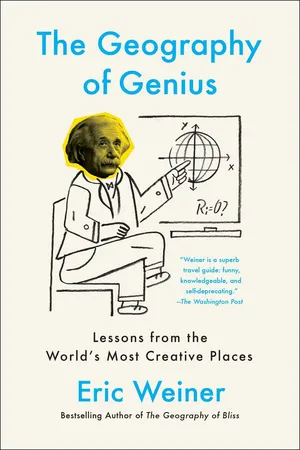
Tag along on this New York Times bestselling "witty, entertaining romp" ( The New York Times Book Review ) as Eric Winer travels the world, from Athens to Silicon Valley—and back through history, too—to show how creative genius flourishes in specific places at specific times. In this "intellectual odyssey, traveler's diary, and comic novel all rolled into one" (Daniel Gilbert, author of Stumbling on Happiness), acclaimed travel writer Weiner sets out to examine the connection between our surroundings and our most innovative ideas. A "superb travel guide: funny, knowledgeable, and self-deprecating" (The Washington Post), he explores the history of places like Vienna of 1900, Renaissance Florence, ancient Athens, Song Dynasty Hangzhou, and Silicon Valley to show how certain urban settings are conducive to ingenuity. With his trademark insightful humor, this "big-hearted humanist" (The Wall Street Journal) walks the same paths as the geniuses who flourished in these settings to see if the spirit of what inspired figures like Socrates, Michelangelo, and Leonardo remains. In these places, Weiner asks, "What was in the air, and can we bottle it?""Fun and thought provoking" (Miami Herald), The Geography of Genius reevaluates the importance of culture in nurturing creativity and "offers a practical map for how we can all become a bit more inventive" (Adam Grant, author of Originals)
Frequently asked questions

Yes, you can cancel anytime from the Subscription tab in your account settings on the Perlego website. Your subscription will stay active until the end of your current billing period. Learn how to cancel your subscription.
No, books cannot be downloaded as external files, such as PDFs, for use outside of Perlego. However, you can download books within the Perlego app for offline reading on mobile or tablet. Learn more here.
Perlego offers two plans: Essential and Complete
  • Essential is ideal for learners and professionals who enjoy exploring a wide range of subjects. Access the Essential Library with 800,000+ trusted titles and best-sellers across business, personal growth, and the humanities. Includes unlimited reading time and Standard Read Aloud voice.
  • Complete: Perfect for advanced learners and researchers needing full, unrestricted access. Unlock 1.4M+ books across hundreds of subjects, including academic and specialized titles. The Complete Plan also includes advanced features like Premium Read Aloud and Research Assistant.
Both plans are available with monthly, semester, or annual billing cycles.
We are an online textbook subscription service, where you can get access to an entire online library for less than the price of a single book per month. With over 1 million books across 1000+ topics, we’ve got you covered! Learn more here.
Look out for the read-aloud symbol on your next book to see if you can listen to it. The read-aloud tool reads text aloud for you, highlighting the text as it is being read. You can pause it, speed it up and slow it down. Learn more here.
Yes! You can use the Perlego app on both iOS or Android devices to read anytime, anywhere — even offline. Perfect for commutes or when you’re on the go.
Please note we cannot support devices running on iOS 13 and Android 7 or earlier. Learn more about using the app.
Yes, you can access The Geography of Genius by Eric Weiner in PDF and/or ePUB format, as well as other popular books in History & World History. We have over one million books available in our catalogue for you to explore.

Information

Year
2016
eBook ISBN
9781451691689
Topic
History
Index
History
Images

ONE


GENIUS IS SIMPLE: ATHENS

THE LIGHT. MAYBE IT WAS the light.
The thought shimmies into my sleep-starved brain, strutting with the awkward bravado of a tweedy classicist on crack. Yes, I think, blinking away the hours of stale Boeing air, the light.
Most light doesn’t do much for me. It’s nice, don’t get me wrong. Preferable to darkness, sure, but strictly utilitarian. Not the light in Greece. Greek light is dynamic, alive. It dances across the landscape, flickering here, glowing there, constantly and subtly shifting in intensity and quality. Greek light is sharp and angular. It’s the sort of light that makes you pay attention, and as I would soon learn, paying attention is the first step on the road to genius. As I glance out my taxi window, shielding my eyes from the painfully bright morning sun, I can’t help but wonder: Have I found a piece of the Greek puzzle?
I hope so, for it is a daunting puzzle, one that has stumped historians and archaeologists, not to mention the Greeks themselves, for centuries. The question that nags is this: Why? Or, more precisely, why here? Why did this well-lit but otherwise unremarkable land give rise to a people unlike any other the world had seen, a people, as the great classicist Humphrey Kitto put it, “not very numerous, not very powerful, not very organized, who had a totally new conception of what human life was for, and showed for the first time what the human mind was for”?
This incredible flourishing didn’t last long. Yes, “classical Greece” is officially considered a 186-year period, but the apex of that civilization, sandwiched between two wars, only lasted twenty-four years. In human history, that’s a lightning flash across the summer sky, the flicker of a votive candle, a tweet. Why so brief?
Ancient Greece. As the taxi slows to a crawl (rush-hour traffic not being something the ancients had to contend with), I ponder those two words. They make me shrink, embarrassed by how much I don’t know, bored with the little I do. When I think of the Greeks—if I think of them at all—images of gray men joylessly pondering life’s imponderables spring to mind. What can they possibly do for me? I have bills to pay and e-mails to send and deadlines to meet. The ancient Greeks seem about as relevant to my life as the rings of Saturn, or trigonometry.
Not for the first or last time, I am wrong. The truth is, no ancient peoples are more alive, more relevant today, than the Greeks. We are all a little bit Greek, whether we know it or not. If you’ve ever voted or served on a jury or watched a movie or read a novel or sat around with a group of friends drinking wine and talking about anything from last night’s football game to the nature of truth, you can thank the Greeks. If you’ve ever had a rational thought or asked Why? or gazed at the night sky in silent wonder, then you have had a Greek moment. If you’ve ever spoken English, you can thank the Greeks. So many of our words sprang from their rich language that a Greek prime minister once gave an entire speech, in English, using only Greek-derived words. Yes, the Greeks brought us democracy, science, and philosophy, but we can also thank (or curse) them for written contracts, silver and bronze coins, taxes, writing, schools, commercial loans, technical handbooks, large sailing ships, shared-risk investment, absentee landlordism. Nearly every part of our lives is inspired by the Greeks, including the very notion of inspiration. “We think and feel differently because of the Greeks,” concludes historian Edith Hamilton.
My taxi stops in front of a tired three-story building that, except for a small sign that says TONY’S HOTEL, is indistinguishable from all the other tired three-story buildings. I step into the alleged lobby, a white-tiled room that looks more like someone’s basement, piled high with rickety chairs, broken coffee machines—possessions you no longer need but, out of sentimentality or inertia, can’t bear to part with. Like Greece itself, Tony’s Hotel has seen better days.
So has Tony. The Greek sun has etched deep lines on his face; the Greek cuisine has inflated his gut to monumental proportions. Tony is all rough edges and sweetness, a throwback to an older, drachma Greece. Less euro; more endearing. Like many Greeks, Tony is a natural performer. He speaks a little more loudly than necessary and swings his arms in large, theatrical motions, no matter how mundane the topic at hand. It’s as if he’s auditioning for Greek Idol. All the time.
I plop down on my bed and thumb through the small library of books I’ve packed, a whimsical collection curated from the vast ocean of ink that ancient Greece has spawned. My eyes are drawn to a quirky, little volume called Daily Life in Athens at the Time of Pericles. It’s a pleasing antidote to the usual history, which is written from a mountaintop and is as dry as a desert. Historians typically track wars and upheavals and sweeping ideological movements like so many weather systems. Most of us, though, don’t experience weather that way. We experience it down here, not as a massive low-pressure system but as sheets of rain that slicken our hair, a crack of thunder that rattles our insides, a Mediterranean sun that warms our face. And so it is with history. The story of the world is not the story of coups and revolutions. It is the story of lost keys and burnt coffee and a sleeping child in your arms. History is the untallied sum of a million everyday moments.
Within this quotidian stew genius quietly simmers. Sigmund Freud nibbling on his favorite sponge cake at Vienna’s CafĂ© Landtmann. Einstein staring out the window of the Swiss patent office in Berne. Leonardo da Vinci wiping the sweat from his forehead at a hot and dusty Florentine workshop. Yes, these geniuses thought big, world-changing thoughts, but they did so in small spaces. Down here. All genius, like all politics, is local.

From this new, terrestrial vantage point, I learn much about the ancient Greeks. I learn that they loved to dance and wonder what exactly transpired during such numbers as “Stealing the Meat” and “The Itch.” I learn that, before exercising, young men would swathe their bodies with olive oil, and that “the manly smell of olive oil in the gymnasium was considered sweeter than perfume.” I learn that the Greeks wore no underwear, that a unibrow was considered a mark of beauty, that they enjoyed grasshoppers both as pets and as appetizers. I learn a lot, but besides these peccadilloes, I learn what the Greeks produced, not how they produced it, and it is the how that I am determined to nail down.
But first, I need something the ancient Greeks didn’t have: coffee. The nectar of the gods shouldn’t be imbibed just anywhere, though. Location matters.
For me, cafĂ©s are a kind of second home, a prime example of what sociologist Ray Oldenburg calls a “great good place.” The food and drink are irrelevant, or nearly so. What matters is the atmosphere—not the tablecloths or the furniture but a more intangible ambience, one that encourages guilt-free lingering and strikes just the right balance of background din and contemplative silence.
I don’t know about the ancients, but twenty-first-century Greeks are not exactly early risers. At 8:00 a.m. I have the streets to myself, save the occasional storekeeper coaxing the sleep from his eyes, and a handful of policemen outfitted in full RoboCop riot gear—a reminder that, like its ancient self, modern Athens is a city on edge.
I follow Tony’s directions, which he conveyed with wild, swinging arcs, and turn onto a pleasant pedestrian walkway, lined with cafĂ©s and small shops, epitomizing the sense of community that characterized ancient Athens. Here I find my great good place. It’s called the Bridge. An appropriate name, I decide, since I’m attempting the quixotic task of bridging the centuries.
The Bridge is nothing fancy, just a few outdoor tables facing Draco Street, positioned as if the customers were theatergoers and the street the theater. In cafĂ©s like this the Greeks indulge in their national pastime: sitting. The Greeks sit in groups and they sit alone. They sit in the summer sun and they sit in the winter chill. They don’t need a chair to do their sitting either. An empty curb or a discarded cardboard box will do nicely. Nobody sits like the Greeks.
I manage a kalimera, good morning, and join the other sitters at the Bridge. I order an espresso and warm my hands on the cup. A morning nip lingers in the air, but I can tell, already, that it’s shaping up to be another fine Greek day. “We may be bankrupt, but we still have great weather,” Tony had announced, triumphantly, as I headed out. He has a point. Not only the sublime light but three hundred days of cloudless skies and little humidity. Might climate explain Athenian genius?
Alas, no. Climate might have sharpened the ancient Greek mind, but it doesn’t explain it. For starters, Greece enjoys essentially the same weather today as it did in 450 BC, yet it is no longer a place of genius. Also, plenty of golden ages blossomed in less agreeable climes. The bards of Elizabethan London, for instance, performed their magic under a dreary English sky.
I order a second espresso, and as my brain reboots, I realize that I’m getting ahead of myself. Here I am hot on the trail of genius, but do I really know what it means? As I said, a genius is someone who makes an intellectual or artistic leap, but who decides what qualifies as a leap?
We do. Francis Galton may have gotten much wrong, but his definition of genius, though typically sexist, points to something important: “A genius is a man to whom the world deliberately acknowledges itself largely indebted.” Admittance to the club of genius is not up to the genius but to his peers, and society. It is a public verdict, not a private assertion. One theory of genius—let’s call it the Fashionista Theory of Genius—states this unequivocally. Admission to the club of genius depends entirely on the whims, the fashion, of the day. “Creativity cannot be separated from its recognition,” says psychologist Mihaly Csikszentmihalyi, the main advocate of this theory. Put more bluntly, someone is only a genius if we say so.
At first, this might seem counterintuitive, even blasphemous. Surely, some inviolate aspect of genius must exist separate from public judgment.
No, say the proponents of this theory, it does not. Take Bach, for example. He was not particularly respected during his lifetime. Only about seventy-five years after his death was he declared a “genius.” Before that, we assume, he resided in that purgatory “undiscovered genius.” But what does that mean? “What—besides unconscious conceit—warrants this belief?” asks Csikszentmihalyi. Saying we discovered Bach’s genius is tantamount to saying that those who came before us were idiots. And what if, at some future date, Bach is demoted, banished from the pantheon of genius? What does that say about us?
Other examples abound. When Stravinsky’s ballet Le Sacre du printemps premiered in Paris in 1913, the audience nearly rioted; critics called it “perverted.” Today, it is considered a classic. When Monet’s late work the NymphĂ©as first came out, art critics recognized them for what they were: the result of the artist’s deteriorating eyesight. Only later, when abstract expressionism was all the rage, were they declared works of genius.
Greek vases are another good example of the Fashionista Theory of Genius. Today, you can see them displayed in many museums around the world. They sit behind bulletproof glass, armed guards nearby, tourists gawking at these works of art. That’s not how the Greeks saw them, though. For them, the vases served a strictly utilitarian purpose. They were everyday objects. Not until the 1970s, when the Metropolitan Museum of Art in New York paid more than $1 million for a single vase, was Greek pottery elevated to high art. So when exactly did these clay pots become works of genius? We like to think they always were, and that only later did we “discover” their genius. That’s one way of looking at it. Proponents of the Fashionista Theory of Genius would argue that they became works of genius in the 1970s when the Metropolitan Museum, speaking the language of money, said so.
The relativity of genius is bubbling in my brain as I order another espresso and plan my attack on the Great Greek Mystery. What made this place shine? I’ve already eliminated climate. Perhaps it was something equally obvious: the rocky terrain, or well-ventilated clothing, or the ubiquitous wine?
Athens is finally beginning to stir, and the Bridge affords a prime viewing spot. I sit back and survey the sea of faces. Are these really the offspring of Plato and Socrates? Many academics have asked that same question. A number of years ago, an Austrian anthropologist posited that modern Greeks were not Plato’s heirs but the descendants of Slavs and Albanians who had migrated here centuries later. His theory caused a minor uproar in Greece. People balked at the suggestion that they were anything other than the children of Plato. “I have no doubt that we are the direct descendants of the ancients,” asserted one politician. “We have exactly the same vices.”
And what vices they were! The ancient Greeks were no Boy Scouts. They held outlandish, weeklong festivals, drank heroic quantities of wine, and never met a sexual act they didn’t like. Despite all these antics, or perhaps because of them, Ancient Greece excelled like no other civilization. That much is clear. The rest is as murky as a glass of ouzo. In fact, my investigation into Ancient Greece encounters its first hiccup when I discover there was no such place as Ancient Greece. What did exist were Ancient Greeces: hundreds of independent poleis, or city-states, that, while they shared a common language and certain cultural traits, were very different, as different as, say, Canada and South Africa today. Each polis had its own government, its own laws, its own customs—even its own calendar. Sure, they occasionally traded goods, competed in athletics, and fought a few spectacularly bloody wars, but mostly they ignored one another.
Why so many Greeces? The answer lies in the land itself. Hilly and rocky, it formed natural barriers, cutting off the Greek city-states from one another and creating, in effect, islands on the land. No wonder a variety pack of microcultures blossomed.
And thank goodness it did. Nature abhors not only a vacuum but a monopoly, too. During times of fragmentation, humanity made its greatest creative leaps. This tendency, known as Danilevsky’s law, states that peoples are more likely to reach their full creative potential when they belong to an independent nation, even if it is tiny. This makes sense. If the world is a laboratory of ideas, then the more petri dishes in the lab, the better.
In Greece, one petri dish flourished like no other: Athens. The city produced more brilliant minds—from Socrates to Aristotle—than any other place the world has seen before or since. (Only Renaissance Florence came close.)
At the time, though, the prospect of such greatness was a long shot, to say the least. For starters, that rocky, hilly land wasn’t exactly fertile. “A discarnate skeleton,” Plato called it. Also, Athens was a small city, with a population equivalent to that of Wichita, Kansas, today. Other Greek city-states were larger (Syracuse) or wealthier (Corinth) or mightier (Sparta). Yet none flourished the way Athens did. Why? Was Athenian genius simply dumb luck, the convergence of “a happy set of circumstances,” as historian Peter Watson puts it, or did the Athenians make their luck? That is, I fear, a riddle that would stump even the Delphic oracle. But, fully caffeinated and armed with the courage of the naive, I soldier on, determined to unlock the mystery. What I need to do first, I decide, is meet the right people.

“Welcome to my office,” says Aristotle, with a dramatic, Tony-esque sweep of his hand. It’s a line he’s clearly used before, but given our vantage point, atop the Acropolis with all of Athens spread below, it is, I concede, a good line.
We had met a few hours earlier, in the lobby of Tony’s Hotel. My first impression of Aristotle was that, with his fair skin and unruly, reddish hair that hung across his face like a curtain, he didn’t look Greek. A ridiculous observation, I quickly realized. There is no one way of looking Greek any more than there is one way of looking French or American or anything else. The Greeks are not one race; they never were.
My second impression of Aristotle is that he seems distracted. Whether it is the weight of his name, or the stress of the permanent crisis that Greece finds itself in these days, I can’t say. But no doubt about it: he is buzzing. As we walk and talk, though, I realize that what I have taken for nervousness is actually intensity—a passion for history that flows through him like an electrical current; 220 volts, I’d say. Possibly more.
As we continue our walk toward the Acropolis, I bide my time, waiting for the right moment to ask about his name. When I first learned that my guide was named Aristotle, I took it as fortuitous. What could be more historically correct, more Greek, than walking in the steps of Aristotle with Aristotle?
As we cross the pedestrian street, now bustling with activity, I dive in, figuring it best to acknowledge the eight-hundred-pound philosopher in the room.
“So, what’s with the name, Aristotle?” I ask lamely.
Aristotle shrugs. It’s inconvenient, he says, leaving it to me to imagine exactly what form this inconvenience takes. His friends call him Ari, which he hates, though he concedes it does provide some distance from the historical Aristotle and, for that matter, the billionaire shipping magnate Aristotle Onassis, who married Jacqueline Kennedy. With a name such as Aristotle, distance is your friend.
As we dodge tourists and riot police, Aristotle recounts how he fell into the tour-guide business. He wanted to join the Greek army but didn’t make the cut. Why exactly, he didn’t say, and sensin...

Table of contents

  1. Cover
  2. Dedication
  3. Epigraph
  4. Introduction: Adventures with the Galton Box
  5. 1. Genius Is Simple: Athens
  6. 2. Genius Is Nothing New: Hangzhou
  7. 3. Genius Is Expensive: Florence
  8. 4. Genius Is Practical: Edinburgh
  9. 5. Genius Is Chaotic: Calcutta
  10. 6. Genius Is Unintentional: Vienna Pitch-Perfect
  11. 7. Genius Is Contagious: Vienna on the Couch
  12. 8. Genius Is Weak: Silicon Valley
  13. Epilogue: Baking Bread and Hanging Ten
  14. Acknowledgments
  15. About Eric Weiner
  16. Select Bibliography
  17. Index
  18. Copyright