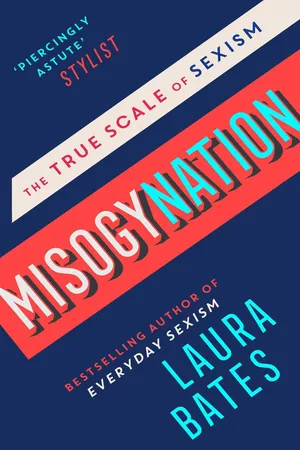
Misogynation
eBook - ePub

Misogynation

The True Scale of Sexism

  1. 320 pages
  2. English
  3. ePUB (mobile friendly)
  4. Available on iOS & Android
eBook - ePub

Misogynation

The True Scale of Sexism

About this book

A COLLECTION OF ESSAYS FROM BESTSELLING AUTHOR AND FOUNDER OF THE EVERYDAY SEXISM PROJECT, LAURA BATES. 

'Following [Everyday Sexism] will make most women feel oddly saner.' Caitlin Moran
'Piercingly astute.' Stylist

Laura Bates, pioneering feminist, activist and bestselling author, has given voice to hundreds of thousands of women through her international Everyday Sexism Project. Drawing attention to both hidden and blatant sexist acts and attitudes, Laura has exposed the startling truth behind misogyny in our society: systemic, ingrained and ignored.
 
From Weinstein to Westminster, a torrent of allegations of sexual harassment and assault have left us reeling. One hundred years since some women were first given the right to vote, we are still struggling to get to grips with the true extent of gender inequality that continues to flourish in our society.

In this collection of essays, originally published in the Guardian, Laura Bates uncovers the sexism that exists in our relationships, our workplaces, our media, in our homes and on our streets, but which is also firmly rooted in our lifelong assumptions and in the actions and attitudes we explain away, defend and accept. Often dismissed as one-offs, veiled as 'banter' or described as 'isolated incidents', MISOGYNATION joins the dots to reveal the true scale of discrimination and prejudice women face.  

A bold, witty and incisive analysis of current events, MISOGYNATION makes a passionate argument for stepping back, opening our eyes and allowing ourselves to see the bigger picture.

IN PRAISE OF LAURA BATES

'Funny and clever.' Telegraph
'Girl Up is an essential compendium of wit, wisdom, advice and straight-talk.' Sarah Knight
'We owe Bates a great debt of gratitude for her Everyday Sexism Project.' LA Times
'Laura was one of the first women to harness the power of social media to fight sexism and misogyny and give millions of young women a voice.' Grazia
'Bates takes a myth-busting approach to body image, food, sex and advertising and is particularly good at boiling down feminist language into a snappy, everyday vernacular' Metro
'For any woman who is sick of being told how to act, how to dress, or how to ward off unwanted advances, [Girl Up] is for you. Independent
'[Girl Up is] another hard-hitting book which exposes the truth surrounding pressures on body image, false representations in the media, and lots of issues very relevant to girls today. Red

Frequently asked questions

Yes, you can cancel anytime from the Subscription tab in your account settings on the Perlego website. Your subscription will stay active until the end of your current billing period. Learn how to cancel your subscription.
No, books cannot be downloaded as external files, such as PDFs, for use outside of Perlego. However, you can download books within the Perlego app for offline reading on mobile or tablet. Learn more here.
Perlego offers two plans: Essential and Complete
  • Essential is ideal for learners and professionals who enjoy exploring a wide range of subjects. Access the Essential Library with 800,000+ trusted titles and best-sellers across business, personal growth, and the humanities. Includes unlimited reading time and Standard Read Aloud voice.
  • Complete: Perfect for advanced learners and researchers needing full, unrestricted access. Unlock 1.4M+ books across hundreds of subjects, including academic and specialized titles. The Complete Plan also includes advanced features like Premium Read Aloud and Research Assistant.
Both plans are available with monthly, semester, or annual billing cycles.
We are an online textbook subscription service, where you can get access to an entire online library for less than the price of a single book per month. With over 1 million books across 1000+ topics, we’ve got you covered! Learn more here.
Look out for the read-aloud symbol on your next book to see if you can listen to it. The read-aloud tool reads text aloud for you, highlighting the text as it is being read. You can pause it, speed it up and slow it down. Learn more here.
Yes! You can use the Perlego app on both iOS or Android devices to read anytime, anywhere — even offline. Perfect for commutes or when you’re on the go.
Please note we cannot support devices running on iOS 13 and Android 7 or earlier. Learn more about using the app.
Yes, you can access Misogynation by Laura Bates in PDF and/or ePUB format, as well as other popular books in Social Sciences & Sociology. We have over one million books available in our catalogue for you to explore.

Information

RIDICULOUS SEXIST ARGUMENTS BUSTED
Being a feminist means listening to a lot of really stupid arguments. It simply comes with the territory. People’s efforts to justify, excuse or deny sexism are so numerous that you can even divide them into different categories.
There are the self-defeating trolls: ‘There’s no such thing as sexism . . . you stupid bitch.’
The anti-feminists, who don’t realize the answer is feminism: ‘Why should I support women’s rights when men still have to pick up the bill at dinner?’ (Answer: because feminism fights for women to have the financial independence required to split the cheque.)
And then there’s the downright ludicrous. I once genuinely encountered somebody who argued that women in Saudi Arabia were lucky not to be allowed to drive because it meant they were involved in fewer car accidents.
It’s no coincidence that a lot of these arguments aren’t logical. They don’t spring from carefully considered reason, but from panic – a knee-jerk terror that feminists, in fighting for equality, must be hell-bent on taking something away from men. Each and every small feminist advance, from recording misogyny as a hate crime to putting the image of a woman on a banknote, is met with a backlash. The irony is that these responses, which allege hysteria and ‘PC gone mad’ are often far more hysterical and out of proportion than the developments they seek to criticize.
The widespread normalization of these arguments is what makes them so pernicious. We have all heard it said that women should take care walking alone at night, or that maternity leave puts an awful strain on businesses. These opinions are so frequently recycled that it is easy for them to become mistaken for facts. In an unequal society, much goes unchallenged because we are so used to hearing the ostensibly reasonable justifications that help to maintain the status quo. But when we begin to unpick some of these commonly recited mores we start to realize that the arguments we’ve accepted for so long are actually full of holes.
WOMEN SHOULD NOT ACCEPT STREET HARASSMENT AS ‘JUST A COMPLIMENT’
Walking down a quiet street at around 7pm a few nights ago, I noticed, without thinking anything of it, that there were two men coming towards me in the opposite direction. It being dark but for the street lamps, it wasn’t until they came quite a lot closer that I started to notice the telltale signs. As they neared, the men were overtly looking me up and down, eyes lingering on my breasts and legs, before turning back to one another, saying something I couldn’t hear, and sniggering. My heartbeat quickened, the hair rose on my arms and I felt the usual emotions flood through me. Fear. Anxiety. Impotence. Anger. Frustration. Misplaced embarrassment and shame.
This is one of the things I think some men don’t understand, the men who ask you what the big deal is about street harassment, say they’d love it if it happened to them, or suggest you just ‘take it as a compliment’. It’s not a simple, one-moment experience. It’s a horribly drawn-out affair. The process of scanning the street as you walk; the constant alert tension; the moment of revelation and the sinking feeling as you realize what is about to happen. Countless women have written to me about the defence mechanisms they put in place – walking with keys between their knuckles just to feel safe – wearing their earphones so they can keep their head down and ignore it. The whole process of going out, particularly at night, can become fraught and difficult.
Why don’t you just take it as a compliment?
Too late to cross the street, I braced myself for the moment of passing, muscles tensed, cold fists involuntarily clenched. I understand that this must sound like an overreaction. But it isn’t. Because the way we think and behave is shaped by our previous experiences. Too many times, in my own experience, this situation has turned from leering to aggressive sexual advances, from polite rebuttal to angry shouts of ‘slag’, ‘slut’, ‘whore’. Once, I was chased down the street. Once, I was trapped against a wall. Once, my crotch was grabbed suddenly, shockingly, in vitriolic entitlement. So yes, my muscles contracted and I drew into myself as they passed.
For a moment, they paused, and one glanced at my breasts before turning nonchalantly to the other. I was expecting the usual. ‘Look at the tits on that’ or ‘I wouldn’t say no’. But what he actually said took my breath away:
‘I’d hold a knife to that.’
The other man laughed, and they walked away without giving me a second glance.
And that, in a nutshell, is why I don’t take it as a compliment. Because it’s not a compliment. It’s a statement of power. It’s a way of letting me know that a man has the right to my body, a right to discuss it, analyse it, appraise it, and let me or anybody else in the vicinity know his verdict, whether I like it or not. It’s a power that is used to intimidate and dehumanize members of the LGBTQIA community, who suffer disproportionate levels of street harassment. It’s a ‘right’ that extends even to the bodies of the 11- and 12-year-old girls who have written to the Everyday Sexism Project in their thousands, describing shouted comments about their breasts and developing bodies as they walk in their uniform to school. Street harassment is no more about compliments than rape is about sex. Both are about power, violence and control. That’s why, when women have the temerity to reject the advances of street harassers, they so often turn, in a moment, to angry outbursts of abuse. Because that rejection disrupts their entitlement to our bodies, which society has allowed them to believe is their inherent right.
This doesn’t mean the end of compliments. It doesn’t mean you can’t flirt, or be attracted to a stranger, or make a polite approach and strike up a conversation. Those are all completely different things from commentary about your body that is directed at you, not to you; the dehumanized discussion of your parts by a group of passers-by, not caring that you can hear, or a scream of ‘sexy’ or ‘slut’ or ‘pussy’. Those aren’t compliments. They’re something else. I believe that the vast majority of people know the difference. If you’re really not sure, err on the side of caution.
This is not to suggest that every woman is a cowering victim, or that we’re all too scared to go about our business on a daily basis. Just that it would be nice if those people who think street harassment is ‘just a compliment’ recognized the very real and enormous impact it has on victims’ lives – not just in the moment, but day in, day out. A compliment doesn’t make you rethink your route the next time you walk down the street. Many women, including Doris Chen, who grabbed hold of a man on the underground after he ejaculated on her, have bravely confronted their harassers. But the point is that they shouldn’t have to. Nobody knows how they will react in that situation until it happens. Often, victims report feeling frozen with shock. Sometimes it isn’t safe to respond. Instead of telling victims how to react, we should focus on preventing it from happening in the first place. And we can start by debunking the myth that street harassment is just a bit of harmless fun.
Originally published 28 February 2014
TEN MYTHS THAT BLAME WOMEN FOR SEXISM
When you’re a woman who spends a lot of time talking about sexism, you start to notice that about one in ten of all the replies you receive begins with the same two words: ‘Yes, but . . .’ Whether you’ve just outlined economic disadvantage or structural oppression, described workplace discrimination or discussed harassment at school, there will always be somebody who tries to argue that, in fact, it’s women themselves who are to blame for the problem. This ‘yes, but’ phenomenon happens so frequently that you start to recognize the same arguments being trotted out again and again; so often, in fact, that you start to wonder if it would be useful to have the responses to them all in one convenient place . . .
1. ‘Yes, but girls just aren’t that interested in science’
Take a baby, bring it up in a world that screams at it from every angle that it should be interested in certain subjects and not in others. Then, at the age of fifteen or so, ask it what subjects it would like to study, and shriek excitedly that society was right all along – girls just aren’t that into maths or science! QED.
2. ‘Yes, but if a girl’s wearing a short skirt, she’s asking for it’
The first flaw in this argument is that it implies the parallel assumption that every man is an animal with such uncontrollable urges that he’s unable to prevent himself assaulting a woman who is wearing a particular piece of clothing. The second is that it’s not backed up by facts. Most victims are already known to their rapists, debunking the theory that it’s a random act provoked by a piece of clothing. Support charity Rape Crisis explains: ‘People, and especially women and girls, of all ages, classes, culture, ability, sexuality, race and faith are raped. The perceived “attractiveness” of a victim has very little to do with sexual violence. Rape is an act of violence, not sex.’ Oh, and the third flaw? Women should have the right to wear whatever the hell they want without fearing assault. That’s setting the bar pretty low.
3. ‘Yes, but women go off and have babies – why should companies pay the price?’
It’s amazing that this still needs addressing, but some people still see pregnancy as some sort of selfish little jaunt at an employer’s expense. The argument goes that small businesses in particular can’t be expected to suffer the financial consequences if a woman wilfully flounces off to procreate, leaving them in the lurch. The glaring omission in the argument, however, is that – contrary to popular belief – there tend to be men involved somewhere in the process as well. Women aren’t gleefully knocking themselves up for a nine-month ‘holiday’ – they are continuing the human race. As such, it isn’t unreasonable to expect society, including businesses and other workplaces, to share the financial cost. Where this is problematic for businesses, it’s because we haven’t yet sufficiently provided the necessary financial and organizational infrastructure to facilitate the process, not because greedy women are causing them trouble.
4. ‘Yes, but it’s women who buy and write the women’s magazines you criticize’
This is a classic chicken-and-egg situation. We bring girls into an image-obsessed world, where they’re taught from birth that their inherent value is mostly in their looks. We raise them in a society that bombards them with images of thin, blonde, long-legged, smooth-skinned, tanned, large-breasted women, and implies that these women are ‘better’ than the 99 per cent of human females who don’t happen to look that way. Then we deride them for buying magazines that promise to teach them how to lose weight, smooth their skin and perfect their looks. If we changed the culture – the way we treat women, and the expectations they grow up with – we might find that media supply and demand would change, too.
5. ‘Yes, but women make different life choices’
Usually used to counter evidence of gender imbalance in top business positions, the problem with this argument is that it stops there. The point shouldn’t be that women ‘choose’ family over career, but that we still live in a society that forces them, in so many cases, to make that choice at all – while men are able to enjoy high-flying jobs and have children without sacrificing either. Yes, women may choose to have children, but they don’t choose the structural set-up of a society in which few options (shared parental leave, flexible working hours, childcare) are widely available enough to allow them to do so without compromising their careers.
6. ‘Yes, but women objectify men, too’
Two wrongs don’t make a right. And there’s a reason why the people who voice this argument nearly always cite the Diet Coke advert . . . because there are far fewer memorable examples of male objectification to choose from. Yes, men are objectified, too, but not to such an extent, so frequently, or to the exclusion of their other attributes – as is the case for women. So it doesn’t have the same wide-ranging negative impact on society’s view and treatment of them. (Not to mention that two wrongs don’t make a right . . .)
7. ‘Yes, but women are their own worst enemies’
This argument seems to hold that, because some women are mean to some other women, we shouldn’t have the audacity to tackle structural oppression until we’ve sorted out our own individual differences. But saying we should all be treated equally regardless of sex is very different from saying everybody should be nice to each other. This is a classic attempt to deflect attention away from ingrained inequality and instead on to women themselves, and leans heavily on the sexist stereotype of ‘catty’, ‘bitchy’ women.
8. ‘Yes, but women are bad role models’
Blah blah blah, Rihanna, blah blah, Miley Cyrus . . . It’s not a coincidence that so many female singers perform extremely sexualized routines or wear very little clothing. They’re women operating in a world that lets their male peers sing fully clothed and tells them they’ll only sell records if they flash the flesh. It’s another example of blaming and shaming women, focusing on the symptom and ignoring the cause.
9. ‘Yes, but women just don’t make good bosses’
This one always makes me laugh. It’s invariably based on the speaker’s own experience of three or four female colleagues, from whose individual failings they extrapolate the unfitness of the 3.5 billion or so other women on the planet. We’ve all had bad bosses, but we’d never look at a disorganized male colleague and assume that every other man in the world would have the same managerial style. Why do the same for women?
10. ‘Yes, but why didn’t she leave?’
Probably the most pernicious of all, this argument is usually directed at victims of domestic violence. It’s a variation on a theme, which also includes such gems as ‘Why does she always go for bad boys?’, ‘Why did she provoke him?’ and ‘Why didn’t she see it coming?’ It shows a deep lack of understanding of the psychological components of domestic abuse and the control an abuser can exert, but, most of all, it betrays a stubborn refusal to focus on the perpetrator instead of the victim. The best answer is the simplest: ‘Yes, but why did he do it?’
Originally published 7 August 2014
WHY IS TRAVELLING ALONE STILL CONSIDERED A RISKY, FRIVOLOUS PURSUIT FOR WOMEN?
Women around the world have spoken out about their experiences of travelling after two young Argentinian women, María Coni and Marina Menegazzo, were killed while backpacking in Ecuador. In the wake of their deaths, online commenters seemed to blame the women for what had happened, asking why they were ‘travelling alone’.
But, as Paraguayan student Guadalupe Acosta pointed out in a Facebook post that has been shared more than 730,000 times, there is an enormous double standard in asking questions like this of female travellers. It’s the equivalent of asking women who have been subjected to unwanted sexual attention or violence what they were wearing, instead of focusing on the wrongdoing of the male perpetrators.
In response to the furore, the phrase #viajosola (I travel alone) trended on Twitter, with more than 5,000 women using the hashtag to discuss their experiences. One woman poignantly wrote: ‘Travelling is freedom. Freedom has no gender.’ Another wrote: ‘I want to . . . travel alone without the fear I’ll be punished for it.’ Another said: ‘For women to stop travelling alone would be admitting we are to blame and have to be careful, when it is the world that has to change.’
Many people also rightly pointed out the irony of criticizing the two women when they were, in fact, travelling together. To suggest that women shouldn’t travel even with female friends takes victim-blaming a step further still – implying that women shouldn’t stray from home at all without male chaperones.
The truth is, women do experience a large amount of harassment and abuse while travelling alone, but they also experience danger in their local communities. To suggest that any woman shouldn’t travel alone is illogical when no country has successfully tackled, and stopped, gender inequality and sexual violence.
The tragic case of the two backpackers, 22-year-old Coni and 21-year-old Menegazzo, is by no means the first of its kind. When 33-year-old New Yorker Sarai Sierra was killed in Turkey during her first trip abroad, online commenters questioned her common sense and asked why she was travelling without a male companion.
But Sierra’s case (the man convicted of murdering her said the attack began after she rebuffed his attempt to kiss her) was strikingly similar to that of Mary Spears, for instance, shot and killed in Detroit in 2014, having rebuffed a man’s advances, and to that of another woman who had her throat slashed by a man in New York (but fortunately survived) after she turned down the offer of a date.
The exact same fate might just as easily have befallen Sierra at home, but it didn’t protect her from judgements and criticisms of her decision to travel. In this sense, there is also an element of racist stereotyping in our readiness to condemn crimes against women that happen abroad as representative of wider violent attitudes towards women. Meanwhile, we fail to make the same generalizations about attacks that happen at home.
To put things in perspective, according to the Foreign and Commonwealth Office (FCO), in 2013–14 there were 106 reported rapes of British nationals abroad and 152 reported sexual assaults. ‘An Overview of Sexual Offending in En...

Table of contents

  1. Cover
  2. Dedication
  3. Introduction
  4. Chapter 1: Ridiculous Sexist Arguments Busted
  5. Chapter 2: Everyday and Insidious
  6. Chapter 3: Rape Is Not a Romp
  7. Chapter 4: Handy Guides for Confused Dudes
  8. Chapter 5: Harassment vs Free Speech vs Banter
  9. Chapter 6: Women Are People, Too
  10. Chapter 7: Our Bodies, Our Battlegrounds
  11. Chapter 8: #NotAllMen
  12. Chapter 9: What Women Are Still Putting Up With at Work
  13. Chapter 10: Facepalm Fails
  14. Chapter 11: Shouting Back
  15. Afterword
  16. Acknowledgements
  17. Copyright