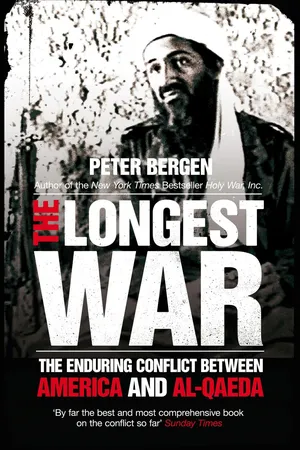
The Longest War
eBook - ePub

The Longest War

The Enduring Conflict between America and Al-Qaeda

  1. 496 pages
  2. English
  3. ePUB (mobile friendly)
  4. Available on iOS & Android
eBook - ePub

The Longest War

The Enduring Conflict between America and Al-Qaeda

About this book

In The Longest WarPeter Bergen offers a comprehensive history of the war on terror and its evolution, from the strategies devised in the wake of the 9/11 attacks to the fighting in Afghanistan, Pakistan, and beyond. Unlike any other book on this subject, Bergen tells the story of this shifting war's failures and successes from both the perspective of the United States and al-Qaeda and its allies. He goes into the homes of al-Qaeda members, rooting into the source of their devotion to terrorist causes, and he spends time in the offices of the major players shaping the U.S. strategic efforts in the region. At a time when many are frustrated or fatigued with what has become an enduring multigenerational conflict, this book will provide an illuminating narrative that not only traces the arc of the fight, but projects its likely future. At a critical moment in world history The Longest Warprovides the definitive account of the ongoing battle against terror.
Frequently asked questions

Yes, you can cancel anytime from the Subscription tab in your account settings on the Perlego website. Your subscription will stay active until the end of your current billing period. Learn how to cancel your subscription.
No, books cannot be downloaded as external files, such as PDFs, for use outside of Perlego. However, you can download books within the Perlego app for offline reading on mobile or tablet. Learn more here.
Perlego offers two plans: Essential and Complete
  • Essential is ideal for learners and professionals who enjoy exploring a wide range of subjects. Access the Essential Library with 800,000+ trusted titles and best-sellers across business, personal growth, and the humanities. Includes unlimited reading time and Standard Read Aloud voice.
  • Complete: Perfect for advanced learners and researchers needing full, unrestricted access. Unlock 1.4M+ books across hundreds of subjects, including academic and specialized titles. The Complete Plan also includes advanced features like Premium Read Aloud and Research Assistant.
Both plans are available with monthly, semester, or annual billing cycles.
We are an online textbook subscription service, where you can get access to an entire online library for less than the price of a single book per month. With over 1 million books across 1000+ topics, we’ve got you covered! Learn more here.
Look out for the read-aloud symbol on your next book to see if you can listen to it. The read-aloud tool reads text aloud for you, highlighting the text as it is being read. You can pause it, speed it up and slow it down. Learn more here.
Yes! You can use the Perlego app on both iOS or Android devices to read anytime, anywhere — even offline. Perfect for commutes or when you’re on the go.
Please note we cannot support devices running on iOS 13 and Android 7 or earlier. Learn more about using the app.
Yes, you can access The Longest War by Peter Bergen in PDF and/or ePUB format, as well as other popular books in Social Sciences & Sociology. We have over one million books available in our catalogue for you to explore.

Information


Part I

Hubris

As a general rule, the easiest way to achieve complete strategic surprise is to commit an act that makes no sense or is even self-destructive.
—maxim once displayed on the desk of Robert Gates,
U.S. secretary of defense in the administrations
of Presidents George W. Bush and Barack Obama
No one loves armed missionaries.
—Maximilien Robespierre

Chapter 1

Holy Tuesday

At 2:30 A.M. on August 29, 2001, the lead hijacker Mohammed Atta called Ramzi Binalshibh, his al-Qaeda handler, telling him he had a riddle that he was trying to solve: “Two sticks, a dash and a cake with a stick down—what is it?” Binalshibh thought for a while and suddenly realized that the two sticks were the number 11, and a cake with a stick down was a 9, and that Atta was telling him the attacks would happen in two weeks, on 11/9. That date is known as 9/11 in the United States.
Binalshibh, a slight, intensely religious Yemeni who had volunteered to be one of the hijackers, was turned down for an American visa. As a consolation prize for not becoming a “martyr,” Binalshibh took control of the coordination of al-Qaeda’s plans for the attacks on America from his apartment in Hamburg, Germany. Atta communicated by email from the United States with Binalshibh, apprising him of the progress of the plot. In his email messages, Atta posed as a university student writing to his girlfriend “Jenny.” Atta used an innocuous code to alert Binalshibh that the plot was nearing completion: “The first semester commences in three weeks. . . . Nineteen certificates for private education and four exams.” The nineteen “certificates” referred to the nineteen al-Qaeda hijackers and the four “exams” to the four targets of the soon-to-be-hijacked planes.
On September 5, Binalshibh left Germany for Pakistan, where he dispatched a messenger to Afghanistan to warn Osama bin Laden about the exact timing and scope of the attacks. Expecting some kind of American reprisal for the coming assaults on Washington and New York, likely in the form of cruise missile attacks like those President Clinton had ordered following al-Qaeda’s 1998 bombings of two U.S. embassies in Africa, all of the organization’s camps and residential compounds were put on high alert in the days before 9/11. A Yemeni living at al-Qaeda’s al-Farouq training camp in Afghanistan recalled that the trainers at the facility said, “If anyone wanted to leave, we were free to leave. There might be problems and there might be bombings.” In Kandahar, the southern Afghan city that served as the de facto capital of the Taliban, bin Laden urged his followers to evacuate to safer locations in early September.
Earlier that summer the scuttlebutt around the al-Qaeda campfires was that a large anti-American attack was imminent. Feroz Ali Abbasi, a British militant of Ugandan descent who was eager to conduct terrorist operations against Jews and Americans, remembered “this information being commonly known amongst everybody in the training camps and guesthouses.” Even “American Taliban” John Walker Lindh heard an instructor at his camp tell a group of trainees that bin Laden had dispatched dozens of suicide operatives for attacks against the United States and Israel.
In mid-June 2001 bin Laden and his top military commander, Mohammed Atef, also dropped broad hints that a major attack was in the works, during a meeting they held in Kandahar with Bakr Atyani, a correspondent for the Middle East Broadcasting Corporation. Atef said that “in the next few weeks we will carry out a big surprise and we will strike or attack American and Israeli interests.” Atyani asked bin Laden, “Would you please confirm that?” The al-Qaeda leader responded only with one of his slight, enigmatic smiles. The report about al-Qaeda’s plans for an anti-American attack was subsequently picked up by the Washington Post on June 23. For those who cared to look during the summer of 2001, al-Qaeda’s plans to wreak havoc on the United States were an open secret.
But the timing, targets, and scale of the operation was information that was tightly held, confined only to the top leaders of al-Qaeda and the pilots of the planes to be hijacked. Ayman al-Zawahiri, the leader of the Egyptian Jihad group, first learned of the details of the operation in June 2001, and that was only after his organization had formally contracted its alliance with al-Qaeda. Bin Laden even kept his spokesman in Afghanistan, Suleiman Abu Ghaith, in the dark. A former high school teacher from Kuwait, Abu Ghaith learned about the attacks on Washington and New York from media reports.
Similarly, the “muscle” hijackers on the four planes, whose primary role was to restrain the passengers on the flights, knew that they were volunteering for a suicide mission in the United States, but only at the final stage of the operation were they told their targets. Before they journeyed to the United States, the hijackers videotaped suicide “wills,” which al-Qaeda’s video production arm would release over the coming years to milk the 9/11 tragedy repeatedly.
In the final run-up to the attacks, Binalshibh made a last call to Ziad Jarrah, a onetime Lebanese party boy who had moved to Hamburg in 1996 and had fallen in there with the zealots in al-Qaeda’s local cell. Despite his increasing militancy, Jarrah continued to date a pretty Turkish dentistry student he had met in Germany. Now Jarrah was in the States to train as a pilot-hijacker, but in the summer of 2001 Binalshibh was concerned that personality clashes between Jarrah and the lead hijacker, Mohammed Atta, a dour misogynist known as “the Ayatollah,” might endanger the entire operation. Binalshibh asked Jarrah, “How do you feel?” He replied, “My heart is at ease, and I feel that the operation will, Inshallah [God willing] be carried out.” Jarrah would soon crash United Airlines Flight 93 into a Pennsylvania field, killing everyone on board.
Bin Laden was more optimistic than other al-Qaeda leaders that what they termed the “Holy Tuesday” operation would result in mass American casualties. Drawing on the experience he had working in his father’s construction company, one of the largest in the Middle East, bin Laden calculated that the impacts of the crashes of the two planes into the World Trade Center towers would take out three or four floors of each building and would then cause intense fires fed by the jet fuel inside each of the hijacked aircraft, which were both headed to the West Coast on full tanks. As bin Laden explained to a fawning Saudi supporter who visited him a few weeks after 9/11, those white-hot fires would then in turn collapse all the floors above their points of impact. “This is all that we had hoped for,” bin Laden told his Saudi guest.
Ali Hamza al-Bahlul, a Yemeni who made propaganda videos for bin Laden, hooked up a satellite receiver for the al-Qaeda leader so he could watch live coverage of the attacks, but Bahlul had trouble finding a satisfactory video signal in the mountainous terrain of Afghanistan. And so as their workday on Tuesday, September 11, finished, eight and a half time zones ahead of Manhattan, bin Laden and some fifty other members of al-Qaeda gathered around radios to listen as the attacks unfolded.
When the news of the first plane to hit the World Trade Center was broadcast on the BBC’s Arabic service, it was around 5:30 p.m. local time. Bin Laden’s followers exploded with joy at the news, shouting and crying, “Allah Akbar! God is great!” Their leader, knowing there were more attacks to come, urged them, “Be patient!”
Ramzi Binalshibh was in Pakistan watching the attacks live on television with a group of others from al-Qaeda. Knowing how the plot was to unfold, Binalshibh could not contain his own excitement: “Our brother Marwan [one of the pilots] was violently ramming the plane into the Trade Center in an unbelievable manner! We were watching live and praying: ‘God! Aim! Aim! Aim!’” Binalshibh remembers the elation of his colleagues: “They all chanted ‘Allah Akbar!’ and bowed to Allah in gratitude and they all wept.”
But shrewder members of al-Qaeda and the Taliban felt otherwise. They realized that the 9/11 attacks might not be the stunning victory that al-Qaeda and many in the West took them to be at the time, and might in fact more resemble a kamikaze operation that would decimate their ranks. Vahid Mojdeh, a Taliban Foreign Ministry official, immediately understood that the game was up: “I was listening to BBC radio broadcasting news that several buildings in the States are burning and planes have crashed into those buildings, and it said that al-Qaeda is behind the attack. As soon as I heard the news, I realized that the Taliban were going to be terminated.”
Abu Walid al-Masri, an Egyptian who was an early bin Laden associate in Afghanistan, explains that in the years before 9/11, bin Laden became increasingly deluded that America was weak. “He believed that the United States was much weaker than some of those around him thought,” Masri remembered. “As evidence he referred to what happened to the United States in Beirut when the bombing of the Marines’ base led them to flee from Lebanon.”
Bin Laden’s belief that the United States was a “paper tiger” was based not only on the American withdrawal from Lebanon in 1983 following the Marine barracks attack there, which killed 241 American servicemen, but also the withdrawal of U.S. forces from Somalia a decade later, following the “Black Hawk Down” incident, and the American pullout from the quagmire of Vietnam in the 1970s. Masri was not convinced by this paper-tiger narrative, though a number of bin Laden’s acolytes were: “Some young Saudi followers confirmed to bin Laden his delusions from the gist of the experiences they had gained from their visits to the United States, namely, that the country was falling and could bear only few strikes.” Bin Laden came to believe implicitly in his own analysis that the United States was as weak as the Soviet Union once was.
There were others in al-Qaeda’s inner circle who worried that large-scale attacks on American targets were unwise. Saif al-Adel, a senior Egyptian military commander, and Abu Hafs the Mauritanian, a religious adviser, opposed the attacks because they feared the American response or were worried that the operation would alienate the Taliban leader Mullah Omar. Abu Hafs the Mauritanian was also concerned that killing American civilians could not be justified on religious grounds.
Other militants also warned bin Laden that attacking the United States would be counterproductive. Noman Benotman, a leader of the Libyan Islamic Fighting Group, an organization that occasionally aligned itself with al-Qaeda, traveled from London in the summer of 2000 to meet with the group’s leaders in Kandahar. He told them bluntly that attacking America would be disastrous. “We made a clear-cut request for him to stop his campaign against the United States because it was going to lead to nowhere,” Benotman recalled, “but they laughed when I told them that America would attack the whole region if they launched another attack against it.” Benotman’s warning should have carried some weight because he had known bin Laden since they were both fighting the communists in Afghanistan.
By early September 2001, al-Qaeda was at the height of its power; the group and its Taliban allies were on the verge of taking over Afghanistan entirely. Yet the curtain raiser for the 9/11 attacks had gone virtually unnoticed in the West; this was the assassination on September 9 of Ahmad Shah Massoud, the leader of the coalition of anti-Taliban groups known as the Northern Alliance, which was the only force that stood in the way of the Taliban’s total victory in Afghanistan.
Bin Laden was well aware that key Taliban officials, such as the foreign minister, Wakil Muttawakil, wanted to rein him in because he was complicating the Taliban’s desperate and ultimately ill-fated quest for international recognition of their government. The Taliban put bin Laden on notice to stop his terrorist plotting and stop giving incendiary anti-American interviews on television networks such as CNN and Al Jazeera. At one point Mullah Omar, their strange, reclusive, one-eyed leader, even visited the al-Qaeda leader to tell him to leave Afghanistan. Bin Laden responded, “Sheikh, if you give in to infidel governments, your decision will be against Islam.” This argument was persuasive to Mullah Omar, a hyperdevout Muslim who had anointed himself “Commander of the Faithful” when he assumed total control of the Taliban movement in 1996.
Bin Laden agreed to desist from plotting terror attacks and from his media campaign and he pledged a religious oath of obedience to Mullah Omar, in exchange for the continued shelter that the Taliban offered his organization. Bin Laden would not honor those pledges and he did not clue in Mullah Omar about his plans for attacking America. But he calculated that there was one gift he could give the Taliban that might temper any anger they might have about his coming attacks on the United States: the head of Ahmad Shah Massoud.
Massoud, an intense, wiry warrior permanently dressed in fatigues, his gaunt face framed by a wispy beard, was one of the great guerrilla commanders of the late twentieth century. He had successfully resisted multiple Soviet offensives against his forces in northern Afghanistan during the 1980s and had taken Kabul from the communists in 1992. Four years later, as the black-turbaned Taliban appeared in force outside the capital, Massoud withdrew his forces to his bases in the north, where he continued to lead an intense resistance to the movement of religious warriors.
Much of Afghanistan’s history over the past three decades, and even the events of 9/11 itself, were in some senses reflective of the ideological and military struggles between bin Laden and Massoud. Not only was there the personal enmity between the two men going back to the 1980s, but they were also both representative of the ideological civil war that was taking place in the Muslim world between those like bin Laden, who wanted to install Taliban-style theocracies from Indonesia to Morocco, and those like Massoud, who espoused a more moderate form of Islamism and an orientation to the West.
By the summer of 2001 the Taliban and their al-Qaeda allies had rolled Massoud’s Northern Alliance back to a small patch of northeastern Afghanistan, where his army, now down to one working helicopter, was on life support. At this point bin Laden knew that killing its charismatic leader would be the coup de grace for the Northern Alliance, and indeed it nearly proved to be.
Al-Qaeda planned the Massoud hit with great care, tasking for the job two Tunisian-Belgian volunteers who disguised themselves as TV journalists eager to interview the heroic Massoud. The “journalists,” who had been hanging around his headquarters for weeks to secure the interview with the storied Afghan military commander, finally got their chance to speak with him on September 9. They set up their gear, saying they were interested in asking Massoud why he had earlier declared that bin Laden was a murderer who should be expelled from Afghanistan. As their videotape appeared to be rolling, one of the men asked the first question: “Sir, what is the state of Islam in Afghanistan?” Then one of them detonated a bomb hidden in the camera, killing himself and mortally wounding Massoud.
Feroz Ali Abbasi, the British-Ugandan militant living in one of al-Qaeda’s training camps, remembers that he heard about the Massoud assassination on the radio. “When this happened I thought that at last the Taliban were going to take the whole of Afghanistan. Massoud was crucial to the Northern Alliance.” That assessment was shared by one of Massoud’s closest confidants, Dr. Abdullah, who worried that the Northern Alliance was finished: “When I heard about the assassination, I was one hundred percent sure that the resistance would be over in a matter of days.”
Northern Alliance commanders kept Massoud’s death a secret for as long as possible, knowing that the news of their beloved leader’s assassination would undermine the morale of their troops. Indeed, absent the 9/11 attacks, the Taliban would have likely taken over Afghanistan permanently.
Whatever the intensity of the internal debates within al-Qaeda about the wisdom of attacking the United States, and despite the fierce private criticism leveled at bin Laden by senior Taliban officials, the only person whose opinion really mattered in Afghanistan following the 9/11 attacks was Mullah Omar, the “Commander of the Faithful” who stood by his Saudi “guest” both publicly and privately. Ten days after the assaults on Washington and New York, the Voice of America radio network interviewed Mullah Omar. When the interviewer asked if bin Laden would be handed over to the United States, the Taliban leader put the issue in the most cosmic of terms: “We cannot do that. If we did, it means we are not Muslims; that Islam is finished.”
As it became obvious that the United States was readying an attack on Afghanistan, bin Laden attempted to stiffen Mullah Omar’s resolve with a letter written on an al-Qaeda computer on October 3, four days before the American bombing campaign against the Taliban began. In the letter, bin Laden explained, “A U.S. campaign against Afghanistan will cause great long-term economic burdens which will force America to resort to the former Soviet Union’s only option: withdrawal from Afghanistan, disintegration, and contraction.”
Even if he indeed received this letter, its arguments do not seem to have been especially persuasive to Mullah Omar. He told a group of his companions a few days before the American bombing campaign began, “You may consider me weak or scared, but I have to send my family to Pakistan.” Up until this point, Taliban officials thought that even if Mullah Omar lacked other good qualities, at least he was both pious and courageous. But now he was showing the first sign of weakness.
On October 7, the day that the American aerial bombardment began, Faraj Ismail, an Egyptian journalist, interviewed Mullah Omar in Kandahar. The cleric naïvely assured him that bin Laden had no role in the 9/11 attacks: “I have control over Afghanistan. I’m sure he didn’t do it.” The Taliban leader also invoked the canard that 9/11 was a Zionist plot, based on “the absence on the same day of the incident of 4,000 Jews who worked in the World Trade Centre.”
That night American bombs began falling on Taliban targets in Afghanistan, the beginning of a campaign that would destroy Mullah Omar’s incompetent and brutal regime.
It was the opening salvo of a long war, a war that has already lasted longer than any conflict in American history. In 2006 the Pentagon even enshrined the concept of “the long war” into its Quadrennial Defense Review, its blueprint for military planning, while al-Qaeda’s leaders and their allies fervently believe that their struggle with the United States and her allies could last for generations. Burning with the conviction that they have God on their side, members of al-Qaeda are generally not deterrable in the conventional sense, and their very relative weakness makes them far more willing to ta...

Table of contents

  1. Cover
  2. Praise for The Longest War
  3. Also by Peter L. Bergen
  4. Title page
  5. Copyright page
  6. Dedication page
  7. Contents
  8. Author's Note
  9. Part I: Hubris
  10. Chapter 1: Holy Tuesday
  11. Chapter 2: Explaining 9/11
  12. Chapter 3: Blinking Red
  13. Chapter 4: Kicking Ass
  14. Chapter 5: The Great Escape
  15. Chapter 6: The Destruction of the Base
  16. Chapter 7: The Gloves Came Of
  17. Chapter 8: Home Front: The First Bush Term
  18. Chapter 9: Building the Case for War with Iraq
  19. Chapter 10: The War of Error
  20. Chapter 11: Almost Losing the War the United States Thought It Had Won
  21. Chapter 12: Al-Qaeda 2.0
  22. Chapter 13: Al-Qaeda's Quixotic Quest for Weapons of Mass Destruction
  23. Part II: Nemesis?
  24. Chapter 14: The United States of Jihad
  25. Chapter 15: Pakistan: The New Base
  26. Chapter 16: The Fall of Al-Qaeda in Iraq and the Rise of an Iraqi State
  27. Chapter 17: The Jihad Within
  28. Chapter 18: The End of the “War on Terror”?
  29. Chapter 19: Obama's War
  30. Chapter 20: The Long Hunt
  31. Note on Sources
  32. Interviewees
  33. Notes
  34. Bibliography
  35. Acknowledgments
  36. Index
  37. Plates