Saturday Night
eBook - ePub

Saturday Night

  1. 288 pages
  2. English
  3. ePUB (mobile friendly)
  4. Available on iOS & Android
eBook - ePub

Saturday Night

About this book

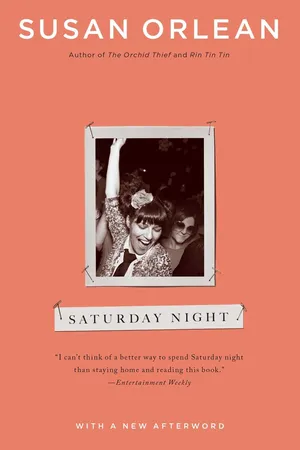
Twenty years ago, before she wrote The Orchid Thief or was hailed as "a national treasure" by The Washington Post, Susan Orlean was a journalist with a question: What makes Saturday night so special? To answer it, she embarked on a remarkable journey across the country and spent the evening with all sorts of people in all sorts of places—hipsters in Los Angeles, car cruisers in small-town Indiana, coeds in Boston, the homeless in New York, a lounge band in Portland, quinceañera revelers in Phoenix, and more—to chronicle the one night of the week when we do the things we want to do rather than the things we need to do. The result is an irresistible portrait of how Saturday night in America is lived that remains.

Frequently asked questions

Yes, you can cancel anytime from the Subscription tab in your account settings on the Perlego website. Your subscription will stay active until the end of your current billing period. Learn how to cancel your subscription.
No, books cannot be downloaded as external files, such as PDFs, for use outside of Perlego. However, you can download books within the Perlego app for offline reading on mobile or tablet. Learn more here.
Perlego offers two plans: Essential and Complete
  • Essential is ideal for learners and professionals who enjoy exploring a wide range of subjects. Access the Essential Library with 800,000+ trusted titles and best-sellers across business, personal growth, and the humanities. Includes unlimited reading time and Standard Read Aloud voice.
  • Complete: Perfect for advanced learners and researchers needing full, unrestricted access. Unlock 1.4M+ books across hundreds of subjects, including academic and specialized titles. The Complete Plan also includes advanced features like Premium Read Aloud and Research Assistant.
Both plans are available with monthly, semester, or annual billing cycles.
We are an online textbook subscription service, where you can get access to an entire online library for less than the price of a single book per month. With over 1 million books across 1000+ topics, we’ve got you covered! Learn more here.
Look out for the read-aloud symbol on your next book to see if you can listen to it. The read-aloud tool reads text aloud for you, highlighting the text as it is being read. You can pause it, speed it up and slow it down. Learn more here.
Yes! You can use the Perlego app on both iOS or Android devices to read anytime, anywhere — even offline. Perfect for commutes or when you’re on the go.
Please note we cannot support devices running on iOS 13 and Android 7 or earlier. Learn more about using the app.
Yes, you can access Saturday Night by Susan Orlean in PDF and/or ePUB format, as well as other popular books in History & North American History. We have over one million books available in our catalogue for you to explore.

Information

Cruising

Elkhart, Indiana
James Patrick Perron, who is twenty-seven years old and the youngest mayor in the history of Elkhart, Indiana, as well as the youngest mayor of any decent-sized town in the state, drives a navy-blue Buick sedan with four doors, plush seats, power brakes, and a big, squishy suspension that smooths out bumps in the road. The car is loaded with luxury options and has a lot of pep. It has a handsome paint job. Still, it is not the sort of vehicle that people in Elkhart who consider themselves judges of such things—and there are quite a few who do—would call a cruising machine or a piece of musclecar perfection.
Mayor Perron is medium-sized and has brown bowl-cut hair, broad cheeks, a mild, toothy, genuine-looking smile, and an unaggressive chin. His skin is as soft-looking and unwrinkled as a child’s, but he carries himself with the gravity of someone who would not wear a bathing suit with abandon. A lot of people who knew Jim Perron when he was growing up in Elkhart recall that the air of maturity—the air of a man who would drive a Buick—has always been rich around him. No one, including the mayor himself, remembers him experiencing adolescent spasms of girl craziness or car craziness or experimental self-destructiveness. At the appropriate moment in history—his and the world’s—he did flirt with the concept of hippieness, but the flirtation exhausted itself with his reading of The Whole Earth Catalog and some discussions about conserving fossil fuels. He has always preferred light classical music to car horns that play the theme song from The Godfather. He ran for city council before he finished college. His earnestness about civic matters and his absolute solidness made the question of his age, or lack of it, irrelevant. In fact, anyone who expected that a young mayor would incline civic temperament in Elkhart toward frivolity would have to admit to having been confounded by Jim Perron.
I had come to spend a Saturday night in Elkhart, Indiana, for a reason not dear to Jim Perron’s heart: I knew Elkhart was one of the nation’s capitals of cruising, and cruising struck me as being what Saturday night in America is all about. Cruising in a motor vehicle is the contemporary equivalent of strolling, which is what Saturday night used to be all about. It is done at approximately strolling speed, so that cruisers can look at one another and tenderly insult one another’s cars as they drive around in a big loop. The purpose of cruising is slow-going and social—it is more spectator than sport. It is an opportunity to get together and do nothing, but in a somewhat organized fashion. It feels silly and wasteful and independent, all of which is especially suited to Saturday night, when people like to do something that very specifically does not duplicate the purposefulness and productivity and obligations of the workday. If you are imagining something done at more than thirty miles an hour, you are confusing cruising with drag racing. If you are thinking of something that is a procession of vintage cars, you are confusing cruising with an auto meet. Some people do cruise in fabulous cars, but plenty cruise in beat-up station wagons with wobbly fenders and bad paint jobs. The car doesn’t really matter. What matters is being out on a street, with friends, in some vehicle, with time on your hands, with nowhere in particular to get to, on a Saturday night—which has a way of making such simple things seem spectacular.
The folklore of cruising suggests that it arose in the 1950s, when many families had cars or second cars for the first time, and town squares made to walk around were being replaced by commercial strips you had to drive around, and the critical mass of people looking for something cheap and easy to do on weekends was reached. Cruising was the elegant solution. It solved the biggest challenge of Saturday night—that is, how to have fun when you don’t have anything much to do. As such, it is especially suited to small towns. In Indiana, a state made up of small towns, cruising flourished.
Elkhart, the largest town in Indiana without mass transit, is the biggest city in the region and the natural magnet on weekends for people from neighboring towns such as Goshen and White Pigeon and Sturgis and Mishawaka. In the center of town is the wide, inviting roadbed of Main Street, and there is very little competition for the local entertainment dollar. It is also a town that has pleasure driving to thank for its economy: Elkhart is the hub of the recreational-vehicle industry, and more than half of its citizens have jobs building, servicing, selling, or outfitting mobile homes and fancy vans. In 1930, when Elkhart was still just a squirt of a town set among cows and farm stands in the northeast corner of this big, flat state, Skyline Motor Homes was founded by a local resident, and in time was joined here by Holiday Rambler and Coachman and Schult and trailer-top manufacturers and van converters and tinted-glass shops and paint-job outfits and rec-vehicle-accessory shops, and pretty soon Elkhart started to be known as the Detroit of the Recreational Vehicle Industry. The only other major business in town is an Alka-Seltzer plant. All of this appears to have inclined people in the area to having a super-developed appreciation of cars as entertainment units.
On Saturday nights for many years, hundreds of people from miles around converged on Elkhart’s Main Street and traveled a loop that went from the railroad tracks through the McDonald’s parking lot and back to the railroad tracks. In some places around the country, the cruising crowd is mostly adolescent; in Elkhart, it was diverse, made up of teenagers who had just discovered cruising and middle-aged adults with nicer cars and fond memories of their teenage cruising years. On Saturday nights, the cruisers on Main Street formed a considerable and interesting cavalcade. Car Craft, a performance-car magazine, has included Elkhart on its list of the ten best American cruising cities—something that has made Main Street regulars understandably proud, considering that Elkhart is not often on lists of the ten best American anythings, and considering that many other towns on the list are in California, where the length of the cruising season and the prevalence of convertibles provide an unfair advantage.
This equation remained intact for many years: a small city grateful for and dependent on the recreational-driving industry, where there isn’t an overabundance of things to do with free time, raises to a near platonic ideal the classic American Saturday-night sport of cruising. Then into this was added James Perron, a young, sort-of-urban professional who drives a Buick and makes use of his turn signals all the time, and who pictures the Elkhart of the future with an expanded economy, more attractive boutiques, more tasteful entertainment, and fewer people who like to wear hats made out of beer cans.
“We’re too dependent on the recreational-vehicle industry,” Mayor Perron has said. “It’s time for Elkhart to diversify. We should become the banking and high-tech center of the region.” On cruising specifically, he has said, “I personally have no feeling about cruising, but it generates too much noise and trash and has made Main Street unusable for emergency vehicles as well as people who are not cruising. We should have all strata of people coming to Main Street to enjoy a variety of cultural and entertainment opportunities. Theater. Symphony. I tend to spend my Saturday nights at home with my wife, or we go out with friends. During election season, of course, I spend most Saturday nights at political functions. Elkhart is a growing metropolitan area. The trend here is community pride. That’s what’s important, not more cars and cruising.”
Just before I came to Elkhart, the mayor did something about his displeasure with the standard Elkhart Saturday night: he enacted an executive order banning traffic from the center two lanes of Main Street after 8 p.m. Of course, traffic could continue as usual in the outer two lanes on Main. But without use of the center lanes, the cruisers, who considered hollering, waving, and peering into one another’s cars the material points of the experience, had to cruise past one another at a fifteen-foot distance—something that had on the activity what legal minds might call a chilling effect. Suddenly, Saturday night—which probably had not been a matter of municipal concern in the past—became a matter of great emotional debate in town. When I told some people in Elkhart that I was coming to spend time in the cruising capital of the Midwest, they warned me that the mayor’s order meant I would be cruising under reduced circumstances. I was also warned that some of the cruisers had banded together and were waging war against Major Perron.
When I first arrived in Elkhart, Mayor Perron met me at my hotel and suggested we drive down Main. I knew it was a symbolic gesture, but it was also a practical one: there is almost nowhere you can go in Elkhart that doesn’t require a trip down Main. The street is as straight as a paper cut, and the town peels off on either side of it. Before it gets to the center of Elkhart, Main is a country road that runs past plowed fields and then fields that look as if they’ve been left fallow in anticipation of a future industrial park, and then past sparse neighborhoods, and then past patches of small businesses with gigantic parking lots festooned with plastic flags and marked with junky electric signs on three-wheeled trailers. Downtown, Main is lined with narrow sidewalks, parking meters, and low, flat-faced buildings with modestly ornate trim and stout dimensions. Some of the downtown storefronts have been remodeled in a style that probably looked snazzy and modern twenty years ago. The building materials are the sturdy, unspectacular sort you often find in old, solvent midwestern towns—brick, granite, some wood, and some aluminum siding—in muted shades that look as if they had been alternately bleached and frozen over the last several decades. Over the railroad tracks, Main peters out quickly, and a mile out of downtown, you feel as if you’re on a country road again.
Mayor Perron drives with his hands in the eleven- and two-o’clock positions. He prodded the accelerator erratically, as if his foot had hiccups. At the first stoplight, he stomped on the brakes and then turned to me. “I want to make one thing clear,” he said. “In spite of all that’s gone on, I think people should know a few things about me. I think they should know that as a matter of fact, I like to drive. I really do. But as much as I might like to drive, I just don’t think of driving as recreation. I think of it as transportation. I realize some people think of driving and cars and I suppose even cruising in their cars as a pastime. I imagine for them it’s like a hobby. They probably view it the way some people view fishing or collecting stamps. But as far as I’m concerned, I just don’t see the attraction in it. A car like this Buick is all I’d ever want.” He smiled at me and patted the dashboard.
“This car takes me where I want to go, and that’s enough for me,” he said. “Personally, I just don’t think of the automobile as a pleasure tool.”
Around nine o’clock that Saturday night, I joined some of the people who do think of the automobile as a pleasure tool in a parking lot on Main Street called the Bucklen Lot.
Bucklen is the biggest parking lot downtown. The Bucklen Opera House, an imposing rococo stone structure built in 1884, used to stand on the site. In its day, the opera house was probably the swankiest recreational facility in town. After burlesque and vaudeville went out of fashion, the Bucklen showed movies, and then the movies moved out to the mall. No other use for the building cropped up. Eventually, it fell into complete disrepair and everyone gave up on it, so it was torn down. Some people in Elkhart consider the incident a shame, but as you might expect in a town of avid drivers, many others consider the parking lot a fine thing to have acquired in the deal.
Bucklen is now regarded as ground zero by the people who come to Elkhart to cruise, and by nine that night, even under these reduced circumstances, it was busy. Three monster trucks—pickups perched on giant tires—were parked along the north edge of the lot; a Mustang convertible, a Dodge classic street rod with tongues-of-flames decals on the hood, several different makes of muscle cars, a blue Pinto with a fuzzy doll hanging from the rearview mirror, a ‘69 Camaro, a ‘63 Impala, and one ratty station wagon were lined up inside. No one had pulled onto the street yet: this was the assembly period, and most people were just standing around chatting and smoking cigarettes.
The fainthearted, of course, were long gone. Center-lane-violation tickets were going at fifty dollars a pop, and as a reminder, the mayor had sent a phalanx of police with pencils and ticket pads to Main Street on the first several Saturday nights after the order had gone into effect. “It’s too expensive to cruise now,” one man who had been ticketed told me. “I can’t afford to go out there and drive around for a few hours if it’s going to cost me a fifty-dollar bill.” Some cruisers had shifted their base of operations to Mishawaka, a nearby town with a cruising strip just beyond its city limits. A lot of Elkhart’s cruisers don’t like the Mishawaka strip because it is dark, dismal, runs past fields and parking lots (which make for a boring cruise backdrop), and has a lot of high-speed incidental traffic that makes the lollygagging pace of cruising a little dangerous. On the other hand, so far, no one in the Mishawaka town government seems to mind the cruisers being there. It may just be a matter of time before Mishawaka goes the way of Elkhart, since bans like Mayor Perron’s are becoming increasingly popular around the country. In Goshen, Indiana—a little town a few miles east of Elkhart—Mayor Max Chiddester made a cruising ban one of his final official acts before retiring. In Portland, Oregon, the city fathers have imposed a $150 fine on anyone driving purposelessly past the same spot twice in an hour. Third time around gets the vehicle impounded. Officials in Allentown, Pennsylvania, have considered similar legislation. The standard complaints were trash, noise, the creation of an unattractive nuisance, and, by implication, greaser overload. “Why encourage this sort of activity?” one city councilman in Oregon complained. “Why can’t these people find something else to do with their weekends that doesn’t include cars?”
For a while, it had looked as if cruising would be killed off by causes other than legislative ones. When the price of gas rose in the 1970s, it pushed cruising out of the category of cheap, fun things to do on Saturday nights, and the vogue for finless, chromeless, subcompact stick shifts with pokey little engines made it seem silly—more like a cortege of bumper cars than a grand display. It became much more with-it and contemporary to spend Saturday nights barhopping or disco dancing or eating in brassy, ferny Tex-Mex restaurants than driving up and down a street engaging in an anachronistic cornball ritual that wasted gasoline.
In Elkhart, the downslide in pleasure driving had a one-two punch. The financial considerations that queered cruising did the same to the town’s economy: once gas cost a dollar or more per gallon, Americans reconsidered the wisdom of the recreational vehicle. What followed in Elkhart was a powerful slump. The net worth of one rich man in town who owned some of the rec-vehicle companies dropped so much in a single day that it was recorded in the Guinness Book of World Records. Unemployment in Elkhart became an ordinary condition. For a while, according to some people in town, it felt as if the rec-vehicle business would never recover, and Elkhart would be left as enervated and useless as a roughneck town on a tapped-out oil well. “Luckily, people eventually got used to high gas prices,” one resident told me. “They came back to the realization that mobile homes are a marvelous thing.” Around the time Elkhart was getting back to speed, Main Street was repaved, and on each subsequent Saturday night, more and more cruisers returned to the road. “They came back right after we got Main Street into good shape, too,” Mayor Perron recalls with dismay. “Before that, for a while, it had really been beautiful.”
Pete Russell, the man generally acknowledged to be leading the Elkhart cruiser resistance, was standing with a large group of people beside his monster truck when I got to the Bucklen Lot. Pete’s truck is a half-ton Chevy pickup, white as milk, named the Intruder. Car naming is as common in Elkhart as estate naming is in the Virginia hunt country. Pete is a lean, leathery man in his mid-forties with narrowed eyes and a set jaw—the aspect of someone who spends a lot of time on his back halfway under car chassis in the bright sun. He wears his hair, which is either platinum blond or prematurely white, in a long and lightly sculpted pageboy. Charley Rich, the country-western star who is sometimes known as the Silver Fox, used to have a similar haircut. It happens that Pete is fond of country music and doesn’t mind the comparison. He is also fond of Elvis Presley, and keeps a life-size bust of him in his living-room window. He is less fond of Mayor Perron, who he considers a nervous youngster with yuppie aspirations and a secret disdain for what is sometimes cruelly described in these parts as “trailer trash”—that is, the people who work in the rec-vehicle business. Pete sells race-car trailers for a living. That night, he was wearing a silver vinyl jacket decorated with Valvoline Motor Oil insignias that made a faint crunching sound when he turned and glinted when it caught the streetlight at certain angles. He calls himself a race-car fan. When he is interviewed on television about the cruising controversy, he is identified as “Pete Russell—Cruising Advocate.”
“Pretty quiet night,” Pete said to me. He gestured around the lot. A few people standing within earshot murmured in agreement. “Actually, since the new rules, we haven’t had a really big night here since fifty German band students who were touring the United States ended up in Elkhart. I don’t know how they knew about cruising, but they wanted to do it. We put ten Germans at a time in the back of a pickup and cruised them up and down Main. They sang obscene German drinking songs and had a great time. They told us they liked cruising more than anything else they did the whole time they were in the United States. They spent the next two days walking around in a daze saying ‘Big truck! Big truck!’” He shook his head. “Except for that night, though, it’s not the way it used to be.”
Someone laughed and said, “It’s not the way it used to be, Pete, but then again, what is?”
“My wife looked up the definition of cruising in the dictionary the other day,” Pete said. “You know what it said? The definition of ‘cruise’ is ‘to meet.’ As in, ‘to meet people.’ That’s all we’re trying to do here, and as far as I’m concerned, that’s a pretty basic right. That’s why we set up the Elkhart Cruising Association.” He pointed to a bumper sticker on his truck that said ELKHART CRUISING ASSOCIATION, CRUISIN’ USA, ELKHART INDIANA. “That’s us against the mayor.”
The fact is that until this point Jim Perron had been a very popular mayor. He’d brought attention to an interesting local groundwater problem and had presided over Elkhart’s return from the depths of the gas crisis and recession. He proposed rehabilitating Main Street and the surrounding neighborhoods, and no one, including the cruisers, denied that Main Street could stand some rehabilitation. Some of its storefronts were empty and some were dilapidated; it looked droopy and outdated while everything snappy and new was out at the mall. The most exciting thing that had taken place on Main in recent memory was the murder of the man who owned the movie theater across from the Bucklen Lot. He was shot by one of his employees as he stood next to the popcorn machine.
It did appear that the mayor had a mandate to tidy up downtown, and he considered the cruising ban the foundation of the effort. He figured that his only liability might be some irritated motorhead kids. He hadn’t counted on the Elkhart Cruising Association—a coalition of teenagers and adult cruisers that soon provided the sociological and political spectacle of the mayor alienating both people fifteen years older and fifteen years younger than himself.
The association was headed by Pete Russell and a couple named Judy and Mark Cooke, two other Elkhart natives who happened to have conducted their own courtship while cruising on Main Street some decades ago. Judy and Mark own a custom auto-glass business in town. Their seventeen-year-old son is also a cruiser. “I didn’t know Pete before, but I saw him interviewed on television about the cruising rules, and I felt I had to do something about it,” Judy Cooke once told me. “To me, cruising is Saturday night. I’d felt that since my adolescence. I felt the mayor was negating my adolescence. I didn’t feel too great about that. I felt like, hey, that’s my youth you’re talking about.”
A few cars were heading down Main Street. A police car drove by...

Table of contents

  1. Cover
  2. Dedication
  3. Introduction
  4. Chapter 1: Cruising
  5. Chapter 2: Riding
  6. Chapter 3: Debuting
  7. Chapter 4: Lounging
  8. Chapter 5: Polka Dancing
  9. Chapter 6: Scene Making
  10. Chapter 7: Killing
  11. Chapter 8: Dining
  12. Chapter 9: Dieting
  13. Chapter 10: Hostessing
  14. Chapter 11: Praying
  15. Chapter 12: Socializing
  16. Chapter 13: Watching Television
  17. Chapter 14: Sitting
  18. Chapter 15: Missileering
  19. Chapter 16: The Next Day
  20. Afterword
  21. Copyright