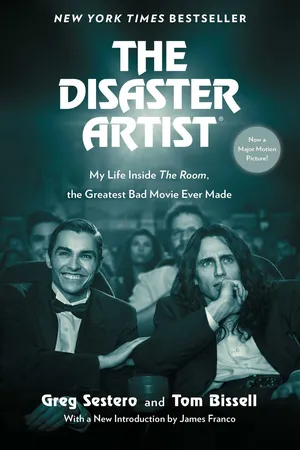
The Disaster Artist
eBook - ePub

The Disaster Artist

My Life Inside The Room, the Greatest Bad Movie Ever Made

  1. 288 pages
  2. English
  3. ePUB (mobile friendly)
  4. Available on iOS & Android
eBook - ePub

The Disaster Artist

My Life Inside The Room, the Greatest Bad Movie Ever Made

About this book

New York Times bestseller— now a major motion picture directed by and starring James Franco! From the actor who somehow lived through it all, a "sharply detailed
funny book about a cinematic comedy of errors" ( The New York Times ): the making of the cult film phenomenon The Room.In 2003, an independent film called The Room —starring and written, produced, and directed by a mysteriously wealthy social misfit named Tommy Wiseau—made its disastrous debut in Los Angeles. Described by one reviewer as "like getting stabbed in the head, " the $6 million film earned a grand total of $1, 800 at the box office and closed after two weeks. Years later, it's an international cult phenomenon, whose legions of fans attend screenings featuring costumes, audience rituals, merchandising, and thousands of plastic spoons. Hailed by The Huffington Post as "possibly the most important piece of literature ever printed, " The Disaster Artist is the hilarious, behind-the-scenes story of a deliciously awful cinematic phenomenon as well as the story of an odd and inspiring Hollywood friendship. Actor Greg Sestero, Tommy's costar and longtime best friend, recounts the film's bizarre journey to infamy, unraveling mysteries for fans (like, who is Steven? And what's with that hospital on Guerrero Street?)—as well as the most important question: how the hell did a movie this awful ever get made? But more than just a riotously funny story about cinematic hubris, " The Disaster Artist is one of the most honest books about friendship I've read in years" ( Los Angeles Times ).

Frequently asked questions

Yes, you can cancel anytime from the Subscription tab in your account settings on the Perlego website. Your subscription will stay active until the end of your current billing period. Learn how to cancel your subscription.
No, books cannot be downloaded as external files, such as PDFs, for use outside of Perlego. However, you can download books within the Perlego app for offline reading on mobile or tablet. Learn more here.
Perlego offers two plans: Essential and Complete
  • Essential is ideal for learners and professionals who enjoy exploring a wide range of subjects. Access the Essential Library with 800,000+ trusted titles and best-sellers across business, personal growth, and the humanities. Includes unlimited reading time and Standard Read Aloud voice.
  • Complete: Perfect for advanced learners and researchers needing full, unrestricted access. Unlock 1.4M+ books across hundreds of subjects, including academic and specialized titles. The Complete Plan also includes advanced features like Premium Read Aloud and Research Assistant.
Both plans are available with monthly, semester, or annual billing cycles.
We are an online textbook subscription service, where you can get access to an entire online library for less than the price of a single book per month. With over 1 million books across 1000+ topics, we’ve got you covered! Learn more here.
Look out for the read-aloud symbol on your next book to see if you can listen to it. The read-aloud tool reads text aloud for you, highlighting the text as it is being read. You can pause it, speed it up and slow it down. Learn more here.
Yes! You can use the Perlego app on both iOS or Android devices to read anytime, anywhere — even offline. Perfect for commutes or when you’re on the go.
Please note we cannot support devices running on iOS 13 and Android 7 or earlier. Learn more about using the app.
Yes, you can access The Disaster Artist by Greg Sestero,Tom Bissell in PDF and/or ePUB format, as well as other popular books in Social Sciences & Film History & Criticism. We have over one million books available in our catalogue for you to explore.

four

Tommy’s Planet

He has so many realities—and he believes them all.
—Tom Ripley, The Talented Mr. Ripley
David and Donna were scene partners in Jean Shelton’s class, and also extremely nice people, but they were in growing danger of raising Samuel Beckett from the dead and compelling him to stomp through San Francisco like Godzilla. I was sitting two rows back from Shelton, who was pinching the bridge of her nose and looking into her lap. When David and Donna came to the end of their scene from Waiting for Godot, Shelton was silent, as was everyone else. David and Donna stood on the stage like prey animals waiting to see which one of them would be eaten first.
Jean Shelton looked a little bit like Yoda’s mother: short, glasses, frizzy white hair. Yet she seemed to us, her students, more like Darth Vader. When you got up onstage in front of her, you were pulled between feelings of terror and exhilaration. She was the best kind of teacher, in that you didn’t care if she liked you personally; you just wanted her to respect you professionally.
Shelton’s class was held in a basement studio space on Sutter Street, off San Francisco’s Union Square. But for the stage, the room was kept very dark, though you could always see Shelton, thanks to the way the light illuminated her halo of white hair. When you were awaiting her judgment, as David and Donna were now, you dreaded the first few words from her mouth. Her accent was very mid-Atlantic: soft, round consonants and fierce vowels. That big, commanding voice of hers filled the room, cutting through the darkness.
“Awful,” Shelton said to David and Donna. “That was just . . . I’d tell you to try it again but I doubt you’ll do any better.” She waited for David or Donna to speak. They didn’t. They couldn’t even look at each other. “Poor selection of material, as well. I saw nothing good. Nothing useful.” She paused. “I’m sorry.”
That was another thing about Shelton. You never felt as though she enjoyed being negative. She always seemed to genuinely want you to be great. As David and Donna climbed from the stage and collapsed into front-row seats, Shelton looked around. “Does anyone want to do anything? We still have some time. The stage is open.” The seats in the theater were old, so their creaking served as a good indicator as to how restless the class was feeling. On this evening, the chairs were creaking like crazy: Everyone was ready to leave.
To my—and, I’m sure, everyone else’s—astonishment, someone stood in the back row. It was the pirate from the previous week. Today he was wearing black pants, an ostentatiously studded belt, and a gleamingly pearlescent button-down shirt. He had a slightly hunchbacked posture, and when he walked his arms barely moved. He was also taking his sweet time getting to the stage. He went backstage and slowly picked around before returning with a foldout chair, which he snapped open and slammed down onstage, so that its back was facing the audience. He straddled the chair, legs spread wide, and pushed his long dark hair from his face. It suddenly seemed possible this guy was actually sort of great. No one who wasn’t great could afford to conduct himself like this.
Shelton asked him, “And what are you doing for us, Thomas?”
“No, not Thomas. It’s Tommy.”
Bored already, Shelton scratched her nose. “What are you doing for us, Tommy?”
“The Shakespeare, Sonnet 116.”
I heard someone mutter, “Oh no, not this again.”
I was watching Shelton very closely now. We all were. “Proceed,” she said.
“Let me not to the marriage of true minds,” he began, “admit impediments.” He bludgeoned his way through the rest, each line a mortal enemy. Where the sonnet demanded clear speech, he mumbled; when it asked for music, he went singsong. Everything he said was obviously the product of diligent mismemorization, totally divorced from the emotion the words were trying to communicate. He was terrible, reckless, and mesmerizing.
Once again we waited, frozen within a dreadful glacier of Sheltonian silence.
“What is it exactly,” Shelton finally said, “that you’re trying to do here?”
The guy drew his head back and flipped his hair over his shoulder. “Sonnet,” he said.
“Yes,” she said. “But what are you trying to do?”
His bearing tensed up. “Send the message,” he said. “Express emotion of Shakespeare.”
That accent, I thought. It sounded almost French, but not quite. Was there some Austrian buried in it?
“It’s a sonnet,” he continued. “You know, sonnet?”
“Oh, God,” someone said next to me, her hand clamped over her mouth.
“Yes,” Shelton said, which she followed with a quick, huffy laugh. “I know what a sonnet is. What I don’t know is what you are trying to do.”
The guy was silent. His face was getting red, rapidly.
Shelton noticed this and went into salvage mode. “Look,” she said. “The chair is not helping you. It’s distracting. Maybe you should do it . . . standing up.”
His face was now a tomato with orifices. But he didn’t budge. “I disagree with that,” he said, now barely keeping control of himself. Everyone in that class was at least a little afraid of Shelton. No one ever got mad at her for expressing her opinion, certainly. But this guy wasn’t afraid of her. It felt oddly liberating to watch someone confront her.
“I see, then.” Shelton lifted herself from her chair and turned to the rest of us. “You’re all free to go.”
What I had just seen almost never happened in acting classes. The pirate was not only confrontational but fearless, a trait I wanted better acquaintance with. Of anyone in our class, this guy had the least cause to be so outspoken, so confident, yet he was. I was intrigued.
My mother, who was meeting me for dinner that evening, was waiting outside the studio. Just as I was describing to her the interesting French guy I’d seen in class, the sonneteer himself passed by us. “There he is,” I said.
My mother enthusiastically marched over to him to say hi, just as any French person outside of France does when informed that a fellow native is within two kilometers. “Excusez-moi? Mon fils me dit que vous ĂȘtes Français. C’est vrai?”
The guy whirled around as though he’d been pickpocketed. “Non, merci,” he said quietly.
My mother didn’t give up. “D’oĂč venez-vous?” she asked pleasantly.
“I have to go,” the guy said with a sick, half-secretive smile.
My mother and I watched as he slithered away into the night. “I thought he was French,” I told her.
“That guy is not French,” she said. “Whatever he is, I think he’s been put through the wringer.”
‱ ‱ ‱
“Something big” was how my agent described it to me, and the more I learned the bigger it sounded. A film called Wildflowers, starring Daryl Hannah, Eric Roberts, and Clea DuVall, was going to be shooting in the Bay Area. I saw this as my chance to land something that would pluck me out of obscurity and plant me in Hollywood.
I ended up getting called back several times. Then my agent called. “Everything was right,” she said, “but someone else fit the part better.” When she saw how upset I was, my mother said, in so many words, “I told you so.” When the person you’re closest to is telling you to quit, it’s not easy to go on. Her voice was still in my head. An acting career? A pipe dream. Agents? Evil with a Rolodex.
I was feeling defeated and almost didn’t bother going to acting class that night. Any momentum I’d thought I’d gathered had vanished. Classes, it was becoming obvious, didn’t guarantee anything. The only thing that made me consider going to class that night was the prospect of watching the unpredictable pirate go bananas onstage again. During the previous week’s class, in the middle of his scene, he had grabbed a glass full of water from a prop table and thrown it against the wall. Then he kept going with his scene as though nothing had happened. When Shelton asked why he had done this, he answered, “I was in zone.” In fact, whenever Shelton questioned his creative choices, he answered as though he had as much right to expound on craft as she did.
That night would be the pirate’s final performance with his current scene partner. They’d decided to do a scene from A Streetcar Named Desire. I had no doubt which scene they’d chosen.
Cut to: Pirate Guy in a white tank top, his wild hair in a ponytail, wandering around stage left, crying out, “Stella!” many more times than the script called for and occasionally breaking into exaggerated sobs. He wasn’t even bothering to direct his agony toward his partner, the intended focus of the scene. He was just launching his performance out into space. Two girls in the first row were squeezing each other’s hands in an effort to contain their laughter. The actor sitting next to me—an older guy who was normally subdued to a fault—actually began laughing so hard he had to bunch his sweater up around his mouth. The pirate’s scene partner valiantly tried to bring him around with the smelling salts of actual lines from the script, but he kept yelling over her, “Stella! Stella!” until he went to his knees, covered his face with his hands, cried for a moment, and finished with a final and piercingly wrong “Stella!”
Most bad performances are met with silence. This was something else. There were murmurs. There were giggles. Everyone in that basement studio knew they had just witnessed one of the most beautifully, chaotically wrong performances they would ever see.
As for me, I felt resuscitated. I’d never been so happy to be in a classroom.
Jean Shelton did not wait to address the lunatic who lay prostrate before her. “Thomas, or Tommy—I’m sorry—I must ask you—again—what you are trying to accomplish?”
He was rising from the floor now. His face was flushed, his eyes intense little blurs of exhaustion. “I am performing the Tennessee Williams scene,” he said. At this, his scene partner—an older woman—shook her head hopelessly.
“No, Tommy,” Shelton said. “I don’t think that’s what you were doing.” I sensed Shelton’s brain trying to plan its attack in a distractingly target-rich environment. “First, you did nothing to demonstrate Stanley’s objective in the scene.” She stopped, shifted, reversed. “What is Stanley’s objective in this scene?”
“Stanley is hysterical,” he said.
“No, that’s . . . not an objective. Stanley loves Stella. He’s trying to reach Stella. And if he’s trying to reach Stella, to speak to her, he is not going to shout at the stagehands or audience members. He’s going to address her. But you hardly noticed Stella. As far as your performance was concerned, she wasn’t even on the same stage.”
That’s when I realized what he’d been doing up there: He was looking for the camera. He wasn’t thinking about Stanley. He was thinking about Brando. For him, there was no stage. There was only an appeal to a camera that didn’t exist.
“You’re wrong,” he said to Shelton.
I don’t think she heard him, because she kept going: “Also, Stanley is a very strong man. A strong character and a strong man. He’s pursuing Stella. He’s not screaming because he’s in pain. Stella is right in front of you, and you’re yelling in the opposite direction. And so I ask again: What are you doing?”
“I’m sorry,” the pirate said. “May I correct you?”
“No!” Shelton cried out, pointing at him. “No, you may not!”
No one was laughing now. But I had a thought, a thought I can’t fully explain, even today: He should be my next scene partner. I have to do a scene with this guy.
Maybe he’d cheer me up. Maybe I’d learn some of his fearlessness. What made him so confident? I was desperately curious to discover that. It wasn’t his acting, obviously, which was extraordinarily bad. He was simply magically uninhibited; the only person in our class—or any class I’d ever taken, for that matter—whom I actually looked forward to watching perform. The rest of us were toying with chemistry sets and he was lighting the lab on fire.
After Shelton dismissed us, I made a beeline for the guy. He was getting his stuff together, putting on his jacket, the adrenaline still draining from his face. I knew he probably didn’t feel like talking, so I got right to it: “You want to do a scene together?”
He looked at me, his eyes narrowed, his mouth partly open. I couldn’t tell if he was annoyed or offended or pleased. “You and me?” he asked.
“Yeah.”
“Why you ask me?” he asked, irritably.
The directness of this question caught me off guard.
“I just thought that since you don’t...

Table of contents

  1. Cover
  2. Dedication
  3. Epigraph
  4. The Players
  5. Introduction
  6. Author’s Note
  7. One: “Oh, Hi, Mark”
  8. Two: La France a Gagné
  9. Three: “Do You Have Some Secrets?”
  10. Four: Tommy’s Planet
  11. Five: “People Are Very Strange These Days”
  12. Six: Too Young to Die
  13. Seven: “Where’s My Fucking Money?”
  14. Eight: May All Your Dreams Come True
  15. Nine: “You Are Tearing Me Apart, Lisa!”
  16. Ten: Do You Have the Guts to Take Me?
  17. Eleven: “I’ll Record Everything”
  18. Twelve: I’m Not Waiting for Hollywood
  19. Thirteen: “Leave Your Stupid Comments in Your Pocket”
  20. Fourteen: Highway of Hell
  21. Fifteen: “God, Forgive Me”
  22. Sixteen: Don’t Be Shocked
  23. Seventeen: This Is My Life
  24. Acknowledgments
  25. About Greg Sestero and Tom Bissell
  26. Copyright