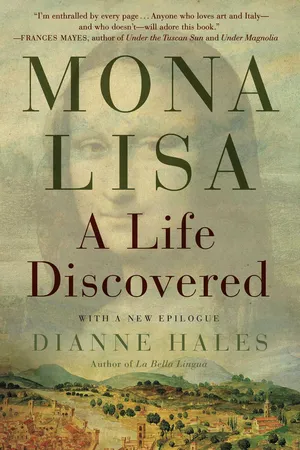
Mona Lisa
eBook - ePub

Mona Lisa

A Life Discovered

  1. 336 pages
  2. English
  3. ePUB (mobile friendly)
  4. Available on iOS & Android
eBook - ePub

Mona Lisa

A Life Discovered

About this book

Everybody knows her smile, but no one knows her story: Meet the flesh-and-blood woman who became one of the most famous artistic subjects of all time—Mona Lisa.

A genius immortalized her. A French king paid a fortune for her. An emperor coveted her. Every year more than nine million visitors trek to view her portrait in the Louvre. Yet while everyone recognizes her smile, hardly anyone knows her story. “Combining history, whimsical biography, personal travelogue, and love letter to Italy...Mona Lisa is an entertaining” (Publishers Weekly) book of discovery about the world’s most recognized face. Who was she? Why did the most renowned painter of her time choose her as his model? What became of her? And why does her smile enchant us still?

Dianne Hales, author of La Bella Lingua, became obsessed with finding the real Mona Lisa on repeated trips to Florence. In Mona Lisa: A Life Discovered, she takes readers with her to meet Lisa’s descendants; uncover her family’s long and colorful history; and explore the neighborhoods where she lived as a girl, a wife, and a mother. In the process, we can participate in Lisa’s daily rituals; understand her personal relationships; and see, hear, smell, and taste “her” Florence. Hales brings to life a time poised between the medieval and the modern, a vibrant city bursting into fullest bloom, and a culture that redefined the possibilities of man—and of woman.

Mona Lisa is “a readable and affectionate my-search-for-story for art lovers and anyone interested in glorious and gory Florence in the fifteenth to sixteenth centuries, and in the divine Leonardo in particular…Hales’s assiduous research has made it possible for us to know Mona Lisa just a bit, enough to wonder if this otherwise ordinary Florentine housewife could ever have imagined her portrait enchanting millions for centuries” (USATODAY.com).
Frequently asked questions

Yes, you can cancel anytime from the Subscription tab in your account settings on the Perlego website. Your subscription will stay active until the end of your current billing period. Learn how to cancel your subscription.
No, books cannot be downloaded as external files, such as PDFs, for use outside of Perlego. However, you can download books within the Perlego app for offline reading on mobile or tablet. Learn more here.
Perlego offers two plans: Essential and Complete
  • Essential is ideal for learners and professionals who enjoy exploring a wide range of subjects. Access the Essential Library with 800,000+ trusted titles and best-sellers across business, personal growth, and the humanities. Includes unlimited reading time and Standard Read Aloud voice.
  • Complete: Perfect for advanced learners and researchers needing full, unrestricted access. Unlock 1.4M+ books across hundreds of subjects, including academic and specialized titles. The Complete Plan also includes advanced features like Premium Read Aloud and Research Assistant.
Both plans are available with monthly, semester, or annual billing cycles.
We are an online textbook subscription service, where you can get access to an entire online library for less than the price of a single book per month. With over 1 million books across 1000+ topics, we’ve got you covered! Learn more here.
Look out for the read-aloud symbol on your next book to see if you can listen to it. The read-aloud tool reads text aloud for you, highlighting the text as it is being read. You can pause it, speed it up and slow it down. Learn more here.
Yes! You can use the Perlego app on both iOS or Android devices to read anytime, anywhere — even offline. Perfect for commutes or when you’re on the go.
Please note we cannot support devices running on iOS 13 and Android 7 or earlier. Learn more about using the app.
Yes, you can access Mona Lisa by Dianne Hales in PDF and/or ePUB format, as well as other popular books in History & History of Renaissance Art. We have over one million books available in our catalogue for you to explore.

Information

Chapter 1


Una Donna Vera (A Real Woman)

A genius immortalized her. A French king paid a fortune for her. An emperor coveted her. Poets lauded her. Singers crooned of her. Advertisers exploited her.
No face has ever captivated so many for so long. Every year more than 9 million visitors trek to her portrait in the Louvre. Like most, I stared at the masterpiece but never thought much about its subject.
Then I went to Florence—not once, but again and again. As a tourist, I explored its treasures. As a student, I learned its language. While researching La Bella Lingua, the tale of my love affair with Italian, I interviewed its scholars. On visit after visit, I immersed myself ever more deeply in its culture. And almost by chance, I came upon the woman behind the iconic smile.
One evening during a dinner at her home, Ludovica Sebregondi, an art historian who befriended me, mentions that the mother of ā€œLa Gioconda,ā€ as Italians refer to Leonardo’s lady, grew up in this very building on Via Ghibellina. The casual comment takes me by surprise. To me Mona Lisa had always seemed nothing more than the painting in the Louvre or the ubiquitous image on everything from tee shirts to teapots, not a girl with a mother and a life of her own.
ā€œMona Lisa was an actual person?ā€ I ask.
ā€œSƬ,ā€ Ludovica replies, explaining that Monna Lisa Gherardini del Giocondo was ā€œuna donna veraā€ (a real woman) who had lived in Florence five centuries ago. Monna, spelled with two n’s in contemporary Italian, means ā€œMadame,ā€ a title of respect. Like other women of her time, Lisa would have carried her father’s name, Gherardini, throughout her life. Italians call the painting ā€œLa Giocondaā€ as a clever play on her husband’s surname (del Giocondo) and a descriptive for a happy woman (from the word’s literal meaning).
Images
Yet the city’s most famous daughter is almost invisible in her hometown. No street or monument bears her name. No plaques commemorate the places where she lived. Curiosity leads me, via a typically Italian network of friends and friends of friends, to the world’s expert on la vera Lisa: Giuseppe Pallanti. Tirelessly pursuing her family’s parchment and paper trail, this archival sleuth has unearthed tax statements, real estate transfers, court proceedings, and records of baptisms, marriages, and deaths, published in La Vera IdentitĆ  della Gioconda in 2006.
We meet on a rooftop terrace overlooking Lisa’s childhood neighborhood in the Oltrarno, the ā€œother,ā€ or southern, side of the Arno River. Pallanti, a soft-spoken, gray-haired economics instructor with a classic and kindly Tuscan face, cannot explain an obsession that has consumed him for decades. His wife has grown weary of her rival for his attention; his children groan at the sound of her name. But from the moment when he came upon her father’s signature on a land deed, he fell under Lisa’s thrall. Soon I would too.
Unfolding a tourist map of Florence, Pallanti marks an X to indicate the location of the house where Lisa was born, a converted wool shop on Via Sguazza. Once again I feel the electric buzz of an epiphany: Of course, una donna vera, a real woman, would have a real place of birth. I can’t wait to see it.
Images
The very next day I make my way to a narrow lane off Via Maggio, once a main artery leading to the Porta Romana, the gate south to Siena. Via Sguazza, meaning ā€œwallow,ā€ lives up to its squalid name. More than five hundred years after residents complained of the stench from a clogged municipal drain, the street still stinks. The foul smell, I discover as I return in different seasons, intensifies as temperatures rise and water levels fall.
Graffiti smear the grimy houses that line the dank street. Trash huddles in corners. Wooden doors splinter and sag on rusty hinges. No one lingers in the gloom. No one seems to care about a girl named Lisa Gherardini born centuries ago amid the clattering mills of Florence’s cloth trade. Unexpectedly, I find that I do.
Although I make no claims as scholar, historian, archivist, or Leonardista, the journalist in me immediately senses that the flesh-and-blood woman born on this fetid block has a story of her own, stretching deep into the past and woven into the rich fabric of Florence’s history. Determined to find out more, I begin asking the basic questions of my trade: who, where, what, when, how, and—the most elusive—why.
Who was she, this ordinary woman who rose to such extraordinary fame? When was she born? Who were her parents? Where did she grow up? How did she live? What did she wear, eat, learn, enjoy? Whom did she marry? Did she have children? Why did the most renowned painter of her time choose her as his model? What became of her? And why does her smile enchant us still?
Images
Mona Lisa Gherardini del Giocondo, we now know with as much certainty as possible after the passage of half a millennium, was a quintessential woman of her times, caught in a whirl of political upheavals, family dramas, and public scandals. Descended from ancient nobles, she was born and baptized in Florence in 1479. Wed to a truculent businessman twice her age, she gave birth to six children and died at age sixty-three. Lisa’s life spanned the most tumultuous chapters in the history of Florence, decades of war, rebellion, invasion, siege, and conquest—and of the greatest artistic outpouring the world has ever seen.
Yet dates and documents limn only the skeleton of a life, not a three-dimensional Renaissance woman. I yearn to know more about la donna vera and how she lived, to time-travel to her world and see it through her eyes. And so I decide to launch my own quest.
ā€œInhabit her neighborhoods,ā€ an art historian advises me. On repeated visits over the course of several years, I take up residence in various Florentine quartieri (districts) and stroll the same stony streets that Lisa Gherardini once did. I genuflect in the churches where she prayed. I linger in courtyards where she too may have breathed the fragrant scent of gelsomino (jasmine). As the X’s on my map multiply, I venture deeper—into musty cellars, abandoned chapels, antique silk mills, restored palazzi, and private libraries so deserted that I consider the dust motes drifting in the air my boon companions.
Each discovery fuels an unanticipated adrenaline surge. My pulse quickens at the touch of a sixteenth-century family history. I whoop in exhilaration when I find Lisa’s baptismal record in an ecclesiastic ledger. One day outside the home her husband, Francesco del Giocondo, bought for their growing family, a woman’s song floats from an open second-story window. Bells toll. Birds chirp. Centuries fall away. Bit by tantalizing bit, I feel la donna vera coming alive.
Now, when I visit or even think of Florence, I see Lisa everywhere: In Santa Maria Novella, eternal resting place of her Gherardini ancestors, once lords of lush river valleys in Chianti. In the Baptistery of St. John, where her godparents swept the newborn through Ghiberti’s gleaming bronze doors. In the Palazzo Vecchio, the town hall where her forefathers and later her husband jostled for the highest seats of power. In the Bargello, once the dread hall of justice, where rebellious Gherardini met a grimmer fate.
Renaissance Florence was indeed, as the researcher Pallanti reminds me, ā€œun fazzolettoā€ (a handkerchief), with everyone within walking and talking distance of each other. Around the corner from Lisa’s grandparents’ palazzo on Via Ghibellina stands the house where the silk merchant Francesco del Giocondo may have come to pay court to the budding beauty. The rambunctious brood of Ser Piero da Vinci, a well-connected legal professional who worked for Florence’s most powerful and prominent citizens, lived just steps away. His illegitimate firstborn son Leonardo trained in a bottega (artist’s workshop) farther down the street.
Images
Crinkled map in hand, I trace the route that Lisa may have ridden on her wedding day in 1495 when, astride a white charger, she crossed the heart of Florence into ā€œMedici country,ā€ the neighborhood clustered around the Basilica of San Lorenzo. There, in a cat’s cradle of streets, I find the original beams and an inner courtyard of one of several del Giocondo properties, now home to the Studio Art Centers International (SACI).
On nearby Via della Stufa, extensively rebuilt over the centuries, I join Silvano Vinceti, a self-styled cacciatore di ossa (bone hunter) spearheading a controversial campaign to identify Lisa Gherardini’s skeleton. A city engineer leads us to No. 23, the approximate location of the home that was the probable destination for Leonardo’s portrait.
With a Parisian television crew filming footage for a documentary, Vinceti, a chain-smoking, spindly-limbed, garrulous showman, rings the doorbell. A chic young Frenchwoman in spiky heels and pale green scarf emerges. She is merely renting an apartment, she explains, and knows nothing of the painting she calls La Joconde. I furtively snap a photo of the entrance hall.
Early one morning I walk through a leafy neighborhood where monasteries and abbeys once clustered to the former convent of San Domenico di Cafaggio, now a military forensic medicine institute. Peering through the wrought-iron fence, I imagine my way back to the long-ago time when shocking scandal and tragic loss rocked this tranquil site—and Lisa’s family as well.
Another day brings me to a cherished Florentine shrine, the Basilica of Santissima Annunziata (Most Holy Annunciation). Heart pounding in fear of trespassing (more so of being caught and ejected), I heed an art restorer’s tip and slip through an unmarked door next to a confessional and make my way along a semicircular row of private chapels. The dark one just to the right of center houses the remains of Lisa’s husband and two of his sons. I kneel to trace the Latin words ā€œfamiliae iucundiā€ (ā€œof the Giocondo familyā€) on a marble floor stone.
Lisa’s mortal remains should lie here with her husband’s, but she defied his wishes and chose a different resting place: the Monastero di Sant’Orsola, just a short block from her home on Via della Stufa. Once an exclusive finishing school for the daughters of Florence’s elite, Sant’Orsola has suffered centuries of neglect. Its bleak walls are blotched with ugly graffiti, peeling posters, rusted grates, and rows of bricked-up arched windows. Jagged beams jut from the parapets; nets suspended along the roof snag crumbling stones before they crash onto the sidewalk. Dodgy characters—drug dealers, I’m told—linger in the shadows. Passersby avert their eyes and speed up their pace.
ā€œLa vergogna di Firenze,ā€ an editorial writer branded the blighted block. ā€œThe shame of Florence.ā€ Several years ago the city announced plans to rebuild the site as a neighborhood cultural center, perhaps named for the woman who epitomizes culture itself. On my most recent visit, I see no signs of progress, just a desolate bookend to a forgotten existence.
Images
Although much has changed over the centuries, the heart of Lisa’s hometown has not. Hers was the urban masterpiece that thrills us still, the city of Brunelleschi’s sky-skimming Cupolone (big dome), Giotto’s graceful Campanile (bell tower), the sacred spaces of Santa Croce and Orsanmichele, the slender spire of La Badia Fiorentina. In Lisa’s lifetime, a galaxy of artistic stars—Michelangelo, Botticelli, Raphael, Perugino, Filippino Lippi—rivaled the heavens with their brilliance. None outshone the incandescent genius of Leonardo, who emerges from the fog of history as more of a cultural force than a mere human being.
Nothing about this artist and architect, musician and mathematician, scientist and sculptor, engineer and inventor, anatomist and author, geologist and botanist was ever ordinary. The consummate Renaissance man sketched, designed, painted, and sculpted like no one else. He looked like no one else, with carefully curled locks in his youth and a prophet’s chest-long beard in age. He wrote like no one else, in his inimitable ā€œmirror scriptā€ that filled thousands of pages. He rode like a champion, so strong that a biographer claimed he could bend a horseshoe with his hands.
During Leonardo’s and Lisa’s lifetimes, larger-than-legend characters strutted across the Florentine stage: Lorenzo de’ Medici, whose magnificence rubbed off on everyth...

Table of contents

  1. Cover
  2. Dedication
  3. Epigraph
  4. Mona Lisa Family Tree
  5. Map
  6. Author’s Note
  7. 1. Una Donna Vera (A Real Woman)
  8. Part I: Gherardini Blood (59 B.C.–1478)
  9. Part II: Una Fiorentina (1479–1499)
  10. Part III: A New Century (1500–1512)
  11. Part IV: The Medici Triumphant (1513–1579)
  12. Part V: The Most Famous Painting in the World
  13. Acknowledgments
  14. Mona Lisa Timeline
  15. Principal Characters
  16. About the Author
  17. Notes
  18. Bibliography
  19. Index
  20. Copyright