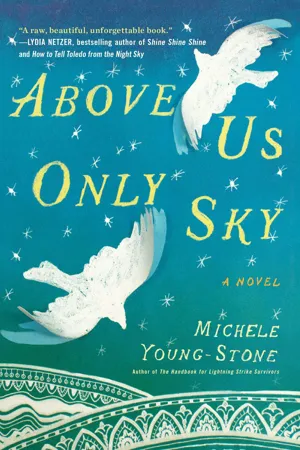
Above Us Only Sky
eBook - ePub

Above Us Only Sky

A Novel

  1. 256 pages
  2. English
  3. ePUB (mobile friendly)
  4. Available on iOS & Android
eBook - ePub

Above Us Only Sky

A Novel

About this book

A "gripping, heartwarming" ( Bookpage ) novel about a family separated by oceans, generations, and war, but connected by something much greater—the gift of wings. On March 29, 1973, Prudence Eleanor Vilkas was born with heart-shaped wings pressed accordion-style against her back. Considered a birth defect, her wings were surgically removed, leaving only the ghost of them behind. In 1980, Prudence's mother takes her from Nashville to Florida, to a town inhabited by people who have run as far as they can without fins or wings. In this new town, Prudence is befriended by a boy who can see what others can't, including Prudence's ghostly wings.The unexpected and unimaginable bubble up from the depths of the Atlantic to confront Prudence when she meets her long-estranged Lithuanian grandfather and discovers a miraculous lineage beating and pulsing with past Lithuanian bird-women, storytellers with wings dragging the dirt, survivors perched on radio towers, lovers lit up like fireworks and heroes disguised as everyday men and women. Above Us Only Sky spans the 1863 January Uprising against Russian Tsarist rule in Eastern Europe to the fall of the Berlin Wall and Lithuania's independence in 1991. It is a "daring, imaginative" ( Milepost magazine) story of mutual understanding between the old and young; it is a love story, a story of survival, and most importantly, a story about disovering where we belong in the world. Young-Stone seamlessly balances Lithuanian history with magical realism in this "amazing, spellbinding, incredible journey" ( Literary Hoarders ).

Frequently asked questions

Yes, you can cancel anytime from the Subscription tab in your account settings on the Perlego website. Your subscription will stay active until the end of your current billing period. Learn how to cancel your subscription.
At the moment all of our mobile-responsive ePub books are available to download via the app. Most of our PDFs are also available to download and we're working on making the final remaining ones downloadable now. Learn more here.
Perlego offers two plans: Essential and Complete
  • Essential is ideal for learners and professionals who enjoy exploring a wide range of subjects. Access the Essential Library with 800,000+ trusted titles and best-sellers across business, personal growth, and the humanities. Includes unlimited reading time and Standard Read Aloud voice.
  • Complete: Perfect for advanced learners and researchers needing full, unrestricted access. Unlock 1.4M+ books across hundreds of subjects, including academic and specialized titles. The Complete Plan also includes advanced features like Premium Read Aloud and Research Assistant.
Both plans are available with monthly, semester, or annual billing cycles.
We are an online textbook subscription service, where you can get access to an entire online library for less than the price of a single book per month. With over 1 million books across 1000+ topics, we’ve got you covered! Learn more here.
Look out for the read-aloud symbol on your next book to see if you can listen to it. The read-aloud tool reads text aloud for you, highlighting the text as it is being read. You can pause it, speed it up and slow it down. Learn more here.
Yes! You can use the Perlego app on both iOS or Android devices to read anytime, anywhere — even offline. Perfect for commutes or when you’re on the go.
Please note we cannot support devices running on iOS 13 and Android 7 or earlier. Learn more about using the app.
Yes, you can access Above Us Only Sky by Michele Young-Stone in PDF and/or ePUB format, as well as other popular books in Literature & Literature General. We have over one million books available in our catalogue for you to explore.

Information

PART ONE
Much unhappiness has come into the world because of bewilderment and things left unsaid.
—Fyodor Dostoevsky
1
Prudence
When I was born, the doctor said, ā€œI’m sorry.ā€
I had a full shock of dark hair and long legs like the rest of the women on Freddie’s side of the family, but no one noticed these things. No one saw anything but the wings, which were heart-shaped, crinkled like a paper fan. They were smaller than Freddie’s palm, slick with primordial ooze, compressed accordion-style against my back. The doctor whispered, ā€œSome kind of birth defect.ā€ Defect. ā€œHow some kids are born with tails and others with cleft palates.ā€ He mopped his brow. ā€œBut I’ve never seen anything like this.ā€
My birth was not particularly pleasant. As a matter of fact, I think that as a fetus and then a baby and then a human being, I came between my parents. Before I emerged, Freddie and Veronica were in love, and they might’ve remained that way if it weren’t for me. But it’s not my fault that they had unprotected sex. It’s not my fault or my doing that they mixed this mad concoction that produced a Prudence Eleanor Vilkas. My father chose the first two names. Vilkas is my surname, my Lithuanian birthright, the name I share with the Old Man. This story is as much about him as it is about me. We are mixed up, tied together by twine and twig, the stuff of nests.
Freddie said, ā€œLittle bird. Our Prudence is a little bird.ā€ If I’d been a boy, I was to be Paul or John. He wasn’t sure. He hadn’t wanted to choose between them: Paul McCartney and John Lennon. He’d wanted a girl, and here I was. He was smitten even while I was slimy with bird wings and birthing. He loved me. Like a male bird, he had a maternal reaction. He loved me more than he’d ever loved anyone. I was from his loins, from his high-functioning sperm. He was in awe of what he had wrought. I’d been caged inside my mother’s womb and now I was let loose upon the world. Upon him.
On the day I was born, I usurped my mother’s importance. These things happen. Freddie wasn’t letting me out of his sight. He insisted on helping the nurse clean me up. ā€œJust look at that,ā€ he said. ā€œShe’s amazing.ā€
ā€œThis is highly unorthodox,ā€ the nurse informed him.
ā€œLeave him alone,ā€ the doctor scowled. ā€œThe poor bastard has a bird for a daughter.ā€
My father’s Caribbean-blue eyes were probably my first clear image outside the womb. Freddie was a looker, which is one of the reasons he and Veronica got together. He’s the kind of man that women know they should stay clear of, but they never do. He isn’t a bad guy, just his own man with his own dreams, so monumental that they supersede the rest of the world, including any woman. Not me. I wasn’t a woman. I was part of the dream, part of him, a contributor to his life’s accomplishments.
As the nurse tried to discern my Apgar score, Freddie cooed. The nursing staff would’ve never allowed him to participate in this initial examination, no matter what the doctor said, but they were alarmed, taken aback by my wings. Do the wings, they must’ve wondered, give her a zero score for appearance? Do they affect her respiration? They’re seemingly close to the lungs. There should be a battery of tests. Someone should telephone Ripley’s Believe It or Not!
I was swaddled and my Apgar score recorded at one minute and again at five minutes, both times as six out of ten, due to my appearance and a general concern for my future ability to breathe. Freddie followed me to the nursery, where he remained, making faces at the glass. Hours later, he held me in the recovery room. The doctor returned smelling of vodka. Veronica was being administered drugs for the episiotomy and follow-up stitches. She was not going to nurse because ā€œthere’s something wrong with it.ā€ She meant me. She didn’t want to hold me either. I don’t blame her. Not really. Freddie said, ā€œWhat’s wrong with you? This is our baby.ā€ Veronica was twenty years old, with no clue that there are sometimes babies born with wings. Freddie gave me my first bottle of formula. If he’d had mammary glands, he would’ve nursed me. The doctor said, ā€œThere will be no tests.ā€ Having overheard the nurses, he added, ā€œNo one is calling Ripley.ā€ He cleared his throat. ā€œIt’s not a big deal. We’ll incise the bifurcated protrusions when she’s a little older.ā€
From then on, they were bifurcated protrusions and not wings, to everyone but Freddie. And me. And later Wheaton and the Old Man.
Freddie didn’t know that our family birthed birds. The Old Man, Freddie’s father, my grandfather, had never told him, or if he had told him, my father hadn’t listened.
The doctor told my parents, ā€œIf there are no emergencies in the meantimeā€ā€”I guess an emergency would’ve been if I’d started flying around the houseā€”ā€œwe’ll operate when she’s five months old. I’ll take some X-rays.ā€
ā€œThe sooner the better,ā€ Veronica said.
On September 10, 1973, my wings were surgically removed. They weren’t biopsied, stored in formaldehyde, or shipped to a freak show. They were discarded as medical waste.
For the next seven years, I lived wingless in Nashville. I was a good kid, or at least a caring one. I tried to resuscitate road kill. I had a first-aid kit and pretended to be a veterinarian and sometimes Florence Nightingale. I wore a white handkerchief over my dark hair. Taking care of baby birds, feral kittens, and squirrels fallen from their nests, I got cat scratch fever twice and had to take a monthlong course of antibiotics both times. I kept toads, turtles, and Japanese beetles for pets. I liked getting along. I didn’t want to upset anyone, not Freddie or Veronica. I always had this feeling like I was standing on a precipice and if I did something wrong, we’d all topple over. Because I was in the middle, I was the glue holding us together. I was grateful for the smallest things, even the starlings who, unable to nest in my hair, defecated there instead. Freddie called me little bird, even though there were no wings, just scars. He played acoustic guitar and sang, ā€œThe sun is up, the sky is blue, it’s beautiful and so are you.ā€ There were instruments strewn and stacked throughout the house. Freddie played whatever was closest.
Those first seven years were good. In fact, compared to the next seven, they were downright stellar. I remember watching Saturday morning cartoons, Freddie still half-asleep, drinking coffee and tickling me. Veronica liked Bugs Bunny. On Saturdays, when we were all home at the same time, we did what I’d later consider normal family activities. We played kickball in the front yard. If it rained or there were too many mosquitoes, we piled on the couch and watched an old movie, whatever was on TV. In the evening, Freddie made homemade pizza or chili. He and Veronica kissed a lot and said how much they loved each other. After I’d gone to bed, Freddie left the house to play music. But before I went to sleep, when they were both in my room, Veronica or Freddie reading to me (they took turns), I pretended Freddie wasn’t leaving to play music. I pretended that every night would be like this, the three of us together. Then, just as I’d doze off, I’d hear the car door squeak open and shut. I was happy. I was just a kid.
I attended kindergarten through half of second grade in Nashville. Freddie played his music, and Veronica worked thirty-eight hours, just shy of the forty-hour week that would’ve gotten her health insurance, at the Piggly Wiggly. Punching a clock, she rang up pork chops and potato chips. I don’t know if things would’ve ended like they did if John Lennon hadn’t been shot and killed. It was not only the end of a man’s life but the end of my parents’ love song. I wonder how many other relationships came to an end on December 8, 1980.
Already, even though it was four months off, I was looking forward to my birthday. We were going to rent a trampoline. I was inviting six girls to my party. Freddie had Monday Night Football on the TV. Mostly, he just listened to the games and tinkered with his instruments. On this particular night, the sports announcer, Howard Cosell, interrupted the game. He said, ā€œJohn Lennon was shot; John Lennon was pronounced ā€˜dead on arrival’ at Roosevelt Hospital.ā€
December eighth was the end. Seeing Freddie bereft, on his knees riffling through albums and crying, convinced Veronica that she’d made a mistake. In Freddie, she suddenly saw her own father, a man obsessed with form and scales, a piano teacher puzzled by emotions. Not that Freddie was cold. But he loved music more than he loved her, and she was tired of competing when there was no chance of winning. That night, she packed our possessions more carefully and far more slowly than she’d packed the night she ran off with Freddie. She was still debating what to do, folding T-shirts, flipping through our only photo album, and eavesdropping on Freddie in the living room. I don’t think she wanted to leave. I think she wanted to get his attention, but sometimes when you start something, you end up following through with it no matter your intentions and the repercussions. I think that this is what happened to Veronica, and by extension, to me.
The next morning, the three of us stood in the driveway. Freddie and Veronica smoked cigarettes. ā€œWhat are you doing?ā€ he asked. His face was red from crying all night, not because of us leaving, but because John Lennon was dead. He said, ā€œDon’t go, Veronica. Come on. What the hell are you doing? Seriously?ā€ I think that if he had said, ā€œDon’t go,ā€ and ā€œI love you,ā€ and left it at that, she might’ve stayed. We might’ve stayed, but he said the wrong thing, and she responded, ā€œI can’t do this anymore.ā€ She held back tears as I held out hope that we wouldn’t leave. In 1980, she was beautiful in that good simple way: sunny blond with brown eyes, like the state of California.
ā€œTell me what you want,ā€ Freddie said. ā€œTell me what I can do.ā€
She didn’t say anything, but even at seven years old, I knew what she wanted. She wanted The Brady Bunch, Father Knows Best, and Leave It to Beaver. She wanted a husband who worked nine to five, who came home for dinner, who took his wife out to the movies and dancing, who had time to do what other families were supposedly doing: bowling and camping. Those normal family activities. But thinking back, half of my friends’ parents were divorced in 1980. I don’t think anyone had it as good as what Veronica imagined it was supposed to be. After Veronica got in the car and started the engine, I was still standing in the dirt. ā€œYou need to go with your mom,ā€ Freddie said.
ā€œI don’t want to go.ā€
ā€œYou better go.ā€ Freddie reached into his jeans and pulled out his p...

Table of contents

  1. Cover
  2. Dedication
  3. Epigraph
  4. Part One
  5. Part Two
  6. Part Three
  7. Part Four
  8. Part Five
  9. Sources
  10. Acknowledgments
  11. Reading Group Guide
  12. About the Author
  13. Copyright