The Snake Eaters
eBook - ePub

The Snake Eaters

Counterinsurgency Advisors in Combat

  1. 352 pages
  2. English
  3. ePUB (mobile friendly)
  4. Available on iOS & Android
eBook - ePub

The Snake Eaters

Counterinsurgency Advisors in Combat

About this book

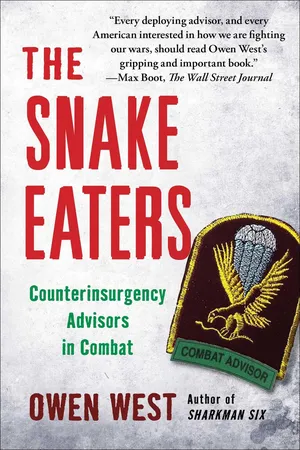
"Every deploying adviser, and every American interested in how we are fighting our wars, should read Owen West's gripping and important book" ( The Wall Street Journal ). From 2005 through 2007, the battle for the poisonous city of Khalidiya became so intensely personal that an Iraqi battalion, its American military advisors, and the insurgents they hunted knew one another by name. A third-generation U.S. Marine, Owen West was one of those combat advisors. This is his gripping account of how a team of underprepared reservists built an Iraqi battalion from the ground up and with them plunged side by side into a mystifying insurgency.Revealing war as a series of human acts, West makes the young American and Iraqi soldiers on patrol and the local townspeople come alive. From the bighearted American medic stalked by a sniper, a tough Iraqi major who is respected by the Americans because he likes them the least, and an enemy who blended into a population that dared not speak the truth, the characters in The Snake Eaters are as complex as the war that changes them.
Frequently asked questions

Yes, you can cancel anytime from the Subscription tab in your account settings on the Perlego website. Your subscription will stay active until the end of your current billing period. Learn how to cancel your subscription.
No, books cannot be downloaded as external files, such as PDFs, for use outside of Perlego. However, you can download books within the Perlego app for offline reading on mobile or tablet. Learn more here.
Perlego offers two plans: Essential and Complete
  • Essential is ideal for learners and professionals who enjoy exploring a wide range of subjects. Access the Essential Library with 800,000+ trusted titles and best-sellers across business, personal growth, and the humanities. Includes unlimited reading time and Standard Read Aloud voice.
  • Complete: Perfect for advanced learners and researchers needing full, unrestricted access. Unlock 1.4M+ books across hundreds of subjects, including academic and specialized titles. The Complete Plan also includes advanced features like Premium Read Aloud and Research Assistant.
Both plans are available with monthly, semester, or annual billing cycles.
We are an online textbook subscription service, where you can get access to an entire online library for less than the price of a single book per month. With over 1 million books across 1000+ topics, we’ve got you covered! Learn more here.
Look out for the read-aloud symbol on your next book to see if you can listen to it. The read-aloud tool reads text aloud for you, highlighting the text as it is being read. You can pause it, speed it up and slow it down. Learn more here.
Yes! You can use the Perlego app on both iOS or Android devices to read anytime, anywhere — even offline. Perfect for commutes or when you’re on the go.
Please note we cannot support devices running on iOS 13 and Android 7 or earlier. Learn more about using the app.
Yes, you can access The Snake Eaters by Owen West in PDF and/or ePUB format, as well as other popular books in History & Middle Eastern History. We have over one million books available in our catalogue for you to explore.

Information

Publisher
Free Press
Year
2012
Print ISBN
9781451655964
eBook ISBN
9781451655971

PART ONE

INTO THE HAZE

image

1

Into the Haze
image

September 2005

Hunched over the steering wheel of his Humvee, U.S. Army Staff Sergeant Chris Watson, 26, cursed. His was the last of four vehicles in a tiny convoy headed into Khalidiya. Watson turned on the wipers to brush away the dust stirred by the heaving troop carrier barely visible ten meters ahead.
Through the scratched Plexiglass of his bulletproof windshield, Watson could see a dozen Iraqi enlisted soldiers, called jundis, packed tightly against the troop carrier’s sandbagged walls, their AK-47s swaying like cattails as the big vehicle heaved. Two jundis were perched dangerously on the tailgate. The Iraqi privates were either too junior to claim shelter against the leaking sandbags or too fatalistic to care if they lived, Insha’Allah, to fight again tomorrow.
It was September 16, 2005. Watson was part of a ten-man advisor team of Army reservists that had deployed to Iraq expecting to teach jundis basic training on a secure, sprawling base with a Burger King, a Green Bean coffee shop, and a fitness center. Their combat tour, they thought, would consist of posting cell phone videos of AK-47 shoots and barracks antics on YouTube. Instead, they were embedded in 3/3–1—the 3rd Battalion of the 3rd Brigade of the 1st Iraqi Army Division—and ordered to remake themselves as infantry combat advisors in Khalidiya, living and fighting as Iraqi soldiers.
The lead vehicle was a sputtering white Nissan truck carrying the Iraqi patrol commander and his bodyguards. Behind it were two armored troop carriers filled with jundis and driven by U.S. National Guardsmen stationed on Camp Habbaniyah. Last came Watson’s Humvee, which was occupied by two fellow combat advisors. The convoy roared out of the barbed-wire gates of Camp Habbaniyah into “Indian country,” soldierspeak for enemy territory since the Dakota Wars of the 1860s when U.S. cavalrymen from isolated forts pursued indigenous tribes. Watson knew from the single predeployment class he’d had on Iraqi religion that there were Sunni tribes in his area and that they hated the Shiites, but that was about it. He was more concerned with the awful road conditions. Death came three ways in Iraq: sniper shots, roadside bombs, and suicide car bombs, which were the most catastrophic.
An Iraqi car swerved to the side of the road as the convoy bore down the highway. Watson could barely see it through the cloud of dust. For a moment he thought the shifting image was a car bomb, but then the troop truck full of jundis barreled right past the idling car and Watson followed tight in its contrail, squinting at the expressionless civilian driver while his own heart hammered.
Joseph Conrad’s Heart of Darkness, a cult favorite of Special Forces advisors, describes British gunboats, a century before, bombarding a dark green African jungle—a metaphor for the gulf between two civilizations. In Iraq, the Humvee had replaced the gunboat. In the hot, dusty haze, Watson could barely see through the four inches of armored Plexiglas.
In the Humvee, Sergeant Shawn Boiko, 24, could see better. Standing on the gunner’s platform above Watson, his torso poked through the hole in the roof where the turret was mounted. A wet cotton T-shirt wrapped over his mouth, Boiko surveyed the bouncing pile of jundis over his 7.62mm machine gun. They were younger and skinnier than he expected, and it scared him. Everything about the mission did.
On paper, Boiko was expected to “advise” the jundis on how to fight like U.S. soldiers. Like the rest of his teammates, he was only a part-time soldier—a flooring manager from California. He figured that before he passed whatever soldiering skills he had on to the jundis, the first order of business was keeping his teammates alive.
This was only his second trip into Khalidiya. On Boiko’s previous journey, a handover ride with the outgoing advisors to give the newcomers an overview of their area of responsibility, they had heard the dull crump of a distant explosion, followed by high-pitched shouts over the radio. Advisors patrolling with a different Iraqi battalion two kilometers away yelled of casualties as they traded rounds with insurgents.
One of the experienced advisors conducting the turnover had said, “Khalidiya. Biggest city in the area. It’s a very bad area. People hate our guts. Couple days and it’s all yours. Can’t say I’ll miss it.”
This time, Boiko was no longer a spectator. He grasped the hand wheel that swiveled the heavy machine gun, cranking like a yachtsman turning the winch on his sail. The wheel’s teeth bit into the turret base ring, shifting the half-ton steel doughnut fluidly to let Boiko’s barrel sweep over one car after the other as Iraqi drivers peeled off the road to let the three trucks of jundis and the Humvee pass.
As the up-gunner, the Humvee’s only defense, Boiko figured he had about two seconds to decide to open fire if one of the hundreds of erratic Iraqi motorists suddenly sped directly at the Humvee. He pointed the jiggling front sight post of his gun at one car, then another, and slightly depressed an imaginary trigger finger for the fifth—or was it the fiftieth?—time.
The convoy was on Route Michigan, the most heavily mined road in Iraq, averaging a dozen firefights and twenty roadside bombs every day between Ramadi, the capital of Anbar Province, and Fallujah. On the route-planning maps it was labeled “black,” or closed to logistics convoys, but not to combat patrols like Boiko’s. Anbar itself, which is larger than North Carolina, was held by just twenty-two thousand U.S. soldiers and Marines dispersed over twenty thousand square kilometers. That was just 20 percent of the total U.S. force in Iraq, yet Anbar was responsible for almost half the American deaths in the entire country.
Boiko didn’t know the statistics. He just sensed that Khalidiya, which was halfway between Ramadi and Fallujah, was bad news because of the local vibe. Vehicle patrols were Iraq’s version of safari. Boiko and his fellow advisors had been told to memorize the web of roadways into Khalidiya, but it was hard to keep his eyes off the people loitering along Route Michigan, the mustached men in dirty knockoff designer sweat suits and the women hidden inside abayas who scurried nervously into doorways as the convoy passed. There was an air of impending doom.
“Don’t let some jackass crash into us,” Chris Watson shouted.
“I’d say ‘watch for IEDs,’ but I doubt it’d do any good,” Sergeant First Class Mark Huss, 36, yelled up to Boiko over the engine roar.
As the senior advisor on the patrol, Huss sat in the right-hand seat next to Watson. Looking out the blast window, he was horrified by the mounds of trash that hemmed them in on both sides. They had been told by a stateside trainer to look for anything out of the ordinary, but there was enough garbage littering the macadam to conceal a hundred bombs. Besides, everything here was “out of the ordinary.”
“If they want to hit us,” said Huss, “there’s not much we can do about it.”
Except react. But the three rookie advisors did not know how they would react under fire. They hadn’t experienced combat, and they were not infantrymen, or even regular soldiers. Watson was a cop from Virginia. Huss ran a plumbing company in Iowa. Since being activated, Watson and Boiko were his new direct reports. With the team’s other seven teammates back in Camp Habbaniyah—including his team leader, Lieutenant Colonel Mike Troster, a DEA agent—Huss felt a crushing weight of responsibility. He vowed never again to be stressed by a call about a burst pipe.
image
By the fall of 2005, reservists like Mark Huss had become, haphazardly, the main effort in America’s exit from Iraq. President George W. Bush had explained the strategy earlier that year in an address to the nation, saying, “As the Iraqis stand up, we will stand down.”1 The New Iraqi Army was being built from scratch, so that they could take over control of the country, but the “new” jundis were mostly poor volunteer recruits with little military experience, and the officers—many of whom had served in the “old” Iraqi army under Saddam—had neither the experience to lead troops in the absence of ruthless conscription nor a plan to break the insurgency in their own country.
Hundreds of Iraqi units in various stages of development needed to be mentored by U.S. advisor teams. Many Iraqi units were still in training and required basic classes that mimicked American boot camp. A few, like 3/3–1—one of the first New Iraqi Army battalions—were in the fight and needed experienced combat advisors to show them how to defeat insurgents firsthand and link them to U.S. medical and fire support.
The U.S. military had few trained advisors. Although the Army’s traditional counterinsurgency instructors, the Special Forces, took great pains to select and train advisors in three-year training blocks, many of their teams had been assigned to raiding units designed to kill or capture high-level insurgents. Even if they were reassigned, the Special Forces had enough teams to fill only 10 percent of the billets. Conventional active-duty infantry commanders, in turn, desperately avoided the mad scramble to embed small groups of Americans in fledgling Iraqi units. They didn’t want to break their units into autonomous parts, effectively ceding control of their men to Iraqi colonels. So the advisor mission fell to reservists.
Confusion over the mission pervaded the highest ranks of the U.S. military. Advising was considered basic training in garrison instead of building counterinsurgency skills in combat. The Army handed the advisor assignment to its two reserve institutional training divisions, the 98th and the 80th, which specialized in classroom education and static training. Neither unit had deployed since World War II, and even then the 98th saw no combat. Selection for advisor duty was not rigorous. Soldiers could not be overtly prejudiced, handicapped, or too fat to deploy. Infantry training was not required, and combat experience was scant among the seven hundred reservists in each division. The soldiers in the 98th were given forty-two days of stateside “advisor training,” where they drilled for a tour training jundis on a giant forward operating base (FOB), a theme that reflected the confusion at the top.
The 98th was the first division to ship out, in the fall of 2004. The advisors posted to Iraqi Battalion 3/3–1 included a lumberjack, a T-shirt salesman, and a trombone player in the U.S. Army band. They soon found themselves in combat. After graduating from training in December 2004, Iraqi Battalion 3/3–1 was ordered into Mosul, north of Baghdad, to fight alongside an American motorized infantry battalion. The advisors went wherever their host unit went. They were classroom instructors no more. The ten-man team was expected not only to teach the fledgling Iraqi battalion how to defeat insurgents, from the jundis all the way up to the commanding officer, but also to manage the relationships their protĂ©gĂ©s formed with nearby U.S. units and even local sheikhs. It was widely considered the trickiest job in Iraq.
Because of the flawed selection process and the brief, misguided training program, performance of the advisors was uneven. Many teams failed to adequately progress their Iraqi units. Complaints about the underprepared reservists stretched from the battlefield to the high command in Baghdad, where one colonel threatened to write a book titled Blame It on the 98th.2 The general in charge of the military advisors, a former Special Forces commander, doubted the reservists had the requisite skills for advising.3 Even the senior U.S. commander in the Middle East, General John Abizaid, criticized the decision to assign the advising mission to reservists. “We didn’t give you the best and the brightest,” he told Lieutenant General David Petraeus, who in the summer of 2004 had been brought in to run the entire Iraqi security rebuild. “We put the third team on the field.”4
Huss’s 80th Institutional Training Division replaced the 98th in September 2005. Recipients of the same misguided training that had plagued the 98th a year earlier, Huss’s ten-man team had two additional obstacles to overcome upon being assigned to Iraqi Battalion 3/3–1: The Iraqi unit had six months of combat experience and required tactical advice that was a step above other Iraqi units emerging from training, and they were stationed in Anbar Province, which meant tough combat and interservice friction. Anbar was sometimes called “Marineland” because it was run by Marines. There were only two other Army advisor teams in the entire province, the vast majority being Marine teams. Several members of the original advisor team from the 98th assigned to 3/3–1 in 2004 had been forcibly replaced, including the team leader, an Army major, who had been replaced by a Marine captain.
When Huss’s team reported to Camp Habbaniyah in September 2005, their Marine bosses tried to comfort them by saying they didn’t need to reinvent the wheel. They just had to “keep up the mentorship,” a senior advisor told them, and “unfuck the Iraqis.” What that meant exactly, the rookie advisors did not know. They...

Table of contents

  1. Cover
  2. Dedication
  3. Introduction
  4. Characters
  5. Map
  6. Part One: Into the Haze
  7. Part Two: Good-bye, Darkness
  8. Epilogue
  9. Photographs
  10. Acknowledgments
  11. About the Author
  12. Q&A with Owen West
  13. Notes
  14. Bibliography
  15. Index
  16. Copyright