The Jesus Discovery
eBook - ePub

The Jesus Discovery

The Resurrection Tomb that Reveals the Birth of Christianity

  1. 272 pages
  2. English
  3. ePUB (mobile friendly)
  4. Available on iOS & Android
eBook - ePub

The Jesus Discovery

The Resurrection Tomb that Reveals the Birth of Christianity

About this book

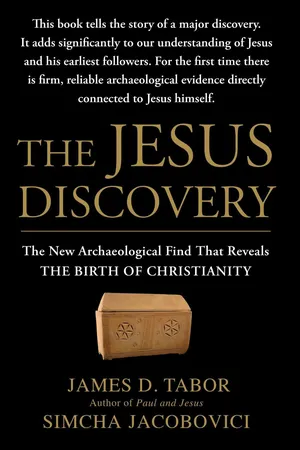
The Jesus Discovery shows how a recent major archeological discovery in Jerusalem is revolutionizing our understanding of Jesus and the earliest years of Christianity. The Jesus Discovery is the story of a stunning new discovery that provides the first physical evidence of Christians in Jerusalem during the time of Jesus and his apostles. In 2010, using a specialized robotic camera, authors Tabor and Jacobovici explored a previously unexcavated tomb in Jerusalem from around the time of Jesus. They made a remarkable discovery—two ossuaries, or bone boxes, one carved with the earliest known image of Jonah; the other displaying a reference to resurrection. Since the newly discovered ossuaries can be reliably dated to before 70 AD, it is possible that whoever was buried in this tomb knew Jesus and heard him preach. In addition, the newly examined tomb is in close proximity to the so-called Jesus Family Tomb, and its discovery increases the likelihood that the "Jesus Family Tomb" is, indeed, the real tomb of Jesus of Nazareth.
Frequently asked questions

Yes, you can cancel anytime from the Subscription tab in your account settings on the Perlego website. Your subscription will stay active until the end of your current billing period. Learn how to cancel your subscription.
No, books cannot be downloaded as external files, such as PDFs, for use outside of Perlego. However, you can download books within the Perlego app for offline reading on mobile or tablet. Learn more here.
Perlego offers two plans: Essential and Complete
  • Essential is ideal for learners and professionals who enjoy exploring a wide range of subjects. Access the Essential Library with 800,000+ trusted titles and best-sellers across business, personal growth, and the humanities. Includes unlimited reading time and Standard Read Aloud voice.
  • Complete: Perfect for advanced learners and researchers needing full, unrestricted access. Unlock 1.4M+ books across hundreds of subjects, including academic and specialized titles. The Complete Plan also includes advanced features like Premium Read Aloud and Research Assistant.
Both plans are available with monthly, semester, or annual billing cycles.
We are an online textbook subscription service, where you can get access to an entire online library for less than the price of a single book per month. With over 1 million books across 1000+ topics, we’ve got you covered! Learn more here.
Look out for the read-aloud symbol on your next book to see if you can listen to it. The read-aloud tool reads text aloud for you, highlighting the text as it is being read. You can pause it, speed it up and slow it down. Learn more here.
Yes! You can use the Perlego app on both iOS or Android devices to read anytime, anywhere — even offline. Perfect for commutes or when you’re on the go.
Please note we cannot support devices running on iOS 13 and Android 7 or earlier. Learn more about using the app.
Yes, you can access The Jesus Discovery by James D. Tabor,Simcha Jacobovici in PDF and/or ePUB format, as well as other popular books in Theology & Religion & Ancient History. We have over one million books available in our catalogue for you to explore.

Information

CHAPTER ONE


THE DISCOVERY

It was a bright summer day in Jerusalem. We were crowded together with our film crew in a narrow corridor around a group of camera monitors in the basement of the condominium building in East Talpiot. The building had been built over the tomb shortly after its discovery in 1981. The tomb itself had been left sealed and the archaeologists who briefly examined it at the time had apparently missed its precious contents. We never set foot in the tomb. We were able to get an archaeological license to explore it remotely using a set of state-of-the-art cameras at the end of a sophisticated robotic arm that we had lowered into its dark interior through holes drilled into the floor of the basement.
We had been filming inside the tomb for two days, painstakingly moving our camera probe from one area to another. We had stuffed our equipment, cables, and high-resolution monitors into a small corridor leading to a storage area in the basement. What we had observed so far was fascinating enough. Just the experience of being able to “enter” this ancient tomb and see its contents kept us on the edge of our seats with our eyes focused on the camera monitors for hour after hour. The robotic arm slowly made its way around the tomb. Suddenly something unusual came into focus. Carved into the side of a limestone ossuary, or “bone box,” was a startling image that we recognized, one never before seen on an ossuary or on any other ancient artifact from the 1st century CE. Right next to this ossuary was a second one with a four-line Greek inscription. We stared at the monitor as the image and the Greek letters came into sharper focus, and adjusted the light to get a better look. A shout went up in the cramped corridor when we read the inscription. What we saw was clear evidence of faith in Jesus’ resurrection from the dead from this sealed tomb securely dated to the time of Jesus. The implications struck us immediately. We were gazing at the carved imagery and writing of some of Jesus’ earliest followers. It was very likely that some of those people buried in this tomb had actually seen and known Jesus, maybe even witnessed his death, and were hereby proclaiming their faith in his resurrection as well.
images
1. Camera shot of the interior of the Patio tomb showing an ossuary in place.
Reeling from this discovery, we flew to Rome to investigate similar, but much later, images in the catacombs in Rome. The catacombs consist of hundreds of miles of many-leveled tunnels and passageways filled with burial chambers deep beneath the ancient city of Rome. It was here that the ancient Romans, and later the Jews and early Christians, buried their dead. The catacombs belonging to the Christians date to the late 3rd and early 4th centuries CE. On the walls of these family burial chambers one finds what was until now the earliest examples of Christian art—painted frescos, carvings, and inscriptions, many having to do with faith in Jesus’ resurrection from the dead as offering hope of eternal life to his followers. In order to provide a wider context for what we had discovered in the Jerusalem Patio tomb we invited Professor Robin Jensen of Vanderbilt University to join us as a guide in the catacombs. She is one of the most distinguished historians of early Christian art in the world.1 We spent hours walking in the deep underground passageways where the pungent odor of damp earth fills the stale air. Jensen took us from chamber to chamber, through the tangled maze of tunnels and levels, offering us a tour of some of the main images and inscriptions in the catacombs of Priscilla and San Sebastiano.
In the evening at our hotel after our first long day of exploration we showed Robin a photograph of the image carved on the ossuary that we had discovered in Jerusalem. She was completely taken back by what she saw. She instantly recognized the image. She kept saying, you mean this was found in a 1st century tomb in Jerusalem? How is that possible? Nothing like this has ever been found dating earlier than the 3rd century CE—and only in Rome, never in Jerusalem. The date and the location connected this discovery to Jesus’ earliest followers. This discovery left us all a bit stunned. It seemed impossible, but a photograph of the evidence was lying on the table before our eyes.

JERUSALEM BURIAL CAVES IN THE TIME OF JESUS

It is against Israeli law to willfully excavate, violate, disturb, or destroy a tomb, whether ancient or modern. Nonetheless, 18th and 19th century explorers, modern tomb robbers, and construction crews have all taken their toll—particularly on ancient Jewish cave burials in Jerusalem. Yet there has been an unexpected positive benefit to these disturbances. Jewish cave tombs in this period contain little of obvious value. Typically Jews did not bury their dead with jewelry, coins, or other items of value. A tomb might contain clay oil lamps and ceramic vessels used for ritual purposes, such as perfume vials and even cooking pots, but little more—except for ossuaries. It is these ossuaries that the thieves want. Carved from soft limestone, these “bone boxes” became the repositories for the bones of loved ones. When a Jew died the corpse was washed and prepared for burial and then laid out in a niche or, in some tombs, on a shelf carved into the walls of the tomb, until the flesh decayed. These burial niches are called kokhim in Hebrew and they served for the initial placement of bodies as well as for the storage of ossuaries. The shelves within the niches are called arcosolia. This initial laying out of the body is referred to as a “primary burial” and was usually followed by a “secondary burial” a year or more later when the flesh had decayed and the bones of the deceased were gathered and placed in an ossuary.
Typically these ossuaries were wide enough to hold the skull of the deceased and long enough for the femur bone, the largest bone in the human body, to fit diagonally. For an adult that would be an average of 25 inches in length, 12 inches high, and 10 inches wide. In some cases the bones of more than one family member were put in a single ossuary—whether a husband and wife, two sisters, or even children with their parents. Other times wives and children had their own separate ossuaries, depending on the wishes and custom of a given Jewish family. We have an ancient rabbinic text that describes the process quite poignantly:
Rabbi Eleazar bar Zadok said, “Thus spoke my father at the time of his death, ‘My son, bury me first in a niche [Hebrew kokh]. In the course of time collect my bones and put them in an ossuary; but do not gather them with your own hands.’ And thus I did attend him: Jonathan entered, collected the bones, and spread a sheet over them. I then came in, rent my clothes for them, and sprinkled dried herbs over them. Just as he attended his father so I attended him.” (Semahot 12.9)2
Jesus once told a would-be follower “Let the dead bury the dead,” when the man protested that he needed to wait until he had buried his father to join Jesus. The cryptic reference most likely reflects this practice of secondary burial—not that the man was waiting for his father to die, but that his father had recently died and he needed to pass the obligatory first year following his father’s death, when the family would gather his bones and put them in an ossuary. Only then could he leave his family and follow Jesus (Luke 9:59).3
images
2. A group of broken and restored ossuaries from a looted Jerusalem tomb.
Tomb robbers usually dump the bones and take the ossuaries, oil lamps, and other pottery vessels. The ossuaries can be sold through the illegal antiquities market for a few hundred dollars—but they are worth much more if they are inscribed with the names of the deceased. Think of these tombs, with their inscribed ossuaries, as time capsules, preserving a tiny slice of history. Rather than a pile of bones of an unnamed and forgotten family, we have the names and relationships of the family that used a particular tomb—and in rare cases, as we will see, much more. These tombs provide a way for us to peer back into the past and recapture a moment in antiquity.
Jerusalem has experienced a huge building boom since 1967, when the Israelis unified the city and took down the dividing barriers between east and west. The population, both Jewish and Arab, has skyrocketed. But whenever you dig below a half meter or so in this ancient city or its environs you are more than likely to uncover archaeological antiquities, whether mosaics, ruins of ancient walls and buildings, or, often as not, ancient Jewish tombs. Antiquities are defined as any human-made material remains that can be dated earlier than the year 1700 CE and any zoological or biological remains older than 1300 CE.4 As a result, with the construction of practically every road, highway, bridge, park, housing unit, or building, the Israeli Antiquities Authority (IAA), responsible for excavating, preserving, and safeguarding historic ancient sites, is called in. This work is called “rescue” or “salvage” archaeology, and it is usually done as quickly as possible so as not to unduly delay the construction project that has been halted.5 It is against Israeli law for anyone to willfully ignore or destroy a site that contains antiquities. One simply never knows what might turn up with the next construction blast or sweep of the bulldozer.
Jerusalem is ringed with ancient tombs. These burial caves are carved into the limestone bedrock and hidden from modern eyes. The city was destroyed in 70 CE by the Romans and nineteen centuries of subsequent building and periodic destruction have obscured the landscape. Most of these tombs date back to the 1st century BCE through the 1st century CE, when the Roman destruction brought a halt to normal Jewish life. Scholars label this time period the Late Second Temple period, and often refer in particular to Herodian Jerusalem, named after Herod the Great, the Roman client king who ruled the country from 37 to 4 BCE. Christians loosely refer to this period as “Jerusalem in the time of Jesus.”6
The use of ossuaries is a practice that is almost exclusive to Jerusalem and its environs in this period. Only a handful of ossuaries have been found in other parts of the country from this time. Scholars debate the reasons for this custom but the archaeological evidence is clear—this localized use of ossuaries flourished from the end of the 1st century BCE to the destruction of Jerusalem by Roman armies in 70 CE and then largely ceased.7
Approximately 1,000 cave tombs have been opened in the Jerusalem area in the past 150 years with over 2,000 documented ossuaries.8 Thousands more have been lost or sold and scattered into private hands. The latest catalogue of inscriptions from Jerusalem lists nearly 600 inscribed ossuaries, or approximately 30 percent of the total.9 Typically these ossuary inscriptions, written mostly in Hebrew and Aramaic or Greek, preserve the names of the dead.10 For historians and archaeologists these ossuaries represent a different kind of treasure, much more valuable than jewelry or coins. In a very few cases these inscriptions include warnings against opening or violating the tomb, or even more rarely, something about the deceased—perhaps where one was from if outside the land of Israel, how one might have been related to others in the tomb, or what one’s occupation might have been. Many ossuaries are plain, but others are decorated, most often with rosettes, various geometric patterns, architectural façades, and occasionally images of plants such as vines or palms. Images of humans and animals were forbidden as violations of the biblical commandment not to make “graven images”—so when there are exceptions, as is the case with our Patio tomb find, they stand out. Epigrams, in which something is said about the beliefs of the deceased about death and the afterlife, so common on Greek tombs in this period, are virtually nonexistent on Jewish ossuaries. As a result, the newly discovered Greek inscription on a Jewish 1st century CE ossuary is unprecedented in the archaeological record from this period.11

THE TALES TOMBS TELL

Construction blasts and bulldozers build the future but sometimes also unearth the past. These Old City tombs represent a valuable cross section of Jewish life—and death—in this period. The inscribed ossuaries, with names of individuals who lived and died before, during, and after the time of Jesus, lie at the crux of our investigation and indeed are what led us to the new discoveries that this book documents. We have spent many hours working side by side, studying and photographing scores of ossuaries all over Jerusalem—in the basement of the Rockefeller Museum, at the Israel Antiquities Authority warehouse in Beth Shemesh, in the storerooms of the Israel Museum, and elsewhere. The experience of walking through row after row of tall shelves of ossuaries, literally surrounded by these silent witnesses to the people who lived and died in Jerusalem in the 1st century CE, is for us a moving one. Most of the names are of long-forgotten individuals who lived and died without leaving behind any other record. But from time to time a tomb or ossuary can be identified with an individual we know from history—in a few cases even someone mentioned in the New Testament gospels. When that happens this hazardous process of tomb violation, whether by explorers, robbers, or modern construction, offers an amazing connection to the past—and the possibility of learning something entirely new, and connecting in a more tangible way with a person whom we had known only from a written text. It is as if the two-dimensional text suddenly becomes a three-dimensional life.
A dramatic example of such a discovery occurred on November 10, 1941. A single-chamber burial cave was found in the Kidron Valley, just southeast of the Old City of Jerusalem, by archaeologists Eleazar Sukenik and Nahman Avigad. The entrance was sealed and the cave had not been looted. Of the eleven ossuaries inside nine were inscribed, one in Hebrew/Aramaic, another bilingual, and the rest in Greek. Archaeologists were able to determine this was a tomb for a family of Jews from Cyrene, in present-day Libya. It was dated to the 1st century CE. One of the eleven ossuaries had two...

Table of contents

  1. Cover
  2. Dedication
  3. Map: Jerusalem in the Time of Jesus
  4. Preface
  5. Chapter 1: The Discovery
  6. Chapter 2: Two Talpiot Tombs
  7. Chapter 3: Decoding the Mysterious Sign of Jonah
  8. Chapter 4: Returning to the Jesus Family Tomb
  9. Chapter 5: Jesus and Mary Magdalene
  10. Chapter 6: The Mystery of the James Ossuary
  11. Chapter 7: Resurrection, Lost Bones, and Jesus’ DNA
  12. Conclusion: The First Christians and Christianity Today
  13. Acknowledgments
  14. About James D. Tabor and Simcha Jacobovici
  15. Notes
  16. Index
  17. Copyright