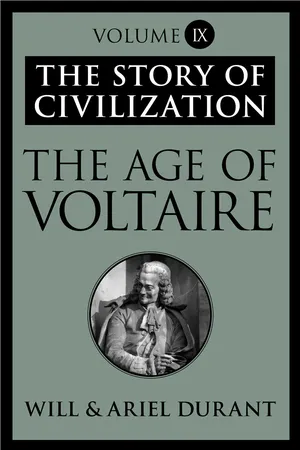
The Age of Voltaire
eBook - ePub

The Age of Voltaire

The Story of Civilization, Volume IX

  1. 799 pages
  2. English
  3. ePUB (mobile friendly)
  4. Available on iOS & Android
eBook - ePub

The Age of Voltaire

The Story of Civilization, Volume IX

About this book

The Story of Civilization, Volume IX: A history of civilization in Western Europe from 1715 to 1756, with special emphasis on the conflict between religion and philosophy. This is the ninth volume of the classic, Pulitzer Prize-winning series.

Frequently asked questions

Yes, you can cancel anytime from the Subscription tab in your account settings on the Perlego website. Your subscription will stay active until the end of your current billing period. Learn how to cancel your subscription.
No, books cannot be downloaded as external files, such as PDFs, for use outside of Perlego. However, you can download books within the Perlego app for offline reading on mobile or tablet. Learn more here.
Perlego offers two plans: Essential and Complete
  • Essential is ideal for learners and professionals who enjoy exploring a wide range of subjects. Access the Essential Library with 800,000+ trusted titles and best-sellers across business, personal growth, and the humanities. Includes unlimited reading time and Standard Read Aloud voice.
  • Complete: Perfect for advanced learners and researchers needing full, unrestricted access. Unlock 1.4M+ books across hundreds of subjects, including academic and specialized titles. The Complete Plan also includes advanced features like Premium Read Aloud and Research Assistant.
Both plans are available with monthly, semester, or annual billing cycles.
We are an online textbook subscription service, where you can get access to an entire online library for less than the price of a single book per month. With over 1 million books across 1000+ topics, we’ve got you covered! Learn more here.
Look out for the read-aloud symbol on your next book to see if you can listen to it. The read-aloud tool reads text aloud for you, highlighting the text as it is being read. You can pause it, speed it up and slow it down. Learn more here.
Yes! You can use the Perlego app on both iOS or Android devices to read anytime, anywhere — even offline. Perfect for commutes or when you’re on the go.
Please note we cannot support devices running on iOS 13 and Android 7 or earlier. Learn more about using the app.
Yes, you can access The Age of Voltaire by Will Durant,Ariel Durant in PDF and/or ePUB format, as well as other popular books in History & World History. We have over one million books available in our catalogue for you to explore.

Information

Year
2011
eBook ISBN
9781451647662
Topic
History
Index
History

CHAPTER I
France: The Regency
1715–23

I. THE YOUNG VOLTAIRE: 1694–1715

HE was not yet Voltaire; till his release from the Bastille in 1718 he was François Marie Arouet. He was born in Paris on November 21, 1694, and became its distilled essence till 1778. His presumptive father, François Arouet, was an affluent attorney, acquainted with the poet Boileau and the courtesan Ninon de Lenclos, whose wills he wrote, and with the dramatist Pierre Corneille, whom he described as “the most boring mortal” he had ever met.1 The mother, Marie Marguerite Daumard, was of slightly noble lineage, daughter of an official of the Parlement, and sister of the comptroller general of the royal guard; through them she had access to the court of Louis XIV. Her vivacity and sprightly wit made her home a minor salon. Voltaire thought she possessed all the intellect in his parentage, as his father had all the financial skill; the son absorbed both of these gifts into his heritage. She died at the age of forty, when he was seven. Of her five children the eldest was Armand, who adhered zealously to the Jansenist theology and the patrimonial property. François Marie, the youngest child, was so sickly in his first year that no one believed he could survive. He continued till his eighty-fourth year to expect and announce his early death.
Among the friends of the family were several abbés. This title, meaning father, was given to any secular ecclesiastic, whether or not he was an ordained priest. Many abbés, while continuing to wear ecclesiastical dress, became men of the world and shone in society; several were prominently at home in irreverent circles; some lived up to their title literally but clandestinely. The Abbé de Chùteauneuf was the last lover of Ninon de Lenclos and the first teacher of Voltaire. He was a man of wide culture and broad views; he passed on to his pupil the paganism of Ninon and the skepticism of Montaigne. According to an old but questioned story, he introduced to the boy a mock epic, La Moïsade, which was circulating in secret manuscripts; its theme was that religion, aside from belief in a Supreme Being, was a device used by rulers to keep the ruled in order and awe.2
Voltaire’s education proceeded when his abbĂ© tutor took him on a visit to Ninon. The famous hetaera was then (1704) eighty-four years old. François found her “dry as a mummy,” but still full of the milk of woman’s kindness. “It pleased her,” he later recalled, “to put me in her will; she left me two thousand francs to buy books with.”3 She died soon afterward.
To balance this diet he was entered, age ten, as a resident student at the Jesuit College of Louis-le-Grand on the Left Bank of Paris. It was reputed the best school in France. Among its two thousand pupils were such sons of the nobility as could bear an education; in his seven years there Voltaire made many of the aristocratic friends with whom he maintained an easy familiarity throughout his life. He received a good training in the classics, in literature, and especially in drama; he acted in plays presented there, and, aged twelve, wrote a play himself. He did well in his studies, won many prizes, and delighted and alarmed his teachers. He expressed disbelief in hell, and called heaven “the great dormitory of the world.”4 One of his teachers sadly predicted that this young wit would become the standard-bearer of French deism—i.e., a religion that discarded nearly all theology except belief in God. They endured him with their customary patience, and he reciprocated by retaining, through all his heresies, a warm respect and gratitude for the Jesuits who had disciplined his intellect to clarity and order. He wrote, when he was fifty-two:
I was educated for seven years by men who took unrewarded and indefatigable pains to form the minds and morals of youth
. They inspired in me a taste for literature, and sentiments which will be a consolation to me to the end of my life. Nothing will ever efface from my heart the memory of Father Porée, who is equally dear to all who have studied under him. Never did a man make study and virtue so pleasant.... I had the good fortune to be formed by more than one Jesuit of the character of Father Porée. What did I see during the seven years that I was with the Jesuits? The most industrious, frugal, regulated life; all their hours divided between the care they took of us and the exercises of their austere profession. I call to witness the thousands educated by them, as I was; there is not one who would belie my words.5
After graduation François proposed to make literature his profession, but his father, warning him that authorship was an open sesame to destitution, insisted on his studying law. For three years François, as he put it, “studied the laws of Theodosius and Justinian in order to know the practice of Paris.” He resented “the profusion of useless things with which they wished to load my brain; my motto is, TO THE POINT.”6 Instead of absorbing himself in pandects and precedents he cultivated the society of some skeptical epicureans who met in the Temple—the remains of an old monastery of the Knights Templar in Paris. Their chief was Philippe de VendĂČme, grand prior of France, who had enormous ecclesiastical revenues and little religious belief. With him were the AbbĂ©s Servien, de Bussy, and de Chaulieu, the Marquis de La Fare, the Prince de Conti, and other notables of easy income and gay life. The AbbĂ© de Chaulieu proclaimed that wine and women were the most delectable boons granted to man by a wise and beneficent Nature.7 Voltaire adjusted himself without effort to this regimen, and shocked his father by staying out with such revelers till the then ungodly hour of 10 P.M.
Presumably at the father’s request, Voltaire was appointed page to the French ambassador at The Hague (1713). All the world knows how the excitable youth fell in love with Olympe Dunoyer, pursued her with poetry, and promised her eternal adoration. “Never love equaled mine,” he wrote to her, “for never was there a person better worthy of love than you.”8 The ambassador notified Arouet pùre that François was not made for diplomacy. The father summoned his son home, disinherited him, and threatened to ship him off to the West Indies. François, from Paris, wrote to “Pimpette” that if she did not come to him he would kill himself. Being wiser by two years and one sex, she answered that he had better make his peace with his father and become a good lawyer. He received paternal pardon on condition that he enter a law office and reside with the lawyer. He agreed. Pimpette married a count. It was apparently Voltaire’s last romance of passion. He was as high-strung as any poet, he was all nerves and sensitivity, but he was not strongly sexed; he was to have a famous liaison, but it would be far less an attraction of bodies than a mating of minds. His energy flowed out through his pen. Already at the age of twenty-five he wrote to the Marquise de Mimeure: “Friendship is a thousand times more precious than love. It seems to me that I am in no degree made for passion. I find something a bit ridiculous in love
 I have made up my mind to renounce it forever.”9
On September 1, 1715, Louis XIV died, to the great relief of Protestant Europe and Catholic France. It was the end of a reign and an age: a reign of seventy-two years, an age—le grand siùcle—that had begun in the glory of martial triumphs, the brilliance of literary masterpieces, the splendor of baroque art, and had ended in the decay of arts and letters, the exhaustion and impoverishment of the people, the defeat and humiliation of France. Everyone turned with hope and doubt to the government that was to succeed the magnificent and unmourned King.

II. THE STRUGGLE FOR THE REGENCY: 1715

There was a new king, Louis XV, great-grandson of Louis XIV, but he was only five years old. He had lost his grandfather, his father, his mother, his brothers, his sisters, his great-grandfather last of all. Who would be regent for him?
Two dauphins had preceded Le Roi Soleil to death: his son Louis, who had died in 1711, and his grandson, the Duke of Burgundy, who had died in 1712. Another grandson had been accepted as Philip V of Spain, on condition of renouncing all rights to the throne of France. Two of the old King’s illegitimate sons survived him; he had legitimized them, and had decreed that in default of princes of the royal blood, they should inherit his crown. The elder of them, Louis Auguste, Duc du Maine, now forty-five, was an amiable weakling whose consciousness of his club foot intensified his shyness and timidity; he might well have been content with the luxury and ease of his 900,000-livre estate at Sceaux (just outside of Paris), had not his ambitious wife prodded him to compete for the regency. The Duchesse du Maine never forgot that she was the granddaughter of the Great CondĂ©; she maintained an almost royal court at Sceaux, where she patronized artists and poets (including Voltaire), and gathered about her a gay and faithful entourage as a prelude and springboard to sovereignty. She had some charms. She was immaculate in body and garb, so short and slim that she could have been taken for a girl; she had wit and cleverness, a good classical education, a ready tongue, an inexhaustible and exhausting vivacity. She was sure that under her thumb her husband would make a delightful regent. She had prevailed sufficiently with the forces about the dying King to have drawn from him (August 12, 1715) a will that left to the Duc du Maine control of the young Louis’ person, education, and household troops, and a place on the Council of Regency. However, a codicil (August 25) to that will named, as president of the Council, Philippe II, Duc d’OrlĂ©ans.
Philippe was the son of the old King’s androgynous brother Philippe I (“Monsieur”) by a second wife, the robust and realistic Charlotte Elisabeth, Princess Palatine. The youth’s education had been entrusted to an abbĂ© whom both Saint-Simon’s Memoirs and Duclos’ Secret Memoirs of the Regency describe as a cloaca maxima of vices. The son of a provincial apothecary, Guillaume Dubois studied hard, earned his living by tutoring, married, then left his wife, with her consent, to enter the CollĂšge Saint-Michel at Paris, where he paid his tuition by zealously performing menial tasks. Graduating, he accepted a position as aide to Saint-Laurent, officer of the household to “Monsieur.” He took the tonsure and minor orders, apparently forgetting his wife. When Saint-Laurent died Dubois was made tutor to the future Regent. According to the rarely impartial Duclos, “the AbbĂ© felt that he would soon be despised by his pupil if he did not corrupt him; he left nothing undone to accomplish this end, and unfortunately was but too successful.”10 Saint-Simon, who hated unpedigreed talent, enjoyed himself describing Dubois:
A little, pitiful, wizened, herring-gutted man in a flaxen wig, with a weazel’s face brightened by some intellect. In familiar terms, he was a regular scamp. All the vices unceasingly fought within him for supremacy, so that a continual uproar filled his mind. Avarice, debauchery, ambition were his gods; perfidy, flattery, footlicking his means of action; complete impiety was his religion; and he held the opinion, as a great principle, that probity and honesty are chimeras with which people deck themselves, but which have no existence
. He had wit, learning, knowledge of the world, and much desire to please and insinuate himself, but all was spoiled by an odor of falsehood which escaped in spite of him through every pore of his body
. Wicked,
 treacherous, and ungrateful, expert in the blackest villainies, terribly brazen when detected. He desired everything, envied everything, and wished to seize everything.11
Saint-Simon was close to Philippe’s family, and must not be rashly contradicted; we must add, however, that this abbĂ© was a good scholar, an able aide, a wise and successful diplomat, and that Philippe, knowing the man well, remained faithful to him to the end.
The pupil, perhaps already botched by his paternal ancestry, took readily to his tutor’s instructions, and bettered them in mind and vice. He delighted his teacher by his tenacious memory, his intellectual acumen, his penetrating wit, his understanding and appreciation of literature and art. Dubois secured Fontenelle to ground the youth in science, and Homberg to initiate him into chemistry; later Philippe, like Charles II of England and Voltaire at Cirey, was to have his own laboratory, and seek in chemical experiments some respite from adultery. He painted tolerably, played the lyre, engraved illustrations for books, and collected art with the most discriminating taste. In none of these fields did he dig deeply; his interests were too varied, and his amusements had an option on his time. He was quite devoid of religious belief; even in public he “affected a scandalous impiety.”12 In this and in his sexual license he gave a symbol and impetus to his country and century.
Like most of us he was a confusion of characters. He lied with ease and sly delight at need or whim; he spent millions of francs, drawn from an impoverished people, on his personal pleasures and pursuits; however, he was generous and kindly, affable and tolerant, “naturally good, humane, and compassionate” (said Saint-Simon13), and more faithful to his friends than to his mistresses. He drank himself drunk as a nightly ritual before going to bed.14 When his mother reproved him he answered her, “From six o’clock in the morning till night I am subjected to prolonged and fatiguing labor; if I did not amuse myself after that, I could not bear it; I should die of melancholy.”15
Perhaps his sexual redundancies had some excuse in the abortion of his first love. He developed a passionate attachment to Mlle. de Séry, a highborn maid of honor to his mother. He wrote poetry for her, sang to her, visited her twice a day, and wished to marry her. Louis XIV frowned, and powerfully recommended his bastard daughter, the Duchesse de Blois. Philippe obeyed (1692), but continued his attentions to Mlle. de Séry so zealously that she bore him a son. The angry monarch banished her from Paris. Philippe sent her many livres, but tried, with brief success, to be faithful to his wife. She gave him a daughter, the future Duchesse de Berry, who became his dearest love and bitterest tragedy.
The death of his father (1701) gave Philippe the ducal title and family wealth, with no other obligation but to enjoy his life in peace and risk it in war. He had already fought bravely against the first Grand Alliance (1692–97), receiving some major wounds; now he won further distinction by his reckless gallantry in the War of the Spanish Succession (1702–13). Surviving, he rewarded himself with a feast of tarts. Through all his sins, and except in his impieties, he maintained a charm of manners and a refinement and courtesy of speech reminiscent of the Sun King’s idyllic youth.
Only when all direct heirs to the throne had been removed by death or treaty did it occur to Philip...

Table of contents

  1. Cover
  2. Dedication
  3. Apology
  4. Acknowledgments
  5. List of Illustrations
  6. Prologue
  7. Chapter I: France: The Regency: 1715–23
  8. Book I: England: 1714–56
  9. Book II: France: 1723–56
  10. Book III: Middle Europe: 1713–56
  11. Book IV: The Advancement of Learning 1715–89
  12. Book V: The Attack Upon Christianity 1730–74
  13. Epilogue in Elysium
  14. Photographs
  15. About the Authors
  16. Notes
  17. Bibliographical Guide
  18. Index
  19. Copyright