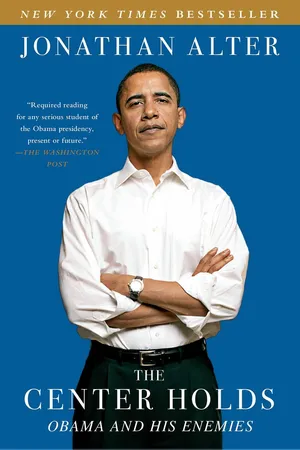
The Center Holds
eBook - ePub

The Center Holds

Obama and His Enemies

  1. 448 pages
  2. English
  3. ePUB (mobile friendly)
  4. Available on iOS & Android
eBook - ePub

The Center Holds

Obama and His Enemies

About this book

From the bestselling author of The Promise, the thrilling story of one of the most momentous contests in American history, the Battle Royale between Obama and his enemies from the 2010 midterms through the 2013 inauguration. The election of 2012 will be remembered as a hinge of history. With huge victories in the 2010 midterm elections the Republican Party had blocked President Obama at every turn and made plans to wrench the country sharply to the right. 2012 offered the GOP a clear shot at controlling all three branches of government and repealing much of the social contract dating back to the New Deal. Facing free-spending billionaires, Fox News, and a concerted effort in 19 states to tilt the election by suppressing Democratic votes, Obama repelled the assault and navigated the nation back to the center.In The Center Holds, Jonathan Alter produces the first full account of America at the crossroads. With exclusive reporting and rare historical insight, he pierces the bubble of the White House and the presidential campaigns in a landmark election that marked the return of big money and the rise of big data. He tells the epic story of an embattled president fighting back with the first campaign of the Digital Age.Alter relates the untold story behind Obama's highs and lows, from the raid on Osama bin Laden's compound to the frustration of the debt ceiling fiasco to his unexpected run-ins with black and Latino activists. There are fresh details about the Koch brothers, Grover Norquist, Roger Ailes, and the online haters who suffer from "Obama Derangement Syndrome." Alter takes us inside Mitt Romney and Paul Ryan's Boston campaign as well as Obama's disastrous preparation for the first debate. We meet Obama's analytics geeks working out of "The Cave" and the man who secretly videotaped Romney's infamous comments on the "47 percent." The Center Holds will deepen our understanding of the Obama presidency, the stakes of the 2012 election, and the future of the country.

Frequently asked questions

Yes, you can cancel anytime from the Subscription tab in your account settings on the Perlego website. Your subscription will stay active until the end of your current billing period. Learn how to cancel your subscription.
No, books cannot be downloaded as external files, such as PDFs, for use outside of Perlego. However, you can download books within the Perlego app for offline reading on mobile or tablet. Learn more here.
Perlego offers two plans: Essential and Complete
  • Essential is ideal for learners and professionals who enjoy exploring a wide range of subjects. Access the Essential Library with 800,000+ trusted titles and best-sellers across business, personal growth, and the humanities. Includes unlimited reading time and Standard Read Aloud voice.
  • Complete: Perfect for advanced learners and researchers needing full, unrestricted access. Unlock 1.4M+ books across hundreds of subjects, including academic and specialized titles. The Complete Plan also includes advanced features like Premium Read Aloud and Research Assistant.
Both plans are available with monthly, semester, or annual billing cycles.
We are an online textbook subscription service, where you can get access to an entire online library for less than the price of a single book per month. With over 1 million books across 1000+ topics, we’ve got you covered! Learn more here.
Look out for the read-aloud symbol on your next book to see if you can listen to it. The read-aloud tool reads text aloud for you, highlighting the text as it is being read. You can pause it, speed it up and slow it down. Learn more here.
Yes! You can use the Perlego app on both iOS or Android devices to read anytime, anywhere — even offline. Perfect for commutes or when you’re on the go.
Please note we cannot support devices running on iOS 13 and Android 7 or earlier. Learn more about using the app.
Yes, you can access The Center Holds by Jonathan Alter in PDF and/or ePUB format, as well as other popular books in Politics & International Relations & North American History. We have over one million books available in our catalogue for you to explore.

1

Image

The Shellacking

President Obama sat hunched over in the second-floor Treaty Room of the White House. It was Election Night 2010, and he was doing his best to offer some solace in a time of loss. The president spent that night and most of the next day on the telephone—hour after hour, call after call, a cortege of funereal conversations with defeated members of Congress.
Reaching out didn’t come naturally to this president, who normally preferred spending his evenings having dinner with his family and reading policy memos (with ESPN on in the background) to chatting with a bunch of politicians he barely knew. His detached and self-contained nature had hampered his presidency, though accounts differed over how much. Obama knew abstractly that he needed to establish what he repeatedly called an “inclusive” White House, but he much preferred the company of friends, his staff, and the extraordinary people he met in his travels to schmoozing in Washington. While The Godfather was one of his favorite movies, he sometimes seemed to have forgotten Hyman Roth’s famous line, “This is the business we’ve chosen.” This business, on this Election Night, was mostly about condolence calls. His personal secretary, Katie Johnson, stayed at her desk until 2 a.m. emailing him the phone numbers of every defeated Democrat on Capitol Hill and several who survived—nearly a hundred calls in all. He was gracious on the phone and between calls remarked to aides how sad it was to lose this member or that in the political earthquake they had just experienced.
The president felt personal affection for early 2008 supporters such as Tom Perriello, Patrick Murphy, and Steve Kagen, who went down in the House, and he reached out to defeated Democrats Russ Feingold and Blanche Lincoln in the Senate. He knew many of the others less well but was genuinely sorry about their fates. A large collection of smart young political leaders saw their careers crash and burn because they voted for health care reform or for the climate change bill that passed the House but died in the Senate, or simply because they were depicted as Obama Democrats. “I really wish I could have done more for those guys,” he told Pete Rouse, his interim chief of staff.
Obama also placed a couple of congratulatory calls to important politicians he knew only from a few meetings. Mitch McConnell, the owlish minority leader of the Senate, had never in two years been to the White House for a one-on-one session with the president. John Boehner, the incoming Speaker of the House, caught the attention of young Obama aides mostly for drinking too much at a White House reception in early 2009 and asking if there was any place to smoke; he was so far off the Obama team’s radar on Election Night that Katie Johnson searched unsuccessfully for his cell phone number before finally getting it from someone at the Democratic National Committee. The snubs went both ways: Neither Republican leader had accepted the president’s invitations to attend state dinners, where politics traditionally gave way to the national interest, and they insisted that a small dinner for the congressional leadership hosted by the president after the midterms be changed to a lower-profile lunch. Obama aides thought that Boehner in particular paid a price with his Obama-despising caucus every time he met with Obama. Boehner said that was bull.
Now McConnell and Boehner could no longer be ignored. When the returns were complete, the GOP had won in a rout. Democrats held a narrow three-seat margin in the Senate, but Republicans had captured sixty-three House seats—the most that had changed hands since 1948. That chamber would soon be controlled by men and women who could not accurately be called members of the Grand Old Party. Boehner may have been an old-fashioned Republican, but he was outflanked by shock troops of the American right—activists elected in opposition to the party establishment that would now seek to corral their votes. The freshmen joined veteran lawmakers who had watched Boehner and company lose the Congress in 2006 and suffer further reversals in 2008.I They too owed little allegiance to the new speaker. Whether or not they identified with the Tea Party (and even most freshman declined to join the Tea Party caucus), these Republicans were impatient with the old guard and hell-bent on radical and immediate reductions in the size of government.
Boehner was so spooked by the freshmen that he felt forced to retreat from a word that lay at the center of the entire experiment in self-government envisioned by the founders. A month after the midterms, the soon-to-be-speaker sat down with Lesley Stahl of 60 Minutes, who asked him why he rejected the idea of compromise. “When you say the word ‘compromise,’ a lot of Americans look up and go, ‘Uh oh, they’re gonna sell me out,’ ” Boehner said. “And so finding common ground, I think, makes more sense.”
Beyond Congress, Republicans also won a landslide in the states, where they took eleven governorships, including five in battleground states won by Obama in 2008. It could have been even worse: In five other blue states, the Democratic candidate for governor won by fewer than ten thousand votes. All told, the GOP now had control of twenty-nine of the fifty statehouses. Less noticed but perhaps more significant, Republicans picked up 680 state legislative seats, giving them control of more than half of state legislative chambers, the most since 1928. Not a single analyst on Election Night predicted what this might mean for election rules that could shape the outcome of the presidential race in 2012.
Democrats had the misfortune of getting clobbered in a census year, which meant a painful loss was potentially catastrophic. The loss of twenty state legislative chambers to Republicans meant that new congressional maps—drawn in state capitals every decade—would almost certainly lock in GOP control of the House for the foreseeable future. In the month ahead, the Republicans’ master plan, called the Redistricting Majority Project (REDMAP), worked beautifully. In the seventy congressional districts labeled “competitive” in 2010, Republicans in 2011 were able to gerrymander forty-seven, compared to only fifteen for Democrats, with the remainder redrawn on a nonpartisan basis.II The result would be about fifty fewer competitive seats in the House of Representatives in 2012, which would mean more Republicans and fewer moderates in either party and thus fewer opportunities for compromise.
Meanwhile Florida, Ohio, Pennsylvania, Michigan, Wisconsin, and Iowa—all states easily carried by Obama in 2008—would now be in the hands of Republican governors and state legislatures with plenty of tools to hurt the other party, the most potent of which would be a series of measures making it harder to vote. These blue states would soon have House delegations that were as much as two-thirds red, an undemocratic result locked in by redistricting. If Republicans could meet expectations by winning the Senate and the presidency, the conservative base—even if out of step with young and minority voters—would have control of all three branches of the federal government.
Image
THE 2010 REBUKE to Obama reflected a powerful message from the voters who bothered to go to the polls: Two years is enough time to get the country back on track. They didn’t want to hear how the recession was officially over, how much worse it could have been, or how impressive it was that Obama pushed more major legislation through Congress in his first two years than any president since Lyndon Johnson. Democrats bore a large share of blame for their own predicament. They chose to hold the president to a standard of perfection instead of working to hold a Democratic Congress.
Obama’s response to his circumstances had been a belated effort to blame the other party, as Franklin Roosevelt had blamed Herbert Hoover’s Republicans and Reagan had blamed Carter’s Democrats during their first midterms. “They [Republicans] drove us into the ditch,” Obama shouted at 2010 campaign rallies. “Don’t give ’em back the keys!” The line was necessary but not sufficient. Reminding voters of the failed past wasn’t enough without offering a coherent message for the future. A pragmatic absence of ideology was no shield against the other side’s passionate ideology. Even in heavily blue New York City, the president couldn’t fill the small ballroom of the Roosevelt Hotel when the tickets were only $100. If the still popular Michelle hadn’t hit the campaign trail at the end, the damage would likely have been even worse.
When David Axelrod talked to the president on the day after the election, they agreed they had gotten their butts kicked. He tried to lift Obama’s spirits by predicting that the GOP would overreach, thus setting up his reelection in 2012. But then Axelrod thought of Winston Churchill’s comment after he was defeated for reelection as prime minister in 1945: “If this is a blessing, it is certainly well-disguised.”
Publicly Axelrod tried to put the best face possible on the results, noting that Democrats had managed to defy expectations and hold the Senate. Of course, that was no thanks to the White House. Colorado, Nevada, and Delaware stayed in the Democratic column because of weak Tea Party challengers, including one who was forced to deny she was a witch. The Democrats’ turnout explanations were more convincing. Only 80 million Americans voted in 2010, compared to 130 million in 2008. Even accounting for the normal drop-off in midterm elections, that difference was staggering. Where were those missing 50 million voters? They would have to be lured back to the polls if Obama was to have any chance of reelection.
Even before the 2010 votes were fully counted, attention was already shifting to 2012, when Democrats would defend twenty Senate seats to the Republicans’ thirteen. It was hard to find anyone in Washington who would give the Democrats odds on holding the Senate. This view would persist. In November of 2011, a year before the 2012 election, Charlie Cook, a well-regarded Washington prognosticator, wrote that in the “best-case scenario” Democrats would lose only three seats, enough to give Republicans control if a Republican vice president broke the tie. (Cook’s projections of a Republican Senate continued well into 2012). If Obama was defeated for reelection—and the odds now favored that too—conservative Republicans would control the presidency, the Congress, and the Supreme Court. They would repeal almost everything Obama had achieved and push the nation sharply to the right.
Less than two years after arriving in Washington as a historic figure heralding a new era, Barack Obama was a wounded president fighting for his political life. The bloggers and cable blowhards who hyped his rise now outdid themselves chronicling his fall. Many confidently invoked statistics about the effect of pocketbook issues on incumbency: Unemployment in October 2010 was a grim 10.2 percent, up 2.5 points from the day Obama took office twenty-two months before. No president had been reelected with an unemployment rate above 7.2 percent since FDR amid the Great Depression in 1936, and that was after the rate fell by a quarter. The consensus in the media was that anything above 8 percent or so would mean the end of the Obama presidency.
Obama despised the noisy cable culture and tried to ignore the manic-depressive fever charts of political fortunes that had come to define public life in the capital. But the car in the ditch was his now, and no one knew if he could haul it out.
Image
THE ONLY COMPARABLE midterm experience was in 1994, when voters thought a young president had “overshot the runway” on health care and other issues and delivered a stinging repudiation at the polls. That year Democrats lost eight Senate seats, costing them their majority, and fifty-four seats in the House, which meant Republican control of that chamber for the first time since 1954. In the aftermath, President Clinton blamed angry white voters upset with the Democrats on “guns, God and gays.” He claimed in public to be accountable for the result but snapped in private at his staff, fired several political advisers, and began spending hours in secret conversations with Dick Morris, a Republican strategist who had worked for him in Arkansas. One aide thought the president seemed foggy, as if he were on medication. He rarely went to the Oval Office, preferring to plot his future in the residence.
The new House speaker was Newt Gingrich, who brought a style of slash-and-burn politics to the Capitol not seen since the McCarthy era. Flush with victory, House Republicans at first rejected the idea of compromise altogether. But many of the new members owed their elections to Gingrich, so they followed him when he compromised with the president on the budget and other issues. Liberal Democrats meanwhile were disappointed with Clinton and what they saw as his modest, small-bore view of the presidency, but they mounted no primary opposition in 1996. The economy strengthened that year, with unemployment declining to 5.4 percent, and Clinton’s reluctant signing of welfare reform legislation made him seem centrist. Two years after the humiliation in the midterms, Clinton handily beat former Senate majority leader Bob Dole for reelection, a comeback that seasoned Democrats kept in mind fifteen years later.
Image
UNFORTUNATELY FOR OBAMA, 2012 wasn’t 1996. The Obama “reelect” (as campaigns involving incumbents are known in the trade) wouldn’t play out against 1990s-style peace and prosperity, a political culture with stakes so low that the country would soon have the luxury to obsess for months about stains on a blue dress. This president took office in 2009 amid two wars and an economy in free fall. Revised estimates showed the gross domestic product (GDP) had shrunk by an astonishing 8.9 percent in the fourth quarter of 2008, a steeper drop than during any single quarter of the Great Depression. Economists agreed that recovery would take at least a few years, as it always does after economic crises that begin in the financial sector.
Unlike Clinton in 1994, Obama didn’t brood or lash out in the weeks following the election. He was in what Rouse described as “a little denial” about the returns. He knew the results looked bad and that he would have to retool, but he never internalized the magnitude of the defeat. This reflected either a worrying level of disengagement or commendable resiliency and solid mental health. Obama told his best friend, Marty Nesbitt, who ran a Chicago-based airport parking company, “In spite of what you’re hearing, we’re really handling it well.” Nesbitt, who visited the White House often, didn’t see anything to indicate otherwise.
Obama figured he had been elected not just to solve problems but to change Washington, and he had failed at the latter because of the circumstances under which he took office. He saw his debut in the presidency as a “triage moment” that pushed everything else aside. To stop the bleeding, he and his team had to play the Capitol Hill inside game proficiently. They had fallen into the habit of working the Washington levers of power, and it cost them.
“We were so busy and so focused on getting a bunch of stuff done that we stopped paying attention to the fact [that] leadership isn’t just legislation,” Obama told Steve Kroft of 60 Minutes shortly after the midterms, “that it’s a matter of persuading people. And giving them confidence. And bringing them together. And setting a tone. And making an argument that people can understand.” This was a startling confession that he had failed at what is practically the sine qua non of a successful presidency.
Obama saw the results as a product of national impatience. “People are frustrated—they’re deeply frustrated—with the pace of the recovery,” he told a news conference on the day after the election. But he acknowledged that the voters apparently did not see the government as the way to quicken it. They “felt as if government was getting more and more intrusive into people’s lives than they were accustomed to.” If true, everything the president stood for—the investments in education, scientific research, clean energy, manufacturing, and the rest—would now be on the chopping block.
The president knew that he had to listen to the verdict of the voters, or at least seem to do so. Yet in the East Room that day there was no point in hiding the pain of a personal repudiation. “I’m not recommending for every future president that they take a shellacking like I did last night,” he said, with as much drollery as the occasion allowed.
Obama left it to his political aides to admit that they had blown the basic blocking and tackling of politics. Looking back, they felt they hadn’t gone negative early enough or strongly enough. “The one thing we could never solve was to create enough sense of risk about voting Republican,” Axelrod said. It was a mistake they vowed to fix.
Image
MITCH MCCONNELL WAS crystal clear about the stakes over the next two years. Just before the midterms, he famously told the National Journal, “The single most important t...

Table of contents

  1. Cover
  2. Dedication
  3. Epigraph
  4. Author’s Note
  5. 1. The Shellacking
  6. 2. Tea Party Tempest
  7. 3. Obama Derangement Syndrome
  8. 4. Strangled in the Bathtub
  9. 5. Fox Nation
  10. 6. The Voter-Suppression Project
  11. 7. The New Chicago Machine
  12. 8. The Cave
  13. 9. Not So Great Communicator?
  14. 10. Missing the Schmooze Gene
  15. 11. The Keeper of the Essence
  16. 12. “We Got Him!”
  17. 13. Obama’s Low Point
  18. 14. The Clown Car
  19. 15. Playground of the Superrich
  20. 16. The Book of Mitt
  21. 17. Boston Mad Men
  22. 18. A Message Built to Last?
  23. 19. Obama­care’s Close Shave
  24. 20. The Machine Hums
  25. 21. Demography as Destiny
  26. 22. In the Scrum
  27. 23. Makers versus Takers
  28. 24. The First Debate
  29. 25. The Homestretch
  30. 26. Shell-shocked
  31. Afterword
  32. Photographs
  33. Acknowledgments
  34. About Jonathan Alter
  35. Notes
  36. Photo Credits
  37. Index
  38. Copyright