
- 304 pages
- English
- ePUB (mobile friendly)
- Available on iOS & Android
eBook - ePub
About this book
From one of the most respected economic thinkers and writers of our time, a brilliant argument about the history and future of economic growth.
The years since the Great Crisis of 2008 have seen slow growth, high unemployment, falling home values, chronic deficits, a deepening disaster in Europe—and a stale argument between two false solutions, “austerity” on one side and “stimulus” on the other. Both sides and practically all analyses of the crisis so far take for granted that the economic growth from the early 1950s until 2000—interrupted only by the troubled 1970s—represented a normal performance. From this perspective, the crisis was an interruption, caused by bad policy or bad people, and full recovery is to be expected if the cause is corrected.
The End of Normal challenges this view. Placing the crisis in perspective, Galbraith argues that the 1970s already ended the age of easy growth. The 1980s and 1990s saw only uneven growth, with rising inequality within and between countries. And the 2000s saw the end even of that—despite frantic efforts to keep growth going with tax cuts, war spending, and financial deregulation. When the crisis finally came, stimulus and automatic stabilization were able to place a floor under economic collapse. But they are not able to bring about a return to high growth and full employment. In The End of Normal, “Galbraith puts his pessimism into an engaging, plausible frame. His contentions deserve the attention of all economists and serious financial minds across the political spectrum” (Publishers Weekly, starred review).
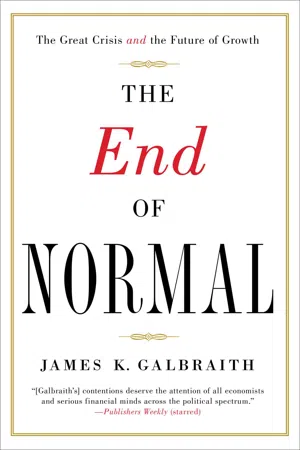
The years since the Great Crisis of 2008 have seen slow growth, high unemployment, falling home values, chronic deficits, a deepening disaster in Europe—and a stale argument between two false solutions, “austerity” on one side and “stimulus” on the other. Both sides and practically all analyses of the crisis so far take for granted that the economic growth from the early 1950s until 2000—interrupted only by the troubled 1970s—represented a normal performance. From this perspective, the crisis was an interruption, caused by bad policy or bad people, and full recovery is to be expected if the cause is corrected.
The End of Normal challenges this view. Placing the crisis in perspective, Galbraith argues that the 1970s already ended the age of easy growth. The 1980s and 1990s saw only uneven growth, with rising inequality within and between countries. And the 2000s saw the end even of that—despite frantic efforts to keep growth going with tax cuts, war spending, and financial deregulation. When the crisis finally came, stimulus and automatic stabilization were able to place a floor under economic collapse. But they are not able to bring about a return to high growth and full employment. In The End of Normal, “Galbraith puts his pessimism into an engaging, plausible frame. His contentions deserve the attention of all economists and serious financial minds across the political spectrum” (Publishers Weekly, starred review).
Frequently asked questions
Yes, you can cancel anytime from the Subscription tab in your account settings on the Perlego website. Your subscription will stay active until the end of your current billing period. Learn how to cancel your subscription.
At the moment all of our mobile-responsive ePub books are available to download via the app. Most of our PDFs are also available to download and we're working on making the final remaining ones downloadable now. Learn more here.
Perlego offers two plans: Essential and Complete
- Essential is ideal for learners and professionals who enjoy exploring a wide range of subjects. Access the Essential Library with 800,000+ trusted titles and best-sellers across business, personal growth, and the humanities. Includes unlimited reading time and Standard Read Aloud voice.
- Complete: Perfect for advanced learners and researchers needing full, unrestricted access. Unlock 1.4M+ books across hundreds of subjects, including academic and specialized titles. The Complete Plan also includes advanced features like Premium Read Aloud and Research Assistant.
We are an online textbook subscription service, where you can get access to an entire online library for less than the price of a single book per month. With over 1 million books across 1000+ topics, weâve got you covered! Learn more here.
Look out for the read-aloud symbol on your next book to see if you can listen to it. The read-aloud tool reads text aloud for you, highlighting the text as it is being read. You can pause it, speed it up and slow it down. Learn more here.
Yes! You can use the Perlego app on both iOS or Android devices to read anytime, anywhere â even offline. Perfect for commutes or when youâre on the go.
Please note we cannot support devices running on iOS 13 and Android 7 or earlier. Learn more about using the app.
Yes, you can access The End of Normal by James K. Galbraith in PDF and/or ePUB format, as well as other popular books in Economics & Economic Conditions. We have over one million books available in our catalogue for you to explore.
Information
Part One
The Optimistsâ Garden
One
Growth Now and Forever
To begin to understand why the Great Financial Crisis broke over an astonished world, one needs to venture into the mentality of the guardians of expectationâthe leadership of the academic economics professionâin the years before the crisis. Most of todayâs leading economists received their formation from the late 1960s through the 1980s. But theirs is a mentality that goes back further: to the dawn of the postwar era and the Cold War in the United States, largely as seen from the cockpits of Cambridge, Massachusetts, and Chicago, Illinois. It was then, and from there, that the modern and still-dominant doctrines of American economics emerged.
To put it most briefly, these doctrines introduced the concept of economic growth and succeeded, over several decades, to condition most Americans to the belief that growth was not only desirable but also normal, perpetual, and expected. Growth became the solution to most (if not quite all) of the ordinary economic problems, especially poverty and unemployment. We lived in a culture of growth; to question it was, well, countercultural. The role of government was to facilitate and promote growth, and perhaps to moderate the cycles that might, from time to time, be superimposed over the underlying trend. A failure of growth became unimaginable. Occasional downturns would occurâthey would now be called recessionsâbut recessions would be followed by recovery and an eventual return to the long-term trend. That trend was defined as the potential output, the long-term trend at high employment, which thus became the standard.
To see what was new about this, itâs useful to distinguish this period both from the nineteenth-century Victorian mentality described by Karl Marx in Capital or John Maynard Keynes in The Economic Consequences of the Peace, and from the common experience in the first half of the twentieth century.
To the Victorians, the ultimate goal of society was not economic growth as we understand it. It was, rather, investment or capital accumulation. Marx put it in a phrase: âAccumulate, accumulate! That is Moses and the Prophets!â Keynes wrote: âEurope was so organized socially and economically as to secure the maximum accumulation of capital . . . Here, in fact, lay the main justification of the capitalist system. If the rich had spent their new wealth on their own enjoyments, the world would have long ago found such a rĂ©gime intolerable. But like bees they saved and accumulatedâ (Keynes 1920, 11).
But accumulate for what? In principle, accumulation was for profits and for power, even for survival. It was what capitalists felt obliged to do by their economic and social positions. The purpose of accumulation was not to serve the larger interest of the national community. It was not to secure a general improvement in living standards. The economists of the nineteenth century did not hold out great hopes for the progress of living standards. The Malthusian trap (population outrunning resources) and the iron law of wages were dominant themes. These held that in the nature of things, wages could not exceed subsistence for very long. And even as resources became increasingly abundant, the Marxian dynamicâthe extraction of surplus value by the owners of capitalâreinforced the message that workers should expect no sustained gains. Competition between capitalists, including the introduction of machinery, would keep the demand for labor and the value of wages down. Marx again:
âLike every other increase in the productiveness of labour, machinery is intended to cheapen commodities, and, by shortening that portion of the working-day, in which the labourer works for himself, to lengthen the other portion that he gives, without an equivalent, to the capitalist. In short, it is a means for producing surplus-value.â (Marx 1974, vol. 1, ch. 15, 351)
Yet living standards did improve. That they did soâhowever slowly, as Keynes later notedâwas a mystery for economists at the time. The improvement might be attributed to the growth of empires and the opening of new territories to agriculture and mining, hence the importance of colonies in that era. But in the nineteenth century, economics taught that such gains could only be transitory. Fairly soon population growth and the pressure of capitalist competition on wages would drive wages down again. Even a prosperous society would ultimately have low wages, and its working people would be poor. This grim fatalism, at odds though it was with the facts in Europe and America, was the reason that economics was known as the âdismal science.â
Then came the two great wars of the twentieth century, along with the Russian Revolution and the Great Depression. Human and technical capabilities surged, and (thanks to the arrival of the age of oil) resource constraints fell away. But while these transformations were under way, and apart from the brief boom of the 1920s, material conditions of civilian life in most of the industrial countries declined, or were stagnant, or were constrained by the exigencies of wartime. The Great Depression, starting in the mid-1920s in the United Kingdom and after 1929 in the United States, appeared to signal the collapse of the Victorian accumulation regimeâand with it, the end of the uneasy truce and symbiotic relationship between labor and capital that had graced the prewar years. Now the system itself was in peril.
For many, the question then became: could the state do the necessary accumulation instead? This was the challenge of communism, which in a parallel universe not far away showed its military power alongside its capacity to inspire the poor and to accelerate industrial development. In some noncommunist countries, democratic institutions became strongerâas they tend to do when governments need soldiersâgiving voice to the economic aspirations of the whole population. For social democrats and socialists, planning was the new alternativeâa prospect that horrified Friedrich von Hayek, who argued in 1944 that planning and totalitarianism were the same.
By the 1950s, communism ruled almost half the world. In the non-communist part, it could no longer be a question of building things up for a distant, better future. Entire populations felt entitled to a share of the prosperity that was at handâfor instance, to college educations, to automobiles, and to homes. To deny them would have been dangerous. Yet the future also could not be neglected, and (especially given the communist threat) no one in the âfree worldâ thought that the need for new investments and still greater technological progress was over. Therefore it was a matter of consuming and investing in tandem, so as to have both increased personal consumption now and the capacity for still greater consumption later on. This was the new intellectual challenge, and the charm, and the usefulness to Cold Warriors, of the theory of economic growth.
The Golden Years
From 1945 to 1970, the United States enjoyed a growing and generally stable economy and also dominance in world affairs. Forty years later, this period seems brief and distant, but at the time it seemed to Americans the natural culmination of national success. It was the start of a new history, justified by victory in war and sustained in resistance to communism. That there was a communist challenge imparted both a certain no-nonsense pragmatism to policy, empowering the Cold War liberals of the Massachusetts Institute of Technology (MIT) and the RAND Corporation, while driving the free-market romantics of Chicago (notably Milton Friedman) to the sidelines. Yet few seriously doubted that challenge could or should be met. The United States was the strongest country, the most advanced, the undamaged victor in world war, the leader of world manufacturing, the home of the great industrial corporation, and the linchpin of a new, permanent, stable architecture of international finance. These were facts, not simply talking points, and it took a brave and even self-marginalizing economist, willing to risk professional isolation in the mold of Paul Baran and Paul Sweezy, to deny them.
Nor were optimism and self-confidence the preserve of elites. Ordinary citizens agreed, and to keep them in fear of communism under the circumstances required major investments in propaganda. Energy was cheap. Food was cheap, with (thanks to price supports) staples such as milk and corn and wheat in great oversupply. Interest rates were low and credit was available to those who qualified, and so housing, though modest by later standards, was cheap enough for whites. Jobs were often unionized, and their wages rose with average productivity gains. Good jobs were not widely open to women, but the men who held them had enough, by the standards of the time, for family life. As wages rose, so did taxes, and the country could and did invest in long-distance roads and suburbs. There were big advances in childhood health, notably against polio but also measles, mumps, rubella, tuberculosis, vitamin deficiencies, bad teeth, and much else besides. In many states, higher education was tuition-free in public universities with good reputations. Though working-class white America was much poorer than today and much more likely to die poor, there had never been a better time to have children. And there never would be again. Over the eighteen years of the baby boom, from 1946 to 1964, the fruits of growth were matched by a rapidly rising population to enjoy them.
It was in this spirit that, in the 1950s, economists invented the theory of economic growth. The theory set out to explain why things were good and how the trajectory might be maintained. Few economists in the depression-ridden and desperate 1930s would have considered wasting time on such questions, but now they seemed critical: What did growth depend on? What were the conditions required for growth to be sustained? How much investment could you have without choking off consumption and demand? How much consumption could you have without starving the future? The economistsâ answer would be that, in the long run, economic growth depended on three factors: population growth, technological change, and saving.
It was not a very deep analysis, and its principal authors did not claim that it was. In the version offered by Robert Solow, the rate of population growth was simply assumed. It would be whatever it happened to beârising as death rates came under control, and then falling again, later on, as fertility rates also declined, thanks to urban living and birth control. Thomas Robert Malthus, the English parson who in 1798 had written that population would always rise, so as to force wages back down to subsistence, was now forgotten. How could his theory possibly be relevant in so rich a world?
Technology was represented as the pure product of science and invention, available more or less freely to all as it emerged. This second great simplification enabled economists to duck the question of where new machinery and techniques came from. In real life, of course, new products and processes bubbled up from places like Los Alamos and Bell Labs and were mostly built into production via capital investment and protected by patents and secrecy. Big government gave us the atom bomb and the nuclear power plant; big business gave us the transistor. Working together, the two gave us jets, integrated circuits, and other wonders, but the textbooks celebrated James Watt and Thomas Edison and other boy geniuses and garage tinkerers, just as they would continue to do in the age of Bill Gates and Steve Jobs, whose products would be just as much the offshoots of the work of government and corporate labs.
With both population and technology flowing from the outside, the growth models were designed to solve for just one variable, and that was the rate of saving (and investment). If saving could be done at the right rate, the broad lesson of the growth model was that good times could go on. There was what the model called a âsteady-state expansion path,â and the trick to staying on it was to match personal savings with the stock of capital, the growth of the workforce, and the pace of progress. Too much saving, and an economy would slip back into overcapacity and unemployment. Too little, and capitalâand therefore growthâwould dry up. But with just the right amount, the economy could grow steadily and indefinitely, with a stable internal distribution of income. The task for policy, therefore, was only to induce the right amount of saving. This was not a simple calculation: economists made their reputations working out what the right value (the âgolden ruleâ) for the saving rate should be. But the problem was not impossibly complex either, and it was only dimly realized (if at all) that its seeming manageability was made possible by assuming away certain difficulties.
The idea that unlimited growth and improvement were possible, with each generation destined to live better than the one before, was well suited to a successful and optimistic people. It was also what their leaders wanted them to believe; indeed, it was a sustaining premise of the postwar American vision. Moreover, there was an idea that this growth did not come necessarily at the expense of others; it was the product of the right sort of behavior and not of privilege and power. Tracts such as Walt W. Rostowâs Stages of Economic Growth spread the message worldwide: everyone could eventually go through âtake-off â and reach the plateau of high mass consumption.I Capitalism, suitably tamed by social democracy and the welfare state, could deliver everything communism promised, and more. And it could do it without commissars or labor camps.
A curiosity of the models was the many things they left out. The âfactors of productionâ were âlaborâ and âcapital.â Labor was just a measure of time worked, limited only by the size of the labor force and expected to grow exponentially with the human population. Capital (a controversial construct, subject to intense debate in the 1950s) was to be thought of as machinery, made from labor, measured essentially as the amalgam of the past human effort required to build the machines. As every textbook would put it, if Y is output, K is capital, and L is labor, then:
Y = f(K, L)
This simple equation said only that output was a function of two inputs: capital and labor. Note that, in this equation, resources and resource costs did not appear.II
The notion of production, therefore, was one of immaculate conception: an interaction of machinery with human hands but operating on nothing. Economists (Milton Friedman, notably) sometimes expressed this model as one in which the only goods produced were, actually, servicesâan economy of barbershops and massage parlors, so to speak. How this fiction passed from hand to hand without embarrassment seems, in deep retrospect, a mystery. The fact that in the physical world, one cannot actually produce anything without resources passed substantially unremarked, or covered by the assumption that resources are drawn freely from the environment and then disposed of equally freely when no longer needed. Resources were quite cheap and readily availableâand as the theory emerged, the problem of pollution only came slowly into focus. Climate change, though already known to scientists, did not reach economics at all. It would have been one thing to build a theory that acknowledged abundance and then allowed for the possibility that it might not always hold. It was quite another to build up a theory in which resources did not figure.
Even the rudimentary and catch-all classical category âlandâ and its pecuniary accompaniment, rent, were now dropped. There were no more landlords in the models and no more awkward questions about their role in economic life. This simplification helped make it possible for enlightened economists to favor land reform in other countries, while ignoring the âabsentee ownersâ at home, to whom a previous, cynical generation had called attention. Keynes had ended his The General Theory of Employment, Interest, and Money in 1936 with the thought that rentiers might be âeuthanized.â Now they were forgotten; theory focused simply on the division of income between labor and capital, wages and profits.
Government played no explicit role in the theory of growth. It was usually acknowledged as necessary in real life, notably for the provision of âpublic goodsâ such as military defense, education, and transport networks. But since the problem of depressions had been curedâsupposedlyâthere was no longer any need for Keynesâs program of deficit-financed expenditure on public works or jobs programs; at least not for the purpose of providing mass employment. Fiscal and monetary policies were available, though, for the purpose of keeping growth âon trackââa concept referred to as âfine-tuningâ or âcountercyclical stabilization.â Regulation could be invoked as needed to cope with troublesome questions of pollution and monopoly (such as price-fixing by Big Steel), but the purpose of that was to make the system resemble as much as possible the economistsâ competitive dream world. Beyond those needs, regulation was accordingly a burden, a drag on efficiency, to be accepted where necessary but minimized.
The models supported the system in two complementary ways. They portrayed a world of steady growth and also of fundamental fairness. Both labor and capital were said to be paid in line with their contributions (at the margin) to total output. This required the special assumption that returns to scale were constant. If you doubled all inputs, youâd get twice the output. While the omnipresent real-world situations of âdiminishing returnsâ (in farming) and âincreasing returnsâ (in industry) lived on and could still be captured in the mathematics, most economists presented them as special cases and, for the most part, more trouble than they were worth. (This authorâs teacher, Nicholas Kaldor of the University of Cambridge, was an exception.) As for inequality, while the basic theory posited a stable distribution, Simon Kuznetsâwho was not a romanticâoffered a more realistic but still reassuring analysis based on the history of industrial development in the United States and Great Britain. Inequality would rise in the transition from agriculture to industry, but it would then decline with the rise to power of an industrial working class and middle class and the social democratic welfare state.
That these assumptions became the foundations of a new system of economic thought was truly remarkable, considering ...
Table of contents
- Cover
- Dedication
- Epigraph
- Prologue: A Contest of One-Note Narratives
- Part One: The Optimistsâ Garden
- Part Two: The Four Horsemen of the End of Growth
- Part Three: No Return to Normal
- Epilogue: When Homer Returns
- Acknowledgments
- About James K. Galbraith
- Bibliography
- Index
- Copyright