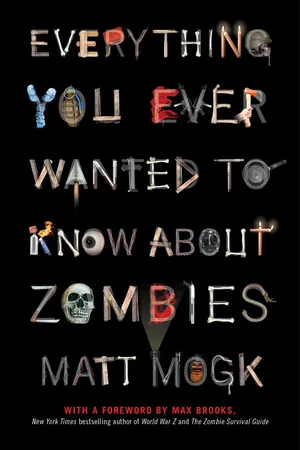
Everything You Ever Wanted to Know About Zombies
eBook - ePub

Everything You Ever Wanted to Know About Zombies

  1. 304 pages
  2. English
  3. ePUB (mobile friendly)
  4. Available on iOS & Android
eBook - ePub

Everything You Ever Wanted to Know About Zombies

About this book

The most comprehensive zombie handbook ever published—with a foreword by Max Brooks! In one indispensable volume, Matt Mogk busts popular myths and answers all your raging questions about the living dead.* Q. How can I increase my chances of survival? A. One simple step is to keep away from other people. Without people there can be no zombies. Q. What is the connection between the Voodoo zombie and the flesh-eating zombie of popular culture? A. Other than a shared name, absolutely nothing. Q. Will zombies actually eat me, or will they just bite and chew? A. Research suggests the neuromuscular activity required for swallowing may be too complex for a zombie. Q. Will we see any warning signs before the dead rise? A. Unfortunately, entire populations could be infected with the zombie sickness before anyone even knows there's a problem. Q. How come Zombie Awareness Month is in May and not October? A. Unlike witches and vampires, zombies are not otherworldly creatures. They are made of flesh and blood. Don't forget to wear your gray ribbon. * Many more questions about zombies—including why not all of them are undead—are answered inside the book.
Frequently asked questions

Yes, you can cancel anytime from the Subscription tab in your account settings on the Perlego website. Your subscription will stay active until the end of your current billing period. Learn how to cancel your subscription.
At the moment all of our mobile-responsive ePub books are available to download via the app. Most of our PDFs are also available to download and we're working on making the final remaining ones downloadable now. Learn more here.
Perlego offers two plans: Essential and Complete
  • Essential is ideal for learners and professionals who enjoy exploring a wide range of subjects. Access the Essential Library with 800,000+ trusted titles and best-sellers across business, personal growth, and the humanities. Includes unlimited reading time and Standard Read Aloud voice.
  • Complete: Perfect for advanced learners and researchers needing full, unrestricted access. Unlock 1.4M+ books across hundreds of subjects, including academic and specialized titles. The Complete Plan also includes advanced features like Premium Read Aloud and Research Assistant.
Both plans are available with monthly, semester, or annual billing cycles.
We are an online textbook subscription service, where you can get access to an entire online library for less than the price of a single book per month. With over 1 million books across 1000+ topics, we’ve got you covered! Learn more here.
Look out for the read-aloud symbol on your next book to see if you can listen to it. The read-aloud tool reads text aloud for you, highlighting the text as it is being read. You can pause it, speed it up and slow it down. Learn more here.
Yes! You can use the Perlego app on both iOS or Android devices to read anytime, anywhere — even offline. Perfect for commutes or when you’re on the go.
Please note we cannot support devices running on iOS 13 and Android 7 or earlier. Learn more about using the app.
Yes, you can access Everything You Ever Wanted to Know About Zombies by Matt Mogk in PDF and/or ePUB format, as well as other popular books in Social Sciences & Film History & Criticism. We have over one million books available in our catalogue for you to explore.
Image

16: WATER TO DRINK

Max Brooks stands onstage before a packed lecture hall. He is the bestselling author of Zombie Survival Guide, the first in what is now a long list of zombie survival manuals, most of which are, in my opinion, poor imitations of Brooks’s original work. Hundreds of college students fill every seat and crowd along the back wall in giddy anticipation. Some are dressed up like zombies or zombie killers. Some flip through dog-eared copies of the guide, as if cramming for the most important test of their lives. Some compare survival strategies in heated, whispered debate. Finally, Brooks steps to the center podium, and the room falls quiet. “What is the first thing you’ll want to have with you in a zombie outbreak?”
Eager students shout out possible answers. A machete! A tank! A shotgun! My mommy! They laugh. They shift in their seats, looking about as suggestions fly from all corners of the room. A jock in the back thinks it must be Molotov cocktails. A young professor with a ponytail twirls a pair of night-vision goggles around his index finger. The housewife zombie in the second row with a human-brain Jell-O mold just wants a friend who runs slower than she does, so she can get away when push comes to shove. Brooks shakes his head. They’re all wrong. Dead wrong. Without a word, he simply holds up the water bottle in his hand. He takes a sip, then holds it up even higher so everyone can see. “Water, people. Water.”
As the most recognized name in zombie survival, Brooks isn’t a student of some exotic martial art. He doesn’t engage in advanced weapons testing at a secret desert compound. He hasn’t trained his family to neutralize an approaching threat instantly with their bare hands. No. Instead, Brooks composts his kitchen waste. He grows home crops in the backyard. He worries about the preservation and storing of extra food and water for drinking and cooking. He rightly focuses on the clear connection between crisis preparedness and response strategies for more common man-made and natural disasters and the measures needed to survive an infestation of the walking dead. He understands that the basics are what keep you alive in a zombie outbreak, and lacking those basics will kill you faster than any undead horde ever could.

DEADLY DEHYDRATION

Symptoms of dehydration can manifest in just a matter of hours, starting with a persistent and intensifying thirst and building to fatigue, chills, and headache. Nausea soon sets in, as your muscles cramp and you experience tingling of the limbs. If you can’t find adequate drinking water, your situation will quickly deteriorate, leading to vomiting, racing pulse, vision problems, confusion, seizures, and even unconsciousness, and finally death.
Image
On July 30, 1945, the USS Indianapolis was torpedoed and sunk in the Philippine Sea. Of the 900 men who abandoned ship, only 316 were still alive when rescue planes spotted them four days later. Though the constant threat of shark attack is what brought the ordeal global attention, as recounted by the fictional salty sea captain in the film Jaws, dehydration killed far more people than the sharks:
First your mouth turns to cotton. Your saliva turns thick and bitter, until it disappears altogether. You become aware of your tongue as a fat, dry thing barricading your air passage. Your throat dries out until you can’t talk, and you feel a massive lump in your windpipe, forcing you to swallow again and again, and every swallow is painful, but the lump won’t go away. Without tears in your tear ducts your eyelids begin to crack, and you might weep blood.38
The survivors of the Indianapolis remember the mass delusions suffered by their fellow sailors. Men thought the water was fresh just below the surface. Some thought they could see land and swam off to their deaths. Others were sure that the water fountains on the sunken ship would still work. Dozens of men dived down all at once, never to be seen again. Ocean survival is clearly a unique situation, but even if you can find fresh water to drink, water-borne illnesses might pose as deadly a threat as having no water at all.
January 12, 2011, was the one-year anniversary of the devastating earthquake in Haiti that killed an estimated 300,000 people and crippled the country’s already weak infrastructure. Even the presidential palace was reduced to rubble. But one year later, nearly every news outlet in the United States reported that the biggest threat to the lives of those who survived was a lack of clean drinking water.
David Walton is deputy chief of the Haiti mission for Partners in Health, a nonprofit relief organization. Speaking about the proliferation of cholera, he says that hundreds of thousands of people contracted the disease within months of the initial disaster, and once the problem starts, it’s almost impossible to control:
If cholera was introduced into the United States tomorrow, it wouldn’t take root because we have great sanitation, we have potable water. If you look at a place like Haiti that is one of the most water-insecure nations in the world and one of the nations that has some of the worst metrics in terms of sanitation, this is the perfect setup for cholera to both spread like wildfire and set up shop for years to come.39
Walton’s assessment is based on a functioning sanitation and municipal water system continuing in North America. But if systems fail in an undead outbreak, as will likely be the case, we in the industrialized world will find ourselves at serious risk of dying of dehydration caused by diarrhea and vomiting associated with any number of water-borne diseases such as cholera and dysentery.

AVAILABLE SOURCES

If you haven’t stocked up on water in advance of the zombie plague, then you’ll be on a forced march to find a ready source almost immediately. Common strategies include filling up bathtubs while the taps are still flowing, collecting rainwater, and looking for available pools.
The average home water heater holds 50 to 75 gallons, or 6,400 to 9,600 ounces. In simple terms, an adult male should drink roughly 64 ounces of water per day. So once the heater water has been properly purified, it should provide enough drinking water for two people to be fully hydrated for at least fifty days.
Start by shutting off the water and gas to the building. This may be contrary to instinct, but the danger of contaminated fluids compromising your existing reserves outweighs any potential benefit. Next, locate the building’s water heater. It’s a large metal tank, usually in the basement, utility closet, or laundry room.
Image
Even if you have a tankless water heater in your own home, chances are you will find yourself on the run and hiding out in new and unfamiliar shelters before too long. Water boilers can serve as lifesaving wells in the dry urban-desert landscape.
Shane Painter, author of The Urban Survivalist Handbook, recommends finding a plot of open grass in the early morning when other options fail:
Now take a sheet and begin dragging it over the grass to collect the dew. As the sheet becomes damp you can wring it out into a bucket. Depending on how big an area you are dragging you could get up to a gallon of water per day.40
In testing, this technique produced wildly varying results depending on climate and location.
Adequate drinking water is essential to buy you needed time to fashion weapons, communicate with other survivors, and develop a solid plan for escape or further fortification. It also prevents you from dying in just a matter of days.

PURIFY YOUR SUPPLY

According to the World Health Organization, 3.5 million people die each year from water-borne illness across the globe. In a zombie outbreak, even the fresh-looking water coming from a working kitchen faucet may hold sewage backup and other deadly toxic substances. It does no good to locate a ready source of water, such as a plugged gutter, rain bucket, or toilet bowl, only to have unseen microbes incapacitate anyone brave enough to drink. Boiling water is a solid option but not always possible. So what’s the answer? Drink bleach.
Mixed in the correct ratio, unscented bleach added to water can kill any unwanted contaminants and render the source safe for human consumption. In rough terms, half a tablespoon of bleach mixed into five gallons of clear water (or 2.5 gallons of cloudy water) should do the trick. Stir in and let sit for thirty minutes. If the water does not have a chlorine smell when finished, add more bleach.
So, next time your buddy says that all he needs is his doublebarrel shotgun and enough ammo to blow every zombie’s head off from here to Cleveland, tell him that you’re going to invest in a bottle of bleach instead, and you’ll pray for him after he’s killed by diarrhea-related dehydration from drinking the tainted water in his badass camouflage commando canteen.
If you’re inclined to prepare your water-purification kit ahead of time, there are dozens of different filters and purifiers that can be easily found and purchased through a simple Internet search. But for solutions on the fly, coffee filters are good for cleaning turbid or muddy water, or even spare clothing such as socks. Most important is that you assume that all water is in need of purification before drinking and take any steps at your disposal to purify it.
Image

KNOW YOUR ZOMBIES: FLYBOY

Dawn of the Dead (1978)

As a helicopter pilot and one of the last remaining humans on earth, Flyboy is an unskilled survivalist who can’t even shoot straight when his life depends on it. Played by David Emge, Flyboy goes from leading man to cult favorite zombie, lurching around in one of the most distinct zombie walks any actor has ever created.
Depicted here with a baby, Flyboy never gets to see his unborn child in the original film, but there is a zombie newborn in the Dawn of the Dead remake of 2004.
ILLUSTRATION BY THOMAS BROERSMA

17: PROTECTIVE SHELTER

In a zombie world, as in any extreme survival situation, the idea of shelter has to be thought of broadly. Shelter is any external protection from that which might do you harm. Forget about sleeping snug in your own bed or crashing on your neighbor’s couch. Forget about pulling over to a roadside hotel after a long, hard day of travel. When the dead walk the earth, Motel 6 may quickly become a luxury beyond your wildest dreams.
Instead, think of shelter as an abandoned parking lot in the middle of a burned-out city. It’s a fallen tree in the woods to shield you from harsh winds and rain. It’s a pile of discarded roof shingles in the back corner of an old trash depot or the crawl space behind a sewer drain grate. Shelter is even the clothes on your own back or a found beach towel cut into strips and wrapped around your aching, swollen feet.
We lived on canned food and we listened to the radio in the dark, listened to static when that was all there was, hoping to hear of shelter somewhere, real shelter.
—Dead Man’s Land (2009), David Wellington

SURVIVAL CLOTHING

I love zombie movies. I love the classics. I love the new stuff. I even love the crap that nobody else loves. And I understand that zombie movies are meant to entertain, not to provide sound survival advice, so it’s unfair to judge them against real zombie-outbreak scenarios. Nonetheless, I’m always struck by the flawed actions that survivors in zombie movies continue to take long after...

Table of contents

  1. Cover
  2. Back Cover
  3. Title Page
  4. Copyright Page
  5. Dedication
  6. Contents
  7. Acknowledgments
  8. Foreword
  9. Section I: Zombie Basics
  10. Section II: Zombie Science
  11. Section III: Zombie Survival
  12. Section IV: Popular Culture
  13. Notes