ONE OF THE MOST IMPORTANT SCIENTIFIC MEMOIRS OF OUR TIME
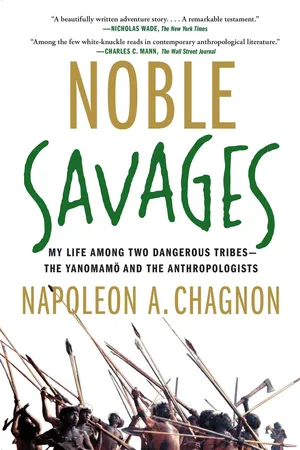
When Napoleon Chagnon arrived in Venezuela’s Amazon region in 1964 to study the Yanomamö Indians, one of the last large tribal groups still living in isolation, he expected to find Rousseau’s “noble savages,” so-called primitive people living contentedly in a pristine state of nature. Instead Chagnon discovered a remarkably violent society. Men who killed others had the most wives and offspring, their violence possibly giving them an evolutionary advantage. The prime reasons for violence, Chagnon found, were to avenge deaths and, if possible, abduct women.
When Chagnon began publishing his observations, some cultural anthropologists who could not accept an evolutionary basis for human behavior refused to believe them. Chagnon became perhaps the most famous American anthropologist since Margaret Mead—and the most controversial. He was attacked in a scathing popular book, whose central allegation that he helped start a measles epidemic among the Yanomamö was quickly disproven, and the American Anthropological Association condemned him, only to rescind its condemnation after a vote by the membership. Throughout his career Chagnon insisted on an evidence-based scientific approach to anthropology, even as his professional association dithered over whether it really is a scientific organization. In Noble Savages, Chagnon describes his seminal fieldwork—during which he lived among the Yanomamö, was threatened by tyrannical headmen, and experienced an uncomfortably close encounter with a jaguar—taking readers inside Yanomamö villages to glimpse the kind of life our distant ancestors may have lived thousands of years ago. And he forcefully indicts his discipline of cultural anthropology, accusing it of having traded its scientific mission for political activism.
This book, like Chagnon’s research, raises fundamental questions about human nature itself.
eBook - ePub
Noble Savages
My Life Among Two Dangerous Tribes -- the Yanomamo and the Anthropologists
- 544 pages
- English
- ePUB (mobile friendly)
- Available on iOS & Android
eBook - ePub
Noble Savages
My Life Among Two Dangerous Tribes -- the Yanomamo and the Anthropologists
About this book
Information
Topic
Ciencias socialesTable of contents
- Cover
- Dedication
- Introduction
- Chapter 1: Culture Shock: My First Year in the Field
- Chapter 2: Discovering the Significance of the Names
- Chapter 3: Raids and Revenge: Why Villages Fission and Move
- Chapter 4: Bringing My Family to Yanomamöland and My Early Encounters with the Salesians
- Chapter 5: First Contact with New Yanomamö Villages
- Chapter 6: Geography Lesson
- Chapter 7: From Fieldwork to Science
- Chapter 8: Conflicts over Women
- Chapter 9: Fighting and Violence
- Chapter 10: First Contact with the Iwahikoroba-teri
- Chapter 11: Yanomamö Origins and Their Fertile Crescent
- Chapter 12: Yanomamö Social Organization
- Chapter 13: Three Headmen of Authority
- Chapter 14: Twilight in Cultural Anthropology: Postmodernism and Radical Advocacy Supplant Science
- Chapter 15: Confrontation with the Salesians
- Chapter 16: Darkness in Cultural Anthropology
- Acknowledgments
- About Napoleon A. Chagnon
- Notes
- Bibliography
- Index
- Copyright
Trusted by 375,005 students
Access to over 1.5 million titles for a fair monthly price.
Study more efficiently using our study tools.
Frequently asked questions
Yes, you can cancel anytime from the Subscription tab in your account settings on the Perlego website. Your subscription will stay active until the end of your current billing period. Learn how to cancel your subscription
No, books cannot be downloaded as external files, such as PDFs, for use outside of Perlego. However, you can download books within the Perlego app for offline reading on mobile or tablet. Learn how to download books offline
Perlego offers two plans: Essential and Complete
- Essential is ideal for learners and professionals who enjoy exploring a wide range of subjects. Access the Essential Library with 800,000+ trusted titles and best-sellers across business, personal growth, and the humanities. Includes unlimited reading time and Standard Read Aloud voice.
- Complete: Perfect for advanced learners and researchers needing full, unrestricted access. Unlock 1.5M+ books across hundreds of subjects, including academic and specialized titles. The Complete Plan also includes advanced features like Premium Read Aloud and Research Assistant.
We are an online textbook subscription service, where you can get access to an entire online library for less than the price of a single book per month. With over 1.5 million books across 990+ topics, we’ve got you covered! Learn about our mission
Look out for the read-aloud symbol on your next book to see if you can listen to it. The read-aloud tool reads text aloud for you, highlighting the text as it is being read. You can pause it, speed it up and slow it down. Learn more about Read Aloud
Yes! You can use the Perlego app on both iOS and Android devices to read anytime, anywhere — even offline. Perfect for commutes or when you’re on the go.
Please note we cannot support devices running on iOS 13 and Android 7 or earlier. Learn more about using the app
Please note we cannot support devices running on iOS 13 and Android 7 or earlier. Learn more about using the app
Yes, you can access Noble Savages by Napoleon A. Chagnon in PDF and/or ePUB format, as well as other popular books in Ciencias sociales & Biografías de ciencia y tecnología. We have over 1.5 million books available in our catalogue for you to explore.