Max Q for Youth Leaders
eBook - ePub

Max Q for Youth Leaders

  1. 270 pages
  2. English
  3. ePUB (mobile friendly)
  4. Available on iOS & Android
eBook - ePub

Max Q for Youth Leaders

About this book

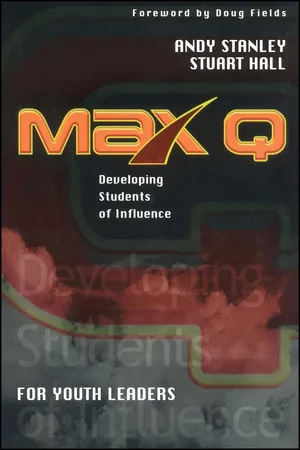
This life-changing book helps students learn how to influence their peers—both saved and unsaved—without being negatively influenced. Maximum Quotient: It is the point in time when a rocket's speed is the highest and air pressure is at its extreme. It is what young Christians feel during their teenage years. Pulling from many years of successful youth ministry, Stanley and Hall introduce youth leaders to a new realm of youth ministry through this dynamic new plan. Youth leaders will learn about: A Ministry of Influence, Jesus & Influence, Maximum Dynamic Pressure, Setting Standards, Establishing Priorities, Maintaining Accountability, Unconditional Acceptance, Sustaining Influence, Using Leverage, and Partnering with Parents.
Frequently asked questions

Yes, you can cancel anytime from the Subscription tab in your account settings on the Perlego website. Your subscription will stay active until the end of your current billing period. Learn how to cancel your subscription.
No, books cannot be downloaded as external files, such as PDFs, for use outside of Perlego. However, you can download books within the Perlego app for offline reading on mobile or tablet. Learn more here.
Perlego offers two plans: Essential and Complete
  • Essential is ideal for learners and professionals who enjoy exploring a wide range of subjects. Access the Essential Library with 800,000+ trusted titles and best-sellers across business, personal growth, and the humanities. Includes unlimited reading time and Standard Read Aloud voice.
  • Complete: Perfect for advanced learners and researchers needing full, unrestricted access. Unlock 1.4M+ books across hundreds of subjects, including academic and specialized titles. The Complete Plan also includes advanced features like Premium Read Aloud and Research Assistant.
Both plans are available with monthly, semester, or annual billing cycles.
We are an online textbook subscription service, where you can get access to an entire online library for less than the price of a single book per month. With over 1 million books across 1000+ topics, we’ve got you covered! Learn more here.
Look out for the read-aloud symbol on your next book to see if you can listen to it. The read-aloud tool reads text aloud for you, highlighting the text as it is being read. You can pause it, speed it up and slow it down. Learn more here.
Yes! You can use the Perlego app on both iOS or Android devices to read anytime, anywhere — even offline. Perfect for commutes or when you’re on the go.
Please note we cannot support devices running on iOS 13 and Android 7 or earlier. Learn more about using the app.
Yes, you can access Max Q for Youth Leaders by Andy Stanley, Stuart Hall in PDF and/or ePUB format, as well as other popular books in Theology & Religion & Christian Ministry. We have over one million books available in our catalogue for you to explore.

Information

PART ONE
The Truth about Influence

The great reformer Martin Luther once said,
If I profess with the loudest voice and clearest exposition every portion of the Truth of God except precisely that point which the world and the devil are at that moment attacking, I am not confessing Christ. Where the battle rages, there the loyalty of the soldier is proved. And to be steady on all the battlefield is merely flight and disgrace if he flinches at that point.
As youth leaders we can spend all of our time, energy, and resources developing and maintaining the greatest programs, the coolest environments, and the best-behaved students within the four walls of the church. But that’s not the battlefront. The point of attack comes elsewhere. The battle takes place at precisely that point where teenagers who know Jesus personally must invest in lost friends and influence peers who desperately need Christ.
Too many youth ministries flinch at this point. May we flinch no more.
Let people feel the weight of who you are and let them deal with it.
JOHN ELDBEDGE

1
Granting Permission
Creating a Ministry of Influence

It was Saturday morning, February 1, 2003. In perhaps the greatest tragedy in space exploration history, seven courageous heroes lost their lives that day. The space shuttle Columbia, returning from a sixteen-day mission to outer space, reentered the earth’s atmosphere at more than eighteen times the speed of sound and, only minutes from its scheduled landing, disintegrated some 207,000 feet over Texas. Most of us will never forget where we were on that fateful morning. Our hearts broke and mourned with the families of those seven astronauts, many of whom were gathered on a runway at Kennedy Space Center in Florida awaiting their loved ones’ safe return. Columbia and her crew were lost only sixteen minutes from home.
It will most likely take the sharpest and brightest minds years to determine the specific cause of this horrific loss. We may never know the full extent of the truth. But one thing is certain: Columbia, in the midst of experiencing maximum dynamic pressure, when she needed to be the strongest, was weak. Perhaps her weakness was minute; perhaps it was greater than well ever know. Regardless of the degree, the fact remains that at the moment of the most intense heat and pressure, Columbia’s integrity was compromised. And what was to be a defining, triumphant moment became a terribly destructive one.

The State of Max Q

Somewhere at that edge where earth’s atmosphere ends and the greater reaches of outer space begin exists a point of tension and stress so extreme and intense that it cannot be simulated. It is a state known by people much smarter than most of us as “maximum dynamic pressure,” or “Max Q” for short. Any object intent on leaving the earth’s atmosphere must pass through it. Nothing and no one can evade it. It cannot be ignored. For a space shuttle to pass successfully through Max Q, every system must be executing perfectly; every person must be operating at the highest level of training and alertness; and the integrity of the spacecraft must be strong and fully functional.
It’s not much of a stretch to parallel the state of Max Q as it relates to space exploration to the pressures our Christian students face as they strive to become young men and women of influence in their world. In fact, the comparisons are hauntingly similar.
Youth-ministry leaders get to observe up close the intense pressure that society exerts on teenagers today. We understand—at least in theory—that in order to withstand the pressure without being influenced by it, our students must live at a very high level of wisdom, purity, and courage. But how many of our students are actually being trained to operate at that level?
Sadly, not many. According to statistics, over three-fourths of Christian teenagers, after graduating from high school, will abandon the church—and possibly even their faith.1
For years we have watched as Christian homes and youth ministries have sent graduates headlong into Max Q. Too often the results have been as tragic as the loss of the space shuttle. Reeling under the intense pressure, many students get suckered into making poor choices. Or they become magnetized to lifestyles that don’t match their stated belief system.
The culture in which our students live has cornered the market on generating maximum dynamic pressure. Popular music, for example, is an exercise of attitudes and word imageries that promote immorality, sexual promiscuity, violence, and disrespect. The accompanying videos merely “color in” the outlines the songs have already made in the minds of their young listeners. Meanwhile, magazines and other media add pressure by promoting a standard of physical beauty that few human beings can attain. As a result, an increasing number of teenagers are developing eating disorders. More and more students are pursuing breast implants, liposuction, and other forms of plastic surgery. They’re convinced they must have abs of steel and match Hollywood’s latest hottie from head to toe in looks and physical appeal.
What were considered pressures reserved for college life—drugs, alcohol, sex—have now trickled down to the high-school, junior-high, and even elementary-school campus. The drug of choice may fluctuate from marijuana to cocaine to ecstasy, but it’s readily available. So is alcohol. There is an unspoken implication here: Not only are teenagers engaging in harmful behavior, they are rebelling against authority and disobeying the law. They are not establishing moral boundaries. For large numbers of them, the end of innocence is coming sooner, rather than later.
Perhaps the most intense point of Max Q for students lies in the arena of friends. Acceptance is, of course, one of the strongest needs teenagers have. Most of our students will never admit it; but fitting in, being accepted, and having a sense of belonging with a person or group is their highest priority. (Let’s be honest: It’s a priority for all of us.) As youth leaders and workers, we have all witnessed the lengths teenagers will go to gain this elusive and fleeting acceptance from their peers. Most of us remember how powerful that desire was for us when we were their age.
Society, culture, peer pressure—these, along with numerous other obvious and not-so-obvious dynamics, combine to create a state of maximum dynamic pressure. It’s invisible, but our students feel it. Our students are affected by it. And ultimately, our students have to deal with it.
Or do they?

The Paradox

Some Christian parents and youth ministers would argue that it’s their job and duty to protect their teenagers from the influence and pressures of the world. We would all agree that it’s not healthy for our students to have close relationships with peers who are foolish, rebellious, and not believers. As we stated in our previous book, The Seven Checkpoints, friendships have a big influence on the quality and direction of a teenager’s life. In fact, friends can be more influential than parents, youth leaders, faith—even God.
For a student to connect with someone in friendship who does not hold the same values, believe in the same God, and desire the same lifestyle can be very destructive. And precisely because the potential for negative consequences is so great, we as parents and youth leaders tend to build strong, inflexible “friendship boundaries” around our teens. For many solid Christian students, bringing a new friend home to meet the parents is the equivalent of trying to get through airport security with a pocket full of change and a pistol in your bag. Why is there such scrutiny? Because we know how harmful a wrong choice of friends can be.
So we encourage—if not exactly force—our students to acquire and maintain friendships only from within the pool of Christian teenagers at church and youth group. And what happens? Subtly over time these students begin to grow more and more distant from their culture and from their peers who need Christ. Our youth ministries turn into shelters from the storm. Most of our evangelism efforts become frustrating and futile attempts on the part of our core students to bridge the ever-widening gap between themselves and their lost peers—in hopes of getting at least one new person to an event at church so the youth pastor will get off their backs.
We’re giving our students a conflicting message. We know that Christians are called by Jesus to “go and make disciples” (Matthew 28:19). So we tell our students to reach out to their unbelieving peers—even as we plead with them to keep their friendships within Christian circles. We trap our core students within a fluctuating ping-pong game of “Go! No! Go! No!”
It doesn’t help that our concept of “going and making disciples” is often centered more on modern student-evangelism strategies than on biblical disciple making. We put a hyper-focus on “going” and take a drudgery-type approach to “making disciples.” This may sound blasphemous, but “making disciples” is not accomplished most effectively through door-to-door witnessing, mall blitzes, or sharing the Four Spiritual Laws. And it’s not accomplished most effectively through our typical Christian education models and strategies.

Disciplism

No, the most effective way to carry out the Great Commission—the way to “go and make disciples” as God intends, even in the midst of Max Q—is to marry the concepts of evangelism and discipleship as we’ve known them. We’ve coined the word disciplism (“disciple,” with an “ism”) to best describe this union of ideas, strategies, and obedience to God’s Word. Disciplism means more than witnessing to someone. It means investing your life into the lives of your unbelieving friends. It means purposefully engaging the culture and your friends in the culture in order to influence them with the gospel. Once you’ve influenced them, it means walking alongside them as they grow in their faith.
Disciplism is not a call you can answer via satellite. It’s a hands-on, on-location challenge. And it’s the very heart of God—his reason for coming to earth in the form of a man: to proclaim his glory by serving and dying for all.
There is a reason why so many of us in youth ministry seem to avoid God’s idea of disciple making. It is a deeply theological concept: Making disciples—disciplism—is hard. For students to invest their lives into the lives of their peers takes energy, time, and sometimes money. It often takes blood, sweat, and tears. Making disciples means that their priorities have to change. Their schedules have to change. Their lifestyles have to change. And the implementation of disciplism means that our philosophies and ideologies as youth leaders have to change too.

To Err Is Trouble

The potential exists for us to err on one of two extremes—and either extreme is dangerous. On the one hand, if our students have the healthiest of Christian friendships, yet never influence their unbelieving friends for the sake of Christ, have we been successful? Is goodness our standard in youth ministry, or godliness? Behavior modification is not our goal: Transformation is. It would be a tragedy for us to settle for developing good students rather than students of greatness.
Ask yourself this question: Has my idea of success in youth ministry been to make sure that my students don’t “drink, smoke, chew, or date those who do?” Our hearts hurt when we think of the students who were exposed to a deranged idea of social reform rather than spiritual renewal under our leadership. We confess: Behavior modification is a much easier road to travel and one we have regretfully traveled.
On the other hand, if our students immerse themselves in their culture and develop friendships with lost peers but then cave in under the pressure and fall into sin, what have we gained? God doesn’t want us to play chess with our students, risking their character and integrity and ignoring the consequences for the sake of his kingdom (and ours). He has not called us to be reckless.
He has, however, called our students to influence their friends. It is the right thing for them to do. And the fact is, most of the time the right thing to do is hard. The right thing to do is full of risk. There are no promises of ease or safety in following Jesus. No guarantees. Just his promise that “I will never leave you or forsake you.” That he is with you always. And understanding this leads us to ask some pretty hefty questions: What happens if we don’t do what we know is right? What happens if we do?
Several years ago these questions forced us to take a hard look at our ideas of evangelism and discipleship within the context of youth ministry. Reaching students for Christ was and is our driving force. We’ve always believed God is passionate about teenagers, and we want to be passionate about what burns in God’s heart. We want to lead teenagers into a growing relationship with Jesus Christ. And we believe that the greatest influence in a teenager’s life was and still is another teenager.
What we found when we “opened the hood” of our ministry, however, was discouraging. Our methodology pointed to a painful truth: We were more consumed with creating evangelistic environments than with developing influential students. Our calendars and our prayers, we realized, were geared primarily towards programs rather than personal development. But the most obvious sign that we were missing the mark came from our own core students, who could not seem to maintain leverage with their lost peers.
These bleak observations caused us to dive deep into the concepts of student evangelism and influence—theologically, practically, and programmatically. We decided to start at square one and reconstruct our philosophy from scratch.

Permission Granted

The beginning of our journey brought us to an interesting word: permission.
We’re not rocket scientists, but we think the odds are pretty high that your students have at least a few acquaintances who are not Christians. And those students feel a certain tension regarding these friends. Is it okay to get close to them? Will they be judged by God or their Christian friends for reaching out to unbelievers? Should they feel guilty for having lost friends?
Well, let us ask you: Is it God’s will for your students to have non-Christian friends?
Apparently the early church battled with this very dilemma. Paul specifically addressed the hyperreaction of the church in Corinth to a challenge he had previously given. His response to their reaction is recorded in 1 Corinthians 5:
I wrote you in my letter not to associate with immoral people; I did not at all mean with the immoral people of this world, or with the covetous and swindlers, or with idolaters, for then you would have to go out of the world. But actually, I wrote to you not to associate with any so-called brother if he is an immoral person, or covetous, or an idolater, or a reviler, or a drunkard, or a swindler—not even to eat with such a one. (1 Corinthians 5:9-11 NASB)
Even though his earlier letter is not included in the New Testament, Paul implies in verse 9 that he had previously written to the church in Corinth, instructing them not to associate with immoral people. Apparently the Corinthian church misinterpreted this directive. For some reason the Corinthian believers—like so many of us—thought that Paul’s message to separate themselves from immoral people meant they were to steer clear of people who did not know God. They assumed he meant they should put as much distance as possible between themselves and the “pagans.”
Paul, however, was not referring to the people who didn’t know God. And in this passage in 1 Corinthians 5, he cleared up the misunderstanding—for the Corinthians and for us. When he said that believers should not associate with immoral people, he did not mean the immoral people of this world. He was referring to people who claim to be Christians (so-called brothers) who continue in the active practice of sin. Paul says we should not even eat with such a person!

Out of This World

It seems that Paul sensed the absurdity of the response of the Corinthian church when he said that in order to disassociate with immoral people, we would have to “go out of the world.” In other words, lost people are all around us. We would have to leave this planet to get away from them. If we as youth ministers don’t want our students to associate with their lost peers, we need to move them to Mars.
Now understand: We are both parents. We recognize and take seriously the pressures of the world our children live in. With our wives we have prayed constantly for their purity of heart and mind. We’ve worked extremely hard to protect them from the negative influences that can creep in so subtly through unhealthy friendships, television, movies, and music.
But we’ve had to ask ourselves: Isn’t our role as parents (and youth leaders) to ground our children in the things of God so they can be influential without being influenced? Won’t they have to stand on their own two feet in this world one day anyway?
Isn’t the major task of our childre...

Table of contents

  1. Cover Page
  2. Title Page
  3. Dedication
  4. Contents
  5. Acknowledgments
  6. Foreword by Doug Fields
  7. Introduction
  8. PART ONE: The Truth about Influence
  9. PART TWO: The Principles
  10. Epilogue
  11. Notes