
- 272 pages
- English
- ePUB (mobile friendly)
- Available on iOS & Android
eBook - ePub
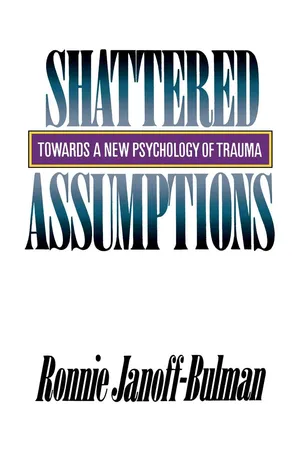
Shattered Assumptions
About this book
This book investigates the psychology of victimization. It shows how fundamental assumptions about the world's meaningfulness and benevolence are shattered by traumatic events, and how victims become subject to self-blame in an attempt to accommodate brutality. The book is aimed at all those who for personal or professional reasons seek to understand what psychological trauma is and how to recover from it.
Frequently asked questions
Yes, you can cancel anytime from the Subscription tab in your account settings on the Perlego website. Your subscription will stay active until the end of your current billing period. Learn how to cancel your subscription.
No, books cannot be downloaded as external files, such as PDFs, for use outside of Perlego. However, you can download books within the Perlego app for offline reading on mobile or tablet. Learn more here.
Perlego offers two plans: Essential and Complete
- Essential is ideal for learners and professionals who enjoy exploring a wide range of subjects. Access the Essential Library with 800,000+ trusted titles and best-sellers across business, personal growth, and the humanities. Includes unlimited reading time and Standard Read Aloud voice.
- Complete: Perfect for advanced learners and researchers needing full, unrestricted access. Unlock 1.4M+ books across hundreds of subjects, including academic and specialized titles. The Complete Plan also includes advanced features like Premium Read Aloud and Research Assistant.
We are an online textbook subscription service, where you can get access to an entire online library for less than the price of a single book per month. With over 1 million books across 1000+ topics, weâve got you covered! Learn more here.
Look out for the read-aloud symbol on your next book to see if you can listen to it. The read-aloud tool reads text aloud for you, highlighting the text as it is being read. You can pause it, speed it up and slow it down. Learn more here.
Yes! You can use the Perlego app on both iOS or Android devices to read anytime, anywhere â even offline. Perfect for commutes or when youâre on the go.
Please note we cannot support devices running on iOS 13 and Android 7 or earlier. Learn more about using the app.
Yes, you can access Shattered Assumptions by Ronnie Janoff-Bulman in PDF and/or ePUB format, as well as other popular books in Psychology & History & Theory in Psychology. We have over one million books available in our catalogue for you to explore.
Information
PART ONE
Background
1
Our Fundamental Assumptions
I n a single day during the fall of 1989, I recall being struck by reports that nineteen high school students were killed when their school bus plunged into a forty-foot chasm in Texas, Hurricane Hugo lashed into the Carolinas, and a jet crashed at LaGuardia Airport in New York. Newscasts have since told us of the sniper death of a teenage girl on a school bus in Massachusetts, a disastrous train crash in London, cyclones and flooding in Bangladesh, earthquakes in California and the Philippines, the mass murder of fourteen women at the University of Montreal, war and devastation in the Persian Gulf, and the death of nine children when a tornado hit a school in upstate New York. These are catastrophes we read about in newspapers or hear about on television or radio. Yet every day countless more are victimized who do not receive such public attention.
Unfortunately, there is no dearth of such extreme events in our world today. Rape, incest, battering, other criminal assaults, the diagnosis of life-threatening disease, the sudden and untimely loss of a loved one, serious accidents, earthquakes, floods, other natural disasters, and combat are all too common. Increasingly, people are exposed to technological disasters such as Three Mile Island and Chernobyl; and we have witnessed mass atrocities in such forms as Nazi concentration camps and the atomic bombings in Hiroshima and Nagasaki. How can we understand the psychological impact and aftermath of these traumatic experiences? How do people come to terms with these events and go on with their lives?
The responses of survivors to extreme life events tell us a great deal about our common human needs, capacities, and illusions. The fundamental properties of a substance or object are often revealed through exposure to extreme conditionsâfor example, the familiar compound H2O is more fully understood by its reactions to intense heat and cold. Just as the scientist attempts to understand the nature of elements by experimenting with them under extreme conditions, so, too, the child experiments with people and objects by exploring behavior at the boundaries. How much air can be inflated into the balloon? What are Mom and Dadâs real limits? Traumatic life events involve reactions at lifeâs extremes. By understanding trauma we learn about ourselves, victim and nonvictim alike, and begin to become aware of our greatest weaknesses and our surest strengths.
Certainly, extreme events differ in severity, and no two survivors will have identical reactions. Yet dramatically different victimizations may have psychological impacts that are similar in important ways. It is these similarities that both provide us with an understanding of those who survive trauma and enable us to draw conclusions about some basic aspects of human thought and behavior.
The survivorâs experience tells us a great deal about the psychology of daily existence. A powerful lesson learned from working with victims is the extent to which we ordinarily rely uponâand take for grantedâa few fundamental assumptions about ourselves and our world, assumptions that generally go unquestioned and unchallenged.
At the Core of Our Internal World
The philosophy which is so important in each of us is not a technical matter; it is our more or less dumb sense of what life honestly and deeply means ⌠it is our individual way of just seeing and feeling the total push and pull of the cosmos.
âWilliam James1
At the core of our internal world, we hold basic views of ourselves and our external world that represent our orientation toward the âtotal push and pull of the cosmos.â Surely our basic assumptions may be more private and less elegant than theories that guide scientific observation and research; yet they are no less important as guides for our day-to-day thoughts and behaviors.
A few psychologists have explicitly discussed the importance of peopleâs fundamental assumptions about themselves and their world. C. M. Parkes uses the phrase âassumptive worldâ to refer to peopleâs view of reality, âa strongly held set of assumptions about the world and the self which is confidently maintained and used as a means of recognizing, planning and acting ⌠Assumptions such as these are learned and confirmed by the experience of many years.â2
Psychiatrist John Bowlby3 writes of âworking modelsâ that people build of themselves and the world, which are used to perceive events, construct plans, and forecast the future. Sociologist Peter Marris refers to our âstructures of meaning,â basic principles that are abstract enough to be applied to any event we encounter and thereby make life continuously intelligible.4 Similarly, psychologist Seymour Epstein writes that âeveryone unwittingly develops a personal theory of reality that includes a self-theory and a world-theory. A personal theory of reality does not exist in conscious awareness, but is a preconscious conceptual system that automatically structures a personâs experiences and directs his or her behavior.â5 From a very different perspective, psychiatrist Joseph Sandler describes a ârepresentational world,â the constellation of organized, enduring impressions culled from experience that serves as a cognitive map.
Although different terms are used, there is clearly congruence in these descriptions of a single underlying phenomenon. The reference is to a conceptual system, developed over time, that provides us with expectations about the world and ourselves. This conceptual system is best represented by a set of assumptions or internal representations that reflect and guide our interactions in the world and generally enable us to function effectively.
A network of diverse theories and representations constitutes our assumptive world; surely some are more central and basic than others. The assumptions âI am a good poker playerâ or âI am a good piano playerâ are different from the assumptions âI am a moral, decent personâ and âI am a competent individual.â Our theories are hierarchically organized, with our most fundamental assumptions being those that are most abstract and general, as well as most pervasive in their applicability.6 Our fundamental assumptions are the bedrock of our conceptual system; they are the assumptions that we are least aware of and least likely to challenge. What are these core assumptions and why do they form the nucleus of our internal world?
Benevolence, Meaning, and Self-Worth
Most generally, at the core of our assumptive world are abstract beliefs about ourselves, the external world, and the relationship between the two. More specifically, and most simply, I propose that our three fundamental assumptions are7:
The world is benevolent
The world is meaningful
The self is worthy
Of course, not everyone holds these basic assumptions; yet it appears that most people do. If you are among those who are now responding, âBut I know the world is bad and unfair. This certainly does not apply to me,â I would ask that you do not yet discount the assumptionsâ role in your own life. Sometimes what we think we believe and what we really believe are not one and the same.
As an introduction to our fundamental assumptions, it is interesting to consider peopleâs fascination, demonstrated generation after generation, with the biblical story of Job. Although this might be attributed to its literary qualities (e.g., Tennyson called it âthe greatest poem of ancient and modern timesâ), it seems far more likely that the appeal of the story stems from its baffling sequence of events. Job is a good, righteous man who suffers catastrophe upon catastrophe, from the death of livestock and servants to the death of his seven sons and three daughters. Great thinkers, including Maimonides, John Calvin, Reinhold Niebuhr, Martin Buber, and Thomas Hobbes, have interpreted and reinterpreted the story of Job; theological and scholarly commentaries, old and new, abound. The attention this biblical story has received reflects the deeply disturbing nature of seemingly unwarranted human suffering; the attention it has received reflects our unwitting acceptance of the three fundamental assumptions.
Benevolence of the World. In general, people believe the world is a good place. The âworld,â in this context, is an abstract conception that refers to both people and events. When we assume other people are benevolent, we believe that they are basically good, kind, helpful, and caring. In assuming that events are benevolent, we believe in the preponderance of positive outcomes and good fortune over negative outcomes and misfortune. In my research, I have found that peopleâs beliefs in the benevolence of people and events are very positive and highly correlated; the two seem to go together.8 It appears that we maintain a kind of implicit base-rate notion about goodness and badness in the world; in general, we believe we live in a benevolent, safe world rather than a malevolent, hostile one.
In considering the benevolence of âtheâ world, people are actually considering the benevolence of âtheirâ world. Generalizations move outward from experience, such that our own experiences with people and events form the basis for more general assumptions about the world. Things that happen to us are typically good, and thus the world that is relevant to us is characterized by positive outcomes. People around us are decent and caring, and thus people in general are good.
Maya Angelou attempted to capture the depth of our belief in the benevolence of others in the title of her book of poetry, Just Give Me a Cool Drink of Water âFore I Diiie. In explaining her choice, she discusses the remarkable âunconscious innocenceâ of human beings, which she feels is best illustrated by the belief that even a murderer, before putting the final wrench on our throat, would nevertheless have enough compassion to give us a sweet cup of water.9
One might ask how we maintain our assumption about the benevolence of the world in the face of so many obvious problems, both nationally and internationally. In this vein, it is interesting to note that individuals often distinguish between their own lot and that of the larger world. People are very optimistic about their own futures,10 and this is the case even when they are pessimistic about political and economic conditions in the world at large. Thus, survey researchers have found a clear contradiction between how Americans view their personal lives, which has remained consistently positive over the years, and their far more somber views of the state of the nation.11 Further, when asked to graph the past, present, and future for both their personal lives and the country on separate âladdersâ (with top and bottom rungs representing the best and worst possible situations), survey respondents are extremely optimistic about their own lives and far less optimistic about the nation.12
We believe the world is benevolent because we see our own relatively limited world as benevolent. There is considerable research evidence demonstrating that people believe events in their lives have been predominantly pleasant. Margaret Matlin and David Stang, in their book The Pollyanna Principle,13 review numerous studies in which peopleâchildren, college students, and older adultsâclassified many more of their life experiences as pleasant than unpleasant. Whether they actually experienced primarily pleasant events, or selectively recalled pleasant events more often than unpleasant ones, they nevertheless had positive perceptions of their world.
Like the caricatured Dr. Pangloss, who maintained a rose-colored view of the world despite a succession of negative outcomes, we view our world as a good, benevolent place. The monstrous calamities that befell Job are alien; to confront such unrelenting misfortune and evil is extremely disturbing. We also believe in a meaningful world, and thus how much more perturbed we are in recognizing that these catastrophes have struck Job, âa sound and honest man who feared God and shunned evil.â
Meaningfulness of the World. Why is Job the victim of such catastrophes? We are puzzled and uncomfortable with the juxtaposition of Jobâs innocence and Jobâs sorry lot. We believe events in our world are meaningful, that they âmake sense.â14 Our fundamental assumption about meaning involves not simply beliefs about why events happen in our world, but, more specifically, why these events happen to particular people. We seek to understand the âdistributionâ of good and bad outcomes, and in the service of meaning we recognize or impose seemingly natural contingencies between people and their outcomes.
A meaningful world is one in which a self-outcome contingency is perceived; there is a relationship between a person and what happens to him or her. People are able to make sense of the âselective incidenceâ of particular outcomes. This concern is reflected in the words of Brother Juniper in Thornton Wilderâs The Bridge of San Luis Rey after the great bridge broke and five travelers fell to their death. He asked, ââWhy did this happen to those five?â ⌠Either we live by accident and die by accident, or we live by plan and die by plan.â15 Brother Juniper then resolved to inquire into the travelersâ lives so as to make sense of their deaths.
This concern with the seemingly selective incidence of events provides a way of understanding peopleâs attempt to seek and impose meaning on events. Anthropologist Max Gluckman describes the belief in witchcraft among the Azande of the Sudan as a need to answer the question âWhy misfortune to me and not others?â16 Discussing the reactions of the Azande father whose son died when the boyâs boat was overturned by a hippopotamus, Gluckman notes that the father is fully aware that the immediate cause of death was drowning, by water in the lungs; yet the parent believes that it was a witch or sorcerer who brought together the paths of the boat and the angry hippopotamus. According to the Azande, people are not harmed arbitrarily or haphazardly, and thus, through witchcraft, they are able to maintain a belief in a meaningful, orderly world.
Science attempts to address the how, but not the why, of events.17 Yet, in science, phenomena are comprehensible if they fit certain physical laws, accepted theories of physical events. In the case of events that happen to people, we typically turn to accepted social rather than scientific laws to understand the distribution of good and bad events in our world. In Western culture, the social laws most likely to be invoked to explain the âwhyâ of events are those of justice and control; these enable us to believe that misfortune is not haphazard and arbitrary, that there is a person-outcome contingency.
According to popularly accepted conceptions of justice, the principle of personal deservingness determines which events affect which people.18 From this perspective, the âgoodnessâ of the individual becomes a primary factor to be considered in determining his or her lot in life. Thus, a good, decent, moral person deserves positive outcomes; conversely,...
Table of contents
- Cover Page
- Title Page
- Credits
- Dedication
- Contents
- Acknowledgments
- Part One: Background
- Part Two: Impact
- Part Three: Coping
- Part Four: Conclusion
- Notes
- References
- Name Index
- Subject Index