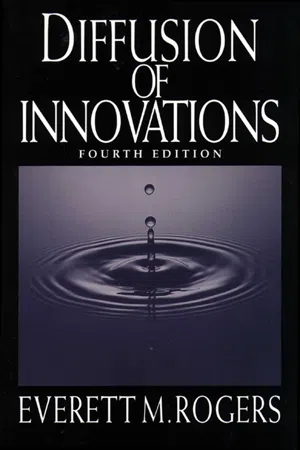
Since the first edition of this landmark book was published in 1962,
Everett Rogers's name has become "virtually synonymous with the study
of diffusion of innovations," according to Choice. The second and
third editions of Diffusion of Innovations became the standard
textbook and reference on diffusion studies. Now, in the fourth
edition, Rogers presents the culmination of more than thirty years of
research that will set a new standard for analysis and inquiry.
The fourth edition is (1) a revision of the theoretical framework and
the research evidence supporting this model of diffusion, and (2) a
new intellectual venture, in that new concepts and new theoretical
viewpoints are introduced. This edition differs from its predecessors
in that it takes a much more critical stance in its review and
synthesis of 5,000 diffusion publications. During the past thirty
years or so, diffusion research has grown to be widely recognized,
applied and admired, but it has also been subjected to both
constructive and destructive criticism. This criticism is due in large
part to the stereotyped and limited ways in which many diffusion
scholars have defined the scope and method of their field of study.
Rogers analyzes the limitations of previous diffusion studies,
showing, for example, that the convergence model, by which
participants create and share information to reach a mutual
understanding, more accurately describes diffusion in most cases than
the linear model.
Rogers provides an entirely new set of case examples, from the
Balinese Water Temple to Nintendo videogames, that beautifully
illustrate his expansive research, as well as a completely revised
bibliography covering all relevant diffusion scholarship in the past
decade. Most important, he discusses recent research and current
topics, including social marketing, forecasting the rate of adoption,
technology transfer, and more. This all-inclusive work will be
essential reading for scholars and students in the fields of
communications, marketing, geography, economic development, political
science, sociology, and other related fields for generations to come.
- 518 pages
- English
- ePUB (mobile friendly)
- Available on iOS & Android
eBook - ePub
Diffusion of Innovations, 4th Edition
About this book
Information
Table of contents
- Cover
- Title Page
- Preface
- Chapter 1: Elements of Diffusion
- Chapter 2: A History of Diffusion Research
- Chapter 3: Contributions and Criticisms of Diffusion Research
- Chapter 4: The Generation of Innovations
- Chapter 5: The Innovation-Decision Process
- Chapter 6: Attributes of Innovations and Their Rate of Adoption
- Chapter 7: Innovativeness and Adopter Categories
- Chapter 8: Diffusion Networks
- Chapter 9: The Change Agent
- Chapter 10: Innovation in Organizations
- Chapter 11: Consequences of Innovations
- About the Author
- Bibliography
- Name Index
- Subject Index
- Copyright
Trusted by 375,005 students
Access to over 1.5 million titles for a fair monthly price.
Study more efficiently using our study tools.
Frequently asked questions
Yes, you can cancel anytime from the Subscription tab in your account settings on the Perlego website. Your subscription will stay active until the end of your current billing period. Learn how to cancel your subscription
No, books cannot be downloaded as external files, such as PDFs, for use outside of Perlego. However, you can download books within the Perlego app for offline reading on mobile or tablet. Learn how to download books offline
Perlego offers two plans: Essential and Complete
- Essential is ideal for learners and professionals who enjoy exploring a wide range of subjects. Access the Essential Library with 800,000+ trusted titles and best-sellers across business, personal growth, and the humanities. Includes unlimited reading time and Standard Read Aloud voice.
- Complete: Perfect for advanced learners and researchers needing full, unrestricted access. Unlock 1.5M+ books across hundreds of subjects, including academic and specialized titles. The Complete Plan also includes advanced features like Premium Read Aloud and Research Assistant.
We are an online textbook subscription service, where you can get access to an entire online library for less than the price of a single book per month. With over 1.5 million books across 990+ topics, we’ve got you covered! Learn about our mission
Look out for the read-aloud symbol on your next book to see if you can listen to it. The read-aloud tool reads text aloud for you, highlighting the text as it is being read. You can pause it, speed it up and slow it down. Learn more about Read Aloud
Yes! You can use the Perlego app on both iOS and Android devices to read anytime, anywhere — even offline. Perfect for commutes or when you’re on the go.
Please note we cannot support devices running on iOS 13 and Android 7 or earlier. Learn more about using the app
Please note we cannot support devices running on iOS 13 and Android 7 or earlier. Learn more about using the app
Yes, you can access Diffusion of Innovations, 4th Edition by Everett M. Rogers in PDF and/or ePUB format, as well as other popular books in Business & Business General. We have over 1.5 million books available in our catalogue for you to explore.