
- 628 pages
- English
- ePUB (mobile friendly)
- Available on iOS & Android
eBook - ePub
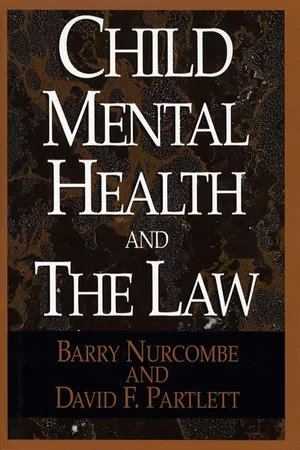
Child Mental and the Law
About this book
The legal aspects of child mental health have changed in recent years, yet many who deal professionally with disturbed children are ill informed about the rights and responsibilities of minors. Child Mental Health and the Law addresses the need for a comprehensive, up-to-date text that describes the evolution of child mental health law and the relevance of the law to the child mental health clinician.
Frequently asked questions
Yes, you can cancel anytime from the Subscription tab in your account settings on the Perlego website. Your subscription will stay active until the end of your current billing period. Learn how to cancel your subscription.
At the moment all of our mobile-responsive ePub books are available to download via the app. Most of our PDFs are also available to download and we're working on making the final remaining ones downloadable now. Learn more here.
Perlego offers two plans: Essential and Complete
- Essential is ideal for learners and professionals who enjoy exploring a wide range of subjects. Access the Essential Library with 800,000+ trusted titles and best-sellers across business, personal growth, and the humanities. Includes unlimited reading time and Standard Read Aloud voice.
- Complete: Perfect for advanced learners and researchers needing full, unrestricted access. Unlock 1.4M+ books across hundreds of subjects, including academic and specialized titles. The Complete Plan also includes advanced features like Premium Read Aloud and Research Assistant.
We are an online textbook subscription service, where you can get access to an entire online library for less than the price of a single book per month. With over 1 million books across 1000+ topics, weâve got you covered! Learn more here.
Look out for the read-aloud symbol on your next book to see if you can listen to it. The read-aloud tool reads text aloud for you, highlighting the text as it is being read. You can pause it, speed it up and slow it down. Learn more here.
Yes! You can use the Perlego app on both iOS or Android devices to read anytime, anywhere â even offline. Perfect for commutes or when youâre on the go.
Please note we cannot support devices running on iOS 13 and Android 7 or earlier. Learn more about using the app.
Yes, you can access Child Mental and the Law by Barry Nurcombe in PDF and/or ePUB format, as well as other popular books in Law & Law Theory & Practice. We have over one million books available in our catalogue for you to explore.
Information
CHAPTER 1

THE MENTAL HEALTH PROFESSIONS AND THE LAW
INTRODUCTION
Clinicians dread the arrival of a subpoena. The thought of testifying conjures up images of arcane rules in an alien domain where lawyers badger and witnesses are demeaned. Unfamiliar with the adversary system, clinicians expect the truth will be hostage to warring strategists. How much better, they imagine, if panels of experts could provide the courts with unfettered, impartial, scientifically informed advice.
Lawyers shudder at the prospect of trial by white coat. To them, mental health professionals are âbleeding hearts or hangmenâs helpersâ1 who cloak personal prejudice in the vestments of authority. What is the difference between social workers and psychologists, and how are they different from psychiatrists? To which of the numerous âschoolsâ do they belong? Arenât their techniques so âsquishyâ2 they can be bent to any point of view? Isnât their jargon designed to confuse? When it comes down to it, arenât they so muddle-headed and unreliable as to be basically irrelevant?
Much of the antagonism between the two fields is due to a mutual ignorance of purposes and techniques. This book addresses barriers between the professions, for when clinicians appreciate the aim of the adversary system and the legal issues with which the courts must grapple, and when, without distortion, they can adapt their techniques and reasoning to the requirements of the law, they will advance interprofessional understanding and strengthen the administration of justice.
Nevertheless, clinicians and lawyers are divided by gulfs that run deeper than mere ignorance. This chapter will analyze the differences between the professions in function, training, and philosophy. It will also debate the limits of mental health expertise, and go on to consider whether the mental health professions have anything of substance to offer the legal process.
LAWYERS, SCIENTISTS, AND CLINICIANS
Put broadly, the purpose of the law is to settle disputes fairly, to punish and deter malfeasors, to compensate the victims of wrongdoing, to keep order, and to promote social policy. In order to fulfill its functions, the law has evolved complex precedents, rules, and procedures (see Chapter 2). Prominent among them is the adversary system, a method of resolving disputes that pits contending parties against one another. Thus, in contrast to a clinician, who seeks compromise and adjustment, and compared with a scientist, who strives to disconfirm his hypotheses, a legal advocate presents a polemic that both favors his own side and impugns the other.* In Anglo-American law, a judge presides over proceedings wherein adversarial parties elicit and test evidence from which the jury will determine the facts, weigh them according to instructions given by the judge, and reach its verdict.
The purpose of science is to discover truths about the relationship between objects, events, and states. Scientists observe natural phenomena with fresh eyes in order to discern scientific puzzles and generate ideas to explain them. They test their hypotheses in a controlled, deductive manner, employing reliable measurement, in a strategic attempt to disprove their pet notions. Good science demands the capacity to entertain alternative hypotheses, a respect for accurate and impartial data gathering, and a frame of mind best characterized by both curiosity and constructive skepticism.3
The purpose of clinical work is to diagnose and treat sick, impaired, or troubled people. Psychologists and social workers who eschew âthe medical modelâ prefer such words as âclientâ over âpatient,â and âmanagementâ over âtreatment.â Nevertheless, what they do is essentially the same: They attempt to understand the nature of their patientsâ or clientsâ problems in order to help them overcome or alleviate distress or impairment. Clinicians are pragmatic: they borrow from basic sciences to facilitate diagnosis or treatment. However, psychiatry, clinical psychology, and clinical social work are not sciences in themselves. When legal cross examiners ask clinicians to concede that psychiatry, psychology, or social work are ânot exact sciences,â the truthful answer would be that clinical work is not science, though it may draw upon it.
Lawyers and clinicians are alike in identifying with their clients or patients; scientists are (or should be) objective. Lawyers and scientists are akin in their preoccupation with facts; clinicians are absorbed in the personal reality of those they treat. Scientists and clinicians both apply scientific knowledge, but to different ends, the one to advance knowledge, the other to help impaired or troubled people. Lawyers and clinicians are similar in their pragmatism; they borrow information from other fields in order to judge cases, advance their clientsâ causes, or diagnose and treat their patients. If it works, they are inclined to use it. Indeed, the hunger of clinicians for diagnostic aids and new therapies may sometimes persuade them to endorse techniques that have not been adequately tested. Ironically, the law seeks to monitor professional standards by deferring to professional judgment while at the same time ensuring that accepted measures are not too readily dismissed.
Judges and juries seek to find the facts of the case, just as scientists search for the truth about objects and events. In that, legal fact-finders and scientists differ subtly from the pragmatistsâclinicians and attorneysâwho are primarily interested in helping their patients and clients. The clinician is more concerned with the patientâs reality than with actuality itself; the legal advocate proposes to marshal the evidence most favorable to his clientâs case. However, a further distinction is apparent, for judges and juries seek facts in order to settle disputes, whereas scientists gather data in order to discover the laws of the universe. Unlike science, the law makes no pretense of reaching âtrueâ solutions; rather, it aims to resolve disputes fairly and regulate society normatively. In the late nineteenth century, law was viewed as a science in which legal principles were deducted from precedents. However, contemporary schools of thought have undermined the scientific model, to the point that law today cannot be properly understood apart from its implicit social, economic, and philosophical basis.4
PHILOSOPHICAL DIFFERENCES
Autonomy and Determinism
The law assumes that, unless it can be proven otherwise, people are competent both to do what they do and to intend the consequences of their actions. We mean what we say, choose to do what we do, and are responsible for what results. Indeed, the driving force of the common law is the idea of individual responsibility. The law in regard to torts, contracts, and criminal offenses turns upon this idea. In its earliest form, tort law protected the physical integrity of the individual, while at the same time ensuring social peace. The new tort of informed consent is founded on the same principleâthat is, the autonomy of the individual can be protected only if he knows the full implications of what it is proposed should be done to him. In criminal law, if legal insanity is established, the defendant is held not responsible for an otherwise criminal act.
In contrast, the dominant theories of psychiatry and psychology are deterministic. Geneticists discern the origins of behavior in the genome. Neuropsychiatrists regard it as stemming from neuronal activity induced by disease, trauma, or inherited abnormality. Behaviorists view behavior as systematically related to stimulus and response, reward and punishment. Psychodynamicists explore the unconscious impulses and conflicts imbedded in psychopathology. Family systems theorists describe the intrasystemic roles, boundaries, and relationships that result in disturbed behavior. Mental health clinicians and scientists alike view behavior as determined. Volition, intention, and consciousnessâthe ingredients of the legally autonomous personâhave always been difficult to contain within a scientific framework.
The Forensic Assessment of Scientific Evidence
As indicated above, scientists are often irritated that the courts do not evaluate science in a scientific manner. The law frequently calls upon scientific evidence, but requires it to satisfy the criteria of reliability defined by the law. Probability estimatesâthe keystone of scientific methodâdo not resonate in a court of law, for opinion must be marshaled within the framework of the adversary system. One check against the admission of invalid scientific evidence is the requirement that a witness may not testify as an expert unless the court first finds him to be qualified to do so on the basis of his knowledge, skill, experience, training, or education. Depending on the jurisdiction, a court may not permit an expert to testify unless it also finds that the testimony will be about a proposition that has achieved a level of acceptance in the scientific community or that is based on procedures reasonably relied upon by experts in the particular field. The requirements of qualification and scientific acceptability therefore permit the judge to exclude testimony for which there is little or no scientific support.
General Statements and Particular Instances
Scientists deal with group data, seeking generalizations that summarize universal relationships. Clinicians, lawyers, and juries are concerned with particulars. The application of statistical studies to individual cases is regarded as conveying the risk of unjust decisions.5 Aware of that risk, the Supreme Court in McCleskey v. Kemp (1987)6 found that the death penalty exacted by Georgia did not breach the Constitution, even though it was demonstrated that a statistically disproportionate number of blacks were sentenced to death if they had killed whites.
Often, legal inquiry will relate to motivation and causation. Science may have established explanations that are valid generally but have insufficient power to explain behavior in a particular case. For that, historical and biographical information are usually required.7
Rights and Needs
Lawyers advocate for their clientsâ rights, in a discourse so compelling that the whole fabric of the law may seem to be made of rights. In Anglo-American law, the rights of the individual are prime, for individual freedom undergirds the liberal state.8 We note, in Chapter 10, the attempt to draw within the discourse of rights the plight of patients in mental health institutions. The same approach is taken with respect to the educational needs of handicapped children (Chapter 4).
Aside from diverting attention from the agenda of clinicians, the pursuit of rights also injects legal considerations into professional decision-making. Individual rights concerning the termination of life support have inspired a complex legal framework that impedes the formerly personalized function of the physician.9 Lawyers advocating patientsâ rights clash with clinicians advocating patientsâ needs in such matters as involuntary commitment to hospital and the refusal of treatment.10 Powerful constitutional rights may appear to do violence to the most vulnerable of witnesses: the right of the accused to face his accuser in court, for example, collides with the desire to protect a sexually traumatized child from the stress of having to confront her victimizer.11
Individual freedom is at the core of our society. Law schools instill it by emphasizing the presumptive right of citizens to be free of state interference. (We discuss the application of those rights to children in Chapter 3.) Law students are taught to be skeptical of government and of other social institutions with disproportionate power, such as corporations and the medical profession. Legal skepticism may be perceived as hostility when the attempt of clinicians to serve patientsâ needs comes under the scrutiny of the courts. Just as malpractice risk can induce costly defensive medicine,12 the assertion of rights, it may be argued, interferes with the mission of clinicians. As we shall observe in Chapter 8, recent developments in the law of informed consent undermine medical dominance in decision-making concerning patient welfare, while concerns expressed by the nonmedical members of medical ethics committees have led to other constraints upon traditional professional prerogatives.
Given their traditions and training, it is not likely that the gulf between court and clinic will disappear. However, as we note in this book, the courts are not indifferent to family values and professional roles and do not favor judicial scrutiny in every instance. For example, in the face of vehement criticism, the Supreme Court in Parham13 preferred the medical model of decision-making to judicial review, with regard to the admission of minors to psychiatric hospitals.
THE CHALLENGE OF PSYCHODYNAMIC PSYCHIATRY
The psychoanalytic view of behavior challenges the law. Michael S. Moore has described three areas of difference.14 The first replaces legal concepts of responsibility and culpability with medical notions of mental health and illness; in this view, âbadnessâ is interpreted as âillness.â How then could criminals be accountable? The second challenge to legal precept refers to the psychoanalytic concept of the unconscious. Having no knowledge of this shadow mind, an individual cannot be responsible for its actions. The third challenge is a fractionated variant of the second: causal agency is attributed to subpersonal entitiesâego, superego, and id. An individual cannot be held responsible since no one is a single rational agent.
These challenges strike at the vitals of criminal and civil law. Moore proposes that law and psychiatry share a new view of the person,15 and that the gap in understanding between law and psychiatry calls for a new philosophical basis for forensic psychiatry. Moore recommends that psychiatry and law should both view people as agents...
Table of contents
- Cover
- Dedication
- Acknowledgments
- Chapter 1: The Mental Health Professions and the Law
- Chapter 2: The Legal System
- Chapter 3: The Rights of Children
- Chapter 4: The Educational Rights of Handicapped Children
- Chapter 5: Child Custody Disputes
- Chapter 6: Forensic Evaluation in Cases of Child Maltreatment
- Chapter 7: Psychological Trauma and Civil Liability
- Chapter 8: Malpractice
- Chapter 9: Juvenile Delinquency
- Chapter 10: The Rights of Institutionalized Children
- Chapter 11: The Child Mental Health Professional as Expert Witness
- Appendix 1: Sample Reports
- Appendix 2: Landmark Cases
- Notes
- Bibliography
- Table of Cases
- Index
- Copyright
- Endnote