Handbook of Stress, 2nd Ed
eBook - ePub

Handbook of Stress, 2nd Ed

  1. 819 pages
  2. English
  3. ePUB (mobile friendly)
  4. Available on iOS & Android
eBook - ePub

Handbook of Stress, 2nd Ed

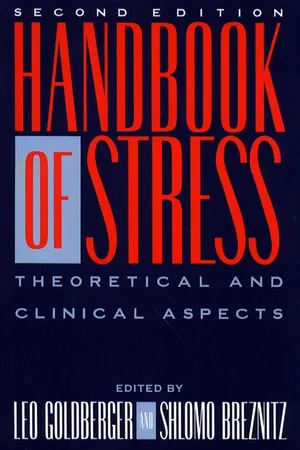
About this book

Presenting authoritative, up-to-date information in convenient handbook form, this premier reference covers an extensive range of current topics on the causes, symptoms, and treatments of stress. In this second edition, new chapters have been added on crime victimization, sexual abuse, multiple roles, gender and distress, AIDS, chronic illness, aging, the burnout phenomenon, psychosomatic disorders, biomedical indices of stress, and more. New research has been added dealing with personality emotion and stress, cognitive processes, depression, bereavement, work-stress, post-traumatic stress reponse, alcoholism, stress management, and more.
Frequently asked questions

Yes, you can cancel anytime from the Subscription tab in your account settings on the Perlego website. Your subscription will stay active until the end of your current billing period. Learn how to cancel your subscription.
No, books cannot be downloaded as external files, such as PDFs, for use outside of Perlego. However, you can download books within the Perlego app for offline reading on mobile or tablet. Learn more here.
Perlego offers two plans: Essential and Complete
  • Essential is ideal for learners and professionals who enjoy exploring a wide range of subjects. Access the Essential Library with 800,000+ trusted titles and best-sellers across business, personal growth, and the humanities. Includes unlimited reading time and Standard Read Aloud voice.
  • Complete: Perfect for advanced learners and researchers needing full, unrestricted access. Unlock 1.4M+ books across hundreds of subjects, including academic and specialized titles. The Complete Plan also includes advanced features like Premium Read Aloud and Research Assistant.
Both plans are available with monthly, semester, or annual billing cycles.
We are an online textbook subscription service, where you can get access to an entire online library for less than the price of a single book per month. With over 1 million books across 1000+ topics, we’ve got you covered! Learn more here.
Look out for the read-aloud symbol on your next book to see if you can listen to it. The read-aloud tool reads text aloud for you, highlighting the text as it is being read. You can pause it, speed it up and slow it down. Learn more here.
Yes! You can use the Perlego app on both iOS or Android devices to read anytime, anywhere — even offline. Perfect for commutes or when you’re on the go.
Please note we cannot support devices running on iOS 13 and Android 7 or earlier. Learn more about using the app.
Yes, you can access Handbook of Stress, 2nd Ed by Leo Goldberger, Shlomo Breznitz in PDF and/or ePUB format, as well as other popular books in Psychology & History & Theory in Psychology. We have over one million books available in our catalogue for you to explore.

Information

Image

Image

ORIENTATION TO STRESS

The proliferation of research on stress over the past two decades makes it difficult to penetrate the universe of discourse in this area. Nonetheless, we shall try to identify the basic themes in the literature.
Stressors are external events or conditions that affect the organism. The description of stressors and their impact on behavior is an open-ended task, and current research considers an increasing number of events and conditions to be stressors. Most of this effort is still in the qualitative domain and parametric investigations are by and large rare.
The stressors themselves impinge on an organism that has specific characteristics of its own. Thus, another open-ended challenge is the systematic exposure of different species to a particular stressor. Such research can provide insight into phylogenetic and evolutionary processes, as well as into the general themes that cut across species boundaries. Within the same species it is, of course, possible to investigate the impact of a given stressor on different organisms, and the study of individual differences is a rapidly growing branch of stress research. The individual differences of most relevance in human research have to do with the cognitive appraisal of stressors. In line with Lazarus’s (1966: Lazarus & Launier, 1978) formulation, cognitive appraisal plays a major role in the transaction between the person and the potentially stressful environment. Accordingly, researchers have sought to uncover the differential effects of a variety of cognitive styles upon the impact of stressors.
Another central element in the adaptational equation relates to coping. After appraising the Stressor, the organism will use one or more coping strategies in an attempt to adjust to the situation. A relatively large body of stress research addresses various coping strategies. Here, again, the issue of individual differences and predispositions plays a key role.
Finally, investigators are interested in stress effects themselves. Ranging all the way from minor changes in behavior to dramatic clinical symptoms, such effects are often viewed as the raison d’ĂȘtre for stress research and stress management approaches.
Somewhere between the Stressor and its effects lies the subjective, phenomenological experience of stress itself. Although from the individual’s point of view experiencing stress is the most germane factor in confronting stressful conditions, such experience lies outside the realm of objective inquiry.
Accordingly, behaviors classified as stress effects can also be categorized as the effects of anxiety, the effects of conflict, etc. Insofar as expressions of emotion, performance deterioration, or symptom manifestations are concerned, stress is interchangeable with these other concepts. Its unique features thus have to be more specifically elaborated.
As this volume illustrates, there is substantial disagreement over the definition of stress. Different scholars have different definitions and oftentimes abide by those most suitable to the pursuit of their particular interests. Thus, for instance, Selye’s (1956) focus on the nonspecific general adaptation syndrome forces an extreme response based definition, and the exact nature of the Stressor becomes largely irrelevant. By contrast, Lazarus’s (1966) focus on cognitive appraisal presumes that specific kinds of information are operative in appraising a particular stimulus as a stressor. Although this lack of agreement on the definition of stress is seen by some as indicative of a paradigm crisis, the absense of consensus more properly reflects the rapid expansion of stress research in many divergent directions and may be more conducive to future theorizing than a premature closure (see Kaplan, 1964, for a cogent argument on tolerance of ambiguity in the conduct of inquiry).
Whereas diversity in definition and emphasis may be helpful, such is not the case, however, with research tools. One of the main reasons that many basic questions relating to the effects of stress on adjustment remain unresolved is the lack of standardization in choosing the stressor, measuring its parameters and effects, and selecting the subjects for specific experiments. The absence of an adequate taxonomy of stressful situations and the paucity of parametric research in this area make it difficult to compare results from different studies. The systematic accumulation of knowledge cannot proceed without comprehensive, longterm research.

FUTURE DIRECTIONS

Reviewing the state of the art from the vantage point of the Handbook of Stress, we can trace some major ideas and biases in stress research. The following review points out broad themes and suggests possible directions for scientific inquirys in the future.

Repeated Exposure to Stressors

From Selye’s initial formulation of the general adaptation syndrome to the diametrically opposite notion of stress inoculation, the analysis of the potential impact of repeated stressors is at the core of many theories (e.g., Breznitz, 1980; Frankenhaeuser, 1980). Investigators are interested in learning whether repeated exposure to the same stressors will result ultimately in immunization, habituation, or breakdown.

Duration of Exposure to Stressors

Our understanding of adaptation will be seriously deficient as long as we are unable properly to estimate the impact of duration of exposure to stressors on behavior. This need is particularly critical in the analysis of chronic versus acute stressors. In both epidemiological and clinical research on risk factors conducive to somatic as well as psychiatric problems, the relatively minor but everyday stressors seem to be emerging as the main culprit.

Pacing of Stressors

A question related to repetition and duration of exposure is the interstressor interval. What is the rate at which stressors follow one another? Is there a critical threshold in terms of pacing? The recent life changes paradigm is a case in point. Proponents of this view argue that different kinds of events produce a cumulative deleterious impact only if they follow one another at a rate above a certain critical level (Breznitz, 1972; Cleary, 1979; Holmes & Masuda, 1974; Lloyd, Alexander, Rice, & Greenfield, 1980).

Recovery from Stress

A crucial but neglected area in understanding stress concerns the temporal characteristics of recovery from stressful encounters. Repeated exposure, duration, and pacing are intimately associated with the recovery function.

THE OPTIMISTIC BIAS

Although stress research is concerned mainly with maladjustment, interest in successful coping is increasingly apparent in the field. The major displacement of focus from the concept of anxiety, which relates primarily to an internal, personal problem, to the concept of stress, which is basically an external, environmental problem, deserves analysis. In our view, this shift indicates a tendency toward the denial of major and often unmanageable difficulties. Advocates of the new approach argue that since stress is caused by factors “out there,” it is necessary only to devise ways to change the stressful features of the environment and all will be well. This view may to a certain extent account for the proliferation in Western societies of simplistic techniques of stress management. In any event, the domain of stress research now puts heavy emphasis on coping. Interest in coping strategies and predispositions, as well as in the teaching of coping skills, indicates an essentially optimistic bias. Whether pursued in the military or in the wide variety of stress inoculation programs, these practices rest on the assumption that given the right tools, one can cope effectively with most sources of stress.
Another sign of this optimistic outlook is the importance accorded the idea of control. Many workers in the field make the value judgment (implicitly or explicitly) that an internal locus of control is preferable to an external one; they argue that self-control can be used effectively to combat the potentially deleterious effects of stress. However, many critical stressors do not leave room for control, and passive acceptance may be the most appropriate coping strategy in such situations (e.g., Lazarus, 1982; Selye, 1956).

THE PSYCHOLOGY OF HEALTH

We suggest that stress research and theory are about to undergo a major change in emphasis—a change that may be yet another expression of the “optimistic bias” just noted. Concern with the negative, illness related impacts of stress will gave way to consideration of stress as a force conducive to health. Although health is still defined primarily as the lack of illness, the absence of symptoms is a very limited and unsatisfactory criterion of well-being. A concept denoting the opposite of stress would enrich our way of looking at person-environment interactions. In other words, can the active influence of positive factors in principle enhance health? Just as Lazarus and Launier (1978) posited daily uplifts as the opposite of daily hassles, some events may act as antistressors. Indeed, stress itself may produce positive effects. Selye (1974) saw the need to coin the concept of eustress essentially to account for certain seemingly harmless or even beneficial stressors. In Chapter 14, Haan, referring to her own research (1977), makes the point that stress can lead to gains as well as losses. (This issue has been examined by Breznitz and Eshel [1982] and by Yarom [1982].) Unless our sense of direction is off the mark, psychology and medicine will see an upsurge of interest along the above lines, and the field of stress will significantly increase its relevance.

REFERENCES

BREZNITZ, S. The effect of frequency and pacing of warnings upon the fear reaction to a threatening event. Jerusalem: Ford Foundation, 1972.
_____. Stress in Israel. In H. Selye (ed.), Selye’s guide ßïstress research, vol. 1. New York: Van Nostrand, 1980.
BREZNITZ, S., & ESHEL, J. Life events: Stressful ordeal or valuable experience? In S. Breznitz (ed.), Stress in Israel. New York: Van Nostrand, 1982.
CLEARY, P. J. Life events and disease: A review of methodology and findings. Stockholm: Laboratory for Clinical Stress Research, 1979.
FRANKENHAEUSER, M. Psychoneuroendocrine approaches to the study of stressful person-environment transactions. In H. Selye (ed.), Selye’s guide to stress research, vol. 1. New York: Van Nostrand, 1980.
HAAN, N. Coping and defending: Processes of self-environment organization. New York: Academic, 1977.
HOLMES, T. H., & MASUDA, M. Life changes and illness susceptibility. In B. S. Dohrenwend & B. P. Dohrenwend (eds.), Stressful life events: Their nature and effects. New York: Wiley, 1974.
KAPLAN, A. The conduct of inquiry: Methodology for behavioral science. San Francisco: Chandler, 1964.
LAZARUS, R. S. Psychological stress and the coping process. New York: McGraw-Hill, 1966.
_____. The costs and benefits of denial. In S. Breznitz (ed.), The denial of stress. New York: International Universities, 1982.
LAZARUS, R. S., & LAUNIER, R. Stress-related transactions between person and environment. In L. A. Pervin and M. Lewis (eds.), Perspectives in interactional psychology. New York: Plenum, 1978.
LLOYD, C., ALEXANDER, A. A., RICE, D. G., & GREEFIELD, N. S. Life change and academic performance. Journal of Human Stress, 1980, 6, 15-25.
SELYE, H. The stress of life. New York: McGraw-Hill, 1956.
_____. Stress without distress. Philadelphia: Lippincott, 1974.
YAROM, N. Facing death in war: An existential crisis. In S. Breznitz (ed.), Stress in Israel. New York: Van Nostrand, 1982.

Image

NOWADAYS, EVERYONE SEEMS TO BE TALKING about stress. You hear about this topic not only in daily conversation but also on television, via radio, in the newspapers, and in the ever increasing number of conferences, centers, and university courses devoted to stress. Yet remarkably few people define the concept in the same way or even bother to attempt a clearcut definition. The businessperson thinks of stress as frustration or emotional tension; the air traffic controller, as a problem in concentration; the biochemist and endocrinologist, as a purely chemical event; and the athlete, as muscular tension. This list could be extended to almost every human experience or activity, and, somewhat surprisingly, most people—be they chartered accountants, short-order cooks, or surgeons—consider their own occupation the most stressful. Similarly, most commentators believe that ours is the “age of stress,” forgetting that the caveman’s fear of attack by wild animals or of death from hunger, cold, or exhaustion must have been just as stressful as our fear of a world war, the crash of the stock exchange, or overpopulation.
Ironically, there is a grain of truth in every formulation of stress because all demands upon our adaptability do evoke the stress phenomenon. But we tend to forget that there would be no reason to use the single word “stress” to describe such diverse circumstances as those mentioned above were there not something common to all of them, just as we could have no reason to use a single word in connection with the production of light, heat, cold, or sound if we had been unable to formulate the concept of energy, which is required to bring about any of these effects. My definition of stress is the nonspecific (that is, common) result of any demand upon the body, be the effect mental or somatic. The formulation of this definition, based on objective indicators such as bodily and chemical changes that appear after any demand, has brought the subject (so popular now that it is often referred to as “stressology”) up from the level of cocktail party chitchat into the domain of science.
One of the first things to bear in mind about stress is that a variety of dissimilar situations—emotional arousal, effort, fatigue, pain, fear, concentration, humiliation, loss of blood, and even great and unexpected success—are capable of producing stress; hence, no single factor can, in itself, be pinpointed as the cause of the reaction as such. To understand this point, it is necessary to consider certain facts about human biology. Medical research has shown that while people may face quite different problems, in some respects their bodies respond in a stereotyped pattern; identical biochemical changes enable us to cope with any type of increased demand on vital activity. This is also true of other animals and apparently even of plants. In all forms of life, it would seem that there are common pathways that must mediate any attempt to adapt to environmental conditions and sustain life.

HISTORICAL DEVELOPMENT

Even prehistoric man must have recognized a common element in the sense of exhaustion that overcame him in conjunction with hard labor, agonizing fear, lengthy exposure to cold or heat, starvation, loss of blood, or any kind of disease. Probably he soon discovered also that his response to prolonged and strenuous exertion passed through three stages: first the task was experienced as a hardship; then he grew used to it; and finally he could stand it no longer. The vague outlines of this intuitive scheme eventually were brought into sharper focus and translated into precise scientific terms that could be appraised by intellect and tested by reason. Before turning to contemporary science, it will be helpful to review some of the intervening developments that laid the foundation for the modern theory of stress.
In ancient Greece, Hippocrates, often considered the “father of medicine,” clearly recognized the existence of a vis medicatrix naturae, or healing power of nature, made up of inherent bodily mechanisms for restoring health after exposure to pathogens. But early investigations were handicapped by the failure to distinguish between distress, always unpleasant, and the general concept of stress, which also encompasses experiences of intense joy and the pleasure of self-expression.
The nineteenth-century French physiologist Bernard (1879) enormously advanced the subject by pointing out that the internal environment of a living organism must remain fairly constant despite changes in the external environment: “It is the fixity of the milieu intĂ©rieur which is the condition of free and independent life” (p. 564). This comment had enormous impact; indeed, the Scottish physiologist Haldane (1922) was of the opinion that “no more pregnant sentence was ever framed by a physiologist” (p. 427). But this influence was due largely to various meanings that subsequently were read into Bernard’s formulation. Actually, inanimate objects are more independent of their surroundings than are living beings. What distinguishes life is adaptability to change, not fixity. Bernard’s more enduring legacy was the stimulation of later investigators to carry forward his pioneering studies on the particular adaptive changes by which the steady state is maintained.
The German physiologist PflĂŒger (1877) crystallized the relationship between active adaptation and the steady state when he noted that “the cause of every need of a living being is also the cause of the satisfaction ofthat need” (p. 57). The Belgian physiologist Fredericq (1885) expressed a similar view: “The living being is an agency of such sort that each disturbing influence induces by itself the calling forth of compensatory activity to neturalize or repair the disturbance” (p. 34).
In this century, the great American physiologist Cannon (1939) suggested the name “homeostasis,” from the Greek homoios, meaning similar, and stasis, meaning position, for “the coordinated physiologic processes which maintain most of the steady states in the organism” (p. 333). Homeostasis might roughly be translated “staying power.” Cannon’s classic studies established the existence of many highly specific mechanisms for protection against hunger, thirst, hemorrhage, or agents te...

Table of contents

  1. Cover Page
  2. Title Page
  3. Dedication
  4. Contents
  5. Preface to the Second Edition
  6. Preface to the First Edition
  7. About the Contributors
  8. PART I. INTRODUCTION
  9. PART II. BASIC PSYCHOLOGICAL PROCESSES
  10. PART III. BASIC BIOLOGICAL PROCESSES
  11. PART IV. MEASUREMENT OF STRESS AND COPING
  12. PART V. COMMON STRESSORS
  13. PART VI. COMMON PSYCHIATRIC AND SOMATIC CONDITIONS
  14. PART VII. EXTREME STRESSORS
  15. PART VIII. TREATMENTS AND SUPPORTS
  16. Author Index
  17. Subject Index