From the authors of the smash bestseller The Carrot Principle comes an inspiring and lively page-a-day guide to harnessing the remarkable power of the carrot—taking yourself and your team to new heights of success in work and life.
Based on their twenty years of experience teaching leaders at Fortune 100 companies, as well as one of the largest research studies ever conducted on workplace satisfaction, Gostick and Elton share a wealth of wisdom about simple but amazingly effective ways to boost your productivity and work satisfaction by setting clear goals, communicating effectively, building trust, and offering recognition in ways that make others feel appreciated and motivated.
Each engaging page of The Daily Carrot Principle features a core kernel of wisdom, enlivened by thoughtful and witty quotes from the likes of Thomas Edison, Rosabeth Moss Kanter, Jim Collins, and Oprah Winfrey, plus a bonanza of insights from standout managers and employees the authors have studied. An easy-to-implement "carrot action" ends each page, providing the simple steps to begin applying this wealth of wisdom immediately.
Whether you are a business leader, team member, student, mom or dad, or anyone hoping to achieve more in your life, this book will be an inspiring and practical guide to unleashing your hidden potential and leading a richer life.
eBook - ePub
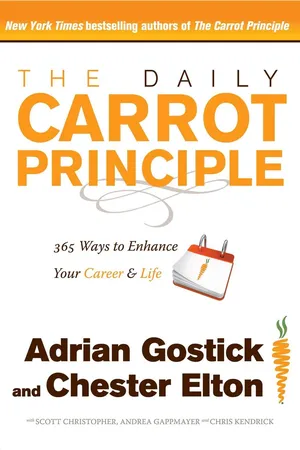
The Daily Carrot Principle
365 Ways to Enhance Your Career and Life
- 384 pages
- English
- ePUB (mobile friendly)
- Available on iOS & Android
eBook - ePub
About this book
Information
Subtopic
Business CommunicationIndex
BusinessTable of contents
- Cover Page
- Title Page
- 1 JANUARY
- 1 FEBRUARY
- 1 MARCH
- 1 APRIL
- 1 MAY
- 1 JUNE
- 1 JULY
- 1 AUGUST
- 1 SEPTEMBER
- 1 OCTOBER
- 1 NOVEMBER
- 1 DECEMBER
Trusted by 375,005 students
Access to over 1.5 million titles for a fair monthly price.
Study more efficiently using our study tools.
Frequently asked questions
Yes, you can cancel anytime from the Subscription tab in your account settings on the Perlego website. Your subscription will stay active until the end of your current billing period. Learn how to cancel your subscription
No, books cannot be downloaded as external files, such as PDFs, for use outside of Perlego. However, you can download books within the Perlego app for offline reading on mobile or tablet. Learn how to download books offline
Perlego offers two plans: Essential and Complete
- Essential is ideal for learners and professionals who enjoy exploring a wide range of subjects. Access the Essential Library with 800,000+ trusted titles and best-sellers across business, personal growth, and the humanities. Includes unlimited reading time and Standard Read Aloud voice.
- Complete: Perfect for advanced learners and researchers needing full, unrestricted access. Unlock 1.5M+ books across hundreds of subjects, including academic and specialized titles. The Complete Plan also includes advanced features like Premium Read Aloud and Research Assistant.
We are an online textbook subscription service, where you can get access to an entire online library for less than the price of a single book per month. With over 1.5 million books across 990+ topics, we’ve got you covered! Learn about our mission
Look out for the read-aloud symbol on your next book to see if you can listen to it. The read-aloud tool reads text aloud for you, highlighting the text as it is being read. You can pause it, speed it up and slow it down. Learn more about Read Aloud
Yes! You can use the Perlego app on both iOS and Android devices to read anytime, anywhere — even offline. Perfect for commutes or when you’re on the go.
Please note we cannot support devices running on iOS 13 and Android 7 or earlier. Learn more about using the app
Please note we cannot support devices running on iOS 13 and Android 7 or earlier. Learn more about using the app
Yes, you can access The Daily Carrot Principle by Adrian Gostick,Chester Elton in PDF and/or ePUB format, as well as other popular books in Business & Business Communication. We have over 1.5 million books available in our catalogue for you to explore.